
In-text Activities
Q4.1. Let us explore (Table 4.1 – magnetic/non-magnetic materials) – sample additions.
Answer:
Sample observations:
| Object | Material | Attracted? |
|---|---|---|
| Screw | Iron | Yes |
| Paper clip | Iron | Yes |
| Key | Iron | Yes |
| Scissors (blade) | Iron | Yes |
| Wooden block | Wood | No |
| Glass tumbler | Glass | No |
| Plastic ruler | Plastic | No |
| Copper wire | Copper | No |
Conclusion: Materials made of iron, steel (screws, key, paperclip, scissors) are attracted to the magnet — these are magnetic materials. Wood, glass, plastic, rubber, and cloth are not attracted — these are non-magnetic materials.
Q4.2. Let us investigate (iron filings on a bar magnet).
Answer:
Iron filings stick mostly near the two ends of the bar magnet, with very few sticking in the middle. This shows the magnetic force is strongest at the ends, called poles.
Q4.3. Let us experiment (freely suspended magnet).
Answer:
The magnet always comes to rest along the same line — the north-south direction — regardless of how many times it is rotated and released. This happens because the Earth itself behaves like a giant magnet.
Q4.4. Let us construct (making a compass).
Answer:
After stroking the needle with a magnet 30–40 times in one direction, the needle becomes magnetised. When floated on a cork in water, it aligns in the North-South direction. Rotating it repeatedly, it always returns to point the same way — confirming it behaves like a magnet.
Q4.5. Let us experiment (attraction and repulsion).
Answer:
- Unlike poles (N-S) attract each other.
- Like poles (N-N or S-S) repel each other.
- When an iron bar (non-magnet) is used instead of magnet B, both its ends are attracted to both poles of magnet A — since iron itself isn't a magnet, it has no fixed polarity and gets attracted regardless of orientation. This helps distinguish a magnet from a non-magnetic iron piece: only magnets show repulsion.
Q4.6. Let us experiment (compass needle + magnet).
Answer:
When the North pole of the bar magnet is brought near the North pole of the compass needle, the needle moves away (repulsion). When the South pole is brought near the North pole of the needle, it moves closer (attraction).
Q4.7. Let us investigate (Table 4.2 – magnetic effect through materials).
Answer:
No appreciable change in deflection is observed when wood, cardboard, plastic, or glass sheets are placed between the magnet and compass — the needle still deflects the same way. Conclusion: Magnetic force can pass through non-magnetic materials.
Margin Questions
QM1. Do magnets stick to objects made of certain materials only?
Answer:
Yes — only magnetic materials (like iron, nickel, cobalt, and their combinations) are attracted to magnets; most other materials (wood, plastic, glass, rubber, most metals like copper and aluminium) are non-magnetic.
QM2. Do all parts of a magnet attract magnetic materials equally?
Answer:
No. The attraction is strongest at the two ends (poles) of the magnet and weakest in the middle.
QM3. Can we find a magnet with a single pole?
Answer:
No. Every magnet, however small it is broken into, always has both a North and a South pole together — a single pole (monopole) cannot exist.
QM4. What direction does this line indicate, and how can we find it out? (referring to freely suspended magnet)
Answer:
It indicates the North-South direction. We can confirm this using the direction of sunrise (East) and sunset (West) as a reference to identify North and South.
QM5. How can we make our own magnetic compass?
Answer:
By magnetising a needle, passing it through a cork, and floating the cork in a bowl of water — the needle will align in the North-South direction (as done in Activity 4.4).
QM6. What happens when we bring two magnets closer to each other?
Answer:
Depending on the poles facing each other, they either attract (unlike poles) or repel (like poles) — explored next in Activity 4.5.
Let Us Enhance Our Learning (End-of-chapter Q&A)
Q1. Fill in the blanks: (i) Unlike poles of two magnets ______ each other, whereas like poles ______ each other. (ii) The materials that are attracted towards a magnet are called ______. (iii) The needle of a magnetic compass rests along the ______ direction. (iv) A magnet always has ______ poles.
Answer:
- (i) attract / repel
- (ii) magnetic materials
- (iii) north-south
- (iv) two
Q2. True/False: (i) A magnet can be broken into pieces to obtain a single pole. (ii) Similar poles of a magnet repel each other. (iii) Iron filings mostly stick in the middle of a bar magnet when it is brought near them. (iv) A freely suspended bar magnet always aligns with the north-south direction.
Answer:
- (i) False
- (ii) True
- (iii) False (they stick near the ends/poles)
- (iv) True
Q3. Column matching: N – N, N – S, S – N, S – S with Attraction/Repulsion.
Answer:
| Column I | Column II |
|---|---|
| N – N | Repulsion |
| N – S | Attraction |
| S – N | Attraction |
| S – S | Repulsion |
Q4. Atharv's experiment (bar magnet rolled over U-clips): Position A = 10, Position B = 2, Position C = 10. Why?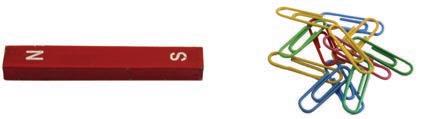
Answer:
Option (i) is correct: Position A and C are the poles (ends) of the magnet where attraction is strongest, and Position B is the middle where attraction is weakest.
Q5. Identifying magnets among 3 identical bars (2 magnets + 1 iron piece), without other material.
Answer:
Take any two bars and bring their ends close, testing all combinations. Since only two bars will show repulsion with each other (magnets repel only other magnets when like poles face each other; iron never repels), the pair that shows repulsion in some orientation are the two magnets. The third one (attracted by both but never causing repulsion) is the plain iron bar.
Q6. Finding poles of an unmarked magnet using a marked magnet.
Answer:
Bring one pole of the marked magnet (say, its North pole) near each end of the unmarked magnet. The end that repels it is also a North pole (like poles repel); the end that attracts it is a South pole.
Q7. Finding North pole of an unmarked bar magnet without another magnet.
Answer:
Suspend the magnet freely with a thread (or float it on a cork in water) and let it come to rest. The end that points towards geographic North is the North pole of the magnet.
Q8. Guessing poles of Earth's magnet using a compass.
Answer:
Since the compass needle's North pole points towards Earth's geographic North, and unlike poles attract, this means Earth's magnetic pole near the geographic North is actually a South magnetic pole (since it attracts the North pole of the compass), and the one near geographic South is a North magnetic pole.
Q9. Mechanic's falling screws problem – how to prevent?
Answer:
The mechanic can use a magnetised screwdriver (or attach a small magnet near the tip of the screwdriver). This way, the steel screws will stick to the magnetic tip and won't fall while being placed or removed.
Q10. Two ring magnets X and Y – X doesn't move down further. Why? How to bring X in contact with Y without pushing?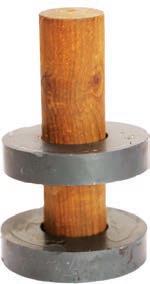
Answer:
This happens because the like poles of magnets X and Y are facing each other, causing repulsion, which keeps X suspended above Y (this is how magnetic levitation toys work).
To bring X in contact with Y without pushing either magnet: Flip/rotate magnet X (or Y) so that unlike poles face each other — this will make them attract and come together.
Q11. Polarity at ends of three magnets (Fig. 4.17). Given end 5 = N. Determine ends 1-4 and 6.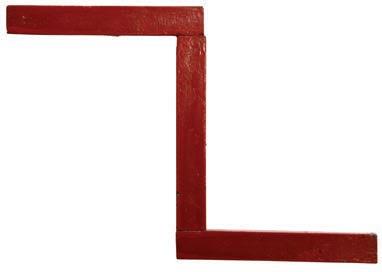
Answer:
- End 5 = N, so end 6 (other end of same magnet) = S
- End 4 (touching end 5's magnet) = S (touching pole must be opposite for attraction)
- End 3 (other end of middle magnet) = N
- End 2 (touching end 3) = S
- End 1 (other end of top magnet) = N
So: End 1 = N, End 2 = S, End 3 = N, End 4 = S, End 6 = S.