NCERT Solutions – Chapter 5: Managing Your Personal Finances
This page offers step-by-step NCERT solutions for Chapter 5, Managing Your Personal Finances, from the Grade 9 Social Science textbook Understanding Society: India and Beyond. The chapter explains the importance of personal finance, budgeting, saving, investing, protection through insurance, responsible borrowing, and income tax. All questions, exercises, and activities are solved with clear explanations and practical examples to help students develop smart financial habits.
The Big Questions
Q1. What is personal finance and why is it important for individuals?
Answer:
Personal finance refers to the planning and management of an individual's money to meet their needs and wants. It involves making smart financial decisions, such as how much to spend, how much to save, and how to invest.
Importance of personal finance:
- Meeting goals: Helps individuals save for goals like buying a house or funding higher education.
- Financial security: Prepares individuals for emergencies and uncertainties.
- Efficient use of money: Money is an important resource that should be utilised efficiently.
- Balancing needs and wants: Helps prioritise essential expenses over unnecessary spending.
- Building wealth: Through saving and investing, individuals can grow their wealth over time.
- Protection: Helps protect income, savings, and assets against risks through insurance.
Q2. What are the pillars of personal finance?
Answer:
Personal finance rests on five pillars:
- Income: The money earned through salary, business, or other sources.
- Budgeting: Planning in advance how income will be spent.
- Saving: Keeping aside a part of one's income for future use.
- Investing: Putting savings into assets with the aim of protecting their value and generating returns.
- Protection: Safeguarding income, savings, and assets against risks through insurance.
Q3. What are some common savings and investment options?
Answer:
Common savings and investment options include:
- Fixed Deposits (FDs): Deposits with banks or post offices for a fixed period at a fixed rate of interest. Safe with assured returns.
- Bonds: Lending money to the government or companies for a fixed period in return for regular interest.
- Stocks (Equity or Shares): Buying ownership in a company. Higher risk but potential for higher returns.
- Mutual Funds: Pooling money from many investors to invest in a basket of shares, bonds, or other assets. Managed by professional fund managers.
- Government-backed schemes: Public Provident Fund (PPF), National Savings Certificate (NSC), Sukanya Samriddhi Yojana.
- Piggy bank (gullak): A simple way to save small amounts at home, though it offers no returns.
Q4. How can you protect your savings and assets?
Answer:
You can protect your savings and assets through:
- Insurance: A legal contract where you pay a regular premium to an insurance company, which provides financial compensation for specific losses.
- Health Insurance: Covers medical expenses like hospitalisation, medicines, and treatments.
- Life Insurance: Provides financial support to family if the policyholder passes away.
- General Insurance: Protects against losses related to vehicles, homes, businesses, and other property. Examples include motor insurance, property insurance, crop insurance, and cattle insurance.
- Emergency Fund: Setting aside money specifically for unexpected events.
- Responsible borrowing: Taking loans only when necessary and ensuring they can be repaid on time.
Q5. What is income tax?
Answer:
Income tax is a tax paid on the income a person earns in a year (called a financial year). All citizens of India with a personal income are required to pay income tax, except those who earn below a certain limit and are exempt.
Key features:
- As income increases, the tax payable also increases (progressive taxation).
- India follows a slab system where taxable income is divided into different ranges, each taxed at a specified rate.
- The tax slabs are proposed by the Ministry of Finance as part of the Union Budget.
- The Central Board of Direct Taxes (CBDT) administers direct tax laws in India.
- Paying taxes honestly and on time is an important responsibility of every citizen.
Let's Explore
Q1. Think of all your expenses and prepare your monthly/weekly budget using the template on Page 122.
Answer:
This is an open-ended activity. Students should prepare their own budget based on their expenses. A sample template is shown below:
| Expense Category | Estimated Amount (₹) | Actual Amount (₹) |
|---|---|---|
| Transport (to school) | 500 | 480 |
| Stationery | 200 | 220 |
| Canteen/Food | 300 | 350 |
| Entertainment | 100 | 50 |
| Savings | 200 | 200 |
| Total | 1300 | 1300 |
Q2. In Fig. 5.4, the curves are flatter in the beginning and tend to become steeper in the later years. Why do you think that happens? Talk to your parents and find out the fixed deposit rates of their bank. You can also refer to the bank's website.
Answer:
The curves are flatter in the beginning and steeper in later years because of compounding. In the early years, the returns earned on the investment are small, so the growth appears slow. Over time, the returns themselves start earning returns, and the accumulated amount grows exponentially. This is why the curve becomes steeper in later years.
For example, if you save ₹1,000 annually at 7% interest starting at age 25, by age 65 you would have about ₹1,99,635. If you start at age 35, you would have only about ₹94,460. The difference is due to the extra 10 years of compounding.
Fixed deposit rates: Students should check with their parents or bank websites. FD rates typically range from 5% to 7.5% per annum, depending on the bank and tenure.
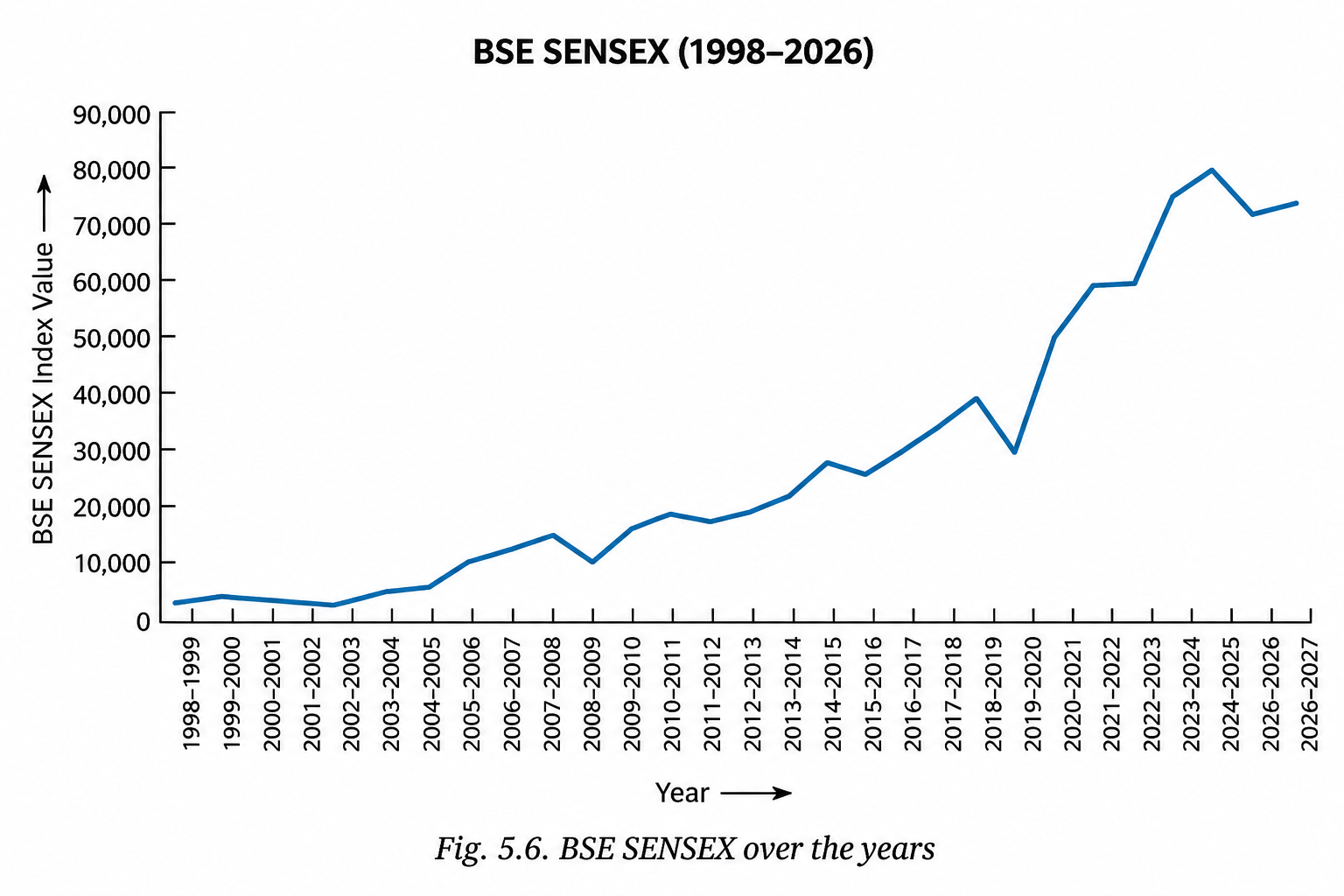
Q3. Look at the graph below that displays the performance of BSE SENSEX over the years. It fluctuates over short time periods; however, it can go up significantly in the long run. Why do you think these fluctuations happen? Discuss possible reasons with your classmates and find out more from newspapers, the internet, or by speaking to your family members.
Answer:
The BSE SENSEX fluctuates due to various factors:
- Market conditions: Supply and demand for shares.
- Company performance: Profits, losses, and growth prospects of companies.
- Economic changes: Inflation, interest rates, and GDP growth.
- Global events: International conflicts, oil prices, and global economic trends.
- Investor sentiment: Confidence or fear among investors.
- Government policies: Changes in taxation, regulations, and reforms.
Despite short-term fluctuations, the long-term trend of the stock market has generally been upward, rewarding patient investors.
Q4. Sai's taxable income is ₹3,80,000 in a financial year. How much income tax does he have to pay according to the above tax slabs?
Answer:
According to the new tax regime (FY 2025–26):
- Up to ₹4,00,000: Nil
Since Sai's taxable income is ₹3,80,000, which is below ₹4,00,000, he does not have to pay any income tax.
Income tax payable = ₹0
Q5. Ask your parents, relative or a person in your neighbourhood if they file personal income tax returns. Make a small report on the procedure to file an income tax return. You may refer to the following website: https://incometaxindia.gov.in/Pages/tax-services/file-income-tax-return.aspx
Answer:
This is an open-ended activity. Students should interview people and prepare a report. The general procedure to file an income tax return (ITR) in India is:
- Visit the Income Tax Department's e-filing portal (incometax.gov.in).
- Register or log in with your PAN and Aadhaar.
- Select the appropriate ITR form based on your income sources.
- Fill in the required details: personal information, income details, deductions, and tax paid.
- Validate the return using Aadhaar OTP, net banking, or digital signature.
- Submit the return and download the acknowledgement (ITR-V).
Exercises
Q1. Why is managing money wisely important for all individuals irrespective of their income?
Answer:
Managing money wisely is important for all individuals irrespective of their income because:
- Meeting needs and wants: Everyone has limited resources and unlimited wants. Wise management helps prioritise essential expenses.
- Financial security: Emergencies can arise at any time. Saving and protecting against risks provides security.
- Achieving goals: Whether it is buying a house, funding education, or planning a trip, wise management helps achieve financial goals.
- Avoiding debt trap: Responsible borrowing and spending prevent unnecessary debt.
- Building wealth: Saving and investing help grow wealth over time, regardless of income level.
- Peace of mind: Financial stability reduces stress and improves quality of life.
Q2. How can budgeting help people balance their present needs with their future financial goals? Give examples.
Answer:
Budgeting helps balance present needs with future goals by:
- Planning expenses: It helps people allocate money for current needs like food, rent, and school fees.
- Setting savings goals: It ensures a portion of income is set aside for future goals like buying a house or funding education.
- Controlling unnecessary spending: It helps identify and reduce impulse purchases.
- Living within means: It balances income and expenditure, preventing debt.
Examples:
- A family budgets ₹5,000 for monthly groceries (present need) and ₹3,000 for savings towards a child's education (future goal).
- A student budgets ₹500 for stationery (present need) and ₹200 for saving towards a school trip (future goal).
Q3. School Reopening Budget Activity
Your parents have given you ₹3,000 to prepare for the new school year. Make a list of the items you need, find out their prices, and prepare a budget. Calculate the total cost and check whether it stays within ₹3,000.
Use the budget template provided.
Answer:
Sample Budget:
| Item | Amount (₹) |
|---|---|
| School bag | 600 |
| Books | 800 |
| Uniform and shoes | 900 |
| Notebooks | 300 |
| Pens | 100 |
| Pencils | 50 |
| Art supplies | 150 |
| Total Expenses | 2,900 |
| Savings | 100 |
Since the total is less than ₹3,000, you can add an additional item of your choice (e.g., a water bottle for ₹100).
Q4. Why is saving alone often not enough to build wealth in the long run? How do investments help increase the value of money over time?
Answer:
Saving alone is not enough because:
- Inflation: The prices of goods and services increase over time, reducing the purchasing power of money. If money is simply kept at home, it loses value over time.
- No returns: Savings kept in cash or a piggy bank do not earn any returns.
- Opportunity cost: Money that is not invested misses the opportunity to grow.
How investments help:
- Returns: Investments like FDs, bonds, stocks, and mutual funds earn interest, dividends, or capital gains.
- Compounding: Returns are earned not only on the original investment but also on the returns already earned, leading to exponential growth over time.
- Beating inflation: Investments can grow faster than the rate of inflation, preserving and increasing purchasing power.
- Wealth creation: Over the long term, investments can significantly increase the value of money.
Q5. Investment Planning Activity
Suppose you received cash gifts worth ₹3,000 on your last birthday and decided to save ₹1,500. With the help of your teacher, calculate the returns you might have earned if you had invested this amount in different combinations of investments. For example, what returns would you have received if you had invested ₹500 in a fixed deposit, ₹800 in the stock market, and ₹200 in gold? Try other combinations and find information on the returns from different investment options using reliable sources. Based on your findings, prepare an investment plan explaining why you think each investment option is suitable or unsuitable.
Answer:
This is an open-ended activity. Students should research current returns on different investment options and prepare a plan. A sample plan:
| Investment Option | Amount (₹) | Expected Return | Suitability |
|---|---|---|---|
| Fixed Deposit | 500 | 6-7% per annum | Suitable for safety and assured returns. |
| Stocks | 800 | 10-15% (long term) | Suitable for higher returns but involves higher risk. |
| Gold | 200 | 8-10% per annum | Suitable as a hedge against inflation. |
| Total | 1,500 |
Q6. How does inflation affect the value of money over time? Why should people consider inflation while making financial decisions?
Answer:
Inflation is the increase in the prices of goods and services over time, which reduces the purchasing power of money. As prices rise, the same amount of money can buy fewer goods and services than before.
Example: If a school bag costs ₹1,000 today and inflation is 6% per year, the same bag may cost about ₹1,060 next year. If your money is simply kept at home and does not grow, you may not be able to buy the bag as your purchasing power will fall over time.
Why consider inflation:
- To ensure that savings and investments grow faster than inflation.
- To maintain the same standard of living in the future.
- To make realistic financial plans for goals like education, housing, and retirement.
Q7. Different investment options involve different levels of risk and return. Do you think taking higher risks is always the best way to earn higher returns? How should a person decide which investment option is most suitable for them?
Answer:
No, taking higher risks is not always the best way to earn higher returns. Higher risk means a greater chance of losing money. While higher-risk investments may offer higher potential returns, they also carry the possibility of losses.
How to decide:
- Financial goals: Short-term goals require safer investments; long-term goals can include higher-risk options.
- Risk tolerance: How much risk can you comfortably take?
- Time horizon: Longer time horizons allow more risk because there is time to recover from fluctuations.
- Liquidity needs: How quickly might you need the money?
- Diversification: Spreading investments across different assets reduces risk.
A balanced approach that matches investments to personal circumstances is usually best.
Q8. Why do people buy insurance policies even though they may never face a major loss? How does insurance provide financial security?
Answer:
People buy insurance policies because life is uncertain—illness, accidents, loss of income, or damage to property can happen at any time. Insurance provides financial protection against these unexpected events.
How insurance provides financial security:
- Risk sharing: Many people pay premiums into a common pool. In case of loss, the insured receive financial support.
- Compensation: Covers a large part of expenses like hospital bills, repair costs, or income loss.
- Reduces impact: Prevents families from using up their savings during emergencies.
- Peace of mind: Allows families to focus on recovery rather than worrying about money.
- Encourages planning: Regular premium payments encourage disciplined financial planning.
Even if a major loss never occurs, insurance provides security and peace of mind.
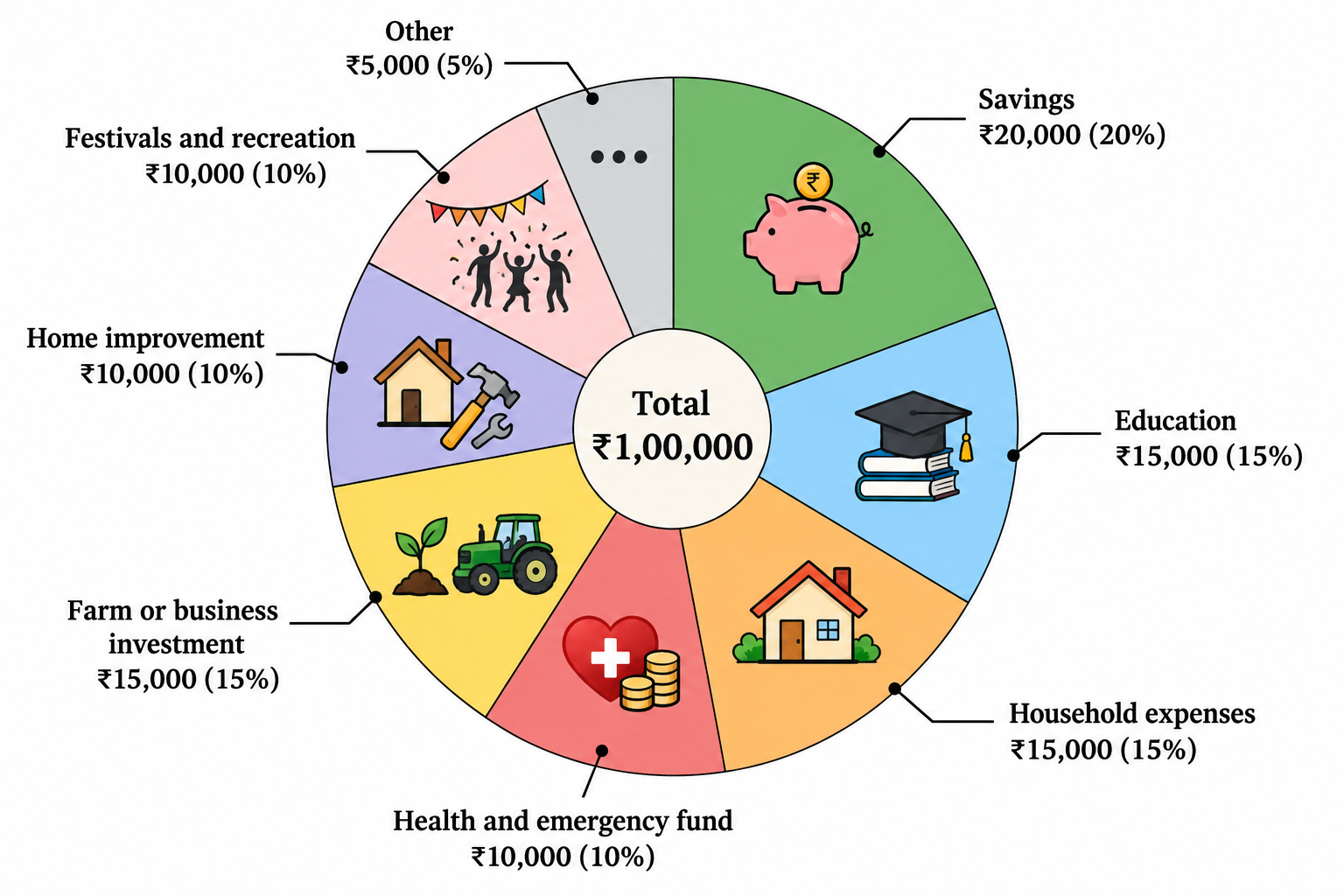
Q9. Imagine your family receives ₹1,00,000 from farming, a small business, livestock sales, and savings. Help your family decide how to use the money wisely.
Step 1: Prepare a Budget
Allocate the ₹1,00,000 among the following categories:
- Savings
- Education
- Household expenses
- Health and emergency fund
- Farm or business investment
- Home improvement
- Festivals and recreation
- Other
Answer:
Sample Budget:
| Category | Amount (₹) | Percentage (%) |
|---|---|---|
| Savings | 20,000 | 20% |
| Education | 15,000 | 15% |
| Household expenses | 25,000 | 25% |
| Health and emergency fund | 10,000 | 10% |
| Farm or business investment | 15,000 | 15% |
| Home improvement | 5,000 | 5% |
| Festivals and recreation | 5,000 | 5% |
| Other | 5,000 | 5% |
| Total | 1,00,000 | 100% |
Step 2: Needs vs Wants
| Expense | Need or Want | Reason |
|---|---|---|
| School fees | Need | Essential for education. |
| New mobile phone | Want | Not essential for daily living. |
| Better seeds or livestock feed | Need | Essential for farm productivity. |
| Festival celebrations | Want | Important for culture but not essential. |
| Water storage tank | Need | Essential for daily water needs. |
Step 3: Save for the Future
If the family saves ₹30,000 at 8% compound interest per year:
Formula: A = P(1 + r)n
- P = ₹30,000
- r = 8% = 0.08
- n = 5 years
A = 30,000 × (1.08)5 = 30,000 × 1.4693 = ₹44,079
Interest earned = 44,079 − 30,000 = ₹14,079
Step 4: Save First, Spend Later
If the family receives ₹1,00,000 and saves ₹20,000 first, only ₹80,000 is available for spending. This ensures that future needs and emergencies can be met.
Step 5: Reflect
- Percentage saved: 20% (₹20,000 out of ₹1,00,000).
- Needs: School fees, better seeds, water storage tank. Wants: New mobile phone, festival celebrations.
- How savings improve financial security: Savings provide a cushion for emergencies, help meet future goals, and reduce dependence on loans.
- How compound interest helps money grow: Returns are earned on both the principal and the accumulated interest, leading to exponential growth over time.
Challenge: Pie Chart