
NCERT Solutions – Chapter 4: Governance and Public Policy
This page offers step-by-step NCERT solutions for Chapter 4, Governance and Public Policy, from the Grade 9 Social Science textbook Understanding Society: India and Beyond. The chapter explains the meaning of governance, its evolution in India, the features of good governance, the role of e-governance, and the process of public policy-making. All questions, exercises, and activities are solved with clear explanations to help students understand how decisions are made and implemented for public welfare.
The Big Questions
Q1. What is governance, and how have its meaning and practice evolved over time?
Answer:
Governance refers to the process of decision-making, implementation, and monitoring of decisions for the welfare of people. It involves government, citizens, media, civil society, and private organisations working together to solve public problems.
Evolution of governance in India:
- Ancient traditions: The Rigveda refers to Sabhā and Samiti as institutions where matters of governance and public welfare were discussed. Rājadharma was the foremost duty of an ideal king—to protect people by upholding Dharma and promote welfare.
- Colonial period: European colonial powers forced their own models of governance on colonised societies. However, India preserved much of its knowledge of pre-colonial institutions through texts and practices.
- Post-Independence: After 1947, leaders framed the Constitution in the spirit of India's own values. Symbols like 'Satyamev Jayate' (from the Mundaka Upanishad) and 'Yato Dharmastato Jayaḥ' (from the Mahābhārata) reflect Indian ethical values.
- Modern democracy: Governance is now based on transparency, accountability, participation, and the rule of law, with citizens at the centre of the political process.
Q2. What is public policy? How does it affect our day-to-day lives, and what makes it 'public'?
Answer:
Public policy is a course of action adopted by the government to solve public problems, meet people's needs, and promote the welfare of society. It involves deciding what should be done, why, who will do it, how it will be implemented, and how success will be measured.
How it affects daily life: The roads we travel on, traffic signals, clean drinking water, electricity, public parks, and waste collection are all examples of public services made possible through public policies.
What makes it 'public':
- It exists for everyone.
- It is formulated by the government.
- It uses public resources (taxes).
- It promotes public welfare.
- Citizens participate in shaping it.
Q3. What are the various stages of policy-making and policy implementation?
Answer:
The policy process is a continuous cycle with the following key stages:
- Policy Desirability (Problem Identification): What needs and problems are to be addressed?
- Prioritising Policy: Deciding which issues need to be addressed on a priority basis.
- Policy Formulation: Consultation with various stakeholders, drafting the policy, and assessing financial feasibility.
- Policy Adoption: Framing the legislation (laws governing the policy) and regulations (rules and guidelines).
- Policy Implementation: Putting the policy into action through government officials, local bodies, civil societies, private organisations, and citizens.
- Policy Monitoring: Measuring the policy's progress, ensuring accountability, and identifying shortcomings.
- Policy Evaluation: Assessing results and the impact of the policy and generating feedback.
Q4. Who are the major contributors to policy-making and implementation?
Answer:
The major contributors to policy-making and implementation are:
| Contributors | What They Do |
|---|---|
| Citizens | Identify problems, vote, participate, give suggestions, and provide feedback. |
| Elected representatives (MPs, MLAs, local representatives) | Represent people, raise public issues, participate in law-making, and approve budgets. |
| Government officials, departments, and ministries | Prepare and implement policies and programmes, coordinate departments, deliver public services, and monitor progress. |
| Civil society organisations, NGOs, experts, researchers, and media | Study problems, suggest solutions, create awareness, monitor programmes, and provide feedback. |
| Private sector | Facilitate technical know-how, innovation, resources, and expertise, often working with the government. |
| International organisations | Bring in international experience, facilitate technical know-how and financial support. |
Q5. What role do citizens play in shaping public policy and strengthening good governance?
Answer:
Citizens play a vital role in shaping public policy and strengthening good governance by:
- Identifying issues: Raising concerns about problems that affect society.
- Voting: Electing representatives who make policies on their behalf.
- Participating in consultations: Providing suggestions during policy formulation.
- Providing feedback: Sharing their experiences after policies are implemented to help improve them.
- Following laws: Obeying rules and regulations that support good governance.
- Community involvement: Volunteering and participating in public affairs.
- Holding authorities accountable: Asking questions and demanding transparency from public officials.
Active citizen participation strengthens democracy and promotes good governance.
Let's Explore
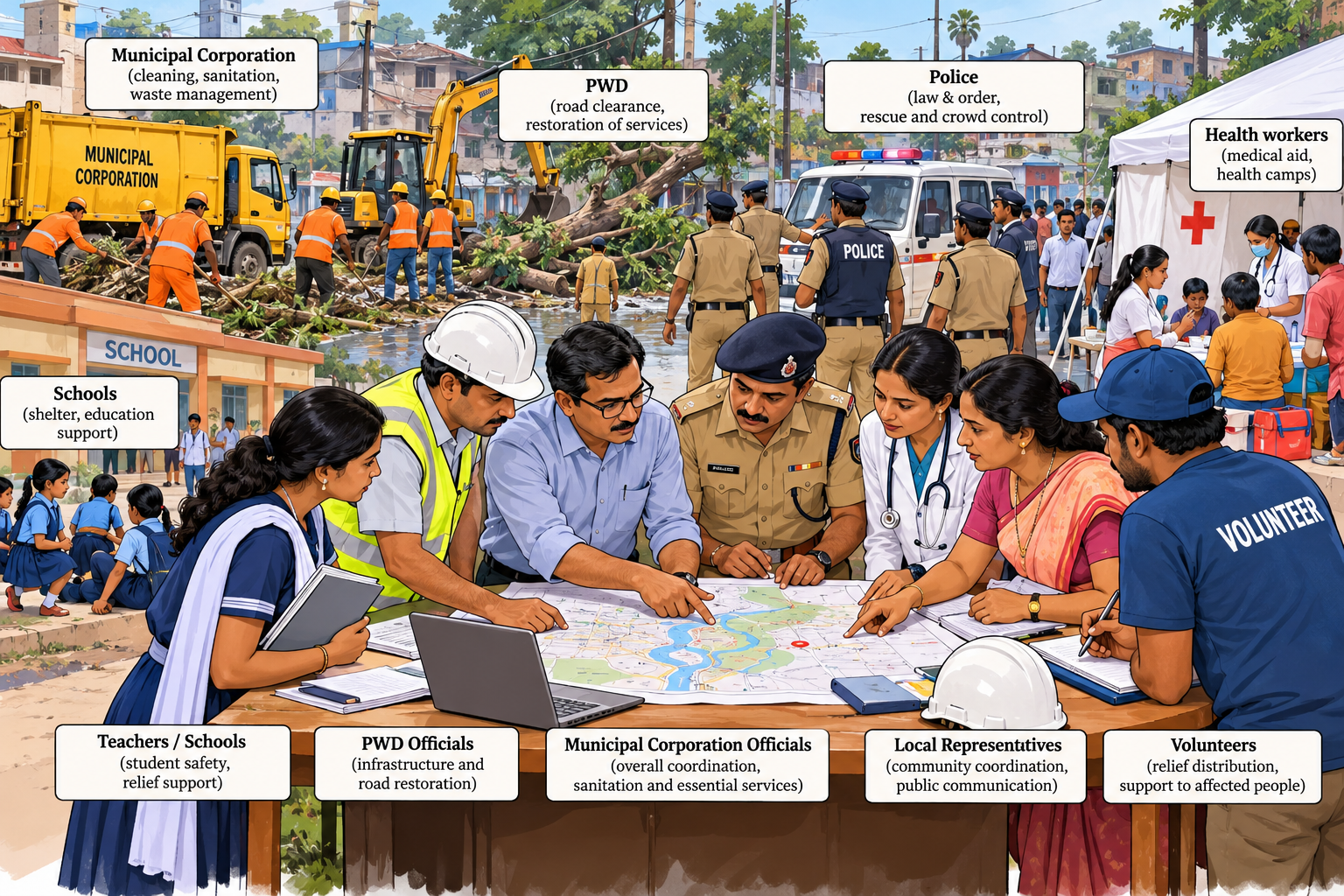
Q1. Imagine that your town experiences several days of unusually heavy rainfall. Roads become flooded, schools remain closed, electricity is disrupted in some areas, public health concerns rise, and many people find it difficult to reach schools, workplaces, or even hospitals. During such situations, organisations and individuals come together to help all in need.
Form groups and discuss the following:
- Who are the different people and organisations involved in dealing with this situation?
- Why cannot a single department solve the problem on its own?
- What would happen if these departments did not communicate or coordinate with one another?
- What role can citizens play before, during, and after the heavy rainfall?
- What makes the collective response effective?
Answer:
People and organisations involved: The municipal corporation (clears drains, removes garbage), Public Works Department (repairs roads), police (manages traffic), school authorities (inform about closures), health workers (prevent disease spread), local representatives (raise concerns), and residents/volunteers (help neighbours, report flooded areas).
Why a single department cannot solve it: The problem is multi-dimensional—it involves drainage, roads, traffic, health, education, and safety. Each department has specialised skills and resources.
If departments did not coordinate: There would be delays, duplication of effort, confusion, and the situation could worsen. For example, if roads are repaired but drains are not cleared, flooding would continue.
Role of citizens: Before—clear drains, avoid littering. During—help neighbours, follow official instructions, report problems. After—participate in clean-up, provide feedback for future preparedness.
What makes collective response effective: Communication, coordination, shared responsibility, and active participation of all stakeholders.
Q2. Government refers to the institution that has the authority to provide public services. For example, the municipal corporation or panchayat is responsible for installing street lights. Governance is the process by which this street lighting is planned, implemented, and maintained, involving people in identifying dark spots, reporting non-functional lights, and providing feedback. It ensures the continuous delivery of public services—in this case, well-lit streets and greater public safety.
Can you identify more such examples from your day-to-day life to understand the difference between government and governance?
Answer:
Yes, here are some examples:
- Water supply: The government (municipal corporation) is responsible for supplying water. Governance involves planning water distribution, maintaining pipelines, involving residents in reporting leaks, and ensuring equitable access.
- Waste management: The government provides garbage collection services. Governance involves planning collection routes, involving citizens in waste segregation, and monitoring the system.
- Public transport: The government runs buses and trains. Governance involves planning routes, maintaining schedules, seeking passenger feedback, and ensuring safety.
- Schools: The government establishes schools. Governance involves curriculum planning, teacher training, parent-teacher meetings, and community involvement.
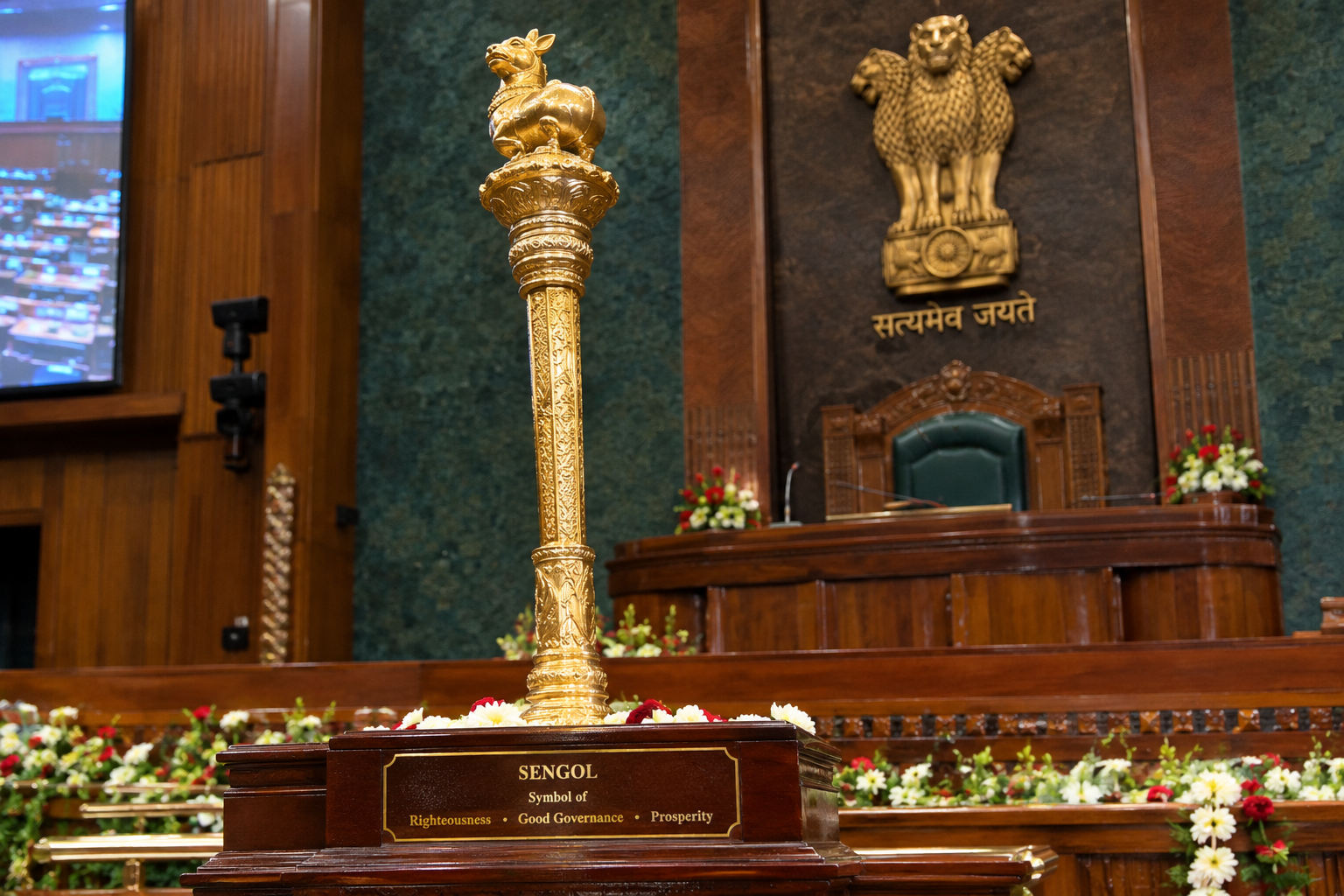
Q3. The Sengol—a cultural marker of rulership and good governance—was placed in India's newly inaugurated Parliament building in the year 2023 by Prime Minister Narendra Modi. The tradition of using the Sengol as a mark of righteous governance began more than a thousand years ago during the reign of the Chola dynasty. To mark the occasion of India's Independence, at the stroke of midnight on 15th August 1947, the first Prime Minister, Jawaharlal Nehru, received the Sengol from the Adheenam Saints (an old Shaivite tradition) of Tamil Nadu. Try to find out more about the journey of the Sengol through its historic pictures.
Answer:
This is an open-ended research activity. Students should find out more about the Sengol, its history, and its significance. Key points:
- The Sengol is a symbol of righteous governance and just rule.
- The tradition dates back to the Chola dynasty, where it was used as a mark of authority.
- On 15 August 1947, Jawaharlal Nehru received the Sengol from the Adheenam Saints of Tamil Nadu.
- In 2023, it was placed in the new Parliament building as a reminder of India's commitment to good governance.
Q4. Select two cities (one should be from a region other than yours) in India that have received awards for being the cleanest city. Make a visual presentation (chart paper or slideshow) to explain the 'good governance model' used in those cities by looking into the role played by government agencies (local, state, and national), residents, market associations, civil society organisations, etc. Also look into the steps they are taking to continue being clean cities.
Answer:
This is an open-ended activity. Students should research cities like Indore and Surat (or any other award-winning clean cities) and analyse:
- Government agencies: Municipal corporation's role in waste collection, segregation, and processing.
- Residents: Participation in segregation at source, avoiding littering.
- Market associations: Managing commercial waste, following regulations.
- Civil society organisations: Awareness campaigns, monitoring, and feedback.
- Steps for continuation: Regular monitoring, innovation in waste management, citizen engagement.
Q5. Did you know that 25th December is celebrated as National Good Governance Day? Can you find out why this date was chosen? How is National Good Governance Day celebrated in your district? Discuss in your class.
Answer:
25th December is celebrated as National Good Governance Day to mark the birth anniversary of former Prime Minister Atal Bihari Vajpayee. The day is observed to promote awareness about government accountability and good governance. In districts, it may be celebrated through awareness programmes, essay competitions, discussions on good governance, and recognition of best practices in governance.
Q6. Below is a chart of a few e-governance initiatives. Complete the chart and also add two such initiatives undertaken by your state government.
| Initiative | Objective |
|---|---|
| UMANG | To provide access to multiple government services through a single mobile app. |
| Aadhaar | To provide a unique identity number for all citizens for easy access to services. |
| GeM (Government e-Marketplace) | To facilitate online procurement of goods and services by government departments. |
| DigiLocker | To provide a secure digital platform for storing and sharing documents. |
| CPGRAMS | To provide a platform for citizens to lodge grievances with the government. |
| APAAR | To provide a unique student identity for academic records and achievements. |
Answer:
Additional state-level e-governance initiatives may include:
- e-District: A platform for delivery of citizen services at the district level.
- e-Seva: Online delivery of various government services at the state level.
- Bhu-Naksha: A web-based land records system in some states.
- e-Pension: Online pension management systems in various states.
Students should identify two initiatives from their own state.
Q7. Let us try to understand the quality of life of citizens before and after e-governance. Form five groups and interview your seniors, teachers, security guards, administrative staff, and parents regarding the issues listed below. Did they have access to the internet and a smartphone or computer to make use of these e-governance facilities? Find out what problems they had faced before e-governance and whether they felt the same issues were easily handled after e-governance.
- Obtaining a birth certificate
- Obtaining an admit card
- Collecting and storing marksheets
- Receiving salary
- Booking rail/flight tickets
- Registering a vehicle
Answer:
This is an open-ended survey activity. Students should conduct interviews and record findings. General observations:
- Before e-governance: People had to visit government offices multiple times, stand in long queues, submit physical documents, and face delays.
- After e-governance: Many services are now available online, reducing paperwork, saving time, and increasing transparency.
- Challenges: Not everyone has access to digital devices or reliable internet. Some people lack the skills to use e-governance facilities.
- Conclusion: While e-governance has improved convenience, the government must ensure digital inclusion for all.
Q8. Read each of the following examples carefully. Identify whether they are a policy or a public policy. Give a reason for your answer.
| Example | Policy / Public Policy | Why? |
|---|---|---|
| The government introduces a sports policy. | Public Policy | Made by the government for public benefit, affects society widely. |
| The government launches a campaign to provide safe drinking water to every household. | Public Policy | Made by the government, aims at public welfare, uses public resources. |
| A company allows employees to work from home twice a week. | Policy | Made by a private organisation, applies only to its employees. |
| A municipality introduces waste segregation in the city. | Public Policy | Made by a local government body, affects all residents, uses public resources. |
| A housing society fixes visiting hours for guests. | Policy | Made by a private body, applies only to the housing society. |
| The government introduces free vaccination for children. | Public Policy | Made by the government, aims at public health, uses public resources. |
Answer:
The answers are provided in the table above. The key difference is that public policies are made by the government for the benefit of society as a whole, using public resources, while ordinary policies are made by private organisations and apply only to a limited group of people.
Q9. Your school's main gate faces a road that connects residential areas and a major market area. There is heavy traffic congestion on the road, especially during morning and afternoon hours. Pedal rickshaws, electric rickshaws, school buses, private vehicles, and pedestrians—all struggle to get their way.
Form groups in your class and choose a course of action from the options given below.
- Form a group of volunteers to regulate traffic in rush hours.
- Write an application to the principal about the issue.
- Meet the principal, along with all the class representatives of the school, to discuss the gravity of the situation and then impress upon the principal the need to take up the issue with the local people's representative so that a traffic signal can be installed.
- Request the school management to construct and open another gate on the other side of the school.
- Suggest that the school shift its pick-up and drop-off point to a location slightly away from the main gate.
- Change school timings so that the school's opening and closing hours do not coincide with the busiest traffic hours in the market.
Answer the following based on the information given above.
- Which option did you choose and why?
- Can you suggest a better solution to address the given problem? Compare your suggestion with other options.
- Which stakeholders would be involved in solving this problem in your suggested solution? Explain their role in solving the problem.
- Suggest a feedback loop to ensure that the problem does not recur.
Answer:
Which option and why: I would choose option 3 (meeting the principal with class representatives) because it involves a systematic approach—raising the issue with the school leadership, who can then take it up with the local representative. This addresses the root cause (need for traffic signal) rather than temporary fixes.
Better solution: A combination of options 3 and 5 could be effective—requesting a traffic signal and shifting the pick-up/drop-off point slightly away from the main gate to reduce congestion.
Stakeholders involved:
- School administration: To coordinate with local authorities and manage school-related traffic.
- Local people's representative (MLA/Councillor): To raise the issue in the municipal corporation and allocate funds for a traffic signal.
- Traffic police: To manage traffic and enforce rules.
- Parents and students: To follow the new pick-up/drop-off arrangements.
- Municipal corporation: To install and maintain the traffic signal.
Feedback loop: After implementing the solution, the school can collect feedback from parents, students, and local residents about whether congestion has reduced. This feedback can be shared with the traffic police and municipal corporation for further improvements.
Q10. Case Study—A Ramp to Better Healthcare
Smt. Shanti Devi, a 72-year-old woman, visits the hospital for health check-up. On arriving at the hospital, she finds that she has to climb stairs to reach the Outpatient Department (OPD). There is no ramp or handrail to support her. At the same time, a man in a wheelchair arrives but is unable to enter the building because the entrance has only steps, with no wheelchair-accessible ramp. A visually impaired person may be able to climb the steps to enter the hospital but finds it difficult to locate different hospital departments because there are no tactile paths or Braille signs.
Many patients and their family members realise that the hospital infrastructure is not accessible to everyone. They decide to raise this issue with the hospital authorities and local representatives. A local disability rights organisation also highlights the problem through newspapers and social media. The district administration takes note of the issue and asks the Public Works Department (PWD) and the Health Department to inspect the hospital.
After consulting doctors, hospital staff, architectural experts, organisations working with persons with disabilities (PwDs), senior citizens, and residents, a plan is prepared to make the hospital more accessible. The government approves the funds needed to construct ramps, lifts, handrails, tactile pathways, and accessible toilets, and to install clear signboards. Once the work is complete, the hospital becomes easier to use for older persons, persons with disabilities, pregnant women, patients, and children.
Read the case study and follow the journey of the issue from identifying the problem to implementing a solution. Then, answer the questions below:
- Arrange the various stages of the policy process in sequence for upgrading the hospital to be more patient-friendly.
- Which stakeholders were involved in solving this problem? Identify at least three.
- Can you think of any public building in your locality that could be made more accessible? What improvements would you suggest?
Answer:
1. Stages of the policy process in sequence:
- Problem identification: Patients and family members realise the hospital is not accessible to all.
- Raising the issue: They raise the issue with hospital authorities and local representatives; a disability rights organisation highlights it through media.
- Government attention: District administration takes note and asks PWD and Health Department to inspect.
- Consultation: Doctors, hospital staff, architectural experts, PwD organisations, senior citizens, and residents are consulted.
- Policy formulation: A plan is prepared to make the hospital more accessible.
- Policy adoption and funding: Government approves funds for construction.
- Implementation: Ramps, lifts, handrails, tactile pathways, accessible toilets, and signboards are constructed.
- Evaluation: The hospital becomes easier to use for all.
2. Stakeholders involved:
- Patients and family members: Identified the problem and raised the issue.
- Local disability rights organisation: Highlighted the problem through media.
- District administration: Took note and initiated action.
- Public Works Department (PWD): Inspected and constructed the infrastructure.
- Health Department: Coordinated and supported the improvements.
- Doctors, hospital staff, architects, PwD organisations, senior citizens, and residents: Consulted for planning.
3. Public building in locality: This is an open-ended question. Students may identify buildings like government schools, bus stands, railway stations, or parks and suggest improvements such as ramps, handrails, tactile paths, accessible toilets, and clear signboards.
Q11. If any step in policy-making and implementation is skipped, what would be the implications? Discuss with a suitable example.
Answer:
If any step is skipped, the policy may fail to achieve its objectives:
- Skipping problem identification: The policy may not address the real issue.
- Skipping consultation: Stakeholders' concerns may be ignored, leading to resistance.
- Skipping implementation: The policy remains on paper only.
- Skipping monitoring and evaluation: Problems may go undetected, and the policy may not improve.
Example: If a government launches a tree-planting programme but skips monitoring, saplings may not survive due to lack of watering and protection. The policy would fail despite funds being allocated.
Q12. Stakeholder Role-Play: Divide the class into groups. Each group represents one of these stakeholders: The Union Government, a state government, a school principal, a teacher, a parent, a student, an NGO, and a journalist. Discuss how the stakeholder group you belong to can contribute to the successful implementation of the NEP. Present your ideas to the class.
Answer:
This is an open-ended activity. Students should discuss the roles of different stakeholders in implementing the National Education Policy (NEP) 2020:
- Union Government: Provides policy framework, funding, and national-level coordination.
- State Government: Implements the policy at the state level, allocates resources, and monitors progress.
- School Principal: Ensures school-level implementation, trains teachers, and communicates with parents.
- Teacher: Adopts new teaching methods, participates in training, and provides feedback.
- Parent: Supports children's education, participates in school activities, and provides feedback.
- Student: Actively participates in learning, follows new curriculum, and provides feedback.
- NGO: Creates awareness, supports implementation, and monitors progress.
- Journalist: Reports on policy implementation, highlights successes and challenges, and creates public awareness.
Q13. As a student, what role can you play in the successful implementation of Khelo Bharat Niti 2025?
Answer:
As a student, I can:
- Participate actively in sports and physical activities.
- Encourage classmates, especially girls and specially-abled students, to take up sports.
- Provide feedback on sports facilities and programmes in my school.
- Help maintain sports grounds and equipment.
- Spread awareness about the importance of sports for health and holistic development.
Q14. Your school is designated as the 'state's sports ambassador'. What actions should it take to fulfil its role as sports ambassador?
Answer:
The school should:
- Organise regular sports events and competitions.
- Provide coaching and training facilities for various sports.
- Encourage participation from all students, including girls and specially-abled students.
- Collaborate with local sports authorities and clubs.
- Promote awareness about sports and fitness through campaigns.
- Share best practices with other schools in the state.
Q15. Which ministries of the government can contribute towards the success of Khelo Bharat Niti 2025? How?
Answer:
Several ministries can contribute:
- Ministry of Youth Affairs and Sports: Formulates sports policy, organises national games, and supports athletes.
- Ministry of Education: Integrates sports into school curriculum and promotes physical education.
- Ministry of Health and Family Welfare: Promotes sports for health and nutrition.
- Ministry of Rural Development: Develops sports infrastructure in rural areas.
- Ministry of Finance: Allocates funds for sports programmes.
- Ministry of Defence: Supports sports through military sports institutions.
Exercises
Q1. "Good governance is the responsibility of the government alone." Do you agree with this statement? Give reasons to support your answer.
Answer:
No, I do not agree with this statement. Good governance is a partnership between the government and citizens. While the government makes laws and policies and provides public services, citizens also play a vital role by electing representatives, following laws, participating in public life, and providing feedback. The media helps people understand public issues, civil society organisations raise awareness, and the private sector contributes through innovation. Good governance depends on how different sections of society and government perform their responsibilities and work together. Therefore, it is a shared responsibility.
Q2. Do you think students can contribute to good governance? Write a short note describing any five ways in which students can become more responsible and active citizens.
Answer:
Yes, students can contribute to good governance. Five ways in which they can become more responsible and active citizens are:
- Following rules and laws: Respecting traffic rules, keeping public spaces clean, and following school rules.
- Participating in school governance: Joining student councils, raising issues, and providing feedback.
- Creating awareness: Participating in campaigns on issues like waste segregation, water conservation, and road safety.
- Helping the community: Volunteering for social causes and helping vulnerable neighbours.
- Providing feedback: Sharing suggestions with local authorities about public services and infrastructure.
Q3. Choose any one public policy (for example, Right to Education (RTE), Swachh Bharat Mission, PM POSHAN, Ayushman Bharat, Digital India, or Jal Jeevan Mission) and prepare a chart showing the following aspects:
Present your findings to the class.
Answer:
This is an open-ended activity. Students should prepare a chart based on their chosen policy. For example, for the Swachh Bharat Mission:
- Problem addressed: Poor sanitation, open defecation, and waste management.
- Major stakeholders: Government (central, state, local), citizens, NGOs, media, private sector.
- Coordination: Central government provides policy framework and funds; state governments implement; local bodies manage waste collection; citizens participate in segregation and cleanliness drives.
- Role of citizens: Segregating waste, avoiding littering, participating in clean-up drives, providing feedback.
Q4. Answer the following in one or two sentences.
- What is governance?
- How is governance different from government?
- What is meant by public policy?
- Name any four principles of good governance.
Answer:
a. What is governance? Governance is the process of decision-making, implementation, and monitoring of decisions for the welfare of people, involving government, citizens, and other stakeholders.
b. How is governance different from government? Government refers to the institutions that exercise political authority, while governance refers to the process by which decisions are made, implemented, and monitored.
c. What is meant by public policy? Public policy is a course of action adopted by the government to solve public problems, meet people's needs, and promote the welfare of society.
d. Name any four principles of good governance. Transparency, accountability, participation, and the rule of law.
Q5. Compare the following and present your answer in a tabular form.
- Government and governance
- Policy and public policy
Answer:
a. Government and Governance
| Government | Governance |
|---|---|
| Refers to the institutions that exercise political authority. | Refers to the process of decision-making and implementation. |
| Includes the Legislature, the Executive, and the Judiciary. | Includes government, citizens, media, civil society, and private organisations. |
| Focuses on who governs. | Focuses on how governing is carried out. |
b. Policy and Public Policy
| Policy | Public Policy |
|---|---|
| Made by any organisation (school, company, housing society). | Made by the government. |
| Applies only to a particular organisation or limited group. | Applies to society as a whole. |
| Example: A company's work-from-home policy. | Example: Swachh Bharat Mission. |
Q6. Imagine you have been appointed to advise the district administration on improving governance. You have proposed six points (given below), but the administration decides to prioritise only three areas for improvement. Which three would you recommend as priority areas, and which one out of the three do you feel is the most important?
- Improve drinking water facilities in schools.
- Improve sanitation and public toilets in schools and market areas.
- Provide tricycles for orthopaedically challenged students.
- Install open-area swings and open-air gym in public parks.
- Ensure the vaccination of stray dogs to prevent rabies.
- Ensure distribution of iron and folic acid tablets for female students in schools.
Answer:
Priority areas: I would recommend the following three as priority areas:
- Improve drinking water facilities in schools – Access to clean drinking water is essential for health and learning.
- Improve sanitation and public toilets in schools and market areas – Sanitation is critical for public health and dignity.
- Ensure vaccination of stray dogs to prevent rabies – This is a critical public health issue that can save lives.
Most important: Among these, I feel improving drinking water facilities in schools is the most important because water is a basic necessity, and lack of clean water can lead to serious health problems, affecting students' attendance and performance.
Q7. Match the policy action point to its corresponding stage in the policy cycle.
| S. no. | Policy action point | Stage of policy cycle |
|---|---|---|
| 1. | Assessing the impact of | Policy implementation |
| 2. | Putting the policy into action | Policy evaluation |
| 3. | Framing the legislation | Policy adoption |
| 4. | Multi-dimensional consultation with stakeholders | Policy formulation |
| 5. | Addressing a new need of the people | Policy desirability (problem identification) |
Answer:
The correct matches are:
| S. no. | Policy action point | Correct Stage of policy cycle |
|---|---|---|
| 1. | Assessing the impact of | Policy evaluation |
| 2. | Putting the policy into action | Policy implementation |
| 3. | Framing the legislation | Policy adoption |
| 4. | Multi-dimensional consultation with stakeholders | Policy formulation |
| 5. | Addressing a new need of the people | Policy desirability (problem identification) |
Q8. Read the following case and answer the given questions.
The government launches a programme to plant one lakh trees in a city. Funds are allocated, but only a few saplings survive because they are not watered or protected.
- Which stage of the policy cycle appears to be weak?
- Which organisations should coordinate to improve the programme?
- Suggest two measures that could improve the outcome.
Answer:
a. Weak stage: The policy monitoring and evaluation stage appears to be weak, as there was no follow-up to ensure saplings were watered and protected.
b. Organisations that should coordinate:
- Municipal corporation (for watering and maintenance)
- Forest department (for technical guidance)
- Local residents and community groups (for protection)
- NGOs and environmental organisations (for awareness and monitoring)
c. Two measures to improve outcome:
- Assign responsibility for watering and protecting saplings to local bodies or community groups.
- Conduct regular monitoring and evaluation to track survival rates and take corrective action.
Q9. Read each statement carefully. Do you agree or disagree? Give reasons for your answer.
- A good public policy can fail if it is not implemented properly.
- Citizen participation sometimes makes decision-making slower, but it can improve governance.
- Technology alone cannot ensure good governance.
Answer:
a. Agree. Even a well-designed policy can fail if implementation is weak. For example, a tree-planting programme may fail if saplings are not watered and protected after planting.
b. Agree. Citizen participation can slow down decision-making because it involves consultation and consensus-building. However, it improves governance by making policies more inclusive, transparent, and responsive to people's needs.
c. Agree. Technology can improve efficiency and transparency, but good governance also requires accountable leadership, active citizen participation, the rule of law, and a commitment to public welfare. Technology alone cannot ensure these.
Q10. Design a public policy. You are a member of your school's student representative body. Identify one issue, for example, plastic waste, water wastage, road safety, energy conservation, or littering in public places. Prepare a simple policy proposal that includes the following aspects of policymaking:
Present your proposal to the class as a chart or slideshow presentation.
Answer:
Example: Plastic Waste Reduction Policy
- Reason for selecting the issue: Large amounts of plastic waste are generated in school from single-use bottles and wrappers, causing environmental degradation.
- Proposed solution: Encourage reusable water bottles, discourage plastic bags, place separate dustbins for waste segregation, organise monthly awareness programmes, and assign teachers to monitor the campaign.
- Who should implement it: School administration, teachers, and student representatives.
- How will students participate: By carrying reusable bottles, segregating waste, participating in awareness programmes, and providing feedback.
- How will you know whether the policy has succeeded: By monitoring the amount of plastic waste generated, conducting regular checks, and collecting feedback from students and staff.