
NCERT Solutions – Chapter 3: Resistance and Resilience (1000–1700 CE)
This page offers step-by-step NCERT solutions for Chapter 3, Resistance and Resilience (1000–1700 CE), from the Grade 9 Social Science textbook Understanding Society: India and Beyond. The chapter explores how Indian rulers, communities, and traditions resisted invasions and preserved cultural identity through military strategies, alliances, the Bhakti movement, and economic resilience. All questions, exercises, and activities are solved with clear explanations to help students understand this transformative period in Indian history.
The Big Questions
Q1. How did Indian rulers use resistance and alliances to safeguard their lands?
Answer:
Indian rulers used a combination of military resistance, strategic alliances, and diplomatic negotiations to safeguard their lands:
- Military resistance: Kingdoms like Mewar, the Ahoms, Vijayanagara, and the Marathas fought fierce battles against invaders. Mahārāṇā Pratāp adopted guerrilla warfare, while the Ahoms used their knowledge of local terrain and river warfare.
- Strategic alliances: The Rajputs formed confederacies, and the Marathas built a vast network of tributary relationships. The Bhil community allied with Mewar, providing tactical and logistical support.
- Diplomacy and negotiation: Some Rajput kingdoms, like the Kachhwāhas of Amber, negotiated cooperative relationships with the Mughals, gaining positions and influence while retaining local autonomy.
- Fort-based defence: The Marathas built forts like Raigad and Sinhagad as strategic nuclei for guerrilla warfare and safe retreats.
Q2. What factors contributed to the resilience of different kingdoms and communities during this period?
Answer:
Several factors contributed to resilience during this period:
- Geographical knowledge: The Ahoms knew Assam's forests, rivers, and monsoon cycles. Mahārāṇā Pratāp used the rugged Aravalli terrain to his advantage.
- Adaptive military strategies: Guerrilla warfare, surprise attacks, and river warfare (bāchārī boats) helped smaller forces resist larger armies.
- Strong community bonds: The Bhakti tradition fostered solidarity through local languages and community singing (sankīrtan).
- Economic strength: Agriculture, irrigation, trade networks, and financial instruments like the hundi provided resources to withstand instability.
- Cultural preservation: Bhakti's non-material forms of worship (nām kīrtan) made devotion less dependent on physical structures.
- Strategic alliances: Confederacies and tributary networks extended influence and provided mutual support.
Q3. How did the Bhakti tradition foster a sense of solidarity?
Answer:
The Bhakti tradition fostered solidarity in several ways:
- Local languages: Saints composed hymns in regional languages, making devotion accessible to common people and strengthening shared identities.
- Inclusivity: Bhakti emphasised socio-religious equality and welcomed people from diverse backgrounds, including women and marginalised communities.
- Community participation: Practices like sankīrtan (community singing) and satsang (gatherings) brought people together and created a shared sense of belonging.
- Non-material worship: Nām kīrtan allowed devotion to continue even when temples were restricted or destroyed.
- Diverse saints: Saints like Kabīr, Rāidāsa, Mīrābāī, and Tulsīdās came from different social backgrounds, showing that devotion was open to all.
Q4. How did the expansion of agriculture, trade, and commerce keep the economy sound?
Answer:
The economy remained dynamic through:
- Agricultural expansion: Land revenue was the main source of state income. Expanding frontiers increased the area under cultivation.
- Irrigation technologies: Rope pulleys, spinning wheels, and Persian wheels enhanced agricultural output. Vijayanagara invested in small-scale irrigation.
- Inland trade: Trade routes connected India to Central Asia. Local communities like the banjārās linked rural regions with urban centres.
- Seaborne trade: From the 13th century, India became a major centre of the Indian Ocean trading network, linking western India to the Persian Gulf and Arabia.
- Financial instruments: The hundi facilitated large-scale commercial transactions and long-distance remittance without carrying large amounts of currency.
- Merchant communities: Gujarati, Malabar, Coromandel, and Bengal merchants flourished, financing trade and supporting political allies.
Let's Recall
Q1. You may recall learning about the invasions of Mahmūd of Ghaznī and Muhammad Ghūrī in the 11th and 12th centuries, covered in Grade 7 Social Science textbook. These invasions had seriously disrupted the political, social, and religious fabric of the Indian subcontinent.
Answer:
This is a recall prompt. Students should remember from Grade 7 that Mahmūd of Ghaznī launched his first invasion in 1001 against Jayapāla of the Hindu Shāhi dynasty. Muhammad Ghūrī's invasions in the late 12th century led to the establishment of the Delhi Sultanate in 1206. These invasions disrupted existing political structures and led to significant socio-cultural changes.
Q2. Do you remember reading about the Battle of Haldighati in your Grade 8 textbook? You may recall that the Bhil community provided crucial, tactical, and logistical support to Mahārāṇā Pratāp in his resistance against the Mughals. Their extensive knowledge of the Aravalli terrain, expertise in guerrilla warfare, skills in archery, role as guides, and above all, their bravery strengthened Mewar's resistance. This enduring alliance was later commemorated in Mewar's state emblem (Coat of Arms), which depicts a Rajput warrior and a Bhil warrior with the local deity Eklingji (Shiva) shown at the centre.
Answer:
This is a recall prompt. Students should remember from Grade 8 that the Bhil community's alliance with Mewar was crucial for Mahārāṇā Pratāp's resistance. The Coat of Arms of Mewar symbolises this enduring partnership between the Rajput and Bhil communities, united under the deity Eklingji.
Q3. In Grade 8, Part I, you have read about how the Vijayanagara Empire reached its peak in the 16th century, under its celebrated ruler, Krişhņadevarāya, who expanded and secured the empire's dominance over the Deccan. Under his rule, the empire achieved both military power and cultural glory. Krişhņadevarāya provided grants to many temples, including Tirupati in Andhra Pradesh and the Vitthala temple in his own capital Vijayanagara, which had many grand temples, palaces and other buildings. After winning many wars against his neighbours, Krişhņadevarāya died of illness in 1529.
Answer:
This is a recall prompt. Students should remember Krişhņadevarāya as the celebrated Vijayanagara ruler who expanded the empire, patronised temples, and promoted literature in Kannada, Telugu, Tamil, and Sanskrit. His reign marked the peak of Vijayanagara's military and cultural glory.
Q4. You have already learnt about the foundation of Maratha power and the rise of Chhatrapati Śhivājī in your Grade 8 textbook, Part I. Think back to his struggle and the ways in which he built and strengthened his kingdom. What do you remember about the strategies and institutions that helped the Marathas establish their power?
Answer:
Students should recall from Grade 8 that Chhatrapati Śhivājī built Maratha power through:
- Guerrilla warfare tactics suited to the Deccan's hilly terrain.
- A network of strategically located forts like Raigad and Sinhagad.
- The concept of swarājya (self-rule) as a political ideal.
- Strategic alliances and a strong military organisation.
- Administrative systems that supported both warfare and governance.
Let's Explore
Q1. After the death of Mahārāṇā Pratāp, renowned poet Dursā Arhā gave a vivid account of Mahārāṇā Pratāp in the following lines:
O Pratap, you kept your horses unbranded, your head unbowed, your fame untarnished. You were strong enough to carry on your work against heavy odds. You never participated in the Nauroz festival, nor did you mount guard for the imperial presence during Jharokha Darshan. You attained a very high place in this world.
Identify any two specific actions mentioned in the text which show that Mahārāṇā Pratāp maintained his independence from the Mughal court.
Answer:
The two specific actions mentioned are:
- He never participated in the Nauroz festival – Nauroz was a Mughal court festival, and by refusing to attend, Mahārāṇā Pratāp rejected Mughal authority.
- He did not mount guard for the imperial presence during Jharokha Darshan – Jharokha Darshan was a Mughal royal practice where the emperor appeared before his subjects. Refusing to participate in this ritual of subordination demonstrated his independence.
Q2. Explore the contributions of the Nayanar saints (devotees of Śhiva) like Karaikal Ammaiyar and the Alvar saints (devotees of Vişhņu) like Andal to the spread of the Bhakti tradition in peninsular India. Discuss their teachings and devotional practices and the ways in which they connected with people through their hymns.
Answer:
This is an open-ended research activity. Students should explore:
- Nayanar saints: Devotees of Shiva like Karaikal Ammaiyar, Appar, Sambandar, and Sundarar composed hymns in Tamil. They emphasised personal devotion and rejection of caste hierarchies.
- Alvar saints: Devotees of Vishnu like Andal, Periyalvar, and Nammalvar composed passionate hymns expressing love for the divine. Andal is unique as a woman saint whose compositions are still sung today.
- Connection with people: They used local languages, sang in temples and public places, and their hymns became part of community worship, making devotion accessible to all.
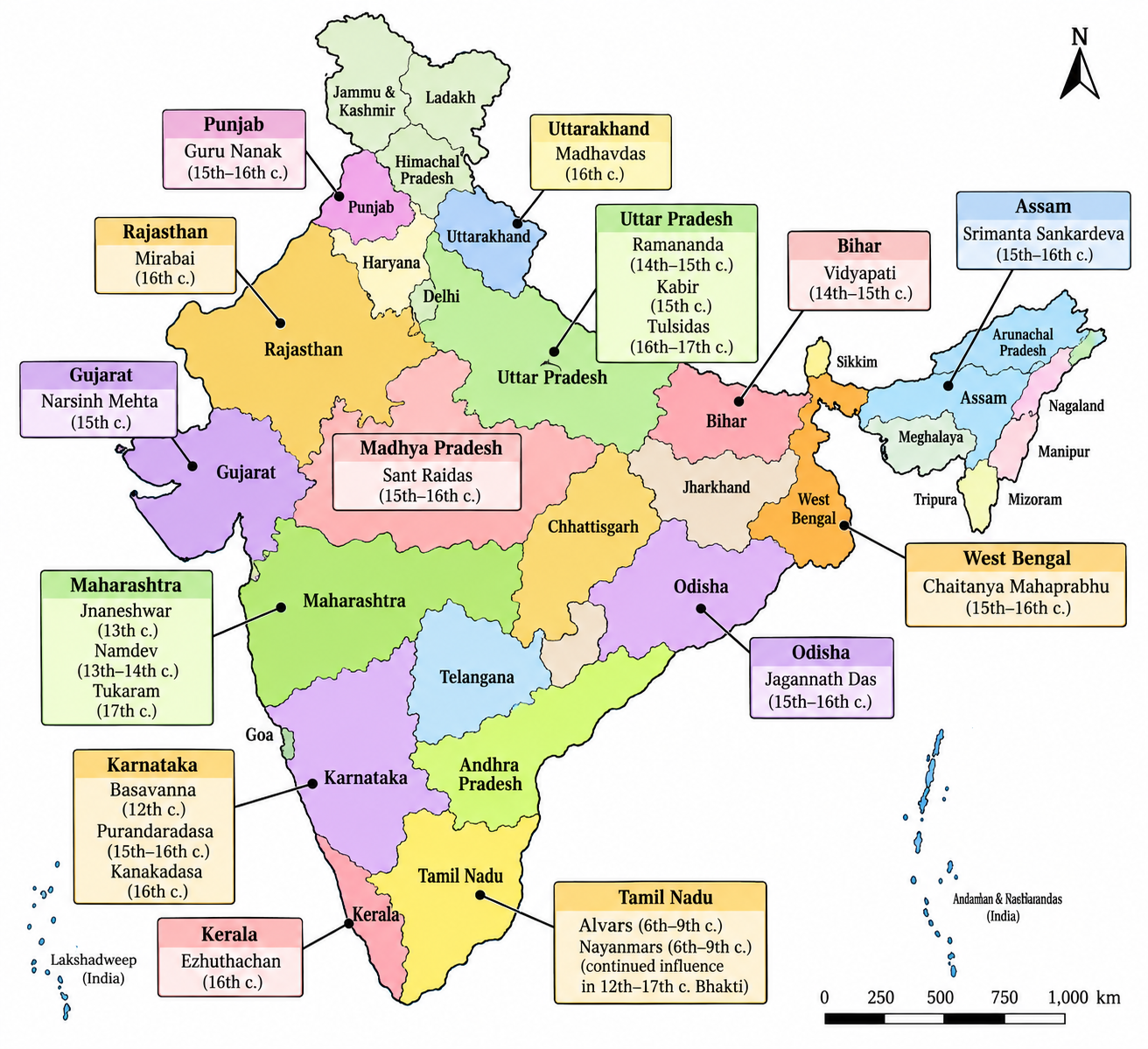
Q3. On a map of India, locate and label the present-day states associated with the saints mentioned in the above infographic. Also, find and mark a saint from your own state who is not on the list. Are you familiar with any songs, poems, or verses composed by these saints? Share with the class and explain what it means or what you like about it.
Answer:
This is an open-ended activity. Students should:
- Locate states associated with Bhakti saints (e.g., Tamil Nadu for Nayanars and Alvars, Maharashtra for Eknāth and Tukārām, Punjab for Guru Nānak, Uttar Pradesh for Tulsīdās and Kabīr, etc.).
- Find a saint from their own state not listed in the infographic.
- Share familiar songs or verses and explain their meaning and significance.
Think About It
Q1. Vakh (vachan or saying) of Läl Ded:
To learn the scriptures is easy, to live them, hard
The search for the Real is no simple matter:
Deep in my looking, the last words vanished.
Joyous and silent, the waking that met me there.
Läl Ded says that it is 'easy' to learn scriptures but 'hard' to live them. What is the difference between knowing a rule and actually following it? Can you give an example from your daily life?
Answer:
Difference between knowing and following: Knowing a rule means being able to explain what it says. Following it means putting it into practice in real situations, especially when it is difficult or inconvenient.
Example: A student may know that one should listen respectfully, but actually following the rule means allowing a classmate to finish speaking without interruption. Knowing that honesty is important is easy, but being honest when admitting a mistake is hard.
Läl Ded's verse emphasises that true spiritual understanding goes beyond intellectual knowledge—it requires lived experience and inner transformation.
Q2. What do you think made hundis a safer and more convenient choice than physically transporting money across long distances?
Answer:
A hundi allowed value to be transferred through a trusted network of money-changers (sarrāfs) and their agents (gumasthas) without carrying a large quantity of coins. This reduced the danger of theft or loss on a journey and made it easier to send money over long distances. The network also made the transfer more practical for merchants, as it was a secure means of long-distance remittance. It can be compared in some respects to modern bank cheques.
Q3. Identify some cultural and economic pillars that exist in any community (places of faith, traditions, business, and trade, etc.). How do you think these contribute to resilience within a society facing invasions/external pressures?
Answer:
Cultural pillars: Places of worship, shared traditions, local-language songs, community gatherings, festivals, and educational institutions. They preserve identity, sustain confidence, and bring people together.
Economic pillars: Agriculture, irrigation, craft production, markets, trade, and financial networks. They provide food, employment, revenue, and resources.
Contribution to resilience: Together these pillars support adaptation and help communities endure external pressure. Cultural traditions maintain morale and identity, while economic strength provides the resources needed to resist and recover. For example, during invasions, temples served as centres of community life, and merchant networks kept trade flowing, allowing society to sustain itself.
Don't Miss Out
Q1. What was the significance of the Battle of Dewair (1582)?
Answer:
The Battle of Dewair, fought near Udaipur in 1582, was significant because it resulted in the collapse of key Mughal military outposts in Mewar and helped Mahārāṇā Pratāp reclaim control over Mewar. It marked a turning point in Mewar's resistance against the Mughals.
Q2. Who were some other Rajput rulers who put up strong resistance?
Answer:
Other Rajput rulers who put up strong resistance at different points of time include:
- Kānhada Deva Chauhān (Jalore)
- Rāņă Hammīra Deva (Ranthambore)
- Rāņā Kumbhā (Mewar)
- Rão Surjan Hādā (Bundi)
Q3. What was the story of Muthu Vīrappa Näyak III of Madurai?
Answer:
Muthu Vīrappa Näyak III of Madurai is remembered for an act of defiance against Mughal authority. Local tradition holds that the Mughal emperor would dispatch a royal slipper to rulers as a symbol of imperial supremacy. When the slipper arrived at the borders of Madurai, Muthu Vīrappa Näyak refused to observe the protocol. He refused to meet the procession at the border, compelling the Mughal emissary to carry the token right up to the palace hall. Even then, he refused to bow before the slipper. Instead, he forced the Mughal representatives to place it on the floor, put his own foot inside it, and mockingly asked why the Badshah had not sent a matching pair. He then had the messengers expelled from his kingdom.
Q4. What is the significance of Gingee Fort (Senji Fort)?
Answer:
Gingee Fort, also known as Senji Fort, is situated in the Villupuram district of Tamil Nadu. It is considered a marvel of military and civil engineering and military architecture. One of its gateways is said to have been designed so that a small contingent of soldiers could defend it against an army of ten thousand. The fort came under the control of several powers, including the Vijayanagara Nayakas, Bijapuri Sultans, Mughals, Marathas, French, and English. Its changing control highlights the fort's strategic importance and centrality to the political affairs of the region. In 2025, the fort was declared a UNESCO World Heritage Site.
Q5. Who was Atukuri Molla?
Answer:
Atukuri Molla was a Telugu poet who composed the Rāmāyaņa in Telugu, now known as the Molla Ramāyaņam. Her father was a potter in Gopavaram, a village in Badvel Mandal, Andhra Pradesh. She also recited the Rāmāyaņa at the court of Krişhņadevarāya. She is an example of a woman saint from a non-elite background who rose to prominence in the Bhakti tradition.
Q6. What was the role of Sufism during this period?
Answer:
Sufism began to expand in the subcontinent with the arrival of the Turks. It was a mystical dimension of Islam that generally adopted a comparatively liberal outlook. It emerged in West Asia as a form of spiritual response to the worldly orientation of some Ulema and the orthodoxy of Shariat. Sufism spread through various orders (silsilahs). During the Delhi Sultanate, the Chishti and Suhrawardi orders became prominent, while under the Mughals, the Qaddiriyya and Naqshbandiya orders gained importance. Sufi khanqahs and shrines developed as centres of popular religious life and played a role in social and political affairs. In India, Sufis adopted many local practices, including using Indian languages such as Hindavi and Bengali, and incorporating yogic practices like prāņāyāma.
Exercises
Q1. Choose the most appropriate answer.
Resistance and resilience are closely connected because:
- Resistance always involves warfare.
- Resilience enables communities to endure difficulties and sustain resistance.
- Resistance is possible only when a kingdom has a large army.
- Resilient societies avoid all forms of conflict.
Answer:
Answer: b. Resilience enables communities to endure difficulties and sustain resistance.
Resistance can take forms other than warfare (diplomacy, negotiation, alliances), and resilience does not mean avoiding all conflict. Resilience is the backbone of resistance—it provides the ability to endure and continue resisting threats.
Q2. Why and how did groups such as the Sikhs, Marathas, and Rajputs assert their political power and identity during periods of changing political authority?
Answer:
These groups sought to protect their lands, autonomy, beliefs, and social identities as political authority shifted:
- Rajputs: Used military resistance, forts, alliances, and negotiation. Mewar maintained a distinct position even when the Mughals sought its submission. Some Rajput kingdoms like the Kachhwāhas of Amber negotiated cooperative relationships.
- Marathas: Built an independent state around swarājya (self-rule), used hill forts and mobile warfare, and formed strategic alliances. Chhatrapati Śhivājī is regarded as one of the earliest proponents of swarājya.
- Sikhs: Strengthened collective organisation, linked spiritual and temporal authority (miri-pīrī), formed the Khalsa, and took up armed defence when they faced persecution. The martyrdom of Gurus Arjan Dev and Tegh Bahādur firmed their conviction that persecution had to be met with firm resistance.
Q3. Why did some Rajput rulers decide to negotiate alliances with the Mughal power?
Answer:
An alliance could protect a kingdom's interests and reduce the cost of continued conflict. Mughal rulers benefited from Rajput military and administrative abilities, while Rajput rulers could gain positions (mansabs), influence, and room to govern local affairs. Rajput responses varied: some cooperated, while Mewar continued to resist and later negotiated terms that recognised its distinct position.
Q4. Imagine a market in a port town of India such as Surat, Masulipatnam, or Puducherry. You are a foreign trader from Italy or France and want to make a deal of cotton textiles. How would you secure the product in the local market? Whose help would you seek and what kind of challenges would you face in terms of language, quality of product, prices of commodities, etc.?
Answer:
I would seek help from local merchants, brokers, translators (dubhāśhīs), and money-changers. I would agree on the type, quantity, quality, price, delivery time, and payment method before placing an order with producers or merchants. A local interpreter could help me communicate with weavers and traders. I would need to inspect samples because cloth quality, dye, and measurements could vary. I would also compare prices, clarify customs duties and transport costs, and use hundis for secure payment. Challenges would include language barriers, understanding local quality standards, negotiating fair prices, and navigating unfamiliar customs and regulations.
Q5. Watch any video at the given link (https://www.indianculture.gov.in/forts-of-india/tales-of-forts) and analyse the various functions of forts and fortresses. How did rulers perceive the importance of forts in terms of strategic concerns?
Answer:
This is an open-ended activity. Based on the chapter content, forts served multiple functions:
- Strategic defence: Forts were nuclei for guerrilla warfare and provided safe retreats.
- Administrative centres: Forts served as centres of administration and judicial authority.
- Self-sufficiency: Strong defences, water sources, and armouries enabled prolonged resistance during sieges.
- Fallback capitals: Frontier forts served as fallback capitals to avoid total defeat.
- Control of territory: Forts allowed rulers to control strategic routes and territories.
Rulers perceived forts as essential for survival, resistance, and governance in times of conflict.
Q6. What architectural changes occurred in temple construction during the period under study? How do these changes reflect upon the resilient nature of Indian civilisation?
Answer:
From the 16th century onwards, temples were often situated in less visible locations, along narrow lanes, with entrances that did not open onto main streets. Many lacked the conventional appearance of temples and instead resembled ordinary houses. Detailed exteriors became less common, and tall shikharas were frequently avoided. This pattern is captured in the term 'haveli temple'.
These changes reflect resilience because communities adapted temple architecture to avoid destruction. By making temples less visible and less identifiable, they ensured that sacred spaces could continue to function. Examples can be found in Delhi, Varanasi, and Rajasthan, including the Jagat Shiromani Temple.
Q7. A kingdom has limited military resources but possesses fertile agricultural land, strong local support, and detailed knowledge. Explain two ways in which these resources could contribute to the kingdom's resilience when faced with a threat.
Answer:
1. Fertile agricultural land and economic strength: Fertile land produces surplus food and revenue, which can fund defences, support soldiers, and sustain the population during prolonged conflict. Economic strength also allows the kingdom to form alliances and pay tributes if necessary, buying time and resources.
2. Strong local support and detailed knowledge: Local support means the population is willing to assist in defence, provide intelligence, and endure hardship. Detailed knowledge of the terrain allows for guerrilla tactics, ambushes, and safe retreats, as demonstrated by Mahārāṇā Pratāp's use of the Aravalli hills and the Ahoms' knowledge of Assam's forests and rivers. These advantages can compensate for limited military resources.
Q8. Consider the following statement: "A tradition becomes more resilient when people can carry it with them." Do you agree? Explain using examples from the Bhakti tradition.
Answer:
Yes, I agree. When a tradition can be carried with people—through songs, practices, and internal conviction—it becomes less dependent on physical structures that can be destroyed.
Examples from the Bhakti tradition:
- Nām kīrtan: The recitation of the divine Name allowed devotees to worship without temples.
- Local languages: Hymns composed in regional languages could be sung anywhere—at home, in fields, or in community gatherings.
- Sankīrtan: Community singing brought people together and became an act of defiance, as seen with Chaitanya Mahāprabhu in Bengal.
- Satsang: Gatherings of devotees kept the tradition alive through shared practice.
These practices made Bhakti resilient because they did not depend on physical structures that could be destroyed. The tradition survived because people carried it in their hearts and communities.
Q9. Voices from the Past: Choose any two of the following and write a short first-person account explaining what resilience means from that person's perspective:
- A Bhakti saint
- A Rajput soldier
- An Ahom commander
- A Maratha administrator
- A merchant
- A Jat leader
Answer:
Example 1: A Bhakti saint
To me, resilience is the ability to keep singing the divine Name even when temples are destroyed and communities are scattered. My songs are in the language of the people, and they carry our devotion wherever we go. When I sing, I am not just worshipping—I am preserving our traditions and giving hope to those who suffer. Resilience is knowing that the divine is not confined to any building, but lives in the hearts of all who love.
Example 2: A Maratha administrator
Resilience means having a fort on every hill, a safe retreat in every valley, and the loyalty of the people who know this land as well as I do. When the Mughals come with their large armies, we do not fight them in open fields. We strike from the hills, disappear into the forests, and wait. Our forts have water and grain to last for months. Our swarājya is not just a dream—it is a system of governance that endures because it is built on the strength of our communities.
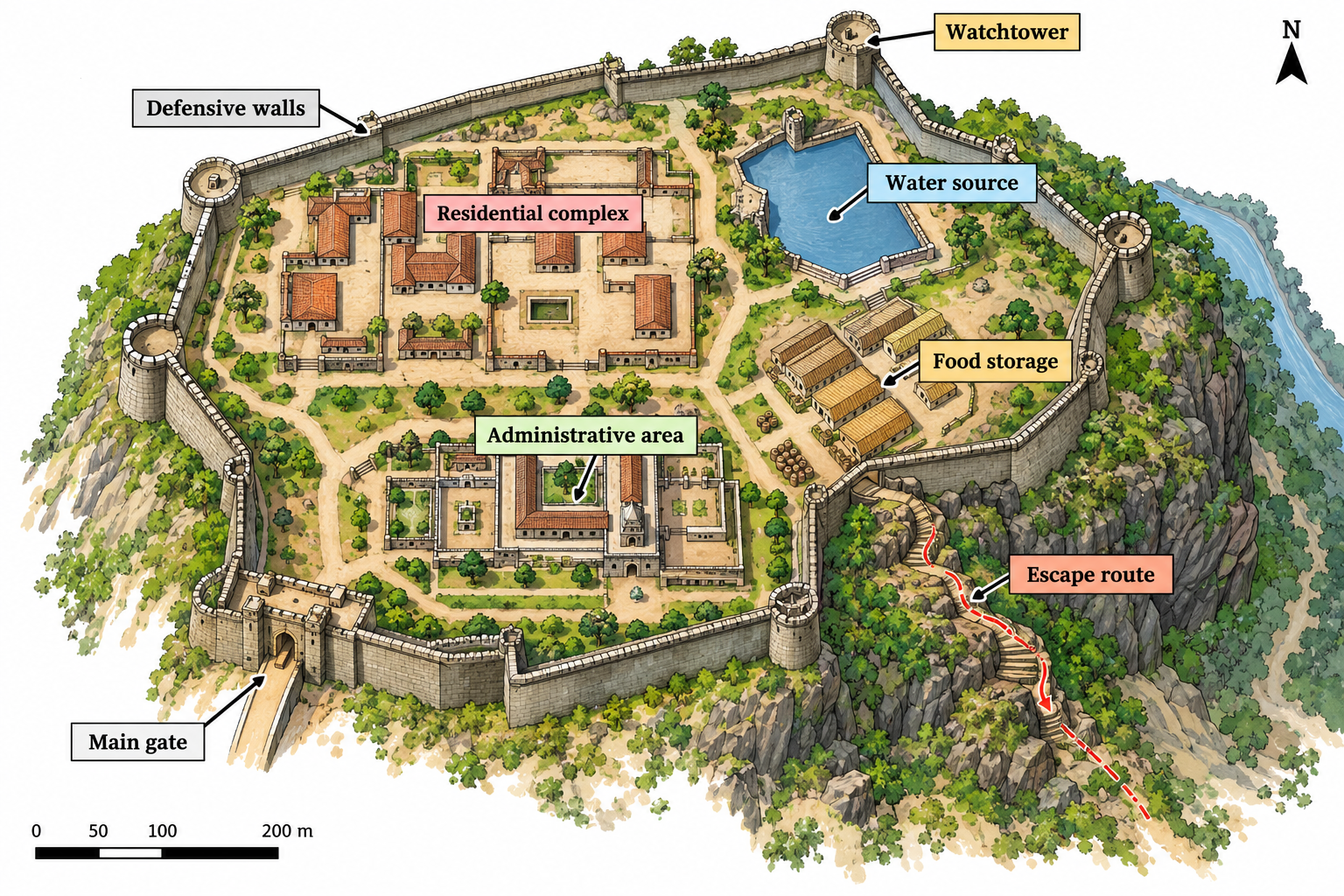
Q10. Design a Fort: You are a military architect advising a ruler. Draw a simple, labelled plan of a fort that includes the following:
- Residential complex
- Defensive walls
- Water source
- Food storage
- Escape route
- Watchtower
- Administrative area
Now, write a few sentences explaining how your design would help the kingdom withstand a long siege.
Answer:
Explanation: My design includes thick defensive walls with multiple gates to control access. The water source is located deep within the fort, protected from enemy fire. Food storage areas are large enough to sustain the population for months. A hidden escape route allows for evacuation or surprise attacks. Watchtowers provide early warning of approaching enemies. The administrative area keeps governance functioning during the siege. The residential complex ensures that soldiers and their families can live within the fort, maintaining morale and readiness. Together, these features enable the kingdom to withstand a long siege by ensuring self-sufficiency, defence, and the ability to outlast the enemy.
Before We Move On...
Q1. Summarise the key points about resistance and resilience from the chapter.
Answer:
- Resilience is the ability of individuals, communities, and societies to endure difficulties, adapt to changing circumstances, and sustain their way of life despite challenges.
- Resistance means actively opposing or challenging a force, authority, or threat, in order to protect political power, territory, interests, or cultural identity.
- Resistance may take the form of warfare, alliances, diplomacy, negotiation, or other political actions.
- The Bhakti tradition demonstrated resilience by adapting devotional practices, using local languages, encouraging community participation, and preserving traditions even when circumstances changed.
- Economic strength, through agriculture, irrigation, markets, merchant networks, financial practices, and trade, also contributed to resilience by providing resources that helped communities withstand periods of instability.
- The period from 1000 to 1700 CE was not simply a story of invasions and battles. It was also a story of how people resisted threats, adapted to changing circumstances, preserved their cultural identities, and built new forms of cooperation and exchange.