
Exploring Mixtures and their Separation — Complete Q&A
Think It Over · Pause and Ponder · Activity 5.9 · Revise, Reflect, Refine · The Journey Beyond · The Quest Continues · Practice Questions · Competency Based
Think It Over (Page 1)
Q1. Why do suspended particles settle in muddy water over time but not in milk?
Answer:
Muddy water is a suspension where the particles are larger (>1000 nm) and settle down due to gravity when left undisturbed. Milk is a colloid where the particles are smaller (1–1000 nm) and remain uniformly dispersed without settling because the particles are too small to be affected by gravity significantly.
Q2. How is evaporation different from boiling?
Answer:
Evaporation occurs at the surface of a liquid at any temperature, while boiling occurs throughout the bulk of the liquid at a specific temperature called the boiling point. Evaporation is a slow process that happens at temperatures below the boiling point, whereas boiling is a rapid process that occurs when the vapour pressure equals atmospheric pressure.
Q3. Why do you see bright rays of sunlight when it passes through small gaps between the leaves of a dense tree?
Answer:
This happens due to the Tyndall effect. When sunlight passes through the gaps between leaves, it encounters dust and smoke particles present in the air. These particles scatter the light, making the path of the light beam visible as bright rays.
Pause and Ponder (Page 5)
Q1. In the example of an athlete running back and forth on a straight track (Fig. 4.4), when will the displacement of the athlete be zero? What will be the total distance travelled in that case?
Answer:
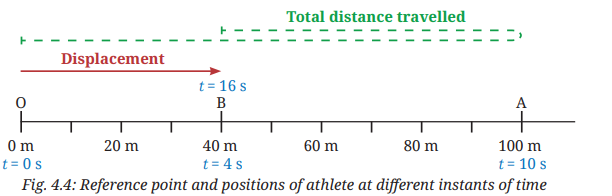
Displacement becomes zero when the athlete returns to the starting point (reference point O).
Using Fig. 4.4: Starting from O, if the athlete runs from O to A (100 m), then back to B (60 m), and continues back to O (40 m more), the displacement will be zero.
Total distance travelled in that case = OA + AB + BO = 100 m + 60 m + 40 m = 200 m
So, displacement is zero but distance travelled is 200 m.
Q2. Your mother gives you a bottle of orange juice concentrate to mix with water and serve it to your visiting friends. She asks you to mix two tablespoons of the concentrate with water in a glass tumbler. If each tablespoon measures 15 mL and you make 150 mL of juice per person, what is the % v/v of orange juice concentrate in the mixture you prepared?
Answer:
Given: Volume of concentrate = 2 × 15 = 30 mL, Total volume of solution = 150 mL
Volume by volume percentage = (Volume of solute / Volume of solution) × 100
= (30 / 150) × 100 = 20% v/v
Therefore, the orange juice concentrate is 20% v/v in the mixture.
Q3. Vinegar, used as a food preservative and additive, contains 5% v/v acetic acid. Glacial acetic acid is a liquid, i.e., 100% acetic acid. If you want to make vinegar from glacial acetic acid, how would you proceed?
Answer:
To make vinegar from glacial acetic acid (100% acetic acid), you need to prepare a 5% v/v solution of acetic acid in water.
Procedure: Take 5 mL of glacial acetic acid and add it to enough water to make the total volume up to 100 mL. This will give a 5% v/v solution of acetic acid in water, which is vinegar.
Pause and Ponder (Page 8)
Q4. Refer to the solubility curves given in Activity 5.2. If equal masses of hot, saturated solutions of compounds 'A' and 'B' are cooled from 80°C to 60°C, which solution is likely to deposit more solid?
Answer:
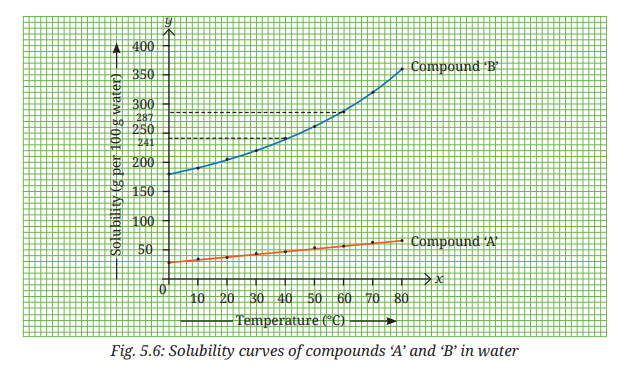
Answer: Compound 'B' is likely to deposit more solid.
Reason: From the solubility curves, compound B has a steeper slope between 80°C and 60°C, meaning its solubility decreases more rapidly with temperature. Therefore, on cooling, more of compound B will come out of solution compared to compound A.
Q5. Will there be any change in the size of common salt crystals if the rate of evaporation is increased or decreased? Explain.
Answer:
Answer: Yes, the size of common salt crystals will change.
Explanation:
- Slow evaporation: Allows particles more time to arrange themselves in a regular pattern, resulting in larger, well-formed crystals.
- Fast evaporation: Particles do not get enough time to arrange properly, resulting in smaller, less well-formed crystals.
Pause and Ponder (Page 11)
Q6. State whether the following statements are True or False. Also, correct the False statements. (i) Salt can be separated from a salt solution by evaporation or distillation. (ii) Distillation can be used for separation of two liquids even when these have the same boiling point. (iii) In paper chromatography, the solvent level should be above the sample spot at the beginning of the experiment. (iv) Evaporation and crystallization are the same processes.
Answer:
(i) True – Salt can be separated from a salt solution by evaporation (to get salt) or distillation (to get pure water).
(ii) False – Distillation cannot be used when two liquids have the same boiling point. Correction: Distillation works only when liquids have a difference of at least 25°C in their boiling points.
(iii) False – The solvent level should be below the sample spot. Correction: In paper chromatography, the solvent level should be below the sample spot so that the sample moves up with the solvent.
(iv) False – Evaporation and crystallization are not the same. Correction: Evaporation removes the solvent completely, while crystallization involves slow cooling of a saturated solution to form pure crystals.
Pause and Ponder (Page 13)
Q7. Why do immiscible liquids form two separate layers in a separating funnel?
Answer:
Immiscible liquids form two separate layers because they have different densities. The liquid with higher density settles at the bottom, while the liquid with lower density forms the upper layer. They do not mix with each other.
Q8. Is sublimation different from evaporation? Justify.
Answer:
Yes, sublimation is different from evaporation.
- Evaporation: Liquid changes to vapour at any temperature below its boiling point. It involves the liquid state.
- Sublimation: Solid changes directly to vapour without passing through the liquid state.
In sublimation, the substance goes from solid to gas directly (e.g., camphor, naphthalene, dry ice).
Pause and Ponder (Page 17)
Q9. Clouds are made up of tiny water droplets or ice crystals floating in the air. Based on what you know about solutions, suspensions and colloids, what type of mixture do you think clouds are and why?
Answer:
Clouds are a colloid.
Reason: The tiny water droplets or ice crystals (dispersed phase) are suspended in air (dispersion medium). The particles are between 1–1000 nm in size, do not settle down easily, and scatter light (Tyndall effect). This makes clouds a colloidal mixture.
Q10. Why do cities with a lot of smoke and dust in the air often look hazy?
Answer:
Cities with a lot of smoke and dust look hazy because of the Tyndall effect. The smoke and dust particles suspended in the air scatter sunlight, making the air appear hazy or foggy. This scattering of light by particles in a colloid or suspension is the Tyndall effect.
Activity 5.9 (Page 17)
Q1. Complete Table 5.1 and review what you have learnt about solutions, suspensions and colloids. Table 5.1: Properties of different types of mixtures
Answer:
Completed Table 5.1:
| S. No. | Property | Solution | Suspension | Colloid |
|---|---|---|---|---|
| 1. | Nature | Homogeneous | Heterogeneous | Heterogeneous |
| 2. | Particle size | Less than 1 nm | More than 1000 nm | 1–1000 nm |
| 3. | Visibility | Not visible | Visible to naked eye | Not visible to naked eye |
| 4. | Separation by filtration | Cannot be separated | Can be separated by filtration | Cannot be separated |
| 5. | Settling | Does not settle | Settles down on standing | Does not settle |
| 6. | Tyndall effect | No Tyndall effect | Shows Tyndall effect | Shows Tyndall effect |
Revise, Reflect, Refine (Page 19)
Q1. Which of the following mixtures are correctly classified as homogeneous (Hm) and heterogeneous (Ht)? Choose the correct option. (i) Air-Hm, Milk-Ht, Sugar solution-Hm, Smoke-Hm (ii) Brass-Ht, Fog-Ht, Vinegar-Ht, Muddy water-Hm (iii) Copper sulfate solution-Hm, Salt solution-Hm, Milk-Hm, Bronze-Hm (iv) Muddy water-Ht, Milk-Ht, Blood-Ht, Brass-Hm
Answer:
The correct option is (iv) Muddy water-Ht, Milk-Ht, Blood-Ht, Brass-Hm.
Explanation:
- Muddy water – Heterogeneous (suspension)
- Milk – Heterogeneous (colloid)
- Blood – Heterogeneous (colloid)
- Brass – Homogeneous (alloy – solid solution)
Option (i) is incorrect because Smoke is heterogeneous. Option (ii) is incorrect because Vinegar is homogeneous and Brass is homogeneous. Option (iii) is incorrect because Milk is heterogeneous.
Q2. Choose the correct options, and explain the reason for the correct and incorrect options. Which among the following mixtures show the Tyndall Effect? A mixture of: (a) air and dust particles (b) copper sulfate and water (c) starch and water (d) acetone and water (i) a and b (ii) b and d (iii) a and c (iv) c and d
Answer:
The correct option is (iii) a and c.
Explanation:
- (a) Air and dust particles – Heterogeneous mixture (suspension) – shows Tyndall effect.
- (b) Copper sulfate and water – Homogeneous solution – does not show Tyndall effect.
- (c) Starch and water – Colloid – shows Tyndall effect.
- (d) Acetone and water – Homogeneous solution – does not show Tyndall effect.
Option (a) is incorrect because copper sulfate solution does not show Tyndall effect. Option (b) is incorrect because both are solutions. Option (d) is incorrect because acetone and water is a solution.
Q3. A mixture can be categorised as a solution, a suspension, or a colloid, each possessing distinct properties. Utilise the words or phrases provided in the box to fill in the Table 5.2. Words and phrases may be used more than once.
Words and Phrases: Large-sized particles; Particles remain evenly distributed; Small-sized particles (less than 1 nm diameter); Moderate-sized particles (1-1000 nm); Settles down when left undisturbed (more than 1000 nm in diameter); Does not settle down; Scatters light; Separates by filtration; Transparent; Salt solution; Milk; Sand in water; Smoke; Heterogeneous mixture; Cannot be separated by filtration; Mud; Butter; Brass. Complete the Table 5.2.
Answer:
Q4. Solve the following problems: (i) A cake recipe uses dry ingredients, namely 75 g of sugar for 420 g of all-purpose flour and 5 g of sodium hydrogencarbonate. Express the concentration of each component in the mixture using an appropriate method. (ii) A brass alloy contains 70% copper by mass. Calculate the quantities of copper and zinc present in 120 g of brass.
Answer:
(i) Total mass of mixture = 75 + 420 + 5 = 500 g
- Sugar % = (75/500) × 100 = 15% m/m
- Flour % = (420/500) × 100 = 84% m/m
- Sodium hydrogencarbonate % = (5/500) × 100 = 1% m/m
(ii) Brass contains 70% copper and 30% zinc.
- Mass of copper = (70/100) × 120 = 84 g
- Mass of zinc = (30/100) × 120 = 36 g
Q5. The label on a cooking oil pack says one litre (910 g). If this oil is mixed with water, will it form a separate layer? If so, which substance will be on top? How will you separate the two layers? Also, draw the diagram of the apparatus used.
Answer:
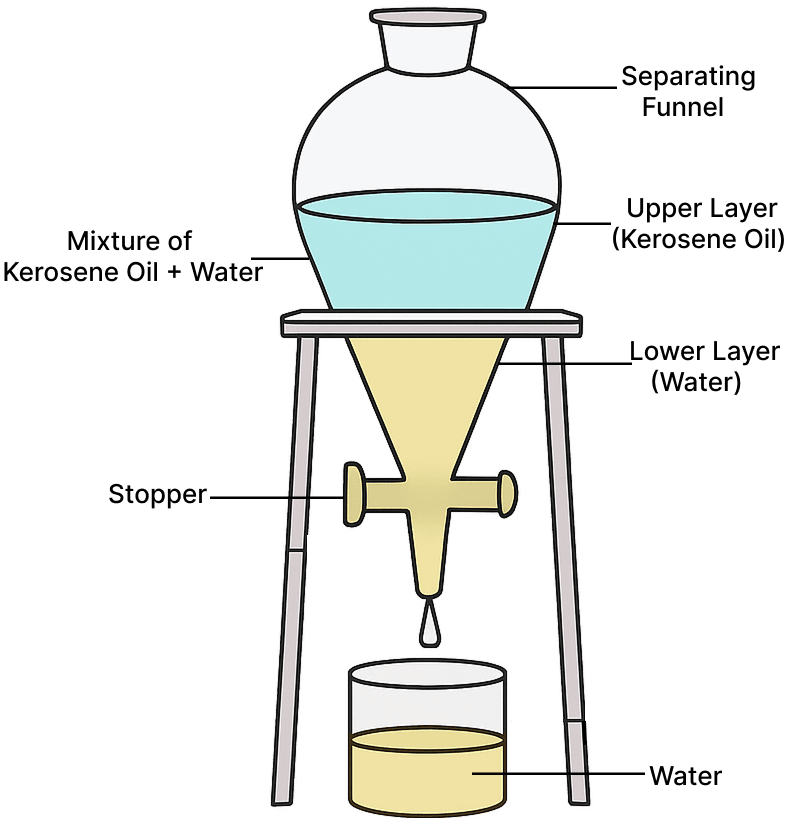
- Oil and water are immiscible, so they will form separate layers.
- Since the density of oil is less than water, oil will form the upper layer and water will form the lower layer.
- They can be separated using a separating funnel.
Procedure: Pour the mixture into a separating funnel. Let it stand until two layers form. Open the stopcock to drain the lower layer (water). Close the stopcock when water is almost drained. Collect the oil layer separately.
Q6. Assertion (A): Solutions do not exhibit the Tyndall effect. Reason (R): The particles in solutions are larger than 100 nm, so they cannot scatter light. Choose the correct option: (i) Both A and R are true, and R is the correct explanation of A. (ii) Both A and R are true, but R is not the correct explanation of A. (iii) A is true, but R is false. (iv) A is false, but R is true.
Answer:
The correct option is (iii) A is true, but R is false.
Explanation:
- Assertion is true: Solutions do not exhibit the Tyndall effect because the particles are too small to scatter light.
- Reason is false: The particles in solutions are less than 1 nm in size, not larger than 100 nm. It is the particles in colloids and suspensions that scatter light.
Q7. How would you separate the mixtures given in Table 5.3? Mention the reason for choosing your method. If a mixture cannot be separated, explain why.
Mixture: Mud from muddy water; Plasma from other components in the blood sample; Naphthalene and sand; Chalk powder and common salt; Common salt and water; Oil from water; Pigments of the flower
Answer:
Q8. Two miscible liquids, A and B, are present in a mixture. The boiling point of A is 60°C and the boiling point of B is 90°C. Suggest a method to separate them. Also, draw a labelled diagram of the method suggested.
Answer:
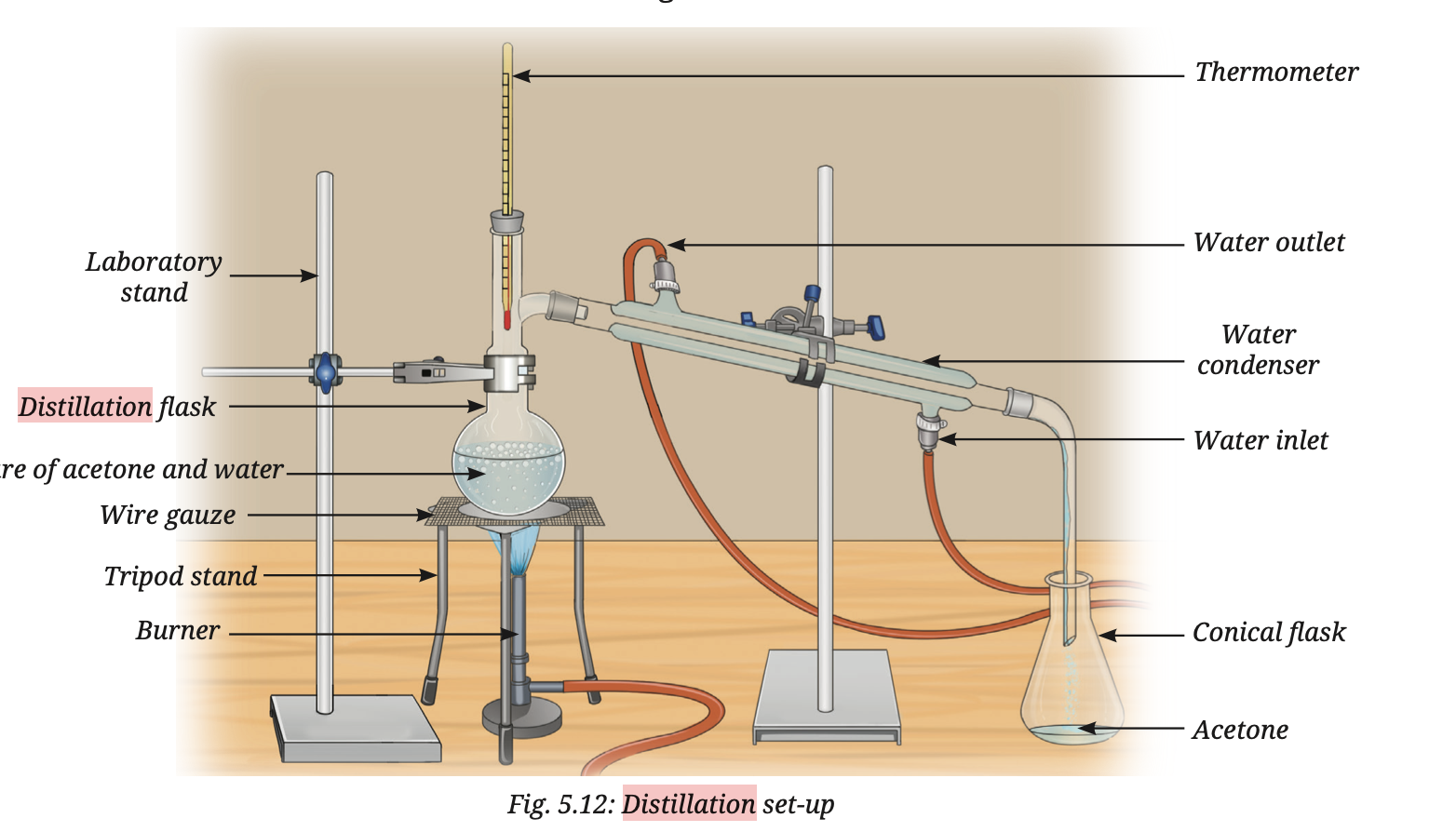
Method: Distillation
Reason: The boiling points of A and B differ by 30°C (difference > 25°C), so they can be separated by simple distillation.
Process: Heat the mixture in a distillation flask. Liquid A (boiling point 60°C) vaporises first. The vapour passes through a condenser where it cools and becomes liquid A, collected in a separate vessel. Liquid B remains in the distillation flask.
Diagram: A distillation setup consists of:
- Distillation flask (with mixture and boiling chips)
- Thermometer (to monitor temperature)
- Condenser (with water inlet and outlet)
- Receiver (to collect the distillate)
Q9. Compare evaporation, crystallization and distillation. In which situation, would you prefer each of these over the others?
Answer:
Comparison of Evaporation, Crystallization and Distillation:
| Method | Definition | When to use |
|---|---|---|
| Evaporation | Removing the solvent from a solution by heating, leaving behind the solute | When you only need the solid solute (e.g., salt from seawater) |
| Crystallization | Forming pure crystals from a saturated solution by slow cooling | When you need pure, well-formed crystals of a substance (e.g., sugar, copper sulfate) |
| Distillation | Separating two miscible liquids based on boiling point difference, or obtaining a pure solvent | When you need both components (liquid and solid) or want to recover the solvent (e.g., water from salt solution) |
Preference:
- Evaporation: When only the solid solute is needed and the solvent is not required.
- Crystallization: When pure crystals of a substance are needed (e.g., sugar, copper sulfate).
- Distillation: When both components need to be recovered or when the solvent is valuable (e.g., obtaining pure water from salt solution).
Q10. Blood is an example of a colloidal mixture. (i) What would happen if blood behaved like a true suspension inside the body? (ii) In a blood sample, identify the dispersed phase and the dispersion medium.
Answer:
(i) If blood behaved like a true suspension:
- The blood cells would settle down due to gravity inside the body.
- This would block blood vessels and prevent proper circulation.
- Oxygen and nutrients would not be transported effectively.
- The body would not be able to function properly, leading to serious health issues.
(ii) In a blood sample:
- Dispersed phase: Blood cells (RBCs, WBCs, platelets)
- Dispersion medium: Plasma (liquid component)
Q11. You are given a mixture of sand, common salt and naphthalene. The Fig. 5.25 depicts various steps used to separate the components of this mixture. Identify and write down the correct sequence of separation techniques.
Answer:
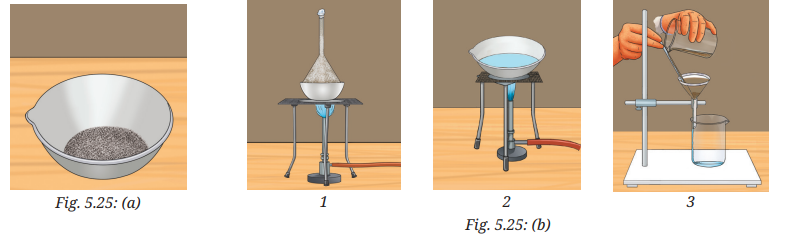
Correct sequence of separation techniques:
- Sublimation – To separate naphthalene from the mixture. Naphthalene sublimes and gets deposited on the inner walls of the funnel.
- Dissolution in water + Filtration – Add water to the remaining mixture (sand + salt). Salt dissolves in water, sand does not. Filter to separate sand (residue) from salt solution (filtrate).
- Evaporation – Heat the salt solution to evaporate water and obtain pure salt crystals.
Q12. Why is distillation an effective method for separating a mixture of water and acetone?
Answer:
Distillation is effective for separating water and acetone because:
- Difference in boiling points: Acetone boils at 56°C, while water boils at 100°C. The difference (44°C) is greater than 25°C, making simple distillation suitable.
- When the mixture is heated, acetone (lower boiling point) vaporises first and is collected as distillate, while water remains in the distillation flask.
Q13. Answer the following questions with the help of the data given in Table 5.4. (i) What mass of potassium nitrate would be needed to prepare its saturated solution in 50 g of water at 40°C? (ii) A student makes a saturated solution of potassium chloride in water at 80°C and leaves the solution to cool at room temperature (25°C). What would she observe as the solution cools? Explain. (iii) What is the effect of a change in temperature on the solubility of salts? Also, compare the changes in the solubility of the four given salts with increasing temperature from 10°C to 80°C.
Answer:
(i) Mass of potassium nitrate needed at 40°C:
- At 40°C, solubility of KNO₃ = 62 g per 100 g water
- For 50 g water = (62/100) × 50 = 31 g
(ii) Observation when cooling saturated KCl solution:
- At 80°C, solubility of KCl = 54 g per 100 g water
- At 25°C (between 20°C and 30°C), solubility ≈ 36 g per 100 g water
- As the solution cools, excess KCl will crystallize out because solubility decreases with temperature.
(iii) Effect of temperature on solubility:
- For most solid solutes, solubility increases with increase in temperature.
- Comparison (10°C to 80°C):
- Potassium nitrate: Large increase (21 → 167 g) – steep increase
- Ammonium chloride: Moderate increase (24 → 66 g)
- Potassium chloride: Moderate increase (35 → 54 g)
- Sodium chloride: Very slight increase (36 → 37 g) – almost constant
Q14. Three students, A, B and C, are preparing sugar solutions for an experiment: Student A dissolves 20 g of sugar in 80 g of water. Student B dissolves 20 g of sugar in 100 g of water. Student C dissolves 30 g of sugar in 80 g of water. (i) Calculate the mass percentage (% m/m) concentration of sugar in each student's solution. (ii) Whose solution is the most concentrated? Explain why.
Answer:
(i) Mass percentage calculations:
- Student A: Mass of solution = 20 + 80 = 100 g; % = (20/100) × 100 = 20% m/m
- Student B: Mass of solution = 20 + 100 = 120 g; % = (20/120) × 100 = 16.67% m/m
- Student C: Mass of solution = 30 + 80 = 110 g; % = (30/110) × 100 = 27.27% m/m
(ii) Most concentrated solution: Student C's solution (27.27% m/m)
Reason: Student C has the highest mass of sugar (30 g) per total mass of solution (110 g), resulting in the highest mass percentage. Even though Student C used the same amount of water as Student A, they used more sugar, making it more concentrated.
Q15. Examine Fig. 5.26. (i) Identify the separation technique marked as 'S'. (ii) Label the apparatus A, B and C. (iii) Which of the following mixtures can be separated by the technique identified above? Use the data given in Table 5.5. Mixtures: (a) water - acetone (b) water - salt (c) acetone - alcohol (d) sand - salt (e) alcohol - chloroform (f) alcohol - benzene
Answer:
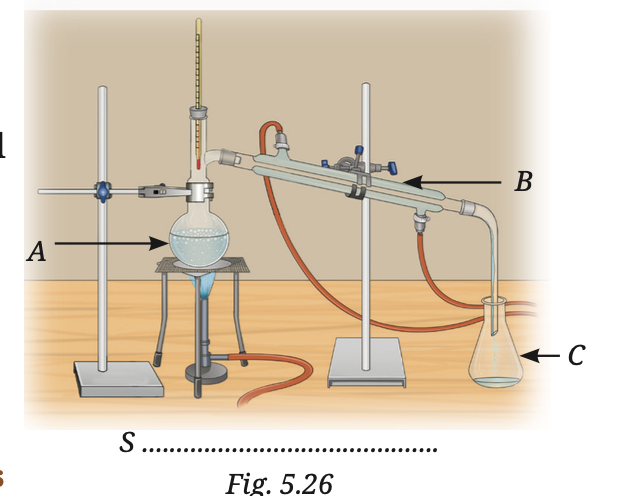
(i) Separation technique marked as 'S': Distillation
(ii) Labelling of apparatus:
- A – Distillation flask (containing the mixture)
- B – Condenser (with water inlet and outlet)
- C – Receiver (collecting the distillate)
(iii) Mixtures that can be separated by distillation:
- (a) water - acetone – Yes (BP difference = 100 − 56 = 44°C > 25°C)
- (b) water - salt – No (distillation can separate but here salt is solid, not liquid)
- (c) acetone - alcohol – No (BP difference = 78 − 56 = 22°C < 25°C, so fractional distillation would be needed)
- (d) sand - salt – No (solid-solid mixture, not suitable)
- (e) alcohol - chloroform – No (BP difference = 78 − 61 = 17°C < 25°C, fractional distillation needed)
- (f) alcohol - benzene – No (BP difference = 80 − 78 = 2°C < 25°C, fractional distillation needed)
Correct answer for simple distillation: Only (a) water - acetone has difference > 25°C.
The Journey Beyond (Page 22)
Q1. Demonstrate the Tyndall effect using different colloids. Create a series of experiments showcasing how light scatters in colloids making the beam visible. Use laser pointers (Safety first: Use it under the supervision of an adult), flashlights, or other light sources for your demonstrations.
Answer:
This is an experiential activity.
Procedure:
- Take three transparent beakers containing: (a) salt solution (true solution), (b) milk + water (colloid), (c) chalk powder + water (suspension).
- Shine a laser pointer or flashlight through each beaker.
- Observe from the side.
- Observation: The beam is visible in milk (colloid) and chalk suspension, but not in salt solution.
- Conclusion: Colloids and suspensions show the Tyndall effect because particles scatter light.
Safety: Never look directly into the laser beam.
Q2. Make crystals of different compounds (common salt, epsom salt, sugar, borax, nickel sulfate, etc.). Observe them under a magnifying glass or a microscope. Note down their colours and shapes.
Answer:
This is an experiential activity.
Procedure:
- Prepare saturated solutions of different compounds in separate beakers.
- Filter each solution and allow them to cool slowly.
- Observe the crystals formed under a magnifying glass or microscope.
- Observations:
- Common salt (NaCl): Colourless, cubic crystals
- Epsom salt (MgSO₄): Colourless, needle-like crystals
- Sugar (C₁₂H₂₂O₁₁): Colourless, monoclinic crystals
- Copper sulfate (CuSO₄): Blue, triclinic crystals
- Borax: Colourless, monoclinic crystals
- Note down the colour and shape of each crystal.
Q3. Do red leaves also contain green pigments? Investigate it using paper chromatography.
Answer:
This is an experiential activity.
Procedure:
- Collect red leaves (e.g., from poinsettia or red maple).
- Grind the leaves with a small amount of alcohol to extract pigments.
- Apply a drop of the extract on a filter paper strip (2 cm from bottom).
- Place the strip in a beaker containing a solvent (alcohol/water mixture).
- Observe after 15-20 minutes.
- Observation: The pigments separate into different bands – you may see green (chlorophyll) along with red/other pigments.
- Conclusion: Red leaves also contain green pigments (chlorophyll) hidden by other pigments.
Q4. You can try chromatography to find the number of components present in a food colour (green, orange, yellow, etc.) or in coloured mouth fresheners (fennel seeds).
Answer:
This is an experiential activity.
Procedure for food colour:
- Take a filter paper strip and draw a pencil line 2 cm from bottom.
- Place a small drop of food colour on the line.
- Dip the strip in a beaker with water (solvent level below the spot).
- Observe as the solvent rises.
- Observation: Different colours separate based on solubility.
For coloured mouth fresheners: Crush the fennel seeds, extract with a few drops of water, and apply the extract on the paper. Run chromatography to see the number of components.
Q5. Design an educational game where players identify and apply separation techniques to different mixtures through interactive challenges and hands-on activities.
Answer:
This is a project activity.
Game Idea – "Separate It!"
- Objective: Players identify the correct separation technique for different mixtures.
- Materials: Cards with mixture names, cards with separation techniques, timer, scoreboard.
- Gameplay:
- Each player draws a mixture card (e.g., "Salt and Water", "Oil and Water", "Sand and Iron Filings").
- They must select the correct separation technique from the technique cards.
- Explain the reason for their choice.
- Score points for correct answers and good explanations.
- Learning Outcome: Students understand the principles of different separation techniques.
Q6. If you are camping outdoors and running short on clean water, you can obtain clean water by distillation. Can you think of a set-up with the items available to you?
Answer:
This is a practical/experiential activity.
Simple distillation setup using camping items:
- Items: Metal pot/cup, lid, small container, fire source, stones, cloth.
- Procedure:
- Place the muddy/salty water in a metal pot.
- Heat the pot over a fire.
- Place a small container inside the pot to collect clean water.
- Cover the pot with a lid (inverted) so that steam condenses on it.
- Collect the condensed water droplets in the container.
- Alternative: Use a plastic sheet stretched over the pot to collect condensed water.
The Quest Continues (Page 22)
Q1. Can we create artificial blood that works just as real blood for all patients?
Answer:
This is a thought-provoking/question-based activity.
Current status: Scientists are working on developing artificial blood substitutes that can carry oxygen and perform some functions of real blood.
Challenges:
- Blood is a complex colloid with multiple components (RBCs, WBCs, platelets, plasma).
- Artificial blood must be compatible with all blood types.
- It must carry oxygen, fight infections, and clot properly.
- It should not cause immune reactions.
Advantages if possible:
- No need for blood type matching.
- Can be stored longer than real blood.
- Can be produced in large quantities.
- Reduces dependency on blood donors.
Current research: Scientists are exploring hemoglobin-based oxygen carriers (HBOCs) and perfluorocarbon-based blood substitutes. However, challenges remain regarding safety and effectiveness.
Practice Questions
Multiple Choice Questions
1. A student prepares four mixtures and observes them after stirring. Which mixture is most likely to be homogeneous?
(a) flour mixed with water (b) lemon juice mixed with water (c) soil mixed with water (d) rice grains mixed with pulses
Answer: (b) lemon juice mixed with water
2. Which of the following mixtures can best be separated using centrifugation?
(a) Sand and water (b) Ink pigments (c) Cream and milk (d) Salt and sugar
Answer: (c) Cream and milk
3. When a hot saturated solution is cooled, crystals form because:
(a) Solubility decreases (b) Density increases (c) Boiling point decreases (d) Colour changes
Answer: (a) Solubility decreases
4. In paper chromatography, different dyes in black ink move different distances on the paper. This separation occurs mainly because dyes differ in:
(a) Density (b) Adsorption and solubility (c) Magnetic properties (d) Particle size
Answer: (b) Adsorption and solubility
5. Distillation separates substances based on:
(a) Density (b) Solubility (c) Boiling point difference (d) Particle size
Answer: (c) Boiling point difference
6. A chemist needs to separate iodine from sand. Which technique is most appropriate?
(a) Chromatography (b) Sublimation (c) Centrifugation (d) Crystallisation
Answer: (b) Sublimation
7. A chemist wants to analyze pigments in plant leaves. Which method is most appropriate?
(a) Distillation (b) Paper chromatography (c) Centrifugation (d) Coagulation
Answer: (b) Paper chromatography
8. In water purification, alum is added to muddy water causing suspended particles to settle quickly. Which process is involved?
(a) Distillation (b) Coagulation (c) Chromatography (d) Sublimation
Answer: (b) Coagulation
9. Simple distillation is effective only when:
(a) Density difference is large (b) Boiling point difference is large (~25°C or more) (c) Solubility is same (d) Liquids are immiscible
Answer: (b) Boiling point difference is large (~25°C or more)
10. A solubility graph shows that the solubility of a salt increases sharply with temperature. Which method would be most suitable to purify this salt?
(a) Centrifugation (b) Crystallisation (c) Sublimation (d) Chromatography
Answer: (b) Crystallisation
11. What is solubility?
(a) Amount of solvent in a solution (b) Maximum amount of solute that dissolves in a solvent at a given temperature (c) Amount of solution formed (d) Rate of dissolving
Answer: (b) Maximum amount of solute that dissolves in a solvent at a given temperature
12. Which concentration method is most suitable when a solid solute is dissolved in a liquid and the final solution is measured in millilitres?
(a) Mass by mass percentage (b) Mass by volume percentage (c) Volume by volume percentage (d) Density percentage
Answer: (b) Mass by volume percentage
13. A beam of light is passed through four mixtures. In which mixture will the path of light not be visible?
(a) soap solution with tiny oil droplets (b) starch mixed with water (c) clear glucose solution (d) smoke-filled air
Answer: (c) clear glucose solution
14. Which of the following correctly matches the mixture with its separation method?
(a) Cream from milk – Separating funnel (b) Blood components – Centrifugation (c) Salt solution – Sublimation (d) Oil and water – Chromatography
Answer: (b) Blood components – Centrifugation
15. Which pair is correctly matched?
(a) Solution – particles visible to naked eye (b) Suspension – particles do not settle (c) Colloid – particles scatter light (d) Solution – particles separated by ordinary filtration
Answer: (c) Colloid – particles scatter light
Assertion–Reason Questions (Q16–Q20)
Direction: In the following questions, two statements are given — one labelled Assertion (A) and the other labelled Reason (R). Select the correct answer from the codes (a), (b), (c), (d) as given below:
(a) Both A and R are correct and R is the correct explanation of A.
(b) Both A and R are correct but R is not the correct explanation of A.
(c) A is true but R is false.
(d) A is false but R is true.
16. Assertion (A): The liquid collected during distillation is called distillate.
Reason (R): Vapours formed during heating condense to form liquid again.
Answer: (a) Both are correct and R explains A.
17. Assertion (A): Rapid cooling during crystallisation may produce impure crystals.
Reason (R): Rapid crystal formation traps impurities within the crystal lattice.
Answer: (a) Both are correct and R explains A.
18. Assertion (A): Sublimation can separate ammonium chloride from sand.
Reason (R): Sand sublimes at a higher temperature than ammonium chloride.
Answer: (c) A is true but R is false. (Sand does not sublime.)
19. Assertion (A): A centrifuge machine rotates samples at high speed.
Reason (R): Rotation produces centrifugal force, which separates particles.
Answer: (a) Both are correct and R explains A.
20. Assertion (A): A saturated solution cannot dissolve more solute at a given temperature.
Reason (R): It already contains the maximum amount of solute possible at that temperature.
Answer: (a) Both are correct and R explains A.
Competency Based Miscellaneous Exercise
Q1. Based on the graph, answer the following question. Separate saturated solutions of compound A and compound B are prepared by dissolving each compound in 100 g water at 80°C. The solutions are then cooled to 20°C. Based on the solubility graph, which of the following statements are correct?
(A) Both substances will crystallize out of the solution.
(B) Substance A will crystallize out in a significantly larger quantity than Substance B.
(C) The solubility of B remains relatively constant, meaning very little of it will solidify upon cooling.
(D) At 20°C, Substance B is more soluble in water than Substance A.
(a) Both A and D (b) A, B and D only (c) B, C and D only (d) All of these
Answer:
Correct option: (b) A, B and D only
Explanation:
- (A) Correct: Both substances will crystallize out because solubility decreases as temperature drops from 80°C to 20°C.
- (B) Correct: Substance A will crystallize out in a significantly larger quantity than Substance B because its solubility decreases much more sharply with temperature.
- (C) Incorrect: The solubility of B does not remain relatively constant; it decreases significantly. Therefore, a considerable amount of B will also solidify.
- (D) Correct: At 20°C, Substance B is more soluble in water than Substance A (the curve for B is higher than A at 20°C).
Q2. A student is given a mixture of two liquids as shown below. A (B.P. 56°C), and B (B.P. 100°C). Which separation technique would be most suitable to separate them? Justify your answer.
Answer:
Most suitable technique: Simple Distillation
Justification: The boiling point difference between A (56°C) and B (100°C) is 44°C, which is greater than 25°C. Therefore, simple distillation can effectively separate the two miscible liquids based on their difference in boiling points. Liquid A will vaporise first and can be collected separately, leaving liquid B behind.
Note: All questions from Think It Over, Pause and Ponder, Activity 5.9, Revise, Reflect, Refine, The Journey Beyond, The Quest Continues, Practice Questions and Competency Based Miscellaneous Exercise are covered. Images are centred and embedded. Inline styles only — TinyMCE compatible.