
Think It Over · Activity 13.1 · Think as a Scientist · Activity 13.2 · Pause and Ponder · What If · Revise, Reflect, Refine · The Journey Beyond · The Quest Continues · Practice Questions · Competency Based
Think It Over
Q1. How does the warming of Arabian Sea water affect the southwest monsoon in India?
Answer:
Warmer sea surface water increases the rate of evaporation from the Arabian Sea, adding more moisture to the air above it. This extra moisture can intensify monsoon rainfall in some years, but it also makes the monsoon less predictable overall.
- It can cause sudden bursts of heavy rainfall and flooding in some regions.
- It can simultaneously cause drought-like conditions in other regions, as rainfall patterns become more erratic.
- Over time, it disrupts the traditional timing and distribution of monsoon rains that Indian agriculture depends on.
Q2. If a large forest is cleared, how can that affect the flow of a river in that area?
Answer:
Clearing a forest disrupts the natural balance between rainfall, soil, and river flow in several ways:
- Fewer trees means less transpiration and less interception of rainfall, so more water reaches the ground quickly as surface runoff instead of soaking in slowly.
- Without tree roots to hold the soil, soil erosion increases, and eroded soil can silt up the riverbed.
- Reduced infiltration means less water recharges the groundwater, so the river may carry very little water (or dry up) during the dry season.
- During heavy rain, the lack of forest cover can cause sudden flash floods, since there is nothing to slow down or absorb the runoff.
In short, deforestation tends to make a river's flow more extreme and unpredictable — flooding during rains, and reduced flow during dry months.
Q3. What might happen to coastal cities in India if glaciers and polar ice keep melting faster?
Answer:
Faster melting of glaciers and polar ice adds large amounts of extra water to the oceans, causing global sea levels to rise. For coastal Indian cities such as Mumbai, Chennai, and Kolkata, this could mean:
- Increased flooding during high tides and storms.
- Saltwater intrusion into groundwater and agricultural land near the coast.
- Permanent loss of low-lying land.
- Displacement of people living in vulnerable coastal areas.
- Greater damage during cyclones, since higher sea levels make storm surges more destructive.
Q4. How would increasing carbon dioxide levels in the atmosphere affect the ocean plankton?
Answer:
Oceans absorb a large share of atmospheric CO₂. As CO₂ levels rise, more of it dissolves into seawater, forming carbonic acid and making the ocean more acidic — a process called ocean acidification.
- Many types of plankton build shells or skeletons from calcium carbonate; higher acidity makes it harder for them to form and maintain these structures.
- Since plankton form the base of most marine food chains, a decline in plankton health can affect fish, whales, and the entire ocean food web.
- Warmer, more acidic oceans can also reduce plankton diversity and disrupt the timing of their growth cycles.
Activity 13.1: Let us explore
Q1. Observe the features of the Earth as shown in Fig. 13.1. Identify and circle one example representing each of the geosphere, hydrosphere, cryosphere, atmosphere, and biosphere.
Answer:
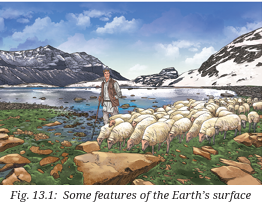
- Geosphere: the rocky mountains and soil
- Hydrosphere: the lake
- Cryosphere: the snow and ice on the mountain peaks
- Atmosphere: the sky and air above the scene
- Biosphere: the sheep, grass, and trees
Q2. How does snow (cryosphere) eventually become part of the lake (hydrosphere)?
Answer:
When temperatures rise (such as during spring and summer), the snow on the mountain slopes melts. The resulting meltwater flows downhill under gravity, along streams and channels, until it reaches and adds to the water in the lake below — converting solid water from the cryosphere into liquid water in the hydrosphere.
Q3. If there is less snowfall during winters for a few years, how would this affect the lake's level and the grass available for the sheep?
Answer:
Less snowfall means less snow accumulates on the mountains, so less meltwater flows into the lake when it melts. This would cause:
- The lake's water level to drop over time.
- Less water available to support the growth of grass around the lake.
- Reduced grazing area and food supply for the sheep, which depend on both the water and the grass.
Q4. Discuss with your classmates and write down how all the spheres are interconnected, and how a disturbance in one can lead to changes in others.
Answer:
All five spheres are linked through the continuous exchange of energy and matter. A change in one sphere can trigger a chain of effects across the others. For example:
- Less snowfall (cryosphere) → less water reaches the lake (hydrosphere) → less grass grows (biosphere).
- Warmer sea water (hydrosphere) → more evaporation and monsoon variability (atmosphere) → floods in some regions, drought in others.
- Rising atmospheric temperature (atmosphere) → faster melting of glaciers and polar ice (cryosphere) → rising sea levels that threaten coastal cities and habitats (biosphere, geosphere).
This shows the Earth behaves as one connected system — a disturbance rarely stays confined to a single sphere.
Think as a Scientist
Q1. Estimate how much of the Earth's surface would need to be covered with solar panels to supply all the electric power that our country uses today.
Answer:
This is an estimation problem, so the goal is a reasonable order-of-magnitude answer, not an exact figure. A suggested approach:
- Look up India's total average electricity consumption (in watts or megawatts) online.
- Look up (or use) an approximate value for insolation reaching the Earth's surface, around 1 kW/m² under clear sky conditions.
- Assume a realistic efficiency for converting sunlight into electricity using solar panels, typically around 15–20%.
- Divide the total power needed by the usable power per square metre to estimate the required area.
Using these numbers, the estimated area works out to only a small fraction of India's total land area — even a portion of the Thar desert could, in principle, supply the country's entire electricity needs.
Activity 13.2: Let us find out
Q1. Complete Table 13.1 (Reflection of solar radiation by surfaces of materials) using information from authentic sources like websites and books.
Answer:
| S. No. | Materials | Albedo |
|---|---|---|
| 1 | Snow | 0.80 – 0.90 |
| 2 | Ice | 0.50 – 0.70 |
| 3 | Crushed rock | 0.25 – 0.30 |
| 4 | Light coloured soil | 0.25 – 0.45 |
| 5 | Black soil | 0.05 – 0.15 |
| 6 | Ocean water | 0.03 – 0.10 |
Snow and ice have the highest albedo, reflecting most incoming radiation and staying cold. Black soil and ocean water have the lowest albedo, absorbing most incoming radiation and staying comparatively warmer.
Pause and Ponder
Q1. Visit the website given (https://phet.colorado.edu/en/simulations/greenhouse-effect) and study the effect of the concentration of greenhouse gas on surface temperature.
Answer:
This is a hands-on simulation activity — visit the link and adjust the greenhouse gas concentration slider to observe the effect on Earth's surface temperature.
You should observe that as greenhouse gas concentration increases, more outgoing infrared radiation gets trapped, and the simulated surface temperature rises — directly demonstrating the enhanced greenhouse effect discussed in this chapter.
Q2. How does the cool mountain breeze benefit agriculture activity, particularly the crops and soil?
Answer:
The cool mountain breeze (which flows down into the valley at night) benefits agriculture in several ways:
- It helps regulate night-time temperature, preventing crops from overheating and reducing water loss from plants.
- It brings some moisture down into the valley, supporting soil moisture retention.
- It helps maintain a more stable temperature range, which supports healthy crop growth and soil microbial activity.
- Regular daily wind patterns like this influence local weather conditions important for farming schedules in hilly regions.
Q3. What happens to the warm surface water from the equator as it travels toward the poles? What impact does this movement have on the area?
Answer:
As warm equatorial surface water travels toward the poles, it gradually cools down and becomes denser. Eventually, it sinks and flows back toward the equator through deeper ocean levels, completing a large-scale circulation pattern.
Impact: This movement transports heat from the equator to higher latitudes, which has a moderating effect on the climate of the regions it passes. For example, the North Atlantic Drift (an extension of the Gulf Stream) keeps many European ports ice-free even in winter, despite being at high latitudes — supporting trade, fishing, and coastal ecosystems in those regions.
Q4. The CO₂ dissolved in the ocean is disturbed when the global temperature increases. What will happen to marine life?
Answer:
As global temperature rises, ocean water warms up, and warmer water can hold less dissolved CO₂ than cooler water — reducing the ocean's capacity to act as a carbon sink. At the same time, the CO₂ that does dissolve makes the water more acidic (ocean acidification).
- Calcifying organisms like corals, molluscs, and some plankton find it harder to build and maintain their shells/skeletons.
- Coral reefs can experience bleaching and die-off under combined warming and acidification stress.
- Since these organisms form the base of many marine food webs, fish and other marine life dependent on them are also affected.
- Reduced CO₂ absorption by oceans also means more CO₂ stays in the atmosphere, further intensifying global warming.
Q5. What would happen to plants and animals on Earth if the biogeochemical cycles were disrupted and stopped? Explain by giving a few examples.
Answer:
Biogeochemical cycles keep essential nutrients like carbon, nitrogen, and oxygen continuously available to living things. If these cycles were disrupted or stopped:
- Nitrogen cycle stopping: plants would be unable to obtain usable nitrogen compounds from the soil, so they couldn't build proteins or nucleic acids, stunting growth; animals that eat plants would also suffer.
- Oxygen cycle stopping: if photosynthesis stopped replenishing oxygen, atmospheric oxygen levels would gradually fall, making respiration difficult for most organisms.
- Carbon cycle stopping: dead organic matter would not be broken down and recycled, nutrients would remain locked away, and CO₂ needed for photosynthesis would become scarce.
- Water cycle stopping: no rainfall or evaporation would mean freshwater would not be replenished, causing widespread drought.
In short, without biogeochemical cycles, essential nutrients would become locked in one place instead of being recycled, and most life on Earth would eventually be unable to survive.
Q6. Discuss how human activities increase the concentration of greenhouse gases in the atmosphere. What would you do as an individual to reduce the emission of greenhouse gas?
Answer:
How human activities increase greenhouse gases:
- Burning fossil fuels (coal, oil, natural gas) for electricity, transport, and industry releases large amounts of CO₂.
- Deforestation reduces the number of trees available to absorb CO₂ through photosynthesis.
- Overuse of nitrogen fertilisers and livestock farming release methane and nitrous oxide, both potent greenhouse gases.
- Industrial processes and landfills also release various greenhouse gases.
What an individual can do:
- Save electricity by using energy-efficient appliances and switching off unused devices.
- Use public transport, cycling, or walking instead of private vehicles where possible.
- Plant trees and support local afforestation efforts.
- Reduce, reuse, and recycle materials to cut down on waste and resource use.
- Support and use renewable energy sources like solar power where available.
What If...
Q1. What if photosynthesis stopped, what would happen on the Earth?
Answer:
Photosynthesis is the main process that produces atmospheric oxygen and absorbs atmospheric CO₂. If it stopped:
- Atmospheric oxygen would no longer be replenished, and would gradually decline as it continued to be consumed by respiration and combustion.
- CO₂ levels would rise unchecked, since nothing would be removing it from the atmosphere, intensifying the greenhouse effect and global warming.
- Plants (the primary food producers) would stop growing, collapsing food chains that depend on them, directly or indirectly.
- Over time, most animal and plant life would be unable to survive without oxygen and food, leading to mass extinction.
Revise, Reflect, Refine
Q1. Choose the most appropriate option to describe the role of biogeochemical cycles in an ecosystem. (i) To provide food directly to all organisms. (ii) To recycle essential nutrients between biotic and abiotic components. (iii) To create new elements for use by living things. (iv) To remove pollutants and toxins from the organism.
Answer:
Answer: (ii) To recycle essential nutrients between biotic and abiotic components.
Biogeochemical cycles (like the water, carbon, nitrogen, and oxygen cycles) continuously move essential nutrients between living organisms and the non-living environment, keeping them available for life to use again and again.
Q2. Which of the following is primarily responsible for warming of the Earth? (i) Solar radiation is immediately absorbed by carbon dioxide, which then releases it as heat. (ii) The atmosphere's tiny particles absorb incoming solar radiation, which directly heats the Earth. (iii) The Earth's surface absorbs solar radiation, which is then re-radiated and trapped by greenhouse gases. (iv) The Earth's environment is heated only by the solar radiation reflected by the clouds.
Answer:
Answer: (iii) The Earth's surface absorbs solar radiation, which is then re-radiated and trapped by greenhouse gases.
Visible sunlight passes through the atmosphere and is absorbed by Earth's surface. The surface then re-radiates this energy as infrared (heat) radiation, a portion of which is trapped by greenhouse gases like CO₂, CH₄, and water vapour, warming the Earth.
Q3. Explain how climate change affects the water cycle. Illustrate with examples.
Answer:
- A warmer atmosphere can hold more moisture, causing heavier rains in some areas — for example, intensified monsoons in parts of India.
- It also causes droughts elsewhere, as rainfall patterns become more uneven and unpredictable.
- Melting glaciers add extra water to rivers, and eventually raise sea levels, threatening coastal cities such as Mumbai and Chennai.
- Sudden bursts of intense rainfall increase surface runoff, which erodes soil.
- Reduced infiltration lowers the recharge of groundwater, making it harder to sustain agriculture, especially during dry months.
Q4. Describe how albedo affects the Earth's surface temperature and its climate.
Answer:
Albedo is the fraction of solar radiation reflected by a surface.
- High-albedo surfaces (like snow and ice) reflect most incoming sunlight, so they absorb less energy and stay cooler — this is why polar regions remain very cold.
- Low-albedo surfaces (like black soil and ocean water) reflect very little sunlight, absorbing most of it, so they heat up more and stay comparatively warmer.
- Changes in albedo can affect climate on a larger scale — for example, when ice melts and exposes darker land or ocean underneath, the surface absorbs more heat, which causes even more melting (an ice-albedo feedback loop), amplifying regional and global warming.
Q5. How are mountain and valley breezes formed? Suppose there are two mountains, one covered with grass and another covered with barren rocks; would the temperature of the two mountain breezes be different? If so, how?
Answer:
Formation: During the day, sun-facing mountain slopes heat up faster than the valley floor, so the air above the slopes becomes warm and rises, creating a low-pressure area; cooler air from the valley moves up to replace it — this upward flow is called a valley breeze. After sunset, the slopes cool down faster than the valley floor; the air above the slopes becomes cool and dense and flows down into the valley — this is called a mountain breeze.
Yes, the temperature of the breezes would differ:
- The barren, rocky mountain would heat up and cool down more quickly and to a greater extreme, since rock has lower albedo (absorbs more heat) and no vegetation to moderate temperature through shade or transpiration — producing a stronger, warmer valley breeze by day and a colder mountain breeze at night.
- The grass-covered mountain would show more moderate temperature swings, since vegetation provides shade, retains some moisture, and releases water vapour through transpiration, cooling the surrounding air — producing gentler breezes in both directions.
Q6. You have witnessed weather phenomena, such as winds, storms, rainfall, etc. Which atmospheric layer is mainly responsible for such phenomena and what is the primary reason for its occurrence?
Answer:
The troposphere is mainly responsible for weather phenomena like winds, storms, and rainfall.
Primary reason: The troposphere is heated directly from below by Earth's surface. This causes warm air near the surface to rise, while cooler air sinks, setting up continuous vertical air movement (convection). This constant mixing of air, along with the presence of most of the atmosphere's water vapour in this layer, drives the formation of clouds, winds, and storms.
Q7. Explain the processes involved in the nitrogen cycle. How would life on Earth be affected if nitrogen were not cycled?
Answer:
Processes in the nitrogen cycle:
- Nitrogen fixation: bacteria such as Rhizobium (in root nodules of legumes) and Azotobacter (in soil) convert atmospheric nitrogen gas (N₂) into ammonia (NH₃).
- Nitrification: Nitrosomonas converts ammonia into nitrite (NO₂⁻), and Nitrobacter converts nitrite into nitrate (NO₃⁻).
- Assimilation: plants absorb nitrate/nitrite from the soil; animals obtain nitrogen by eating plants or other animals.
- Ammonification: decomposers (bacteria and fungi) break down dead organisms and waste, returning ammonia to the soil.
- Denitrification: bacteria such as Pseudomonas convert some nitrates back into nitrogen gas, releasing it into the atmosphere and completing the cycle.
If nitrogen were not cycled: atmospheric nitrogen gas would remain locked in its non-reactive form, unusable by plants and animals. Soil would become depleted of usable nitrogen compounds, plants would be unable to make proteins and nucleic acids, growth would be stunted, and the entire food chain depending on plants would be severely disrupted — making life as we know it unsustainable.
Q8. What are the impacts of deforestation on the Earth's oxygen and carbon cycles? What are the other consequences of deforestation?
Answer:
Impact on oxygen and carbon cycles:
- Fewer trees means reduced photosynthesis, so less oxygen is produced and less atmospheric CO₂ is absorbed.
- This allows CO₂ to build up in the atmosphere faster, intensifying the greenhouse effect and contributing to global warming.
Other consequences of deforestation:
- Reduced transpiration, which can lead to a decline in local rainfall.
- Altered surface albedo, changing how much solar radiation is absorbed or reflected.
- Increased soil erosion, since tree roots no longer hold the soil together.
- Loss of habitats, leading to a decline in biodiversity as species lose their natural homes.
Q9. Explain with a suitable diagram the path that carbon takes to go back to the atmosphere. You may start from plants using CO₂ from the atmosphere.
Answer:
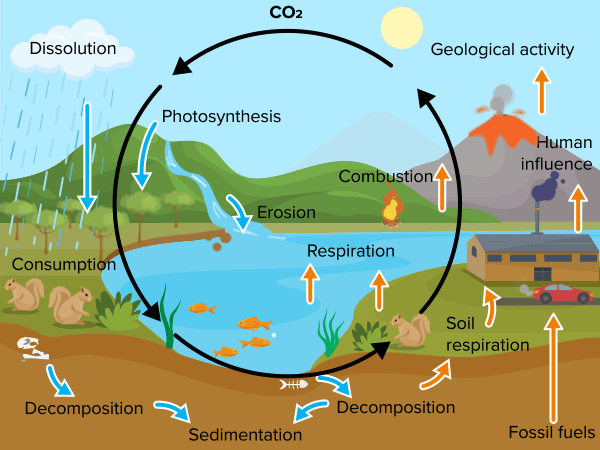
- Plants absorb atmospheric CO₂ and convert it into glucose through photosynthesis, storing carbon in their tissues.
- Some of this carbon returns to the atmosphere directly, as plants release CO₂ through respiration.
- Animals eat plants (or other animals), passing carbon along the food chain; this carbon returns to the atmosphere when animals respire.
- When plants and animals die, decomposers break down their organic matter, releasing stored carbon back as CO₂ through decomposition.
- Over long periods, some dead organic matter gets buried and slowly converted into fossil fuels (coal, oil, gas); when these fuels are burned (combustion), the carbon stored for millions of years is released back into the atmosphere as CO₂ very quickly.
Q10. Why is an excess of CO₂ in the atmosphere considered undesirable even though it is required by plants?
Answer:
CO₂ is essential in the right amount — plants need it for photosynthesis, and it helps keep the Earth warm enough to support life through the natural greenhouse effect. However, an excess of CO₂ is undesirable because:
- It intensifies the greenhouse effect beyond its natural, life-sustaining level, trapping more heat than needed.
- This leads to global warming, causing glaciers and polar ice to melt faster and sea levels to rise.
- It increases the frequency and intensity of extreme weather events.
- It also increases ocean acidification as oceans absorb more CO₂, harming marine life.
In short, a balanced amount of CO₂ supports life, but an excess disrupts the delicate balance of Earth's climate system.
Q11. How is heat lost from the surface of the Earth? What is its significance?
Answer:
Earth's surface absorbs solar radiation during the day and gets warmed by it. It then loses this heat by re-radiating it back into the atmosphere as infrared (long-wave) radiation, some of which eventually escapes into space.
Significance: This outgoing heat loss balances the incoming solar energy, helping maintain Earth's overall energy balance. Greenhouse gases in the atmosphere trap a portion of this outgoing heat, which keeps the Earth warm enough to support life. However, if too much of this heat gets trapped due to excess greenhouse gases, it leads to global warming.
Q12. If the Earth were a flat disc instead of a sphere, how would the patterns of solar radiation and temperature be different?
Answer:
On a spherical Earth, the Sun's rays strike different latitudes at different angles — concentrated over a small area at the equator, and spread over a much larger area near the poles, which is why the equator stays warm and the poles stay cold.
If the Earth were a flat disc facing the Sun directly:
- Solar radiation would fall on the surface at a more uniform angle across the disc's face, so temperature differences between the "equator" and "edges" would likely be much smaller than what we see between Earth's actual equator and poles.
- This would reduce or eliminate the large-scale pressure differences that currently drive global wind belts and ocean currents, since these depend heavily on uneven equator-to-pole heating.
- If the disc also rotated, the side facing away from the Sun would receive no sunlight at all, creating an extreme temperature difference between the lit and unlit sides, unlike the gradual day-night cycle we experience on a rotating sphere.
Q13. Suppose there is a rise in atmospheric temperature on Earth. How would this affect the cryosphere, hydrosphere and biosphere?
Answer:
| Sphere | Effect of Rising Atmospheric Temperature |
|---|---|
| Cryosphere | Glaciers and polar ice caps melt faster, reducing the extent of ice cover. |
| Hydrosphere | Extra meltwater raises sea levels; changes in temperature and salinity affect ocean currents; increased evaporation intensifies the water cycle. |
| Biosphere | Habitat loss for species dependent on cold/ice environments; coral bleaching in warmer oceans; shifts in species distribution; overall threats to biodiversity. |
Q14. Explain how the Earth's atmosphere helps in maintaining a suitable temperature for life to survive on the Earth.
Answer:
The atmosphere maintains a suitable temperature for life in two main ways:
- It partly absorbs incoming solar radiation — the ozone layer blocks harmful UV rays, and clouds/gases absorb some sunlight before it reaches the surface, preventing excessive heating.
- It traps outgoing heat — Earth's surface absorbs sunlight and re-radiates it as infrared heat; greenhouse gases like CO₂, CH₄, and water vapour absorb some of this outgoing heat and prevent it from escaping directly into space.
Without this natural greenhouse effect, the Earth would be far too cold to support life. However, an excess of greenhouse gases from human activity can trap too much heat, causing harmful global warming.
Q15. Describe the interrelationship between different spheres of the Earth. Illustrate with an example how these spheres function in a delicate balance.
Answer:
The Earth's five spheres — geosphere, hydrosphere, cryosphere, atmosphere, and biosphere — are continuously connected through the flow of energy and matter. A change in one sphere often causes changes in the others, since none of them function in isolation.
Example:
- Rising atmospheric temperature (atmosphere) causes glaciers and polar ice to melt faster (cryosphere).
- This extra meltwater raises sea levels and affects ocean currents (hydrosphere).
- Rising sea levels threaten coastal land and increase erosion (geosphere).
- This, in turn, causes habitat loss for coastal and marine ecosystems (biosphere).
This single chain of events, starting from just a rise in temperature, shows how a disturbance in one sphere ripples through all the others — illustrating why the Earth must be understood as one interconnected system operating in a delicate balance.
The Journey Beyond
Q1. Consider two hypothetical Earth-sized planets that have an atmosphere. Assume that one planet is entirely covered by oceans and the other is entirely by land. Knowing that the Sun heats the equator more than the poles, how would the wind patterns on these planets compare with the wind systems we observe on Earth, with its combination of land and sea?
Answer:
This is an open-ended reasoning task. A guiding line of thought:
- Ocean-covered planet: water has a high heat capacity and heats/cools slowly and evenly, so temperature differences between regions would be smaller and more gradual. Wind patterns would likely be more uniform and predictable, following broad, steady, zonal (latitude-based) belts similar to Earth's planetary wind belts, but without the local disruptions caused by land features.
- Land-covered planet: land heats up and cools down much faster and more unevenly than water, causing sharper day-night and seasonal temperature swings. This could produce stronger, more localised, and more variable wind patterns — potentially with more extreme storms, similar to how land areas on Earth (like monsoon regions) show more dramatic seasonal wind reversals than ocean regions.
- Earth (mixed land and ocean): Earth's actual wind patterns are more complex than either extreme, because the uneven distribution of land and ocean creates additional local pressure differences (like monsoon systems, sea breezes, and land breezes) on top of the broad planetary wind belts.
Q2. Choose any one meal you ate recently (for example, roti and dal, rice and sambar, idli and chutney). For each main item in the meal, find out and explain: (i) how the carbon in it originally came from carbon dioxide in the air through photosynthesis, and (ii) how the nitrogen in it likely came from the atmosphere into the soil and then into the plant. Further, list other human activities involved in producing or cooking this meal that add extra carbon dioxide or nitrogen to the environment.
Answer:
This is a personal, open-ended research task. A guiding example using rice and dal:
- Carbon path: Rice and lentil (dal) plants absorbed atmospheric CO₂ through photosynthesis, using it to build glucose and other carbon-containing compounds (starches, proteins) that make up the grains we eat.
- Nitrogen path: Nitrogen-fixing bacteria (like Rhizobium in lentil root nodules, or Azotobacter in the soil) converted atmospheric nitrogen into usable compounds in the soil; alternatively, nitrogen fertilisers made via the Haber-Bosch process may have added nitrogen directly to the soil, which the plant roots then absorbed.
- Additional CO₂/nitrogen-adding activities: ploughing and irrigating fields (machinery uses fossil fuels), transporting the produce to markets, using nitrogen fertilisers (energy-intensive to manufacture), and cooking the meal using a gas stove or electricity generated from fossil fuels.
Repeat this reasoning for your own chosen meal, tracing each main ingredient back through the carbon and nitrogen cycles described in this chapter.
Q3. Using data from the India Meteorological Department (IMD, https://mausam.imd.gov.in/) or newspaper records, find the average monsoon rainfall (June–September, or the local season) for your city or district for 5 years during two decades, such as the 1980s and 2020s. Note any trend you may find (increasing or decreasing, or the total number of days) with heavy rain (>50 mm). How can this be connected to the warmer Arabian Sea temperatures or changes in land use (forests to farms to cities) as discussed in the chapter?
Answer:
This is a data-collection and research task using real IMD records for your own city/district, so there is no single fixed answer. A guiding approach:
- Visit the IMD website or check local newspaper archives for monsoon rainfall data (June–September) for 5 years in the 1980s and 5 years in the 2020s for your chosen location.
- Record the total seasonal rainfall and the number of days with heavy rain (>50 mm) for each decade.
- Compare the two decades — has rainfall become more, less, or more erratic? Has the number of heavy-rain days changed?
If you observe increased variability or intensification, this can be connected to the chapter's discussion of warmer Arabian Sea water increasing evaporation and monsoon variability, and to land-use changes (deforestation, urbanisation) altering local rainfall patterns, runoff, and infiltration.
The Quest Continues
Q1. New tools are allowing scientists to observe the planet in real time and uncover hidden connections between climate, ecosystems, and human activity. What new discoveries will these tools reveal about the changing Earth, and how will they improve our understanding of global warming and climate change?
Answer:
This is an open, reflective question meant to encourage curiosity about ongoing scientific research rather than have one fixed answer. Points to consider:
- Modern tools like satellites, ocean buoys, and advanced computer models (such as those used at IITM Pune) let scientists track changes in ice cover, sea temperature, and atmospheric gases in real time, across the whole planet at once.
- These tools may reveal previously hidden feedback loops or tipping points — for example, subtle links between glacier melt, ocean currents, and monsoon behaviour.
- Better real-time data can improve the accuracy of climate models, leading to more reliable predictions and more timely warnings about extreme weather events.
- Over time, such discoveries could help scientists and policymakers design more effective, targeted strategies to slow down or adapt to climate change.
Practice Questions
Multiple Choice Questions
1. The total range of electromagnetic radiation is called:
(a) Solar spectrum (b) Radiation band (c) Electromagnetic spectrum (d) Energy spectrum
Answer: (c) Electromagnetic spectrum
2. The uneven heating of the Earth is mainly caused by:
(a) The Earth's spherical shape (b) The Earth's magnetic field (c) Ocean tides (d) Volcanic eruptions
Answer: (a) The Earth's spherical shape
3. Most weather phenomena, such as clouds and storms, occur in which layer of the atmosphere?
(a) Troposphere (b) Stratosphere (c) Mesosphere (d) Exosphere
Answer: (a) Troposphere
4. Planetary winds are mainly caused by:
(a) Earthquakes (b) Large scale pressure differences between the equator and poles (c) Ocean tides (d) Volcanic eruptions
Answer: (b) Large scale pressure differences between the equator and poles
5. Which bacteria fix nitrogen?
(a) Rhizobium (b) Lactobacillus (c) E. coli (d) Pseudomonas
Answer: (a) Rhizobium
6. Due to Earth's rotation, winds in the Northern Hemisphere are deflected towards the:
(a) Left (b) Right (c) North (d) South
Answer: (b) Right
7. Which Earth "sphere" includes Himalayan glaciers and polar ice caps?
(a) Geosphere (b) Biosphere (c) Cryosphere (d) Atmosphere
Answer: (c) Cryosphere
8. Which gas is known as the major greenhouse gas?
(a) Oxygen (b) Nitrogen (c) Carbon dioxide (d) Helium
Answer: (c) Carbon dioxide
9. The tilt of the Earth's axis and its revolution around the Sun are responsible for:
(a) Earthquakes (b) Seasons and changing length of daytime (c) Formation of mountains (d) Ocean currents
Answer: (b) Seasons and changing length of daytime
10. In the nitrogen cycle, nitrogen in the soil is converted into usable forms by:
(a) Decomposers (b) Nitrogen-fixing bacteria (c) Animals (d) Plants
Answer: (b) Nitrogen-fixing bacteria
11. What causes valley and mountain breezes?
(a) Earth's rotation (b) Uneven heating and cooling of mountain slopes and valleys (c) Ocean currents (d) Seasonal changes
Answer: (b) Uneven heating and cooling of mountain slopes and valleys
12. Algal bloom is caused due to:
(a) Lack of nutrients (b) Excess nutrients (c) Less sunlight (d) Less oxygen
Answer: (b) Excess nutrients
13. The movement of nutrients and elements through living and non-living components of Earth is called:
(a) Food chain (b) Biogeochemical cycle (c) Energy flow (d) Ecosystem
Answer: (b) Biogeochemical cycle
14. Which of the following influences the movement of ocean currents?
(a) Temperature differences (b) Salinity differences (c) Earth's rotation (d) All of these
Answer: (d) All of these
15. Warm air at the equator rises because it is:
(a) Denser (b) Heavier (c) Lighter (d) Colder
Answer: (c) Lighter
Assertion–Reason Questions (Q16–Q20)
Direction: In the following questions, two statements are given — one labelled Assertion (A) and the other labelled Reason (R). Select the correct answer from the codes (a), (b), (c), (d) as given below:
(a) Both A and R are correct and R is the correct explanation of A.
(b) Both A and R are correct but R is not the correct explanation of A.
(c) A is true but R is false.
(d) A is false but R is true.
16. Assertion (A): The Sun emits short-wave radiation.
Reason (R): The Earth's surface has a higher temperature than the Sun.
Answer: (c) A is true but R is false. (The Sun has a much higher temperature than Earth, so it emits short-wave radiation; Earth emits long-wave radiation.)
17. Assertion (A): Wind is the vertical movement of air.
Reason (R): Air always moves from high-pressure areas to low-pressure areas.
Answer: (d) A is false but R is true. (Wind is the horizontal movement of air, though it is driven by pressure differences.)
18. Assertion (A): Photosynthesis plays an important role in the carbon cycle.
Reason (R): Plants release carbon dioxide during photosynthesis.
Answer: (c) A is true but R is false. (Plants absorb CO₂ during photosynthesis, they do not release it during photosynthesis; they release CO₂ during respiration.)
19. Assertion (A): Valley breezes occur during the day.
Reason (R): Due to the Earth's rotation, planetary winds deflect to the left in the Southern Hemisphere.
Answer: (b) Both A and R are true, but R is not the correct explanation of A. (Valley breezes occur due to uneven heating of slopes and valley; the Coriolis effect is a separate phenomenon.)
20. Assertion (A): Chlorofluorocarbons cause ozone layer depletion.
Reason (R): CFCs release chlorine atoms that break ozone molecules.
Answer: (a) Both A and R are correct and R is the correct explanation of A.
Competency Based Miscellaneous Exercise
Q1. A developing nation facing rapid industrial growth launched multiple environmental initiatives, including expansion of solar power plants, promotion of organic farming and large-scale recycling programmes. Environmental scientists studied the long-term impact of these measures on Earth's natural systems and resource balance. Consider the following statements regarding these initiatives:
(i) Increased use of renewable energy sources can reduce atmospheric CO₂ accumulation and greenhouse warming.
(ii) Sustainable agricultural practices help maintain the balance of nutrient cycles in ecosystems.
(iii) Large-scale recycling and reuse of materials accelerate depletion of natural resources.
Which of the statements given above are correct?
Answer:
Correct option: (a) i and ii only
Explanation:
- (i) Correct: Renewable energy reduces CO₂ emissions, slowing greenhouse warming.
- (ii) Correct: Sustainable farming helps maintain nutrient cycles and soil health.
- (iii) Incorrect: Recycling and reuse actually reduce the depletion of natural resources, not accelerate it.
Q2. During winter mornings, a thick layer of smog covers a metropolitan city with heavy vehicular traffic, industries and thermal power plants. Doctors report increasing cases of asthma, breathing problems and eye irritation. Scientists explain that nitrogen oxides and hydrocarbons released from vehicles react with sunlight to produce harmful secondary pollutants near Earth's surface, making the air unhealthy. Which of the following correctly explains the formation of smog in the above situation?
Answer:
Correct option: (b) Nitrogen oxides and hydrocarbons undergo photochemical reactions in sunlight to form harmful smog and ground-level ozone.
Explanation:
- (a) Incorrect: Ground-level ozone is harmful; it is stratospheric ozone that protects from UV.
- (b) Correct: This is the correct mechanism of photochemical smog formation.
- (c) Incorrect: Smog is not caused merely by greenhouse gases trapping heat.
- (d) Incorrect: Pollutants do not mainly destroy atmospheric nitrogen and oxygen.
Q3. The Venn diagram shows the interaction between the Hydrosphere, Geosphere and Biosphere. Which option best represents the region where all three spheres interact together?
Answer:
Correct option: (c) Marshy land containing water, soil, aquatic plants and microorganisms
Explanation: Marshy land is a zone where water (hydrosphere), soil (geosphere), and living organisms like plants and microorganisms (biosphere) all interact together. The other options involve only one or two spheres.
Q4. Given below are a few statements related to an electromagnetic radiation:
• It has the shortest wavelength and highest frequency in the electromagnetic spectrum.
• It possesses extremely high energy and can damage living tissues.
• Most of it is absorbed by the Earth's upper atmosphere before reaching the surface.
Identify the radiation and select the correct statement regarding it.
Answer:
Correct option: (c) Gamma rays — They lie near the high-frequency end and carry very high energy.
Explanation: The statements describe gamma rays, which have the shortest wavelength, highest frequency, and highest energy in the EM spectrum, and are absorbed by the upper atmosphere. The other options do not match all the given statements.
Note: All questions from Think It Over, Activity 13.1, Think as a Scientist, Activity 13.2, Pause and Ponder, What If..., Revise, Reflect, Refine, The Journey Beyond, The Quest Continues, Practice Questions and Competency Based Miscellaneous Exercise are covered. Page numbers and the word “Exercise” have been removed from headings. Images are centred and embedded. Inline styles only — TinyMCE compatible.