
Reproduction: How Life Continues — Complete Q&A
Think It Over · Pause and Ponder · Revise, Reflect, Refine · The Journey Beyond · The Quest Continues
Think It Over
Q1. When does a farmer prefer asexual or sexual methods of reproduction for crops production?
Answer:
A farmer prefers asexual reproduction when they want to produce:
- Genetically identical plants with desired traits (e.g., high yield, disease resistance).
- Plants quickly and uniformly.
- Propagate plants that do not produce viable seeds.
A farmer prefers sexual reproduction when they want:
- Genetic variation in offspring.
- To develop new varieties with improved characteristics.
- Seeds that can be stored and used for future planting.
Q2. Why do you think most complex animals and flowering plants use sexual reproduction, while many simple organisms, like yeast and hydra mainly reproduce asexually?
Answer:
Complex animals and flowering plants use sexual reproduction because:
- It creates genetic variation, helping species adapt to changing environments.
- It allows for evolution over generations.
- They have specialised reproductive organs for sexual reproduction.
Simple organisms like yeast and hydra use asexual reproduction because:
- It is fast and efficient in favourable conditions.
- They can produce large numbers of offspring quickly.
- It does not require a mate, saving energy and time.
Pause and Ponder
Q1. In a china-rose (hibiscus or gudhal) plant, a pollen tube grows and continues through the style after pollen lands on the stigma. Which process is about to happen next?
Answer:
The process about to happen next is fertilisation. The pollen tube carries the male gamete down through the style to the ovary, where it fuses with the egg cell to form a zygote.
Q2. Look at the pictures (fig 11.16) of calotropis (madar) seeds and dandelion seeds. Can you guess what kind of seed dispersal these seeds are adapted for?
Answer:
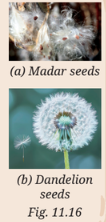
Calotropis (madar) and dandelion seeds have hair-like structures that help them float in the air. They are adapted for wind dispersal.
Q3. A farmer plants two varieties of maize side by side, but notices that seeds form only when pollen from one variety reaches the stigma of the other. What type of pollination is this?
Answer:
This is cross-pollination. The pollen from one variety is transferred to the stigma of another variety of the same species.
Q4. Why do animals with external fertilisation generally produce more eggs than animals with internal fertilisation?
Answer:
Animals with external fertilisation produce more eggs because:
- Eggs are released into the environment where many are destroyed by predators, water currents, or environmental factors.
- Producing more eggs increases the chances that at least some will be fertilised and survive.
Q5. In animals, which fertilisation method provides more protection to gametes?
Answer:
Internal fertilisation provides more protection to gametes because:
- Fertilisation occurs inside the female body, protecting gametes from external threats.
- The developing embryo is protected inside the mother or inside a shelled egg.
- Young ones have a higher chance of survival.
Q6. Ravi suddenly notices that he is growing taller rapidly, his shoulders are broadening, and his voice cracks. What stage of life is he entering?
Answer:
Ravi is entering puberty (adolescence). These are physical changes caused by hormones during the transition from childhood to adulthood.
Q7. Rina's period occurs every 28 days. Her last period was on the 5th of March. On which day is she most likely to get her next period?
Answer:
Rina's next period is most likely on 2nd April.
Calculation: 5th March + 28 days = 2nd April (assuming March has 31 days).
Q8. A human zygote has just formed. How many chromosomes does it have?
Answer:
A human zygote has 46 chromosomes (23 pairs). It receives 23 chromosomes from the sperm (father) and 23 from the egg (mother).
Q9. What protective devices can be used during sexual activity to reduce the spread of STIs?
Answer:
Condoms (male or female) are protective devices that can be used during sexual activity to reduce the spread of Sexually Transmitted Infections (STIs).
Q10. If a couple uses oral contraceptive pills but not condoms, which risks remain and why?
Answer:
If a couple uses oral contraceptive pills but not condoms, the risk of Sexually Transmitted Infections (STIs) remains because:
- Oral pills only prevent pregnancy by altering hormone levels.
- They do not provide a barrier against bacteria or viruses that cause STIs.
Q11. In many animals, the young ones can walk or find food soon after birth but human babies are completely dependent on adults for a long time. What might be some advantages and disadvantages of this for humans as a species?
Answer:
Advantages:
- Human babies receive extensive care and learning from adults.
- They develop complex social and cognitive skills.
- Parental care ensures higher survival rates.
Disadvantages:
- Parents must invest a lot of time, energy, and resources.
- Fewer offspring can be produced over a lifetime.
- Increased vulnerability during early years if caregivers are not present.
Revise, Reflect, Refine
Q1. A flower's anthers are removed before it matures. Later, pollen from another plant of the same species is dusted onto its stigma and seeds are produced. Which process has been ensured here? (i) Self-pollination (ii) Cross-pollination (iii) Fertilisation (iv) Tissue culture
Answer:
The correct option is (ii) Cross-pollination.
Explanation: Since the anthers were removed (emasculation), self-pollination was prevented. Pollen from another plant of the same species was used, ensuring cross-pollination.
Q2. Arrange the following stages of sexual reproduction in plants in the correct order: (i) Pollen germination on stigma (ii) Fertilisation (iii) Pollination (iv) Formation of zygote
Answer:
Correct order: (iii) → (i) → (ii) → (iv)
Pollination → Pollen germination on stigma → Fertilisation → Formation of zygote
Q3. Assertion (A): The zygote formed after fertilisation immediately attaches to the uterus wall. Reason (R): The uterus wall is always prepared to receive the zygote. (i) Both A and R are true, and R is the correct explanation of A. (ii) Both A and R are true, but R is not the correct explanation of A. (iii) A is true, but R is false. (iv) A is false, but R is true.
Answer:
The correct option is (iv) A is false, but R is true.
Explanation: The zygote does not immediately attach to the uterus wall – it travels to the uterus and implants after several days. The uterus wall is prepared to receive the zygote only after ovulation, not always.
Q4. Why does asexual reproduction produce offspring that are genetically identical to the parent?
Answer:
Asexual reproduction produces genetically identical offspring because:
- It involves only one parent.
- The offspring are produced by mitosis, which produces daughter cells with the same number of chromosomes as the parent.
- There is no fusion of gametes from two parents.
Q5. Explain why the menstrual cycle stops during pregnancy.
Answer:
The menstrual cycle stops during pregnancy because:
- Once fertilisation occurs and the embryo implants in the uterus, the uterine lining is maintained to support the developing foetus.
- Hormones produced during pregnancy prevent the shedding of the uterine lining.
- Menstruation would remove the lining and the embryo, so it stops to protect the pregnancy.
Q6. Why are flowers that bloom at night white or light in colour as compared to flowers that bloom during the day?
Answer:
Night-blooming flowers are white or light in colour because:
- They are pollinated by nocturnal pollinators like moths and bats.
- White or light flowers are more visible in low light conditions.
- They often have a strong fragrance to attract pollinators at night.
Q7. Why do vegetatively propagated plants tend to be more vulnerable to diseases than sexually reproduced plants?
Answer:
Vegetatively propagated plants are more vulnerable to diseases because:
- They are genetically identical (clones) – if one plant is susceptible to a disease, all are.
- There is no genetic variation to help plants resist new diseases.
- Sexually reproduced plants have genetic diversity, increasing the chance that some plants will be resistant.
Q8. If all flowers in a type of plant were only capable of self-pollination, how would it affect the genetic diversity over several generations? Explain.
Answer:
If all flowers were only capable of self-pollination:
- Genetic diversity would decrease over generations.
- Offspring would be genetically identical or very similar to the parent.
- The population would become more vulnerable to diseases and environmental changes.
- New traits would not be introduced, limiting the ability to adapt.
Q9. A farmer wants to produce a large number of genetically identical plants quickly. Suggest suitable reproduction methods and explain why they are effective.
Answer:
Suitable methods:
- Vegetative propagation – cutting, grafting, layering.
- Tissue culture – growing plants from small tissue samples.
Why effective:
- They produce genetically identical plants quickly.
- They require only one parent.
- They are faster than sexual reproduction and do not require seeds.
Q10. Suresh prepares slides with pollen grains in different sugar concentrations (0%, 2.5%, 5%, 7.5%, 10%) to study the germination of pollen. (i) What are the different hypotheses which can be tested using this set-up? (ii) What parameters should be kept the same in this set-up?
Answer:
(i) Hypotheses that can be tested:
- Pollen germination is highest at a specific sugar concentration.
- Higher sugar concentrations may inhibit pollen germination.
- Optimal sugar concentration is required for pollen tube growth.
(ii) Parameters to keep the same:
- Type of pollen grains used.
- Temperature.
- Amount of pollen on each slide.
- Time allowed for germination.
- Type of sugar used.
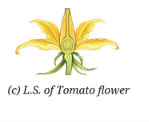
Q11. Look at the picture and find out which type(s) of pollination might have been followed in these flowers — Tomato, Wheat, Papaya. Tomato: Stamens cover the stigma. Wheat: Flowers open after pollination. Papaya: Male and female flowers are often borne on different papaya trees.
Answer:
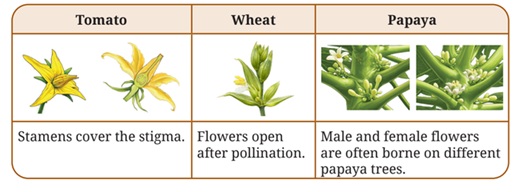
Tomato: Self-pollination – stamens cover the stigma, so pollen can fall directly onto the stigma of the same flower.
Wheat: Wind pollination – flowers open after pollination, pollen is light and carried by wind.
Papaya: Cross-pollination – male and female flowers are on different plants, so pollination must occur between plants.
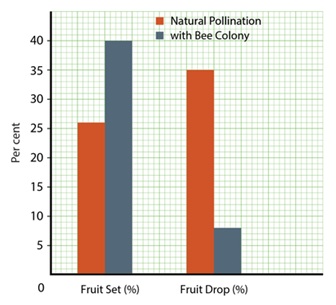
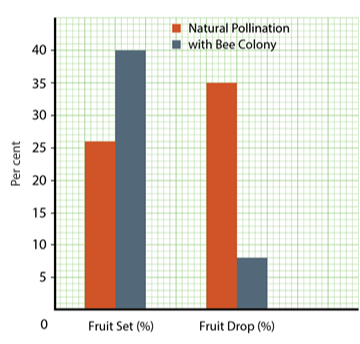
Q12. In the lower Himalayan region of northern India, apples are an important cash crop that contribute significantly to farmer's livelihoods. The fruit yield in apple cultivation is declining continuously, associated with climate change and a significant decline in the population of natural pollinators. A researcher-farmer group set up two experimental apple orchards at two distinct locations: Places A and B. In apple orchards at Place A, they allowed natural pollinators to pollinate the flowers of the apple. In apple orchards at Place B, they applied mixed farming techniques of beekeeping. Along with honey, the farmer yielded apples. The yield of apples is depicted in Fig. 11.24, in terms of fruit setting (number of fruits/the total number of corresponding fruit-bearing branches) and fruit drop (premature falling of developing fruits) in the two types of experimental places of apple orchards. (i) What are the hypotheses the researcher-farmers group has thought of for this investigation? (ii) What are the different parameters in the experiment? (iii) Compare and analyse the data of two experimental orchards Places A and B, in terms of high yields of apple fruits. (iv) Based on your analysis, what do you infer from the data?
Answer:
(i) Hypotheses:
- Beekeeping (mixed farming) increases apple fruit yield.
- Natural pollinators are insufficient for optimal apple production.
- Beekeeping reduces fruit drop and increases fruit setting.
(ii) Parameters:
- Fruit setting percentage.
- Fruit drop percentage.
- Type of pollination (natural vs beekeeping).
- Location and environmental conditions.
(iii) Comparison:
- Place B (with beekeeping) likely shows higher fruit setting and lower fruit drop compared to Place A.
- Beekeeping ensures more effective pollination and higher yields.
(iv) Inference:
- Beekeeping improves apple yield.
- Declining natural pollinator populations affect agriculture.
- Mixed farming (beekeeping + apple cultivation) is a sustainable solution.
Q13. A student claims, "In humans, ovulation always happens on day 14 of the menstrual cycle". Critically examine this claim and state whether the claim is correct or not. Give at least two reasons for your answer.
Answer:
The claim is not always correct.
Reasons:
- The menstrual cycle varies from 21 to 35 days in different women – not everyone has a 28-day cycle.
- Ovulation typically occurs about 14 days before the next period begins, not always on day 14.
- Stress, health conditions, and lifestyle can affect the timing of ovulation.
The Journey Beyond
Q1. Read about the 'Seed Village Programme' (Beej Gram Yojana) run by the Government of India. Why is it important to save indigenous seeds?
Answer:
This is a research/project activity.
Why save indigenous seeds:
- Indigenous seeds are adapted to local climate and soil conditions.
- They have natural pest resistance and require fewer chemical inputs.
- They help maintain genetic diversity in crops.
- They are climate-resilient and important for food security.
Q2. Prepare a report on IVF, its uses and drawbacks. Discuss it with your class.
Answer:
This is a research/report activity.
IVF (In-vitro Fertilisation):
- Uses: Helps couples with infertility, genetic disorders, and for fertility preservation.
- Drawbacks: Expensive, not always successful, ethical concerns, multiple pregnancies.
Q3. Conduct a survey on crop fields. Interact with farmers on the crops grown on their farms and farm animals based on the points given.
Answer:
This is a field survey activity.
Points to cover:
- Crops grown through vegetative propagation.
- Crops grown using seeds.
- Indigenous vs hybrid varieties.
- Indigenous vs hybrid breeds of farm animals.
Q4. Explore the crop fields near your school and find out different pollination strategies adopted by different cereal and vegetable crop plants.
Answer:
This is a field observation activity.
Key observations:
- Identify pollinators (bees, butterflies, wind, water).
- Record which plants they visit.
- Understand reasons for declining pollinator populations.
Q5. Assist your elders in cutting fruits in the kitchen. While cutting fruits like lady finger, tomato, brinjal, capsicum, papaya, orange, muskmelon and more, make your observations based on the following and draw diagrams — (i) When you cut a fruit longitudinally (Longitudinal Section: L.S.) (ii) When you cut a fruit transversely (Transverse Section: T.S.) (iii) Attachment of seeds Link your observations of the L.S. and T.S. of the fruit with the internal structure of the ovary of same species.
Answer:
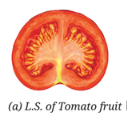
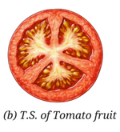
This is a practical kitchen activity.
Expected observations:
- L.S.: Shows internal structure – seed arrangement, placenta, fruit wall.
- T.S.: Shows cross-section – number of chambers (locules), seed attachment.
- Seed attachment: Seeds are attached to the placenta (ovary wall).
Link: The ovary develops into the fruit, and ovules develop into seeds.
The Quest Continues
Q1. Does a unicellular organism like amoeba or yeast ever 'grow old'? When it divides, it produces almost two identical copies. So, does aging happen at all?
Answer:
This is a thought-provoking question.
Unicellular organisms do not age in the same way as multicellular organisms because:
- They reproduce by binary fission or budding, creating new individuals.
- The parent cell essentially divides into two new cells, leaving no 'old' individual.
- Aging is associated with deterioration of tissues and organs, which unicellular organisms lack.
- However, over many generations, mutations can accumulate, affecting the population.