
Tissues in Action — Complete Q&A
Think It Over · Pause and Ponder · Revise, Reflect, Refine · The Journey Beyond · The Quest Continues · Practice Questions
Think It Over
Q1. How is the study of cells and tissues significant for understanding the life processes and human welfare?
Answer:
The study of cells and tissues is significant because:
- It helps us understand how life processes like respiration, nutrition, and reproduction occur at the cellular level.
- It forms the basis for medical advances, including understanding diseases, developing treatments, and performing organ transplants.
- It enables advances in agriculture through plant tissue culture and genetic engineering.
- It helps in understanding growth, development, and repair mechanisms in living organisms.
- Muscle tissue helps in movement, nervous tissue carries messages, xylem transports water, and phloem transports food.
- This knowledge also helps in human welfare through plant tissue culture, crop improvement, development of disease-resistant plants, stem cell therapy and treatment of blood disorders.
Q2. How are tissues in plants and animals different, and why?
Answer:
Differences between plant and animal tissues:
- Cell wall: Plant cells have a rigid cell wall for support; animal cells lack a cell wall, allowing flexibility.
- Movement: Plants are fixed and need support tissues; animals move and need flexible tissues.
- Growth pattern: Plants have meristematic tissues for lifelong growth; animals have limited growth.
- Mode of nutrition: Plants have photosynthetic tissues; animals have tissues for digestion and nutrient absorption.
- Conducting tissues: Plants have xylem and phloem for transport; animals have blood and lymph.
These differences arise because plants and animals have different lifestyles, habitats, and nutritional requirements.
Q3. How is the division of labour at various levels of organisation in multicellular organisms correlated with their structure and function?
Answer:
In multicellular organisms, division of labour occurs at different levels:
- Cells → Tissues: Similar cells group together to form tissues that perform specific functions (e.g., muscle tissue for movement).
- Tissues → Organs: Different tissues combine to form organs that perform complex functions (e.g., heart pumps blood).
- Organs → Organ Systems: Organs work together in systems (e.g., digestive system breaks down food).
- Organ Systems → Organism: All systems coordinate to maintain life.
This organisation allows efficiency, with each part structurally adapted for its specific function, making complex life processes possible.
Pause and Ponder
Q1. You may have noticed that fibres of coconut husk are hard and brittle, whereas the leaf stalks of coriander are soft and flexible. Find out the reason.
Answer:
Coconut husk fibres:
- They are made of sclerenchyma tissue.
- Sclerenchyma cells have thick walls due to lignin deposition.
- These cells are dead and provide hardness, strength, and brittleness.
Coriander leaf stalks:
- They are made of collenchyma tissue.
- Collenchyma cells have unevenly thickened corners due to pectin deposition.
- These are living cells that provide flexibility and support without breaking.
Thus, the difference in structure of these tissues explains their different properties.
Q2. Why do you think that a thick cuticle on the outer wall of epidermis is advantageous for a plant living in the desert but disadvantageous for a plant living underwater?
Answer:
For desert plants:
- A thick cuticle is advantageous because it reduces water loss through transpiration.
- It protects the plant from intense sunlight and heat.
- It prevents dehydration in dry conditions.
For underwater plants:
- A thick cuticle is disadvantageous because it would prevent the exchange of gases (oxygen and carbon dioxide) with water.
- Underwater plants already live in water, so water loss is not a concern.
- They need thin or no cuticle to allow diffusion of gases and nutrients.
Q3. Once water is absorbed by plant roots, it has to travel against gravity through xylem. How do the 'dead' cells of the xylem work together with the living cells of leaves at the top to keep the water moving?
Answer:
Mechanism of water movement in xylem:
- Transpiration pull: Water evaporates from leaves through stomata, creating a negative pressure (pull) in the leaf.
- Cohesion: Water molecules stick to each other due to hydrogen bonds (cohesion), forming a continuous column in xylem.
- Adhesion: Water molecules stick to xylem walls (adhesion), helping to resist gravity.
- Capillary action: The narrow tubes of xylem draw water upward.
- Living cells of leaves: Mesophyll cells create an osmotic gradient that draws water from xylem into leaf cells.
- Root pressure: Living root cells actively pump minerals, creating pressure that pushes water upward.
Thus, dead xylem cells provide the physical tubes, while living cells create the driving forces (transpiration and osmotic gradients).
Q4. What do you think will happen if there were no stomata in the epidermis of the stem or leaves?
Answer:
If there were no stomata in the epidermis:
- Gas exchange would stop: CO₂ could not enter for photosynthesis, and O₂ could not exit.
- Photosynthesis would stop: Without CO₂, plants could not synthesise food.
- Transpiration would not occur: Water movement through the plant would be severely reduced.
- Plants would overheat: Without transpiration, evaporative cooling would not occur.
- Nutrient transport would fail: Transpiration pull helps draw water and minerals from roots.
- The plant would eventually die due to lack of food, water, and mineral supply.
Q5. Look at the picture given below (Fig. 3.17). Carefully observe the various poses of classical and folk dances of India. Can you identify which joints are involved? Also, what type of movement does each joint allow?
Answer:
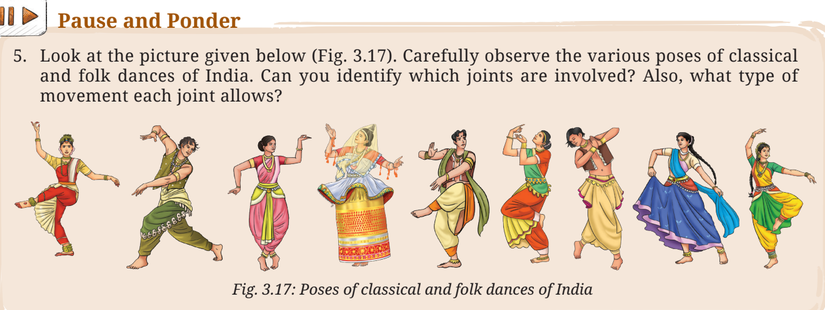
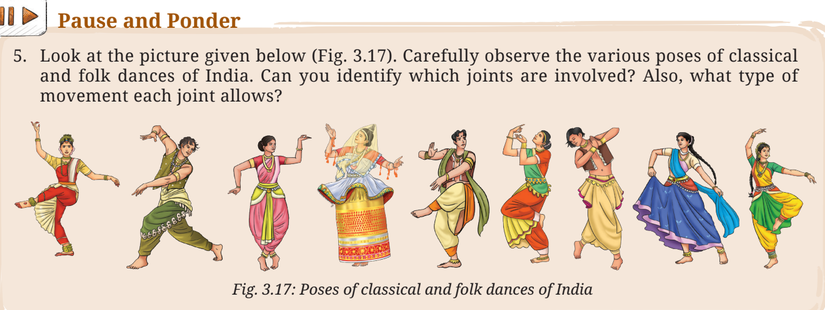
Joints involved in dance poses:
- Shoulder joint (Ball and socket): Allows arm movement in all directions — forward, backward, sideways, and circular.
- Elbow joint (Hinge): Allows bending and straightening of the arm in one direction only.
- Wrist joint (Gliding): Allows limited movement in multiple directions for hand gestures.
- Hip joint (Ball and socket): Allows leg movement in multiple directions for dance steps.
- Knee joint (Hinge): Allows bending and straightening of the leg.
- Ankle joint (Hinge with gliding): Allows up and down movement plus some sideways movement.
- Neck joint (Pivot): Allows the head to rotate side to side and tilt.
- Finger joints (Hinge and gliding): Allow fine movements for mudras (hand gestures).
Different dance forms utilise different combinations of these joints, allowing graceful and expressive movements.
Revise, Reflect, Refine
Q1. Meristematic tissues divide repeatedly. What property of their cells allows them to do this?
(i) They have thick walls for protection.
(ii) They contain large vacuoles that store nutrients.
(iii) They have thin walls, dense cytoplasm and large prominent nucleus.
(iv) They are functionally differentiated cells.
Answer:
The correct answer is (iii) They have thin walls, dense cytoplasm and large prominent nucleus.
Meristematic cells have thin cell walls that allow easy division, dense cytoplasm with many organelles for rapid metabolism, a large prominent nucleus containing genetic material, and lack vacuoles which would occupy space needed for division. This structure enables continuous and rapid cell division.
Q2. If a plant is unable to transport food from leaves to roots which tissue is malfunctioning?
(i) Xylem
(ii) Phloem
(iii) Epidermis
(iv) Sclerenchyma
Answer:
The correct answer is (ii) Phloem.
Phloem is the conducting tissue responsible for transporting food (sugars) from leaves (where photosynthesis occurs) to all other parts of the plant, including roots. If phloem is malfunctioning, food cannot reach the roots, affecting root growth and function.
Q3. Why are the epithelial tissues that line an animal's internal organs usually only one or a few cells thick?
(i) To store food efficiently.
(ii) To provide maximum strength.
(iii) To allow quick exchange of materials across them.
(iv) To reduce friction.
Answer:
The correct answer is (iii) To allow quick exchange of materials across them.
Epithelial tissues lining internal organs are thin to facilitate rapid diffusion and exchange of substances such as nutrients, gases, and waste products. For example, the thin epithelial layer in the lungs allows quick gas exchange, and in the small intestine it allows rapid nutrient absorption.
Q4. You can perform these two jumps (Fig. 3.21): Straight-leg jump – keep knees and ankles stiff. Normal jump – bend knees and ankles naturally. How did your ankle, knee and hip positions differ between the two jumps?
Answer:
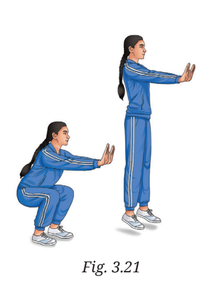
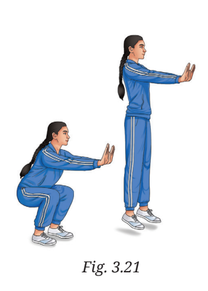
Straight-leg jump (knees and ankles stiff):
- Ankle: Remains fixed, no dorsiflexion or plantar flexion.
- Knee: Stiff and straight, no bending.
- Hip: Limited flexion, body moves upward primarily through hip extension.
- Result: Less height, more impact on joints, less power.
Normal jump (bending knees and ankles naturally):
- Ankle: Bends (dorsiflexion) on landing, extends (plantar flexion) during takeoff.
- Knee: Bends (flexion) to absorb shock on landing, straightens (extension) during takeoff.
- Hip: Bends (flexion) during preparation, extends during takeoff.
- Result: Higher jump, better shock absorption, more efficient use of muscles.
This demonstrates how joints and muscles work together for efficient movement.
Q5. Which type of joint is involved when you bend your knees and ankles?
(i) Ball and socket
(ii) Hinge
(iii) Pivot
Answer:
The correct answer is (ii) Hinge.
The knee and ankle joints are hinge joints. A hinge joint allows movement primarily in one direction — bending (flexion) and straightening (extension), similar to the opening and closing of a door hinge. The knee allows bending and straightening of the leg, while the ankle allows up and down movement of the foot.
Q6. In each of the following cases (A, B, C and D), choose the correct option as given below:
(i) Both (A) and (R) are true, and (R) is the correct explanation of (A).
(ii) Both (A) and (R) are true, but (R) is not the correct explanation of (A).
(iii) (A) is true, but (R) is false.
(iv) (A) is false, but (R) is true.
Answer:
A. (iii) (A) is true, but (R) is false.
Epithelium in the lungs is thin (single layer of flat cells) to allow rapid gas exchange. The reason states it has multiple layers of tall cells that slow diffusion, which is incorrect.
B. (i) Both (A) and (R) are true, and (R) is the correct explanation of (A).
Cardiac muscle can contract continuously without fatigue due to abundant mitochondria for ATP production and rich blood supply for oxygen and nutrients.
C. (iv) (A) is false, but (R) is true.
Tendons connect muscle to bone, not bone to bone. Ligaments connect bone to bone. The reason correctly states that tendons transmit force from muscle to bone.
D. (iii) (A) is true, but (R) is false.
Hinge joints allow movement primarily in one plane (flexion/extension). The reason is false because bone ends in hinge joints are shaped to allow movement in one direction, not sliding in all directions.
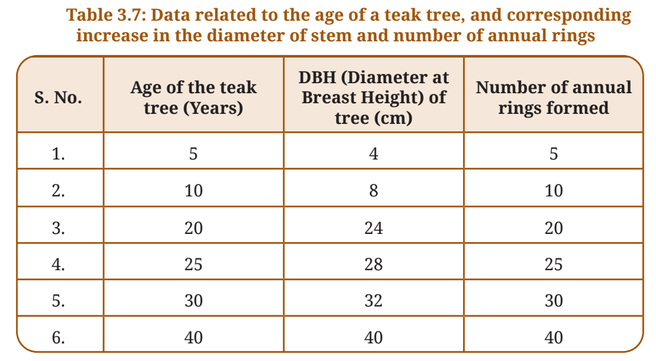
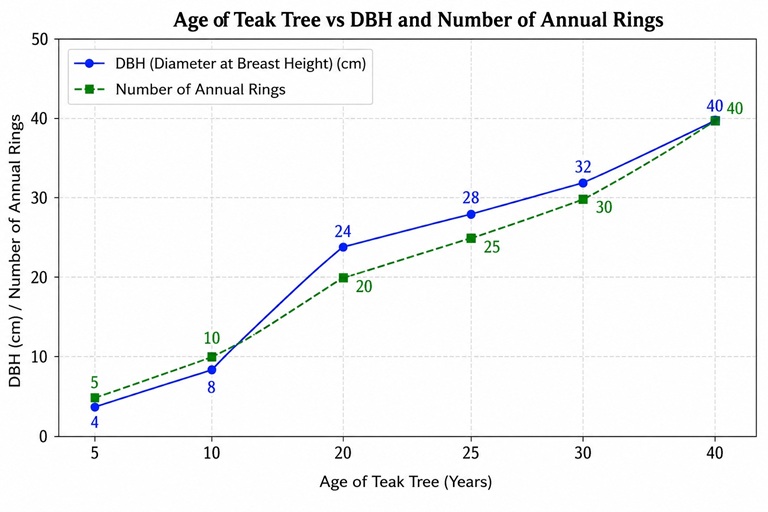
Q7. Plot a graph between the age of a tree (in years) on the x-axis and the diameter of the tree (in cm) along with the number of annual rings formed over time on the y-axis, using the data given in Table 3.7.
(i) Analyse the graph in terms of the diameter of the stem over time and share the interpretation.
(ii) What is the relation between the diameter of the teak tree to the annual rings formed?
(iii) Which specialised tissue is responsible for the girth of the stem and where is it located?
Answer:
(i) Interpretation of the graph:
- As the age of the tree increases, both the diameter of the stem (DBH) and the number of annual rings increase.
- The relationship is almost linear — older trees have larger diameters and more rings.
- The increase is gradual but shows accelerated growth between 10–20 years.
- By 40 years, the tree has a diameter of 40 cm and 40 annual rings.
(ii) Relation between diameter and annual rings:
- The diameter of the tree is directly proportional to the number of annual rings.
- Each year of growth adds one annual ring and increases the diameter.
- One annual ring (a combination of earlywood and latewood) represents one year of growth.
- The diameter can be used to estimate the age of the tree approximately.
(iii) Tissue responsible for girth:
- Lateral meristem (also called vascular cambium) is responsible for the increase in girth.
- It is located along the circumference of the stem, between the xylem and phloem.
- The lateral meristem divides and produces new cells inward (forming xylem) and outward (forming phloem), increasing the diameter.
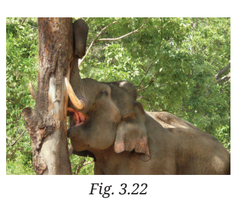
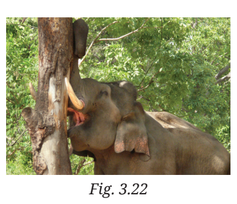
Q8. In a forest, it was observed that one of the trees was severely debarked by an elephant to meet its food requirements, as the bark is a rich source of nutrients (Fig. 3.22). Based on your learning, answer the following:
(i) Which function(s) of the tree is/are hampered by debarking?
(ii) Which plant tissue would be affected by further damage to the tree trunk even after debarking?
(iii) Which function of the tree would be hampered if the tissues beneath the bark were severely damaged?
(iv) What assumptions are you making to answer the questions above? How would the answer change if your assumptions are also changed?
Answer:
(i) Functions hampered by debarking:
- Protection: Bark protects the tree from mechanical injury, pests, and pathogens.
- Transport of food: Phloem in the bark transports food from leaves to other parts.
- Water loss prevention: Bark prevents excessive water loss.
- Insulation: Bark insulates the tree from extreme temperatures.
(ii) Tissue affected by further damage:
- Vascular cambium (lateral meristem) would be affected.
- This tissue is located just beneath the bark and is responsible for producing new xylem and phloem.
(iii) Functions hampered if tissues beneath bark are damaged:
- Transport of water and minerals: Xylem (which includes wood) would be damaged, stopping water transport.
- Transport of food: Phloem would be destroyed, stopping sugar transport.
- Increase in girth: Lateral meristem damage would prevent the tree from growing thicker.
- Overall survival: The tree would eventually die as essential transport systems fail.
(iv) Assumptions and changes:
- Assumptions made: The debarking is severe enough to remove the phloem layer; the tree has not developed any alternative transport mechanisms; the damage is extensive around the circumference.
- How answers would change with different assumptions: If only a small portion of bark is removed, the tree might survive; if the tree is young and has thin bark, damage may affect cambium sooner; some trees can heal wounds through new tissue formation if the damage is not complete; if the elephant only removes outer bark (dead cork layer) and not phloem, functions may not be severely affected.
Q9. Aamrapali observed that a young mango sapling's stem bends flexibly during monsoon winds and does not break. Which tissue is responsible for this flexibility? Predict and provide your explanation of the impact if the existing tissue was replaced by sclerenchyma.
Answer:
Tissue responsible for flexibility:
- Collenchyma is responsible for the flexibility of the young mango sapling stem.
- Collenchyma cells have unevenly thickened corners due to pectin deposition.
- These cells are living and provide flexible support, allowing the stem to bend without breaking.
- Collenchyma is commonly found in the stems of young plants and in leaf stalks.
Impact if replaced by sclerenchyma:
- Loss of flexibility: Sclerenchyma cells are dead with thick walls due to lignin deposition.
- Brittleness: The stem would become hard and brittle instead of flexible.
- Easy breakage: During monsoon winds, the stem would likely snap rather than bend.
- Stunted growth: The plant might not grow properly as the stem would not be able to sway and adjust.
- Reduced longevity: The plant would be more susceptible to wind damage and could break prematurely.
Thus, collenchyma is ideally suited for young, growing parts that need flexibility, while sclerenchyma is better for mature, hardened parts that need strength.
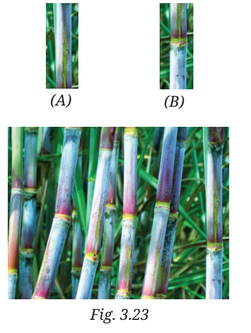
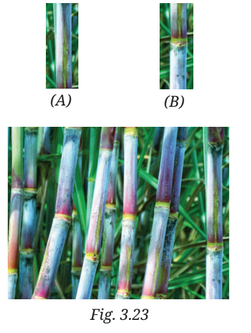
Q10. Sohan designed an experiment for the regeneration of sugarcane, where he used cuttings to grow sugarcane. He used two types of cuttings, type 'A' and type 'B' (Fig. 3.23). After a few weeks, type 'B' cuttings sprouted and developed into sugarcane plants, whereas the type 'A' cuttings did not sprout.
(i) Why were the type 'B' cuttings able to grow as sugarcane but type 'A' could not?
(ii) What difference was present in type 'B' compared to type 'A'?
(iii) What observation or measurement was made to determine whether this change had an effect?
(iv) What parameters should be kept the same for both types of cuttings to ensure a fair comparison?
Answer:
(i) Why type 'B' cuttings grew and type 'A' did not:
- Type 'B' cuttings likely contained nodes (the points on the stem where buds are present).
- Nodes have intercalary meristem that can give rise to new shoots.
- Type 'A' cuttings probably lacked nodes or had them removed.
- Sugarcane primarily grows through its nodes, which contain meristematic tissue capable of forming new roots and shoots.
(ii) Difference between type 'A' and type 'B':
- Type 'B' cuttings likely had intact nodes (where buds are present).
- Type 'A' cuttings probably lacked nodes or had them removed.
- Type 'B' also likely had sufficient stored food in the stem.
- The presence of meristematic tissue at the nodes allowed type 'B' to regenerate.
(iii) Observation/measurement made to determine the effect:
- Sprouting of new shoots from the nodes.
- Growth of roots from the base.
- Number of new shoots produced per cutting.
- Length of new shoots over a period of time.
- Count of number of nodes that produced shoots.
(iv) Parameters to keep same for fair comparison:
- Length of cuttings — both should be of the same size.
- Number of nodes — if comparing node presence/absence.
- Soil type and composition — same soil mixture.
- Watering and irrigation — same amount and schedule.
- Light exposure — same duration and intensity of sunlight.
- Temperature — same environmental conditions.
- Planting depth — same depth in the soil.
- Time period — same duration of observation.
Q11. During the discussion in class, Rohan gives a statement that, "A tissue is a group of similar cells performing similar functions". But Rajiv counter argues that, "this is true in case of simple tissues but little different in case of complex tissues". Provide your explanation in view of the discussion in class.
Answer:
Rohan's statement: A tissue is a group of similar cells performing similar functions. This is true for simple tissues.
Rajiv's argument: This definition is different for complex tissues.
Explanation:
- Simple tissues: Composed of only one type of cell. Examples: Parenchyma, collenchyma, sclerenchyma, epithelium. All cells in these tissues are similar in structure and function.
- Complex tissues: Composed of more than one type of cells working together to perform a common function. Examples: Xylem, phloem.
- Xylem: Contains tracheids, vessels, xylem fibres, and xylem parenchyma — different cells working together for water transport.
- Phloem: Contains sieve tubes, companion cells, phloem fibres, and phloem parenchyma — different cells working together for food transport.
Thus, Rohan's definition applies to simple tissues, while complex tissues have multiple cell types that coordinate to perform a specific function.
Q12. Coconut husk fibres are used for mats which are tough and fibrous. Which tissue has structural features suitable for providing this strength? Explain why living parenchyma couldn't serve the same purpose.
Answer:
Tissue providing strength to coconut husk fibres:
- Sclerenchyma tissue is responsible for the toughness of coconut husk fibres.
- Sclerenchyma cells have thick walls due to lignin deposition.
- These cells are dead at maturity, providing rigidity and strength.
- They lack protoplasm and are essentially hollow tubes with thick, lignified walls.
Why living parenchyma couldn't serve the same purpose:
- Parenchyma cells have thin cell walls made primarily of cellulose.
- They are living and contain protoplasm, which occupies space that could be used for strengthening material.
- No lignin deposition in parenchyma walls, making them soft.
- Intercellular spaces in parenchyma reduce overall strength.
- Parenchyma is meant for storage and metabolism, not for providing mechanical strength.
Thus, sclerenchyma with its thick, lignified, dead cells is structurally suited for providing the toughness and strength needed in coconut husk fibres.
Q13. Vibha claims to her friend Neha that, "Meristematic cells are located only at the root and shoot apices". What do you think about this statement? What question can Neha ask Vibha to help her understand further if the statement is incorrect?
Answer:
Assessment of Vibha's statement:
- The statement is incorrect.
- Meristematic tissues are located in three regions, not just at root and shoot apices.
Correct location of meristematic tissues:
- Apical meristem: At root and shoot tips — responsible for growth in length.
- Lateral meristem: Along the circumference of stems and roots — responsible for growth in girth.
- Intercalary meristem: At the base of internodes/nodes (e.g., in grasses) — responsible for regeneration after cutting.
Question Neha could ask Vibha:
- "What happens when you cut grass or a hedge? How do they grow back?" This question would help Vibha realise that there are meristematic tissues other than apical meristems, specifically intercalary meristems that allow regeneration.
- Alternatively, "How do tree trunks increase in thickness over time?" — leading to the discovery of lateral meristems.
Q14. A plant cell and an animal cell are of the same size.
(i) Which cell will have a larger vacuole? Give reasons.
(ii) What assumptions are you making to answer the question above?
Answer:
(i) Which cell will have a larger vacuole:
- The plant cell will have a larger vacuole.
- Plant cells typically have a single large central vacuole that occupies up to 90% of the cell volume.
- Animal cells have smaller, temporary vacuoles.
Reasons:
- Storage: Plant vacuoles store water, minerals, sugars, and waste materials.
- Turgidity: The large vacuole maintains turgor pressure, keeping plant cells firm and helping plants stay upright.
- Support: The vacuole provides structural support to plant cells in the absence of skeletal systems.
- Waste disposal: Plant vacuoles store waste products that cannot be easily excreted.
(ii) Assumptions made:
- The plant cell is a typical parenchyma cell (not a young meristematic cell with small vacuoles).
- The animal cell is a typical somatic cell (not a specialised cell like an adipocyte with large lipid vacuoles).
- Both cells are mature and fully functional.
- The plant cell is from a tissue that requires turgidity (e.g., leaf mesophyll, root cortex).
- Both cells are observed under normal, healthy conditions.
If these assumptions change (e.g., if the plant cell is a meristematic cell with small vacuoles, or the animal cell is an adipocyte with large lipid vacuoles), the answer could differ.
Q15. A textbook states, "Each plant tissue performs only one specific function". What questions would you ask to critically examine the correctness of this statement? What examples of tissues would you take to find out the answers to these questions?
Answer:
Critical examination questions:
- "Does parenchyma perform only one function?" — No, it performs storage, photosynthesis, and provides buoyancy.
- "Does the epidermis perform only protection?" — It also helps in absorption (root hairs), gas exchange (stomata), and reduces water loss.
- "Is xylem only for water transport?" — It also provides mechanical strength to the plant.
- "Is phloem only for food transport?" — It also provides some support and stores food in some plants.
- "Can the same tissue perform different functions in different parts of the plant?"
- "Are there tissues that perform multiple functions?"
Examples of tissues with multiple functions:
- Parenchyma: Storage of food, photosynthesis (chlorenchyma), buoyancy (aerenchyma), secretion.
- Epidermis: Protection, absorption (root hairs), gaseous exchange (stomata), reducing water loss (cuticle).
- Xylem: Water transport, mineral transport, mechanical strength.
- Phloem: Food transport, storage (phloem parenchyma), some support (phloem fibres).
- Collenchyma: Support, flexibility, and in some cases photosynthesis.
Conclusion: The statement "each plant tissue performs only one specific function" is not entirely correct. Most plant tissues perform multiple functions, though one function may be primary.
The Journey Beyond
Q1. Visit a doctor and find out what happens in ligament rupture, cartilage rupture and fracture of bones. How can we reduce the risk by changing our lifestyle and nutritional balance?
Answer:
Ligament rupture: Ligaments connect bone to bone. When ruptured, it causes joint instability, pain, and swelling. Treatment may require rest, immobilisation, or surgery.
Cartilage rupture: Cartilage cushions bone ends. Rupture causes joint pain, stiffness, and reduced mobility. It may lead to osteoarthritis if not managed.
Bone fracture: A break in bone tissue. Causes pain, swelling, and loss of function. Treatment involves immobilisation (cast) or surgery with pins/plates.
Risk reduction through lifestyle:
- Regular exercise: Strengthens bones and muscles, improves joint flexibility.
- Proper posture: Reduces strain on bones and joints.
- Avoiding high-impact activities: Reduces risk of fractures and joint injuries.
- Maintaining healthy weight: Reduces stress on joints, especially knees and hips.
Nutritional balance:
- Calcium: For strong bones — dairy products, leafy greens, fortified foods.
- Vitamin D: For calcium absorption — sunlight exposure, fish, eggs.
- Vitamin C: For collagen formation — citrus fruits, bell peppers.
- Protein: For muscle and tissue repair — lean meats, legumes, nuts.
- Omega-3 fatty acids: For joint health — fish oil, flaxseeds.
- Magnesium: For bone health — nuts, seeds, whole grains.
Q2. Perform the following activity.
(i) Sit with your feet flat on the floor.
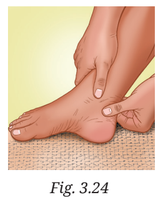
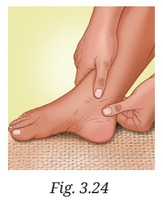
(ii) Place your fingers on the back of your ankle just above the heel (Fig. 3.24).
(iii) Point your toes down and up, and you will feel the tendon moving. Tendons are designed to withstand huge pulling forces. Try exploring other tendons in your body around the different joints.
Answer:
This is an experiential activity:
What you would feel: When you point your toes down (plantar flexion), you can feel the Achilles tendon (calcaneal tendon) moving. This tendon connects your calf muscles to your heel bone and is one of the strongest tendons in the body.
Other tendons to explore:
- Behind the knee: Hamstring tendons — feel them when you straighten your leg.
- Wrist: Flexor and extensor tendons — feel them when you bend your wrist up and down.
- Shoulder: Rotator cuff tendons — feel the shoulder joint when you rotate your arm.
- Fingers: Flexor tendons — feel them on the palm side when you make a fist.
Key learning: Tendons are tough, flexible bands of connective tissue designed to withstand strong pulling forces. They transmit force from muscles to bones, enabling movement.
Q3. Reflect on any of the physical practices you are familiar with, such as yoga, kabaddi, etc. How would it support bone and muscle health?
Answer:
Yoga for bone and muscle health:
- Improves flexibility: Stretches muscles and keeps joints supple.
- Strengthens bones: Weight-bearing poses increase bone density.
- Builds muscle: Isometric contractions strengthen muscle fibres.
- Improves posture: Spinal alignment reduces strain on bones and muscles.
- Reduces stress: Lowers cortisol levels, which can weaken bones.
Kabaddi for bone and muscle health:
- Cardiovascular fitness: Improves heart health and oxygen delivery.
- Muscle strength: Stops, starts, and tackles build muscle power.
- Bone density: Impact movements strengthen bones.
- Agility and coordination: Improves neuromuscular control.
- Joint health: Range of motion exercises keep joints healthy.
Q4. Reflect on any gardening methods you know, such as pruning, grafting, irrigation or crop rotation. How does each practice support the healthy functioning of plant tissues like meristems, conducting tissues or supporting tissues?
Answer:
Pruning:
- Removes dead or diseased branches, promoting growth of new shoots.
- Stimulates intercalary meristems at nodes to produce new branches.
- Improves air circulation, reducing disease in supporting tissues.
Grafting:
- Joins two plant parts so they grow as one.
- Cambium (lateral meristem) of both parts must align for successful union.
- Allows combining desired traits (e.g., disease resistance from rootstock, fruit quality from scion).
Irrigation:
- Provides water needed for conducting tissues (xylem) to transport nutrients.
- Maintains turgor pressure in cells, keeping plants firm.
- Supports phloem function by maintaining proper osmotic balance.
Crop rotation:
- Prevents soil nutrient depletion, ensuring meristematic tissues have nutrients for growth.
- Reduces pest and disease buildup, protecting all plant tissues.
- Different plants have different root depths, improving soil structure.
Q5. Turn a nature walk into a research project.
(i) Observe different leaves and study their adaptations for various environments, such as desert, very moist or aquatic habitats.
(ii) Consult an elder community resource persons about their knowledge on different plant leaves, such as leaves that remain fresh for a long time, repel water or deter insects. Find out their traditional uses, such as making plates, preparing cooling wraps or functioning as insect repellents.
Answer:
(i) Leaf adaptations to different environments:
- Desert plants (xerophytes): Small, thick leaves with thick cuticle, reduced stomata, or spines (modified leaves) to reduce water loss. Example: Cactus.
- Moist/humid plants (hydrophytes): Large, thin leaves with many stomata for rapid gas exchange and transpiration. Example: Banana.
- Aquatic plants: Leaves may be submerged (thin, ribbon-like with no cuticle) or floating (broad, waxy upper surface, stomata only on upper surface). Example: Water lily.
(ii) Traditional uses of leaves:
- Long-lasting leaves: Palmyra palm leaves — used for making mats, baskets, thatch, and writing material.
- Water-repellent leaves: Lotus leaves — inspire self-cleaning surfaces (lotus effect), used for wrapping food.
- Insect-repellent leaves: Neem leaves — used as natural insect repellent, stored with grains to prevent pests.
- Cooling leaves: Khus (vetiver) leaves — used to make cooling mats and screens.
- Plate-making leaves: Banana leaves (large, waterproof) — used as plates in many parts of India.
- Medicinal leaves: Tulsi (basil), neem, and turmeric leaves — used in traditional medicine.
Traditional knowledge about plant tissues (epidermis, cuticle, mesophyll) helps us understand how these adaptations work.
Q6. Study various dance forms of different tribal communities across the country. Each student learn and experience at least five steps. Observe the joint movements involved in performing these steps and then develop a dance or drama on the concept of joint movements. Perform this at the school's annual function so that students from different grades can learn from it.
Answer:
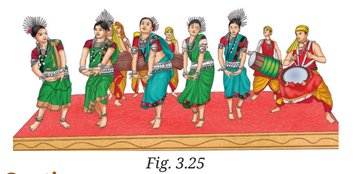
This is an experiential project activity.
Steps to follow:
- Research: Study different tribal dance forms from various regions of India.
- Learn: Learn at least five steps from these dance forms.
- Observe: Identify which joints are involved in each step.
- Create: Develop a dance/drama that demonstrates joint movements.
- Perform: Present at school annual function.
Joint movements to observe:
- Shoulder joint (ball and socket): Used in arm movements and gestures.
- Elbow joint (hinge): Used in bending and straightening of arms.
- Wrist joint (gliding): Used in hand gestures.
- Hip joint (ball and socket): Used in leg movements and body bends.
- Knee joint (hinge): Used in bending and squatting.
- Ankle joint (hinge): Used in footwork.
- Neck joint (pivot): Used in head movements.
- Spine (gliding): Used in torso bends and twists.
Learning outcome: Students will understand the structure and function of different joints through practical experience, making the chapter concepts more meaningful.
Q7. The Quest Continues…… Will it be possible to obtain a complete animal from an animal cell like plants? If yes, what would be the advantages and challenges of this development?
Answer:
Yes, it is possible to obtain a complete animal from a single animal cell — this process is called animal cloning. The first successful example was Dolly the sheep (1996), created using somatic cell nuclear transfer (SCNT).
In SCNT, the nucleus from a somatic (body) cell is transferred into an enucleated egg cell (an egg with its own nucleus removed). The egg is then stimulated to divide and develop into an embryo, which is implanted into a surrogate mother. The resulting offspring is a genetic clone of the animal that provided the nucleus.
Advantages:
- Medical & Scientific: Disease research, gene therapy, organ transplantation.
- Agriculture & Conservation: Preserve superior traits, endangered species, genetic uniformity.
Challenges:
- Technical & Biological: Low success rate, health issues, telomere shortening.
- Ethical & Social: Animal welfare, loss of genetic diversity, human cloning concerns, high cost.
Conclusion: While cloning is a scientific reality, it is not yet practical or ethical for widespread use.
Practice Questions
Multiple Choice Questions
1. The place where two bones meet is called a:
(a) Muscle (b) Ligament (c) Joint (d) Tendon
Answer: (c) Joint
2. Which nutrient is essential for strong bones?
(a) Vitamin C (b) Calcium (c) Iron (d) Iodine
Answer: (b) Calcium
3. The bone that protects the brain is the:
(a) Rib cage (b) Skull (c) Vertebral column (d) Femur
Answer: (b) Skull
4. All the xylem elements are dead except:
(a) xylem fibre (b) xylem parenchyma (c) tracheid (d) vessels
Answer: (b) xylem parenchyma
5. The body weight contributed by muscles in human males:
(a) 0% (b) 40–50% (c) 10% (d) 100%
Answer: (b) 40–50%
6. "X" is a fluid connective tissue having matrix "Y". Y contains protein, salt and hormones while X transports gases, digested food, hormones and waste materials to different parts of the body. X and Y respectively are:
(a) plasma and blood (b) plasma and erythrocyte (c) blood and plasma (d) erythrocytes and leucocytes
Answer: (c) blood and plasma
Assertion–Reason Questions (Q7–Q10)
Direction: In the following questions, two statements are given — one labelled Assertion (A) and the other labelled Reason (R). Select the correct answer from the codes (a), (b), (c), (d) as given below:
(a) Both A and R are correct and R is the correct explanation of A.
(b) Both A and R are correct but R is not the correct explanation of A.
(c) A is true but R is false.
(d) A is false but R is true.
7. Assertion (A): Permanent tissues are derived from meristematic tissues once they lose the ability to divide.
Reason (R): Meristematic tissue is the dividing tissue present in the growing regions of the plant.
Answer: (a) Both are correct and R explains A.
8. Assertion (A): Both apical meristem and intercalary meristems are permanent tissue.
Reason (R): Apical meristem is present at root and shoot tips.
Answer: (d) A is false but R is true. (Apical and intercalary meristems are meristematic, not permanent.)
9. Assertion (A): A simple tissue is made of only one type of cell.
Reason (R): Various simple tissues in plants are parenchyma, collenchyma and sclerenchyma.
Answer: (b) Both are correct but R is not the correct explanation of A.
10. Assertion (A): Tendons connect muscles to bones.
Reason (R): Tendons are connective tissue having hard and rigid structure providing strength, support and protection.
Answer: (c) A is true but R is false. (Tendons are tough but not hard and rigid like bone; they are flexible.)
Note: All questions from Think It Over, Pause and Ponder, Revise, Reflect, Refine, The Journey Beyond, The Quest Continues and Practice Questions are covered. Images are centred and embedded. Inline styles only — TinyMCE compatible.