
Sound Waves: Characteristics and Applications — Complete Q&A
Think It Over · Pause and Ponder · Threads of Curiosity · What If · Revise, Reflect and Refine
Think It Over
Q1. (i) Two astronauts are repairing the arm of a space station together during a spacewalk. Can they talk to each other and hear the sounds of metal clanking as they do on the Earth? (ii) How do most bats use sound to locate their prey in the dark at night?
Answer:
- No, astronauts on a spacewalk cannot talk to each other or hear sounds like metal clanking as they would on Earth. This is because there is a near-vacuum in outer space, and sound cannot propagate without a medium. Sound needs a material medium (like air, water, or solid) to travel.
- Most bats use echolocation to locate their prey in the dark. They emit short bursts of ultrasonic waves that reflect off objects and prey. By sensing the returning echoes, the bat can determine the position, distance, and even the size and shape of its prey and obstacles. This ability to locate objects using reflected sound waves is called echolocation.
Pause and Ponder
Q1. Explore various ways of producing sound. Make a list of different types of musical instruments and identify their vibrating parts which produce sound.
Answer:
Sound can be produced by various vibrating objects, including:
- Striking or hitting objects: e.g., tabla, drum, gong, doorbell, cymbals. The vibrating part is the surface that is struck.
- Plucking or strumming: e.g., guitar, sitar, veena, violin. The vibrating part is the string.
- Blowing air: e.g., flute, shehnai, trumpet. The vibrating part is the air column inside the instrument.
- Shaking: e.g., tambourine, maracas. The vibrating part is the surface or the beads inside.
- Rubbing: e.g., a violin bow on strings. The vibrating part is the string.
Other examples include human vocal cords (vibrating flaps in the larynx) and a tuning fork (vibrating prongs). The object that produces sound is called its 'source'.
Q2. Assertion (A): We cannot hear the sound of a bell ringing in a closed jar after most of the air is pumped out. Reason (R): Sound requires a medium to travel. Choose the correct statement: (i) Both A and R are true, but R is not the correct explanation of A. (ii) Both A and R are true, and R is the correct explanation of A. (iii) A is true, but R is false. (iv) A is false, but R is true.
Answer:
The correct statement is (ii) Both A and R are true, and R is the correct explanation of A.
In the vacuum bell jar experiment, as air is removed, the sound of the bell becomes faint and eventually cannot be heard, even though the bell is still ringing. This is because the air (medium) that carries the sound waves to our ears is removed. Sound cannot travel through a vacuum. Therefore, the reason (R) correctly explains the assertion (A).
Q3. Assertion (A): Compressions and rarefactions move through the medium. Reason (R): Individual particles of the medium continuously move forward with the wave. Choose the correct statement: (i) Both A and R are true, but R is not the correct explanation of A. (ii) Both A and R are true, and R is the correct explanation of A. (iii) A is true, but R is false. (iv) A is false, but R is true.
Answer:
The correct statement is (iii) A is true, but R is false.
Compressions and rarefactions are disturbances that move (propagate) through a medium, carrying energy. However, the individual particles of the medium do not move forward with the wave. They only oscillate or vibrate about their mean positions. The disturbance (compression and rarefaction) is passed on through collisions from one particle to the next, but the particles themselves do not travel with the wave. Therefore, the assertion is true, but the reason is false.
Q4. When sound travels from a tuning fork to your ear, which of the following actually reaches your ear? (i) Air particles near the tuning fork (ii) Energy carried by sound waves (iii) The tuning fork material (iv) A continuous stream of compressed air
Answer:
The correct answer is (ii) Energy carried by sound waves.
When a tuning fork vibrates, it transfers its energy to the particles of the surrounding medium (air). These particles vibrate and pass the energy to their neighbours in the form of a sound wave (compressions and rarefactions). The air particles themselves do not travel from the tuning fork to your ear; they only oscillate about their mean positions. It is the energy carried by the wave that travels and reaches your ear, causing your eardrum to vibrate and enabling you to hear the sound.
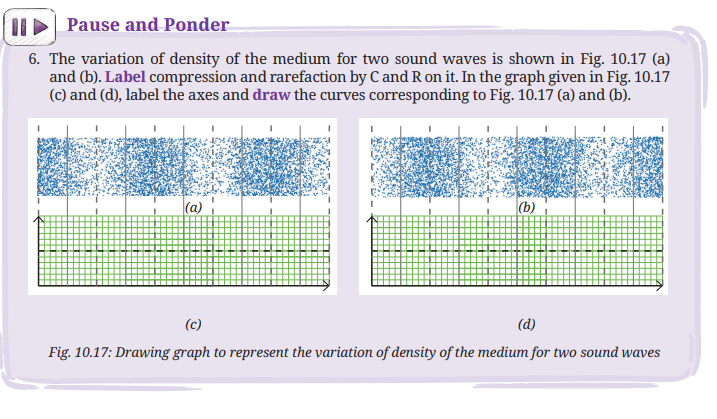
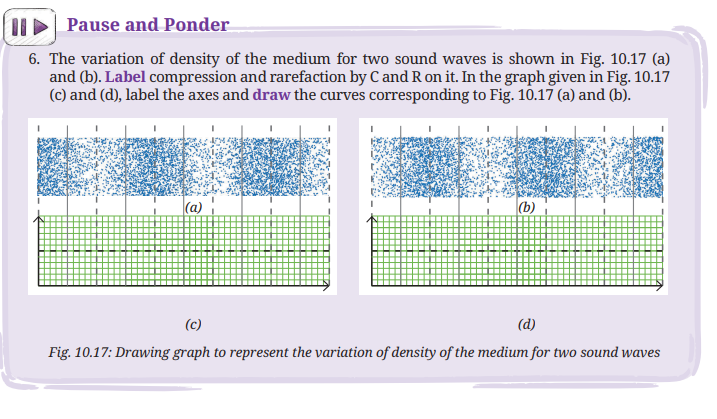
Q5. The variation of density of the medium for two sound waves is shown in Fig. 10.17 (a) and (b). Label compression and rarefaction by C and R on it. In the graph given in Fig. 10.17 (c) and (d), label the axes and draw the curves corresponding to Fig. 10.17 (a) and (b).
Answer:
The task in this question requires labelling diagrams, which cannot be fully represented in text. However, the solution can be described as follows:
For Fig. 10.17 (a) and (b), the regions where the dots are closer together represent compressions (C), and the regions where they are farther apart represent rarefactions (R).
For the graph in Fig. 10.17 (c) and (d), the X-axis should be labelled 'Distance' and the Y-axis should be labelled 'Density'. The curves will represent the variation of density with distance. The crests (high points) on the graph correspond to compressions (C), and the troughs (low points) correspond to rarefactions (R). The curve for Fig. 10.17 (c) will have a larger amplitude (greater density changes) compared to the curve for Fig. 10.17 (d).
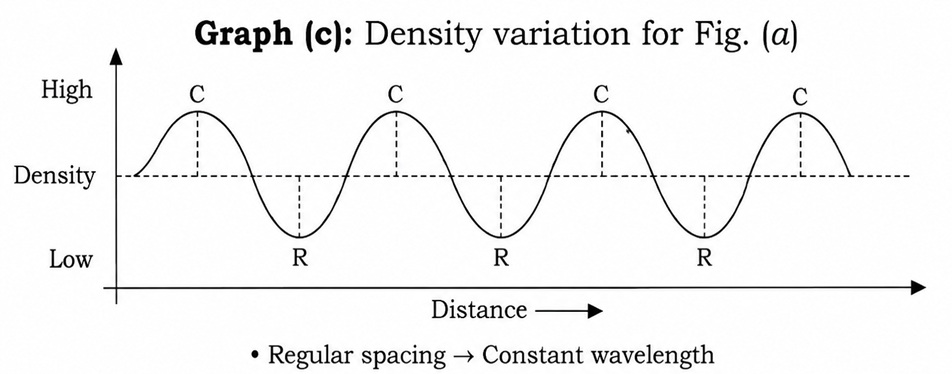
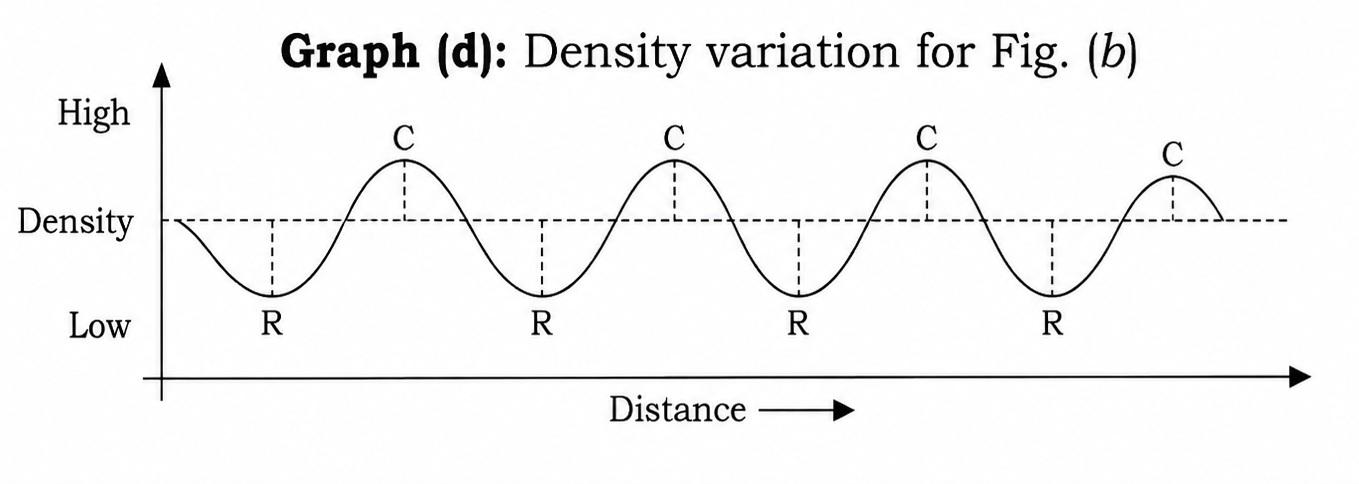
C = compressions; density increases | R = Rarefactions; density decreases
Q6. Conduct Activity 10.1 once again with a thick rubber band and then with a thin rubber band. Does the thin rubber band vibrate faster than the thick rubber band? If yes, how do the frequency and time period of the sound produced by the thin rubber band differ from that of the thick rubber band?
Answer:
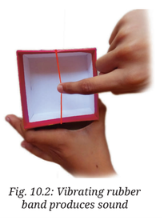
Yes, a thin rubber band generally vibrates faster than a thick rubber band.
A faster vibration means a higher frequency. Therefore, the sound produced by the thin rubber band has a higher frequency than the sound produced by the thick rubber band. Since frequency and time period are inversely related (T = 1/ν), the sound produced by the thin rubber band has a shorter time period compared to the sound produced by the thick rubber band.
In simpler terms, the thin rubber band produces a sound with a higher pitch (shrillness) due to its higher frequency, while the thick rubber band produces a sound with a lower pitch.
Q7. If the frequency of a sound wave produced by an oscillating piston of a long tube filled with air is 20 Hz, then how many oscillations does the piston complete per minute?
Answer:
Frequency is defined as the number of oscillations per second. A frequency of 20 Hz means the piston completes 20 oscillations in 1 second.
To find the number of oscillations in 1 minute (60 seconds), we multiply the frequency by the time:
Oscillations per minute = Frequency × Time (in seconds) = 20 Hz × 60 s = 1200 oscillations.
Therefore, the piston completes 1200 oscillations per minute.
Q8. For the sound wave represented by the graph shown in Fig. 10.19, what is half of its wavelength?
Answer:
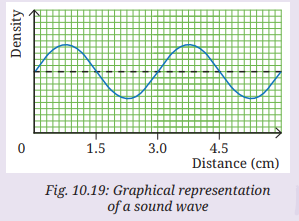
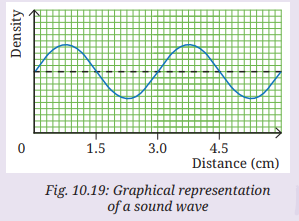
The solution depends on the graphical representation of the sound wave (Fig. 10.19). Wavelength (λ) is the distance between two consecutive crests (or troughs). By measuring the distance between two consecutive crests on the given graph, you can find the wavelength. Half of the wavelength is λ/2.
Q9. Table 10.1 shows the speed of sound in a few media at atmospheric pressure. Compare the speeds in different media by finding the ratio of (i) the speed of sound in water with respect to the speed in the air. (ii) the speed of sound in steel with respect to the speed in the water.
Answer:
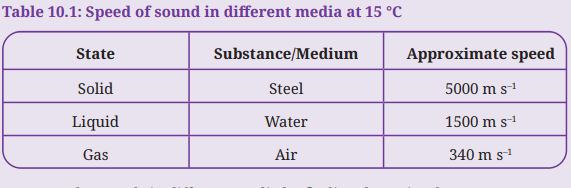
From Table 10.1, the speed of sound in air is 340 m/s, in water is 1500 m/s, and in steel is 5000 m/s.
(i) Ratio of speed in water to speed in air = Speed in water / Speed in air = 1500 m/s / 340 m/s ≈ 4.4. Sound travels about 4.4 times faster in water than in air.
(ii) Ratio of speed in steel to speed in water = Speed in steel / Speed in water = 5000 m/s / 1500 m/s ≈ 3.3. Sound travels about 3.3 times faster in steel than in water.
Q10. Two friends are standing along a steel fence at a distance of 340 m from each other (Fig. 10.23). Gunjan places her ear over the fence and her friend knocks the fence with a metal object. Using the values of the speed of sound in steel and air given in Table 10.1, calculate the time difference between the sound that reached Gunjan through the air and the steel. Would it have been possible for her to distinguish between the two sounds? (The time interval between two sounds must be at least 0.1 s to be heard separately.)
Answer:
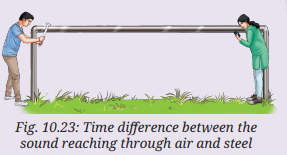
Given:
- Distance between the two friends, d = 340 m
- Speed of sound in air, vair = 340 m/s (from Table 10.1)
- Speed of sound in steel, vsteel = 5000 m/s (from Table 10.1)
Step 1: Calculate the time taken for sound to travel through air.
Timeair = Distance / Speedair = 340 m / 340 m/s = 1.0 s
Step 2: Calculate the time taken for sound to travel through steel.
Timesteel = Distance / Speedsteel = 340 m / 5000 m/s = 0.068 s
Step 3: Calculate the time difference.
Time difference = Timeair - Timesteel = 1.0 s - 0.068 s = 0.932 s
Step 4: Determine if the sounds can be distinguished.
Since the time difference (0.932 s) is greater than the minimum required time difference of 0.1 s, Gunjan would be able to hear the two sounds separately.
Q11. An experiment is being set up that requires echoes to arrive at least 0.2 s after the emission of sound. What minimum distance should a reflecting surface be placed at? Assume the speed of sound to be 343 m/s.
Answer:
Given:
- Time interval between the emission of sound and the arrival of echo, t = 0.2 s
- Speed of sound in air, v = 343 m/s
The sound must travel from the source to the reflecting surface and back to the listener, so the total distance travelled by the sound is twice the distance from the source to the reflecting surface (d).
Total distance = v × t = 343 m/s × 0.2 s = 68.6 m
Therefore, the minimum distance of the reflecting surface (d) = Total distance / 2 = 68.6 m / 2 = 34.3 m
The reflecting surface should be placed at a minimum distance of 34.3 m from the source.
Q12. Sound travels much farther in water than light, and thus, is used for various underwater applications. A sonar signal sent to find the depth of ocean takes 4 s to return. What is the depth of the ocean at that location if the speed of sound in seawater is 1500 m/s?
Answer:
Given:
- Time for the sonar signal to go to the bottom and return, t = 4 s
- Speed of sound in seawater, v = 1500 m/s
The sonar signal travels down to the ocean floor and back up to the ship. So, the total distance travelled by the signal is twice the depth (d) of the ocean at that point.
Total distance = v × t = 1500 m/s × 4 s = 6000 m
Depth of the ocean, d = Total distance / 2 = 6000 m / 2 = 3000 m
The depth of the ocean at that location is 3000 m (or 3 km).
Threads of Curiosity
Q1. How do humans and animals create sound?
Answer:
In humans, sound is produced by the vibration of vocal cords, which are tightly stretched muscular flaps located inside the voice box or larynx in the throat. The tongue, lips, mouth, and nasal cavity help convert the basic sound into speech or music.
Some animals produce sound by striking or rubbing certain body parts. For example, grasshoppers and crickets rub their wings or legs to produce sound. Bats use their larynx to produce ultrasonic waves. Many other animals, like birds, use a syrinx (a vocal organ) to produce sound.
Q2. What causes sudden loud sounds, such as when firecrackers explode or during a clap of thunder?
Answer:
These sounds are produced when air or gases are heated rapidly, causing them to expand very quickly in a short time. This rapid expansion creates a sudden disturbance in the air density, which travels outward as a loud sound pulse. When this disturbance reaches our ears, we perceive it as a sudden loud sound.
A similar but more complex disturbance is produced when a supersonic aircraft flies at a speed higher than the speed of sound, creating a loud sound known as a sonic boom.
Q3. There are some free apps which can be used by the teacher to produce as well as identify the sounds of different frequencies. Phyphox is one such app. In fact, using the 'Audio Scope' in the Phyphox app and whistling carefully will often produce a graph like Fig. 10.18 indicating that it is almost a single frequency sound.
Answer:
This is a practical activity. The solution involves:
- Downloading and using the Phyphox app (or similar sound analysis apps).
- Using the 'Audio Scope' or 'Audio Spectrum' feature to produce and observe sound waves in real-time.
- Whistling carefully to produce a sound close to a single frequency, which will appear as a clean sine wave pattern on the graph.
- Observing how different sounds produce different wave patterns and frequencies.
This demonstrates that a pure tone (like a whistle or tuning fork) is a sound of a single frequency, which can be graphically represented.
Q4. Everyone's voice sounds unique and you can often instantly recognise your teacher or friends calling out your name. Why do our voices sound different?
Answer:
Everyone's voice sounds unique because it is shaped by the throat, mouth, and nasal cavities in addition to the vocal cords. The frequency of the sound produced by the vocal cords is the fundamental pitch, but the overtones and the way the sound is shaped by the vocal tract give each voice its unique character or 'timbre'.
During adolescence, boys' vocal cords lengthen and thicken, vibrating less frequently, which 'deepens' their voice. Similarly, women and children typically have shorter and thinner vocal cords, which vibrate at higher frequencies, resulting in higher-pitched voices. The unique combination of these factors makes each person's voice distinct.
Q5. A tone is a sound of a single frequency like that produced by a tuning fork or by oral whistling. A musical note like the sound produced by plucking a tanpura string or singing is a combination of a lowest frequency called the fundamental and higher frequencies called overtones, which together create a rich and pleasant sound. Indian string instruments like the sarangi, sitar, and veena often use extra strings to enrich this combination. Even when different instruments like a flute, ektara, or tabla play the same note at the same loudness each sounds unique. This quality is called timbre, and comes from their shape, material and construction, which determine the pattern and intensity of the overtones. An octave is the interval between two notes where one has double the frequency of the other (for example, 200 Hz and 400 Hz), measured between their fundamental frequencies.
Answer:
This is an informative 'Threads of Curiosity' text explaining the concepts of tone, musical notes, fundamental frequency, overtones, timbre, and octave.
- Tone: A sound of a single frequency (e.g., tuning fork).
- Musical Note: A combination of a fundamental frequency (the lowest) and its overtones (higher frequencies). This combination creates a rich and pleasant sound.
- Timbre: The quality that makes different instruments sound unique even when playing the same note at the same loudness. It depends on the pattern and intensity of overtones, which is determined by the instrument's shape, material, and construction.
- Octave: The interval between two notes where one has double the frequency of the other (e.g., 200 Hz and 400 Hz).
Q6. Indian drums like the tabla or mridangam have a black patch at the centre of the drum head membrane called the syaahi. This patch alters the vibration of the membrane, allowing these instruments to produce a rich variety of sounds. The syaahi also gives a level of tonal control rarely found in other drums.
Answer:

This is an informative 'Threads of Curiosity' text explaining the role of the 'syaahi' in Indian percussion instruments like the tabla and mridangam.
The syaahi is a black patch at the centre of the drum head. It alters the vibration of the membrane, allowing the instrument to produce a rich variety of sounds and a level of tonal control rarely found in other drums. This contributes to the unique and complex sound of these instruments.
What If
Q1. What if your name were a tune instead of a word? In Kongthong, a village near Shillong in Meghalaya also known as the Whistling Village every person has a 'tune name' that can be sung or whistled. This unique tradition, called Jingrwai Iawbei, begins at birth when a mother composes a lullaby-like tune for her child.
Answer:
This is an interesting cultural fact mentioned in the chapter. It highlights how sound and music are deeply integrated into human societies in unique ways. The tradition of Kongthong village shows that sound can be used not just for communication, but also as a form of identity and cultural expression. Each person having a unique musical 'tune name' is a beautiful example of how sound can be personalized and meaningful beyond words.
Revise, Reflect and Refine
Q1. Which observation best supports the idea that sound is a mechanical wave? (i) Sound shows reflection (ii) Sound needs a medium to propagate (iii) Sound has frequency (iv) Sound carries energy
Answer:
The correct answer is (ii) Sound needs a medium to propagate.
A mechanical wave is a wave that requires a material medium to propagate. Sound cannot travel through a vacuum, as demonstrated by the vacuum bell jar experiment. This is the defining characteristic of a mechanical wave. While reflection, frequency, and energy are also properties of sound, they are not unique to mechanical waves (e.g., light is a transverse wave that reflects and carries energy but does not need a medium).
Q2. For a sound wave propagating in a medium, increasing its frequency will increase its (i) wavelength (ii) speed (iii) number of compressions per second (iv) time period
Answer:
The correct answer is (iii) number of compressions per second.
Frequency is defined as the number of complete oscillations (or density variations) per unit time. An increase in frequency means more compressions (and rarefactions) pass a point in the medium per second. The speed of sound depends on the medium, not the frequency. Wavelength is inversely proportional to frequency (v = fλ), so increasing frequency decreases wavelength. Time period (T = 1/f) is inversely proportional to frequency, so it decreases when frequency increases.
Q3. If 20 compressions pass a point in 4 seconds, the frequency is (i) 80 Hz (ii) 5 Hz (iii) 10 Hz (iv) 0.2 Hz
Answer:
The correct answer is (ii) 5 Hz.
Frequency is the number of waves (or compressions) passing a point per second. In 4 seconds, 20 compressions pass.
Frequency (ν) = Number of compressions / Time taken = 20 / 4 s = 5 s-1 = 5 Hz
Q4. In a room, the reflected sound reaches the ear 0.05 s after its production. Will it produce an echo or reverberation? Justify your answer.
Answer:
It will produce a reverberation.
An echo is heard when the reflected sound reaches the ear after a time delay of at least 0.1 s, allowing the brain to distinguish it from the original sound. If the reflected sound reaches the ear within less than 0.1 s, it blends with the original sound, causing a prolongation of the sound known as reverberation.
In this case, the reflected sound arrives after only 0.05 s, which is less than 0.1 s. Therefore, it will not produce a distinct echo; instead, it will cause reverberation.
Q5. Graphs representing two sound waves are given in Fig. 10.30. If the scales on the X and Y axes of the two graphs are the same, which of the two sound waves has (i) greater wavelength, and (ii) smaller amplitude?
Answer:
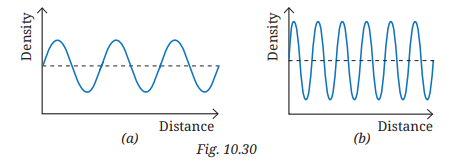
The solution depends on the graphical representation of the two sound waves (Fig. 10.30).
(i) Greater wavelength: The wave that has a larger distance between two consecutive crests (or troughs) has the greater wavelength. Wave (a) has the greater wavelength.
(ii) Smaller amplitude: The wave that has a smaller vertical distance from the mean position to the crest (or trough) has the smaller amplitude. Wave (a) has the smaller amplitude.
Q6. The sound waves emitted by three sources A, B and C are represented in Fig. 10.31. If the frequency of A is maximum and C is minimum, identify the corresponding curves, and mark A, B and C on them.
Answer:
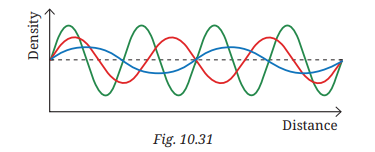
Frequency corresponds to how closely packed the wave cycles are within a given distance. The wave with the shortest wavelength (most number of crests in a given distance) has the highest frequency, and the wave with the longest wavelength has the lowest frequency.
- Source A (Maximum frequency): The curve with the most wave cycles packed into the given distance.
- Source C (Minimum frequency): The curve with the fewest wave cycles across the distance.
- Source B: The curve with a wavelength between A and C.
Q7. Draw a graph to represent a sound wave for which the density amplitude is 3 units and wavelength is 4 cm.
Answer:
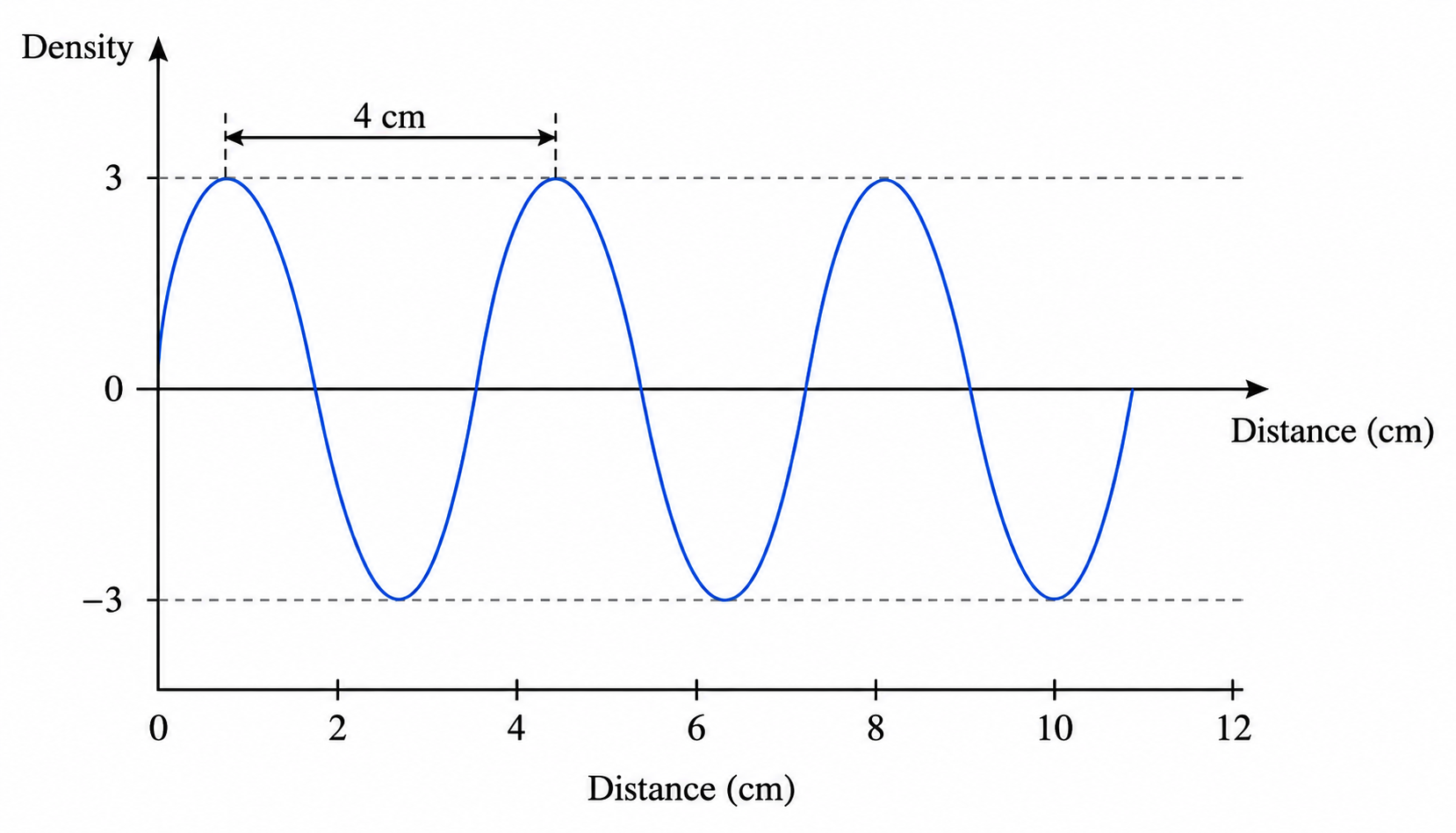
The graph should plot density on the Y-axis and distance on the X-axis. The density amplitude is 3 units, meaning the maximum change in density from the mean is 3 units. The wavelength is 4 cm, meaning the distance between two consecutive crests (or troughs) is 4 cm.
The graph will show a sine wave pattern oscillating between +3 and -3 units relative to the mean density, with a period of 4 cm along the X-axis. The crests represent compressions and the troughs represent rarefactions.
Q8. In a movie, while showing the explosion of a spacecraft in space, a flash of light is shown along with sound at the same time. What are the errors in this depiction?
Answer:
There are two main errors in this movie depiction:
- Sound cannot travel in space: Space is a near-vacuum, meaning there is no material medium (like air) for sound waves to propagate. Sound is a mechanical wave and requires a medium to travel. Therefore, the explosion of a spacecraft in space would not produce any sound that could be heard by anyone in the vicinity. The movie incorrectly shows a sound accompanying the explosion.
- Sound travels slower than light: Even in a medium, sound travels much slower than light. If there were air to carry sound, the flash of light would be seen before the sound is heard (like during a thunderstorm on Earth). The movie shows both light and sound reaching the viewer at the same time, which is physically inaccurate.
The correct depiction would be to show only a flash of light with no accompanying sound, as the explosion would be silent in space.
Q9. A source produces a sound wave of wavelength 3.44 m. If the wave travels with a speed of 344 m/s, find its time period.
Answer:
Given:
- Wavelength, λ = 3.44 m
- Speed of sound, v = 344 m/s
Step 1: Calculate the frequency.
Using the relation v = λ × ν, where ν is the frequency, we have:
ν = v / λ = 344 m/s / 3.44 m = 100 Hz
Step 2: Calculate the time period.
The time period (T) is the inverse of frequency: T = 1/ν
T = 1 / 100 Hz = 0.01 s
The time period of the sound wave is 0.01 s.
Q10. A ship searching for a sunken ship sent a sonar signal and detected an echo after 5 s. If ultrasonic wave travels at 1525 m/s in seawater, approximately how far down in the ocean is the wreckage of the sunken ship located?
Answer:
Given:
- Time for the sonar signal to travel to the wreckage and back, t = 5 s
- Speed of sound in seawater, v = 1525 m/s
The sonar signal travels from the ship down to the wreckage and back. So, the total distance travelled by the signal is twice the depth (d) of the wreckage below the ship.
Total distance = v × t = 1525 m/s × 5 s = 7625 m
Depth of the wreckage, d = Total distance / 2 = 7625 m / 2 = 3812.5 m
The wreckage is located approximately 3812.5 m (or about 3.8 km) below the ship.
Q11. A vehicle is fitted with an ultrasonic distance sensor as part of parking assistance system which provides echolocation, while the driver is reversing the vehicle. It emits ultrasonic wave (about 40 kHz) which is reflected by the obstacle. When the warning beep starts sounding at a distance of 1.2 m from the obstacle, how much time is taken by ultrasonic wave to travel to the obstacle and come back? Assume the speed of ultrasonic wave in air to be 345 m/s.
Answer:
Given:
- Distance from the obstacle, d = 1.2 m
- Speed of ultrasonic wave in air, v = 345 m/s
The ultrasonic wave travels from the sensor to the obstacle and back. The total distance travelled by the wave is twice the distance to the obstacle: 2d.
Total Distance = 2d = 2 × 1.2 m = 2.4 m
Time taken for the wave to travel to the obstacle and come back:
t = Total distance / Speed = 2.4 m / 345 m/s ≈ 0.00695 s
The time taken by the ultrasonic wave to travel to the obstacle and come back is approximately 0.00695 s.
Q12. The speed of sound in air is about 331 m s⁻¹ at 0 °C and nearly 344 m s⁻¹ at 22 °C. Roughly how much extra time will the sound of thunder take to travel a distance of 1720 m, if the air temperature changes from 22 °C to 0 °C? Assume that all other conditions remain unchanged.
Answer:
Distance: 1720 m
Speed of Sound at 22°C: 344 m/s
Speed of sound at 0°C: 331 m/s
1. Time taken at 22 °C
Speed = 344 m/s | Distance = 1720 m
Time = Distance ÷ Speed
t₁ = 1720 ÷ 344 = 5 s
2. Time taken at 0 °C
Speed = 331 m/s | Distance = 1720 m
t₂ = 1720 ÷ 331 = 5 + (65 ÷ 331) ≈ 5.196 s
(331 × 5 = 1655 ; 1720 − 1655 = 65 ; 65 ÷ 331 ≈ 0.196)
3. Extra time taken
Extra time = Time at 0 °C − Time at 22 °C
= 5.196 − 5 = 0.196 s
Roughly → 0.2 seconds (about 1/5 of a second)
Final answer: The thunder will take roughly 0.2 seconds extra when temperature drops from 22 °C to 0 °C.
Q13. The variation of density of medium for a sound wave propagating with a speed of 340 m s⁻¹ is shown in Fig. 10.32. Calculate the wavelength and frequency of the sound wave.
Answer:
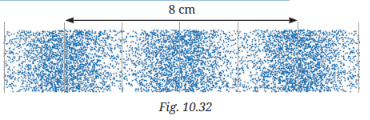
From Fig. 10.32: The distance between two consecutive compressions (or rarefactions) is given as 8 cm. That distance represents the wavelength (λ). Speed of sound, v = 340 m/s.
1. Wavelength (λ)
In the figure, the distance between two successive compressions (or rarefactions) is 8 cm.
Wavelength = distance between two consecutive compressions
2λ = 8 cm
λ = 0.08/2 m (since 1 m = 100 cm)
✅ λ = 0.04 m
2. Frequency (f)
Use the wave formula: v = f × λ
f = v ÷ λ
f = 340 ÷ 0.04
340 ÷ 0.04 = 340 ÷ (4/100) = 340 × 100 ÷ 4 = 34000 ÷ 4 = 8500 Hz
✅ f = 8500 Hz (or 8.5 kHz)
Final Answer: The wavelength is 0.04 m (or 4 cm) and the frequency is 8500 Hz.
Q14. The graphical representation of two sound waves A and B propagating at the same speed of 345 m s⁻¹ is shown in Fig. 10.33. What is the wavelength of each of them? Also, calculate their frequencies.
Answer:
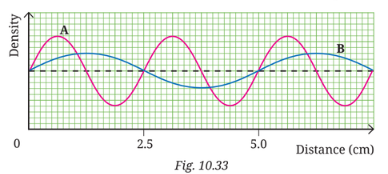
Given:
- Speed of sound, v = 345 m s⁻¹
Step 1: Find the wavelength of wave A
Wavelength is the distance between two successive points in the same phase, such as two consecutive crests or two consecutive troughs.
From the graph, wave A completes one complete cycle in a distance of 2.5 cm.
Therefore, λA = 2.5 cm = 0.025 m
Step 2: Find the frequency of wave A
We know, v = fλ
Therefore, f = v / λ
For wave A:
fA = 345 / 0.025
fA = 13,800 Hz
Step 3: Find the wavelength of wave B
From the graph, wave B completes one complete cycle in a distance of 5.0 cm.
Therefore, λB = 5.0 cm = 0.05 m
Step 4: Find the frequency of wave B
Using, f = v / λ
For wave B:
fB = 345 / 0.05
fB = 6,900 Hz
Final Answer:
- Wavelength of wave A = 2.5 cm
- Frequency of wave A = 13,800 Hz
- Wavelength of wave B = 5.0 cm
- Frequency of wave B = 6,900 Hz
Q15. Two identical sound sources are placed at A and B — one in air and one submerged in water (Fig. 10.34). Both produce sounds at the same time, which travel horizontally to the vertical side of the cliff and come back. If the time taken by the sound to return to A is 4.5 times than that of B, what is the ratio between the speeds of sound in air and water?
Answer:
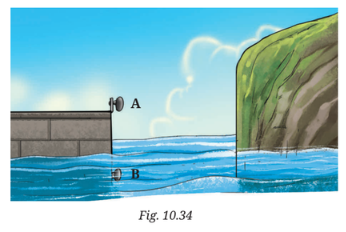
Given:
- Two identical sound sources are placed at A and B.
- Sound from A travels through air.
- Sound from B travels through water.
- Time taken by sound to return to A is 4.5 times the time taken by sound to return to B.
Step 1: Use the relation between speed, distance and time
We know that: Speed = Distance / Time
The sound waves travel to the cliff and then return, so both sounds cover the same total distance. Let the total distance travelled by each sound be d.
Step 2: Write the times for the two sounds
Let:
- Speed of sound in air = va
- Speed of sound in water = vw
- Time taken by sound in air = ta
- Time taken by sound in water = tw
Therefore, ta = d / va and tw = d / vw
According to the question: ta = 4.5tw
Step 3: Find the ratio of speeds
Substituting the expressions for time:
d / va = 4.5(d / vw)
Cancel d from both sides:
1 / va = 4.5 / vw
vw = 4.5va
Hence, va : vw = 1 : 4.5 = 2 : 9
Final Answer:
The ratio of the speed of sound in air to the speed of sound in water is: Speed in air : Speed in water = 2 : 9
Key idea: For the same distance, a sound that takes more time has a lower speed. Since the sound in air takes 4.5 times longer, sound travels 4.5 times faster in water.