CUET Sociology Syllabus 2027: Complete Guide to Topics, Exam Pattern, Books & Cutoffs
- Introduction
- CUET Sociology Syllabus 2027: Highlights
- Marking Scheme for CUET Sociology Exam 2027
- CUET Sociology Syllabus 2027: Unit-Wise Breakdown
- Part 1: Indian Society
- Part 2: Social Change and Development in India
- CUET Sociology Preparation Tips 2027
- Best Books for CUET Sociology Syllabus 2027
- CUET Sociology Cutoffs: Previous Year Trends
- Key Takeaways
Introduction
If you are curious to learn about the reasons for social differences and the understanding of social behaviour, B.A (Hons) Sociology is a good choice. Out of 280+ CUET universities, B.A (Hons) Sociology is offered in many of them, including top-ranked universities like BBAU, DU, Amity, and Graphic Era. This calls for a thorough understanding of the CUET Sociology Syllabus 2027 to aim for a perfect score.
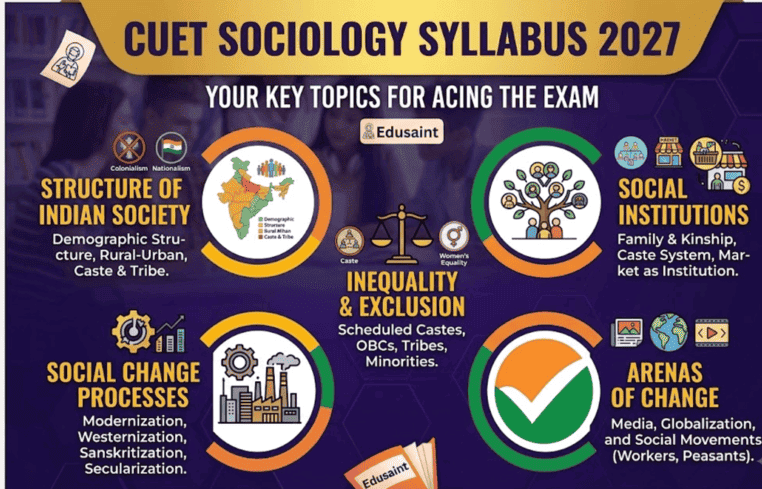
The official website provides the CUET Sociology syllabus in PDF format, ideally based on the 12th-grade curriculum. The syllabus covers a total of 9 major units with subtopics, drawn from class 12 textbooks covering continuity and change, social inequality and exclusion, and the structure of Indian society.
CUET Sociology Syllabus 2027: Highlights
Section II of the Common University Entrance Test curriculum includes 23 domain-specific topics, one of which is Sociology. Not many colleges offer a specialisation in Sociology, so you can expect high competition for seats. The following gives a full outline of the exam:
| Aspects | Details |
|---|---|
| No. of questions | 50 questions |
| Questions to attempt | 50 questions (all questions are to be attempted) |
| Total marks | 250 |
| Time | 60 minutes |
| Question-type | Multiple-choice questions (MCQ) |
| Exam Format | Computer-based test (CBT) |
Marking Scheme for CUET Sociology Exam 2027
You will be graded as per the CUET marking scheme by NTA:
- The correct answer will receive 5 marks.
- 1 mark will be deducted for every incorrect response.
- Zero marks will be awarded for unattempted questions.
Choose to answer the questions wisely to avoid negative markings. Many students mistakenly attempt all questions without considering the negative marking scheme.
CUET Sociology Syllabus 2027: Unit-Wise Breakdown
Once you have reviewed the syllabus, plan your CUET study plan carefully with proper time allotment for each unit. The syllabus is divided into two parts:
Part 1: Indian Society
Unit I: Structure of Indian Society
Demographic Structure, Rural-Urban Linkages and Divisions.
Unit II: Social Institutions, Continuity and Change
Family and kinship, The caste system, Tribal society, The market as a social institution.
Unit III: Social Inequality and Exclusion
Caste Prejudice, Scheduled Castes, and Other Backward Classes, Marginalisation of Tribal Communities, The Struggle for Women's Equality, The Protection of Religious Minorities, Caring of the Different Abled.
Unit IV: The Challenges of Unity in Diversity
Problems of Communalism, Regionalism, Casteism, and Patriarchy, Role of the State in a Plural and Unequal Society, What We Share.
Part 2: Social Change and Development in India
Unit I: Process of Social Change in India
Process of Structural Change: Colonialism, Industrialisation, Urbanisation, Process of Cultural Change: Modernization, Westernisation, Sanskritisation, Secularisation, Social Reform Movements and Laws.
Unit II: Social Change and the Polity
The Constitution as an instrument of Social Change, Parties, Pressure Groups and Democratic Politics, Panchayati Raj and the Challenges of Social Transformation.
Unit III: Social Change and the Economy
Land Reforms, the Green Revolution and Agrarian Society, From Planned Industrialisation to Liberalisation, Changes in the Class Structure.
Unit IV: New Arenas of Social Change
Media and Social Change, Globalisation and Social Change.
Unit V: Social Movements
Class-Based Movements: Workers, Peasants, Caste-Based Movements: Dalit Movement, Backward Castes, Trends in Upper Caste Responses, Women's Movements in Independent India, Tribal Movements, Environmental Movements.
CUET Sociology Preparation Tips 2027
Sociology is a memory-based subject that requires memorisation and revision. It can be difficult to remember many definitions or facts, so make notes, use flashcards, and create mind maps for quick learning.
- Focus on high-weightage units first and then move to other units. Topics like Social Inequality and Exclusion carry higher weightage.
- Finish Part 1 first, then Part 2. Tick topics as you complete them.
- Revise smartly by making 1-page notes for each unit.
- Practice daily and solve MCQs after every unit to improve speed and accuracy. Do a daily warm-up of 15 MCQs in 12 minutes.
- Avoid negative marking. If you're unsure, don't guess blindly (+5/−1 matters). Try to bring guesses from 20% to under 5% in 4 weeks.
- Read the CUET preparation books thoroughly and note important points and concepts for a deeper understanding.
- Practice with sample papers and mocks to familiarise yourself with the exam pattern and types of questions.
- Learn topics from deleted chapters as questions can be asked from them as well.
Best Books for CUET Sociology Syllabus 2027
Some of the best books to study CUET Sociology syllabus are:
- NCERT Class 11 & 12 Sociology — Start here for foundational concepts.
- All in One Sociology Class 12th — Arihant
- Together with CUET UG Sample Papers for Sociology — Rachna Sagar
- CUET UG Sociology — R. Gupta
- Haralambos & Holborn Sociology (Selected Topics) — For deeper understanding of sociological theories and thinkers
- Arihant CUET UG Sociology Chapterwise Notes & Question Bank — Specifically designed for CUET preparation
CUET Sociology Cutoffs: Previous Year Trends
While preparing for the Sociology exam, check the CUET cut-off trends for past years for various participating universities to set realistic targets. Here are some previous year cutoffs for B.A. (Hons.) Sociology at Delhi University colleges:
| College | 2025 Cutoff | 2023 Cutoff | 2022 Cutoff |
|---|---|---|---|
| Sri Venkateswara College | 809 | 739.2 | 768 |
| Kamala Nehru College | 728 | 716.1 | 744 |
| Bharati College | 633 | 723.8 | 784 |
| Janki Devi Memorial College (JDMC) | 628 | 716.1 | 744 |
Source: DU college cutoff data
Jesus and Mary College — 2025 cutoff for B.A. (Hons.) Sociology was 764.12.
Note: Cutoffs vary significantly by category (General, OBC, SC, ST, EWS, PwD). For example, the expected cutoff for BA Sociology at Lakshmibai College for OBC candidates was around 545+ in Round 3.
Key Takeaways
- Syllabus: 9 units covering Indian Society and Social Change in India.
- Exam Pattern: 50 MCQs, 250 marks, 60 minutes.
- Marking: +5 for correct, −1 for incorrect, 0 for unattempted.
- Preparation: Focus on high-weightage topics, practice MCQs daily, and avoid guesswork.
- Books: Start with NCERT, then use Arihant, Rachna Sagar, and R. Gupta.
- Cutoffs: DU colleges like Sri Venkateswara (809) and Jesus & Mary (764) have high cutoffs for Sociology.
Always refer to the official NTA website (cuet.nta.nic.in) and the latest Information Bulletin for the most current guidelines.
📚 Practice Topics
Frequently Asked Questions
How many units are there in CUET Sociology Syllabus?
The CUET Sociology syllabus is divided into 9 major units across two parts — Part 1: Indian Society (4 units) and Part 2: Social Change and Development in India (5 units).
Does Sociology paper have negative marking?
Yes, the CUET Sociology paper has negative marking. You get +5 marks for a correct answer and −1 mark for every incorrect response. Unattempted questions receive 0 marks.
How many questions are asked in CUET Sociology paper?
The CUET Sociology paper consists of 50 multiple-choice questions, and you are required to attempt all 50 questions. The total marks for the paper are 250.
What is the cut off for Sociology?
Cutoffs vary by college and category. For example, in 2025, Jesus and Mary College's cutoff for B.A. (Hons.) Sociology was 764.12, Sri Venkateswara College was 809, and Kamala Nehru College was 728. OBC category cutoffs are typically lower, around 545+ at some colleges.
What do I prepare for Social Change and the Economy?
This unit covers Land Reforms, the Green Revolution and Agrarian Society, From Planned Industrialisation to Liberalisation, and Changes in the Class Structure. It is part of Part 2 of the syllabus.
Which books are best for CUET Sociology preparation?
Start with NCERT Class 11 and 12 Sociology textbooks. Then use Arihant's All in One Sociology Class 12th, Together with CUET UG Sample Papers for Sociology by Rachna Sagar, and CUET UG Sociology by R. Gupta. For deeper understanding, refer to Haralambos & Holborn Sociology.