
The Big Questions (p.195)
Q1. What are the factors that influence the demand for and supply of goods and services in a market?
Answer:
Factors influencing demand:
- Price of the good: Inverse relationship – higher price leads to lower demand (Law of Demand).
- Income of the consumer: Higher income generally increases demand for normal goods.
- Price of related goods: Changes in prices of substitutes (tea/coffee) and complements (car/petrol) affect demand.
- Taste and preferences: Consumer choices and cultural factors influence demand.
- Seasonality: Demand for goods like sweaters, school books, and festive items changes with seasons.
- Future price expectations: If prices are expected to rise, current demand increases.
- Population size and composition: More people and demographic shifts affect overall demand.
Factors influencing supply:
- Price of the good: Direct relationship – higher price leads to higher supply (Law of Supply).
- Cost of production: Higher input costs (labour, raw materials) reduce supply.
- Technology: Better technology reduces costs and increases supply.
- Number of sellers: More sellers increase market supply.
- Price of related goods: Higher prices of alternative goods may shift supply.
- Future expectations: Expectations of higher future prices may reduce current supply.
- Natural conditions: Weather, disasters, and climate affect supply of agricultural goods.
Q2. How are prices of goods and services determined through demand and supply interactions?
Answer:
Prices are determined by the interaction of demand (buyers' willingness and ability to pay) and supply (sellers' willingness to offer goods at various prices).
- When demand exceeds supply, there is a shortage, and prices tend to rise.
- When supply exceeds demand, there is a surplus, and prices tend to fall.
- The point where quantity demanded equals quantity supplied is called market equilibrium. At this point, the market clears, and the equilibrium price is established.
For example, at the start of the mango season, supply is low, prices are high. As supply increases, prices fall. This dynamic adjustment through demand and supply determines the market price.
Q3. What is market equilibrium, and does it exist in the real world?
Answer:
Market equilibrium is the point where the quantity demanded equals the quantity supplied at a given price. At this point, there is neither a shortage (excess demand) nor a surplus (excess supply), and prices tend to remain stable unless external factors change.
Does it exist in the real world? In theory, equilibrium is a stable point. However, in the real world, markets are dynamic and constantly changing due to factors like technology, weather, income, population, and government policies. Therefore, equilibrium is rarely stable – it is a moving target. Markets continuously adjust toward a new equilibrium as conditions change.
For example, during COVID-19, the demand for masks surged, creating a temporary shortage and price rise. Over time, supply increased, and prices fell. When the pandemic ended, demand fell further, and prices returned to normal levels. This shows that equilibrium is a continuous process of adjustment.
Q4. How and why does the government intervene in the market?
Answer:
Why government intervenes:
- To correct market failures – when markets do not allocate resources efficiently or fairly.
- To ensure equity and social welfare – protecting vulnerable groups from exploitation.
- To provide public goods (roads, parks, defence) that private firms may not provide.
- To regulate monopolies and prevent unfair trade practices.
- To stabilise prices of essential goods and services.
How government intervenes:
- Price controls: Setting maximum prices (price ceiling) for essentials like medicines, or minimum prices (price floor) like minimum wages.
- Regulation: Laws like the Essential Commodities Act, Competition Act, and consumer protection laws.
- Regulatory bodies: RBI (banking), SEBI (securities), TRAI (telecom), CCPA (consumer protection).
- Public goods provision: Building infrastructure, national defence, sanitation.
- Taxation and subsidies: Taxing harmful goods (tobacco) and subsidising essential goods.
However, excessive intervention can distort prices, reduce producer incentives, and hamper business efficiency.
Think About It — Marginal Utility (p.199)
Q1. Create your own demand schedule for buying notebooks at different prices. At what price would you buy the most? At what price would you stop buying altogether? What could be the reason behind your choices?
Answer:
Sample demand schedule:
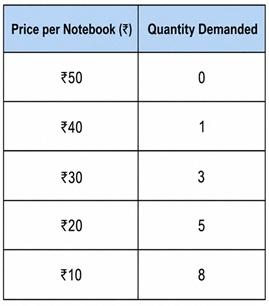
Reason: As price falls, I am willing to buy more notebooks because they become more affordable. At very high prices, I may stop buying altogether if it exceeds my budget or if I find cheaper alternatives. This reflects the Law of Demand – inverse relationship between price and quantity demanded.
Let's Explore — Demand Schedule (p.200)
Q1. What happens when you consume the first mango? It tastes delicious, right? The second one is good? The third one and so on? You are barely interested in eating mangoes by this point. Why do you think this happens?
Answer:
This is due to the principle of diminishing marginal utility. The first unit of a good provides the highest satisfaction (marginal utility). As more units are consumed, the additional satisfaction from each successive unit declines. By the fourth or fifth mango, the enjoyment is very low or even negative. As the utility derived from additional consumption falls, the willingness to pay for more units also decreases. This explains why demand curves slope downward – consumers are only willing to buy more at lower prices.
Q2. Can you think of another real-life example (other than hotels) where prices change frequently? Explain why the prices keep changing.
Answer:
Example 1: Airline tickets – Airline fares vary by season, day of the week, how early you book, and even time of day. Demand is high during holidays and weekends, so prices rise. Off-peak demand is lower, so prices fall. Airlines use dynamic pricing to maximise revenue.
Example 2: Vegetables and fruits – Prices change daily based on supply arrivals, weather, and demand. For example, tomato prices are high at the start of the season and drop as supply increases. Heavy rains can reduce supply and cause sudden price spikes.
Example 3: Fuel (petrol, diesel) – Prices change frequently due to global crude oil prices, currency exchange rates, and government taxes. Geopolitical events can also cause fluctuations.
Let's Explore — Supply Factors (p.203)
Q1. 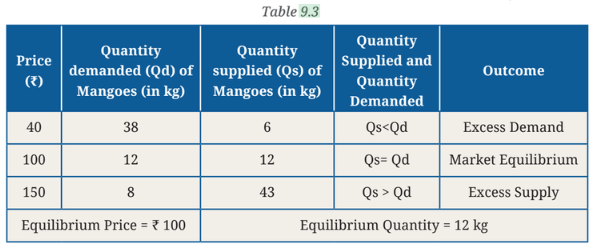 Using data from Table 9.3, plot the demand and supply curve at the three prices, i.e., ₹40, ₹100, and ₹150. Identify and mark excess demand and supply on the graph. Think about how equilibrium could be reached in these scenarios.
Answer:
Data from Table 9.3:
Graph: 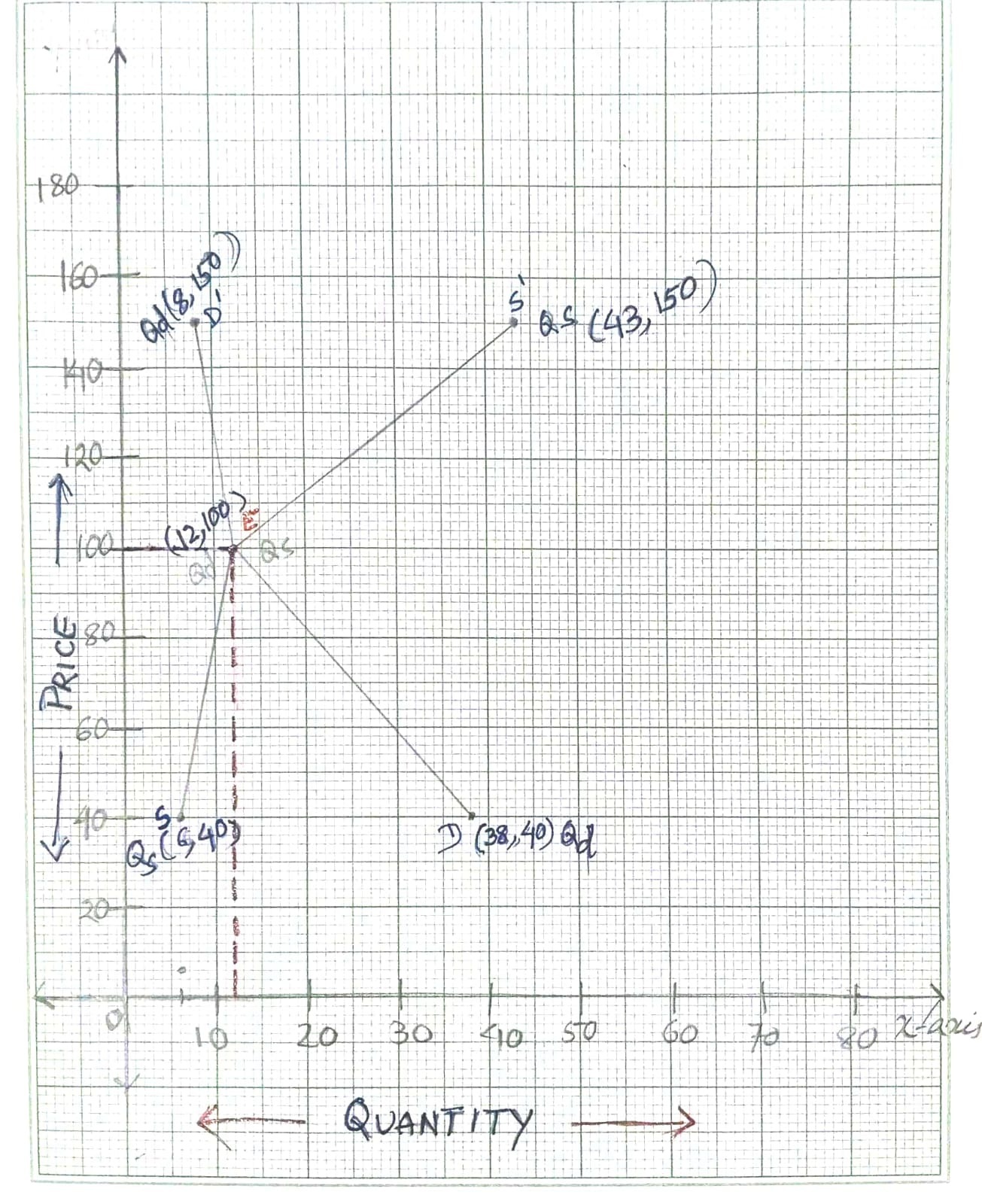
Plot price on the Y-axis and quantity on the X-axis. Plot the points and draw the demand curve (DD') and supply curve (SS'). The intersection at ₹100 and 12 kg is the equilibrium point E.
- At ₹40, demand exceeds supply (excess demand). This shortage will push prices up towards equilibrium.
- At ₹150, supply exceeds demand (excess supply). This surplus will push prices down towards equilibrium.
- At ₹100, market clears – equilibrium is reached.
Let's Analyse (p.204)
Q1. In the chapter 'Democracy', you have read that a democratic government is accountable to the people and is expected to act in their interest. According to you, how should a democratic government decide when and how much it should intervene in markets to protect people's welfare? Whose voices should a democratic government consider while making such decisions—consumers, producers, workers, or others? Why?
Answer:
When to intervene? A democratic government should intervene when:
- There is market failure (monopolies, externalities, information gaps).
- Essential goods become unaffordable for the poor.
- Public goods (like roads, sanitation) are under-provided.
- Consumer exploitation occurs – hoarding, black marketing, unfair trade practices.
How much to intervene? Intervention should be proportionate, evidence-based, and temporary where possible. It should not be excessive or permanent, as it can distort markets and reduce incentives.
Whose voices to consider:
- Consumers – to ensure affordability and fair access.
- Producers – to avoid discouraging production and innovation.
- Workers – to protect livelihoods and ensure fair wages.
- Experts – economists, regulators, and civil society for informed decision-making.
- Citizens – through democratic processes like consultations, debates, and parliamentary discussions.
Think About It — Price Changes and Sustainability (p.205)
Q1. An increase in income always leads to a rise in demand for goods. Defend or refute, giving reasons for the same.
Answer:
Refute. An increase in income does not always lead to a rise in demand for all goods.
- Normal goods: Demand increases with income (e.g., branded clothes, cars).
- Inferior goods: Demand decreases as income rises (e.g., coarse grains, second-hand goods) because consumers switch to better alternatives.
- Giffen goods: A rare case where demand rises when price increases, but income effects are complex.
Thus, while income generally increases demand for normal goods, it may reduce demand for inferior goods. The effect depends on the type of good and consumer preferences.
Q2. If petrol prices double, what happens to: a. Demand for diesel cars b. Demand for electric cars c. Demand for car accessories d. Demand for public transport
Answer:
- a. Demand for diesel cars: May rise if diesel is relatively cheaper than petrol (substitute). However, if diesel prices also rise, demand may fall.
- b. Demand for electric cars: May rise as consumers look for alternatives to petrol (substitute).
- c. Demand for car accessories: May fall as people reduce overall car usage due to higher fuel costs.
- d. Demand for public transport: Will rise as people switch from private vehicles to cheaper public transport options (substitute).
Think About It — Government Price Fixing (p.206)
Q1. Have you ever seen or heard of the government fixing prices or wages (for example, bus fares, medicines, or minimum wages)? Share an example and why you think it was done.
Answer:
Example: The government fixes prices of essential medicines and capped the maximum retail price of sanitisers during COVID-19 under the Essential Commodities Act, 1955. This was done to prevent overcharging, hoarding, and black-marketing, and to keep essential goods accessible and affordable, especially for vulnerable and low-income groups.
Don't Miss Out — Price Controls During COVID (p.207)
Q1. How do such price controls affect suppliers and consumers?
Answer:
Consumers benefit from affordable, capped prices and protection from exploitation during shortages. Suppliers/sellers who were hoarding or black-marketing lose the ability to profiteer, though legitimate producers may face lower margins temporarily — as seen with sanitisers, many companies still entered production once prices stabilised and demand normalised, ensuring wide availability at fair prices.
Q2. While in this case the price control was for an emergency, do you think such controls should be in practice forever?
Answer:
Generally no — price controls are best used temporarily during emergencies or market failures (like the COVID-19 sanitiser shortage). If kept permanently, they can distort prices, reduce producer incentives, and eventually create shortages, so they should be lifted once the market stabilises and supply catches up with demand.
Let's Explore — Public Goods (p.207)
Q1. From your surroundings, list two goods or services that are provided by the government (for example: roads, streetlights, parks, police, and so on). Choose one of the goods you listed and answer:
- Who does benefit from it?
- Why would it be difficult for a private company to provide this service on its own?
- Imagine the government stops providing this good or service, what problems might people in your area face?
Answer:
Example: Streetlights and public parks.
Taking streetlights:
- a) Benefits: All residents, pedestrians, and commuters benefit from improved night-time visibility and safety.
- b) Why difficult for private companies: Streetlights are non-excludable (anyone can use them) and non-rivalrous (one person's use doesn't reduce availability), so a private company cannot easily charge individual users or profit from providing them.
- c) If stopped: Streets would become unsafe at night, raising accident and crime risk, and residents would have to arrange costly private lighting, creating unequal access to safety.
Let's Recall (p.208)
Q1. In the chapter 'Democracy', you have read that a democratic government is accountable to the people and is expected to act in their interest.
- According to you, how should a democratic government decide when and how much it should intervene in markets to protect people's welfare?
- Whose voices should a democratic government consider while making such decisions—consumers, producers, workers, or others? Why?
Answer:
a) A democratic government should intervene when markets fail — e.g., essential goods become unaffordable, monopolies exploit consumers, or public goods are under-provided — but proportionately, correcting the failure without discouraging production, innovation, or investment.
b) It should consider all stakeholders — consumers (affordable access), producers/sellers (incentive to keep supplying), and workers (fair wages, safe conditions) — since balancing all perspectives protects welfare without causing shortages or job losses, reflecting the government's accountability to the entire population.
Questions and Activities (p.210-213)
Q1. An increase in income always leads to a rise in demand for goods. Defend or refute, giving reasons for the same.
Answer:
Refute. While rising income generally increases demand for normal goods, it is not universal — for inferior goods (cheaper necessity items, e.g., low-cost grains), demand can actually fall as income rises, since consumers switch to better-quality substitutes. So the statement depends on the type of good.
Q2. If petrol prices double, what happens to
- Demand for diesel cars
- Demand for electric cars
- Demand for car accessories
- Demand for public transport
Answer:
- a) Diesel cars: Rises — diesel becomes a relatively cheaper substitute fuel.
- b) Electric cars: Rises — electric cars avoid petrol dependency entirely.
- c) Car accessories: Falls slightly for petrol cars, as accessories are complementary and discretionary spending is cut back.
- d) Public transport: Rises — it becomes a cheaper substitute for private petrol travel.
Q3. A farmer traditionally irrigates fields manually (labour-intensive). He installs drip irrigation (a technology upgrade) that reduces water use by 40 per cent and increases yield by 30 per cent. How does this affect
- His cost of production
- His willingness to supply at different prices
- The overall market supply if many farmers adopt this technology
Answer:
- a) Cost of production: Falls, due to lower water/labour use and higher yield spreading fixed costs.
- b) Willingness to supply: Increases — cheaper, more efficient production means the farmer supplies more at the same or lower price.
- c) Overall market supply: Shifts right (increases) if widely adopted, potentially pushing equilibrium prices down as more output becomes available.
Q4. During online festival sales, the prices of many products are very low. Use the concept of demand and supply to explain why the sellers sell at such a low price. What happens to the equilibrium when the price is lowered? Does this benefit only consumers or sellers as well? Explain.
Answer:
Sellers lower prices to trigger a large rise in quantity demanded (Law of Demand), clearing excess inventory and attracting more buyers even at lower per-unit margins — higher volume can offset lower profit per item.
Lowering price below the earlier equilibrium temporarily creates excess demand, managed via limited-time offers/stock limits, settling into a new higher-volume equilibrium.
This benefits both: consumers get lower prices, and sellers gain higher sales volume, cleared stock, and potential repeat customers.
Q5. Suppose the government sets a maximum sale price for an essential vaccine below the market-driven price. What is likely to happen? Choose from the options below and elucidate your point.
- Surplus
- Shortage
- No effect
- Fall in demand
Answer:
Answer: (b) Shortage. A price ceiling below equilibrium means quantity demanded exceeds quantity supplied at the capped price — producers are less incentivised to supply, while consumers want more at the cheaper price, creating a shortage.
Q6. The government levies higher taxes on products such as tobacco and alcohol to promote healthier choices among citizens. Can you find out other goods where price controls have been set in place? What are the reasons for the same?
Answer:
- Essential medicines — price ceilings keep life-saving drugs affordable.
- LPG cylinders/kerosene — subsidised prices for accessible cooking fuel.
- Minimum Support Price (MSP) for crops — a price floor protecting farmer income.
- Petrol/diesel (in some periods) — regulated to control inflation and shield consumers from volatile global oil prices.
Reasons include protecting consumer affordability, securing producer income, or discouraging harmful consumption.
Q7. Can excessive government regulation hurt markets? Explain with suitable examples.
Answer:
- Price distortions: Fixing wheat prices below market levels reduces farmer income, discouraging production and causing shortages.
- Compliance burdens: Excessive licenses/permits (e.g., a small restaurant needing multiple safety/pollution clearances) discourage small businesses and hurt ease of doing business.
- Discourages innovation: Heavy price controls reduce incentive to invest in better seeds, irrigation, or technology, lowering long-term productivity.
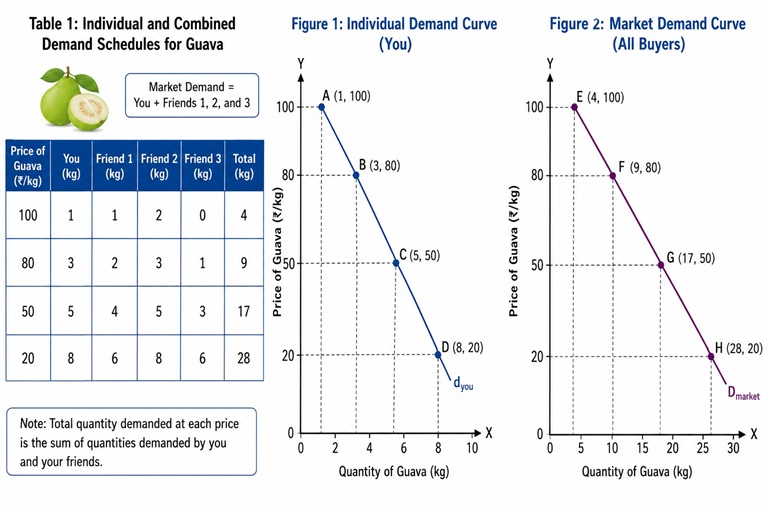
Q8. In the table below, different prices of guava are given.
- Think and write how much guava you will buy at each price.
- Ask the same question to three of your friends and fill in the table.
- Also make a graph for each one of you and one final graph for the total quantity.
Answer:
Open-ended activity. Students record quantities they and 3 friends would buy at ₹100/kg, ₹80/kg, ₹50/kg, ₹20/kg (quantity should rise as price falls, per the Law of Demand), then sum individual quantities at each price to derive market demand, plotting individual and combined demand curves (similar to Fig. 9.3). Here is an eample.
Q9. Visit the nearby vegetable market and try to find answers to the following questions.
- Who decides the prices of different vegetables in the vegetable market?
- Sometimes the prices of a few vegetables is too high, and sometimes too low. Why is this?
- The price of tomatoes is high in the morning and eventually gets lower by the evening. Have you ever noticed this? Comment.
Answer:
- a) Prices are set through negotiation between sellers/wholesalers and buyers, based on the day's supply (fresh stock arrival) and demand — not fixed by a single authority.
- b) Prices fluctuate because supply depends on season, weather, transport, and perishability, while demand varies with festivals and weekday patterns — any mismatch causes prices to rise or fall.
- c) Morning prices are higher due to fresh stock and eager early buyers; by evening, sellers cut prices to clear perishable, unsold stock before it spoils — a supply-side (perishability) effect on same-day pricing.
Q10. Categorise the following combination of goods into substitute goods and complementary goods.
- Movie ticket in the cinema hall and popcorn
- Eraser and pencil
- Laptop and computer
- Air Conditioner and cooler
- Notebook and pen
- Apple and banana
- Mobile and earphones
Answer:
- a) Movie ticket and popcorn — Complementary goods.
- b) Eraser and pencil — Complementary goods.
- c) Laptop and computer — Substitute goods.
- d) Air Conditioner and cooler — Substitute goods.
- e) Notebook and pen — Complementary goods.
- f) Apple and banana — Substitute goods.
- g) Mobile and earphones — Complementary goods.
Q11. 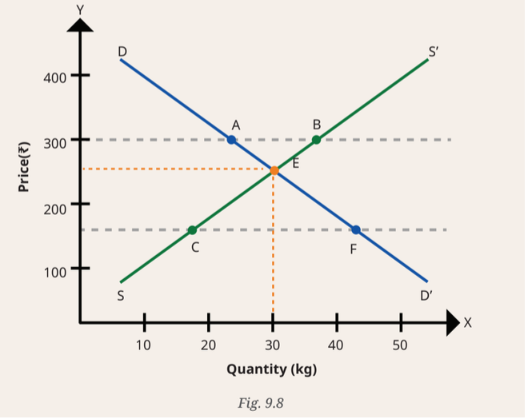 Fig. 9.8 shows the demand curve DD' and Supply curve SS'. Based on the figure, answer the following questions:
- What does point E represent in this market?
- What is the equilibrium price and equilibrium quantity at point E?
- Point A lies on DD'. Point B lies on SS'. What do the points A and B indicate about demand and supply? What does the gap between A and B (both on the upper dashed price line) represent?
- Point F lies on DD'. Point C lies on SS'. What do the points F and C indicate about demand and supply? What does the gap between C and F (both on the lower dashed price line) represent?
- If the price stays at the lower dashed line, what could happen next in a free market?
Answer:
- a) Point E represents market equilibrium — the intersection of DD' and SS', where quantity demanded equals quantity supplied.
- b) From Fig. 9.8, equilibrium price = ₹250 and equilibrium quantity = 30 kg (reading the intersection point E).
- c) At the upper price line (300): point A (on DD') shows quantity demanded around 23 kg, point B (on SS') shows quantity supplied around 37 kg. Since B is greater than A, this represents excess supply (surplus).
- d) At the lower price line (₹160): point F (on DD') shows quantity demanded around 43 kg, point C (on SS') shows quantity supplied around 17 kg. Since F is greater than C, this represents excess demand (shortage).
- e) If price stays at the lower line, the resulting shortage would create pressure for price to rise, as buyers compete for limited supply, pushing the market back toward equilibrium at E.
Q12. Draw a market equilibrium graph using the following demand schedule. 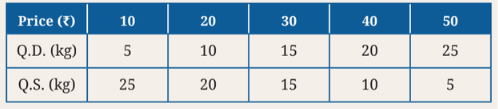
- Plot the demand and supply curve using the above data.
- Identify the equilibrium price and quantity.
- Observe the above data and analyse what happens if the price is set at ₹20 or ₹40.
Answer:
- a) Plot the downward-sloping demand curve and upward-sloping supply curve using the given price-quantity pairs.
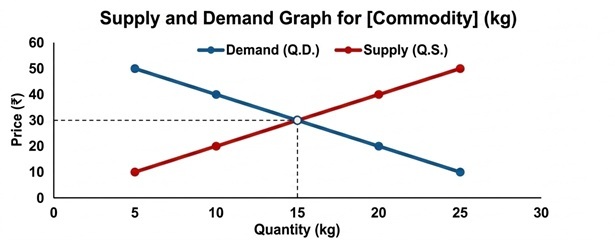
- b) Equilibrium occurs where Q.D. = Q.S. — at Price = ₹30, both equal 15 kg.
- c) At ₹20: Q.S. (20 kg) is greater than Q.D. (10 kg) — excess supply (surplus) of 10 kg, pushing prices down. At ₹40: Q.D. (20 kg) is greater than Q.S. (10 kg) — excess demand (shortage) of 10 kg, pushing prices up.