
Q1. There are two fruit baskets A and B. Basket A has one apple and two oranges. Basket B has one banana and one mango. You randomly pick one fruit from each basket. (i) Draw a tree diagram showing all possible pairs of fruits. (ii) List the sample space. (iii) What is the probability of picking one apple and one banana?
Answer:
(i)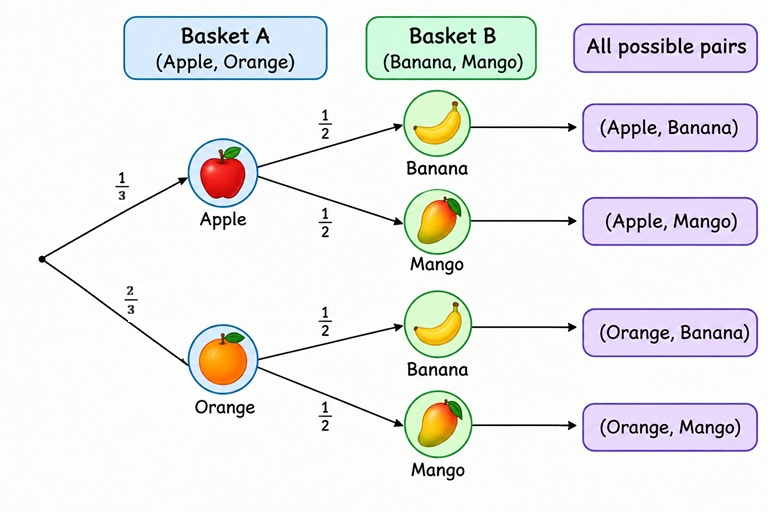
Becuause there are 1 apple and 2 oranges ,
Probability of getting Apple=Number of apple/total fruits
=1/3
Probability of getting an Orange = Number of orange/total fruits
=2/3
(ii) Sample Space:
There are 2 oranges in Basket A. Since they are identical in nature,they considered as one .
So Sample space:
S = {(Apple-Banana), (Apple-Mango), (Orange-Banana), (Orange-Mango)}
n(S)=4
(iii) Probability of picking one apple and one banana:
Favourable outcome = {Apple-Banana} → 1 outcome.
Total outcomes = 4.
So, P(Apple and Banana) = 1/4 = 0.25 or 25%.
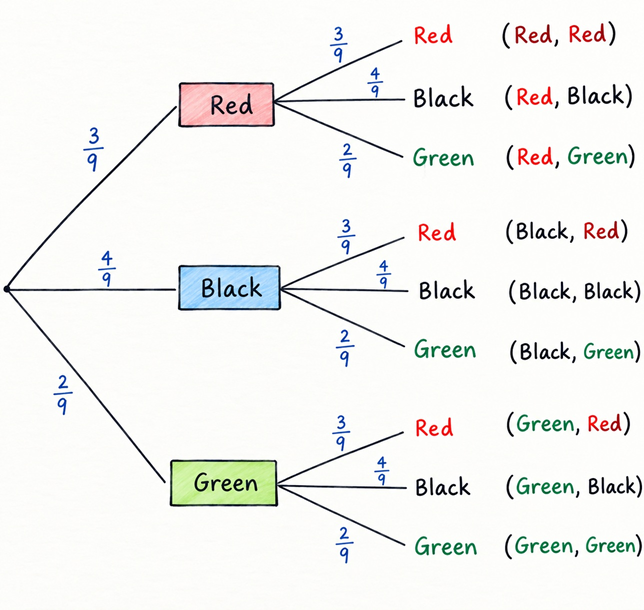
Q2. Let us say that you have a box containing 3 red pens, 4 black pens and 2 green pens. You pick a pen (without looking) from the box and put it back. Then your friend does the same. (i) What are the possible outcomes of the pen colours? Can you draw a tree diagram representing the possible outcomes? (ii) Can you use the tree diagram to guess the probability that both you and your friend pick pens of the same colour?
Answer:
A box containing 3 red pens, 4 black pens and 2 green pens.
Total number of Pens = 3+4+2= 9
Probability of choosing a red Pen=
P(Red)=number of red pen /total number of Pens
=3/9=1/3
P(Black)=number of black pen /total number of Pens
=4/9
P(Green)= number of Green pen /total number of Pens
= 2/9
(i) Possible outcomes: The possible colours are Red (R), Black (B), and Green (G).
Sample space= S={(R,R),(R,B),(R,G),(B,R),(B,B),(B,G),(G,R),(G,B),(G,G)}
Thus total number of outcomes =n(S)= 9
(ii) Probability both pick same colour:
Total outcomes =Your 3 choices × Friend’s 3 choices = 9 ways
Outcomes where both pick same colour: (R,R), (B,B), (G,G) → 3 outcomes.
P(R,R)=3/9 ×3/9=9/81
P(B,B)= 4/9 × 4/9=16/81
P(G,G)=2/9 × 2/9= 4/81
Total probability = 9/81+16/81+4/81=29/81
Therefore, P(Same colour) = 29/81 = 0.358 or 35.8%