
Think and Reflect (Page 2)
Q1. Jamuna has a circular piece of paper. She is trying to locate its centre. Amina gives her a suggestion. She follows the instructions and is thrilled to find that it works. Can you guess what Amina told her?
Answer:
Amina likely told Jamuna to fold the circular paper in half twice. Each fold will create a crease that is a diameter of the circle. The point where the two creases intersect is the centre of the circle. This works because all diameters of a circle pass through the centre.
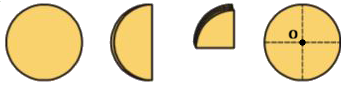
Alternatively, she could fold the paper so that the boundaries overlap, creating a crease (a diameter). She can repeat this with a different fold. The intersection of the two diameters is the centre.
Think and Reflect (Page 3)
Q1. What are the rotational symmetries of a square? How many lines of reflection symmetry does it have? What about a regular pentagon? A regular hexagon?
Answer:
- Square: It has rotational symmetry of order 4 (angles of 90°, 180°, 270°, and 360°). It has 4 lines of reflection symmetry.
- Regular Pentagon: It has rotational symmetry of order 5 (angles of 72°, 144°, 216°, 288°, and 360°). It has 5 lines of reflection symmetry.
- Regular Hexagon: It has rotational symmetry of order 6 (angles of 60°, 120°, 180°, 240°, 300°, and 360°). It has 6 lines of reflection symmetry.
Q2. What is the length of the longest chord in a circle of radius 5 units? Is there a smallest chord?
Answer:
The longest chord in a circle is the diameter. If the radius is 5 units, the diameter (and the longest chord) is 5 × 2 = 10 units.
There is no defined 'smallest chord' because as you move a chord closer and closer to the edge of the circle, its length gets smaller and smaller, approaching zero. In theory, a chord can be infinitely small, so it doesn't have a minimum length.
Q3. The locus of points at a given distance from a given point is a circle. What can we say about the locus of points equidistant from two given points? (Hint: We know that any point that is equidistant from two given points A and B lies on the perpendicular bisector of AB. Does this make the perpendicular bisector the locus? For this, we have to show that all the points on the perpendicular bisector are equidistant from A and B.)
Answer:
The locus of points equidistant from two given points A and B is the perpendicular bisector of the line segment AB.
This is because:
- Any point on the perpendicular bisector of AB is equidistant from A and B. This can be proven by the RHS congruence criterion for triangles formed by the point, the midpoint of AB, and either endpoint.
- Conversely, any point that is equidistant from A and B must lie on the perpendicular bisector of AB.
Therefore, the set of all such points is exactly the perpendicular bisector.
Think and Reflect (Page 4)
Q1. How many circles pass through two points on a plane?
Answer:
Infinitely many circles can pass through two given points on a plane.
Q2. Are there circles of all possible radii passing through A and B? What is the radius of the smallest circle passing through A and B? What is the radius of the largest circle passing through A and B?
Answer:
Yes, there are circles of all possible radii passing through A and B, provided the radius is at least half the distance between A and B.
- The smallest circle passing through A and B has radius equal to half the length of AB (AB/2). In this circle, AB is the diameter.
- There is no largest circle. As you move the centre farther away along the perpendicular bisector of AB, the radius keeps increasing without bound.
Q3. As you move away from segment AB along its perpendicular bisector, do the radii of the circles containing A and B increase or decrease?
Answer:
As you move away from the midpoint of AB along its perpendicular bisector, the radii of the circles passing through A and B increase.
Q4. As you go along the perpendicular bisector, will the circle drawn from that point through A and B appear more curved or less curved?
Answer:
As you move the centre farther away from AB along the perpendicular bisector, the circle will appear less curved (flatter) because its radius becomes larger.
Q5. You are given two points A and B on a plane. How many squares can you draw on the same plane with A and B on the boundary? How many squares can you draw on the plane with A and B as the corners of the square?
Answer:
Case 1: A and B on the boundary (perimeter): Infinitely many squares can be drawn with A and B on their boundaries (e.g., as two points on one side, on adjacent sides, or on opposite sides).
Case 2: A and B as corners: Only two squares can be drawn with A and B as corners: one with A and B as adjacent corners and another with A and B as opposite corners.
Exercises (Page 7)
Q1. Draw \( \triangle ABC \) with \( AB = 5 \mathrm{cm} \), \( \angle A = 70^{\circ} \) and \( \angle B = 60^{\circ} \). Draw the circumcircle of \( \triangle ABC \). Is the centre inside or outside the triangle?
Answer:
Solution:
- Draw a line segment AB = 5 cm.
- At point A, draw a ray making an angle of 70° with AB.
- At point B, draw a ray making an angle of 60° with AB.
- The two rays intersect at point C. This completes triangle ABC.
- Draw the perpendicular bisectors of any two sides of the triangle (e.g., AB and BC). Their intersection point is the circumcentre (O).
- With O as centre and OA as radius, draw the circle. This is the circumcircle.
Observation: Since \( \angle A = 70° \) and \( \angle B = 60° \), \( \angle C = 50° \). All angles are less than 90°, so triangle ABC is acute-angled. Therefore, the circumcentre (O) lies inside the triangle.
Q2. Draw \( \triangle ABC \) with \( AB = 5 \mathrm{cm} \), \( \angle A = 100^{\circ} \), \( AC = 4 \mathrm{cm} \). Draw the circumcircle of \( \triangle ABC \). Is the centre inside or outside the triangle?
Answer:
- Draw a line segment AB = 5 cm.
- At point A, draw a ray making an angle of 100° with AB.
- On this ray, mark point C such that AC = 4 cm.
- Join B and C to complete triangle ABC.
- Draw the perpendicular bisectors of any two sides. Their intersection point is the circumcentre (O).
- With O as centre and OA as radius, draw the circumcircle.
Observation: Since \( \angle A = 100° \) (greater than 90°), triangle ABC is obtuse-angled. Therefore, the circumcentre (O) lies outside the triangle.
Q3. Draw \( \triangle ABC \), with \( AB = 6 \mathrm{cm} \), \( BC = 7 \mathrm{cm} \) and \( CA = 7 \mathrm{cm} \). Draw the circumcircle of \( \triangle ABC \). Let the circumference be \( O \). Measure \( OA \), \( OB \), \( OC \).
Answer:
- Draw BC = 7 cm.
- With B as centre and radius 6 cm, draw an arc.
- With C as centre and radius 7 cm, draw another arc intersecting the first arc at A.
- Join AB and AC to complete triangle ABC.
- Draw the perpendicular bisectors of AB and BC to find their intersection point O (the circumcentre).
- With O as centre and OA as radius, draw the circumcircle. This circle will also pass through B and C.
- Measure OA, OB, and OC. All three will be equal (each is the radius of the circumcircle).
Q4. What is the least possible radius of a circle through two points \( A \) and \( B \)?
Answer:
The least possible radius of a circle passing through two points A and B is half the distance between A and B, i.e., \( \frac{AB}{2} \). In this case, AB is the diameter of the circle.
Think, Draw and Infer (Page 7)
Q1. A, B and C are three collinear points. Can you find a point P such that \( \mathrm{PA} = \mathrm{PB} = \mathrm{PC} \)? What can you say about the perpendicular bisectors of AB and BC? Draw and check. Can you show that for three collinear points A, B and C, the perpendicular bisector of AB and BC are parallel? Is it possible for a circle to pass through collinear points? Can you draw a line that cuts a given circle in three distinct points?
Answer:
- Point P: No such point P exists because the perpendicular bisectors of AB and BC are parallel (since both are perpendicular to the same line ABC), so they never meet. There is no single point equidistant from all three collinear points.
- Perpendicular bisectors: The perpendicular bisectors of AB and BC are parallel to each other.
- Circle through collinear points: No, a circle cannot pass through three collinear points. A circle can intersect a line at a maximum of two points. Therefore, no circle can pass through three points on the same straight line.
- Line cutting a circle: No, a straight line cannot cut a circle at three distinct points. A line can intersect a circle at a maximum of two points.
Q2. The circumcircle of a given \( \triangle ABC \) is drawn. Can there be other triangles congruent to \( \triangle ABC \) that share the same circumcircle?
Answer:
Yes, there can be other triangles congruent to \( \triangle ABC \) that share the same circumcircle. The circumcircle has a fixed radius. A triangle congruent to ABC can be inscribed in the same circle in different positions. For example, by rotating triangle ABC about the centre of the circle, you can get another congruent triangle that is also inscribed in the same circle.
Exercise (Page 16)
Q1. A circle with centre O is drawn, and A, B, C, D are points on the circle (see Fig. 5.19). Measure the angles subtended by arc AKB and arc CLD at the centre O. If the angle at the centre is less than \( 180^{\circ} \), it is a minor arc. If the angle at the centre is greater than \( 180^{\circ} \), it is a major arc. State whether arcs AKB and CLD are minor arcs or major arcs.
Answer:
To determine if an arc is major or minor, you need to measure the angle it subtends at the centre. Since I don't have the specific figure, I can provide the general rule:
- If the angle subtended by the arc at the centre is less than 180°, the arc is a minor arc.
- If the angle subtended by the arc at the centre is greater than 180°, the arc is a major arc.
If the angle is exactly 180°, the arc is a semicircle.
Based on the figure, measure the central angle for arc AKB and arc CLD, and classify accordingly.
Exercise (Page 22)
Q1. A cyclic quadrilateral has angles measuring \( \angle A = 80^{\circ} \), \( \angle B = 110^{\circ} \), \( \angle C = 100^{\circ} \), and \( \angle D = 70^{\circ} \). Can such a quadrilateral be drawn? Explain why or why not.
Answer:
Yes, such a cyclic quadrilateral can be drawn.
In a cyclic quadrilateral, the sum of opposite angles must be 180°.
Here, \( \angle A + \angle C = 80° + 100° = 180° \), which satisfies the condition for opposite angles.
Also, \( \angle B + \angle D = 110° + 70° = 180° \), which also satisfies the condition.
Both pairs of opposite angles sum to 180°, so the quadrilateral is cyclic.
Therefore, such a quadrilateral can be drawn.