
Think and Reflect (Page 71)
Q1. What can you say about a and b if (a + b)2 < a2 + b2?
Answer:
We know that (a + b)2 = a2 + 2ab + b2.
If (a + b)2 < a2 + b2, then a2 + 2ab + b2 < a2 + b2.
Subtracting a2 + b2 from both sides, we get 2ab < 0.
This implies that ab < 0. Therefore, a and b must have opposite signs (one positive and the other negative).
Answer: a and b have opposite signs.
Q2. What can you say about a and b if (a + b)2 > a2 + b2?
Answer:
We know that (a + b)2 = a2 + 2ab + b2.
If (a + b)2 > a2 + b2, then a2 + 2ab + b2 > a2 + b2.
Subtracting a2 + b2 from both sides, we get 2ab > 0.
This implies that ab > 0. Therefore, a and b must have the same sign (both positive or both negative).
Answer: a and b have the same sign.
Q3. When will (a + b)2 be equal to a2 + b2?
Answer:
We know that (a + b)2 = a2 + 2ab + b2.
If (a + b)2 = a2 + b2, then a2 + 2ab + b2 = a2 + b2.
Subtracting a2 + b2 from both sides, we get 2ab = 0.
This implies that ab = 0. Therefore, at least one of a or b must be zero.
Answer: Either a = 0 or b = 0 (or both).
Think and Reflect (Page 73)
Q1. What if we replace b by -b in (a + b)2 = a2 + 2ab + b2?
Answer:
Replacing b by -b in the identity (a + b)2 = a2 + 2ab + b2, we get:
(a + (-b))2 = a2 + 2a(-b) + (-b)2
⇒ (a - b)2 = a2 - 2ab + b2
This is also an identity and can be used in ways similar to (a + b)2 = a2 + 2ab + b2.
Think and Reflect (Page 9)
Q1. Label the squares and rectangles in Fig. 4.4 so that it represents the identity (a + b + c)2 = a2 + b2 + c2 + 2ab + 2bc + 2ca.
Answer:
In Fig. 4.4, the large square of side (a + b + c) is divided into 9 parts:
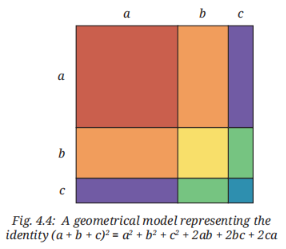
- One square of side a (area a2)
- One square of side b (area b2)
- One square of side c (area c2)
- Two rectangles of dimensions a × b (area ab each)
- Two rectangles of dimensions b × c (area bc each)
- Two rectangles of dimensions c × a (area ca each)
Thus, the total area of the large square is the sum of these areas: a2 + b2 + c2 + 2ab + 2bc + 2ca.
Think and Reflect (Page 10)
Q1. Try to evaluate the following using a suitable identity: (i) 352 (ii) 652 (iii) 852 (iv) 1052 Do you observe any interesting pattern?
Answer:
Using the identity a2 = (a + b)(a - b) + b2:
(i) 352 = (35 + 5)(35 - 5) + 52 = 40 × 30 + 25 = 1200 + 25 = 1225
(ii) 652 = (65 + 5)(65 - 5) + 52 = 70 × 60 + 25 = 4200 + 25 = 4225
(iii) 852 = (85 + 5)(85 - 5) + 52 = 90 × 80 + 25 = 7200 + 25 = 7225
(iv) 1052 = (105 + 5)(105 - 5) + 52 = 110 × 100 + 25 = 11000 + 25 = 11025
Pattern observed: For numbers ending in 5, the square ends in 25. The preceding digits are the product of the number formed by the digits before 5 and that number plus 1. For example, 352: 3 × 4 = 12, and then 25, so 1225. 652: 6 × 7 = 42, then 25, so 4225.
Q2. Observe the two rows of figures below. They represent an algebraic identity. Try to identify it. [IMAGE NEEDED: Two rows of figures representing an algebraic identity. First row likely shows a square of side a, a square of side b, and rectangles representing ab. Second row likely shows a rectangle of dimensions (a+b) and (a-b).]
Answer:
The figures likely represent the identity a2 - b2 = (a + b)(a - b).
In the first row, a square of side a has a smaller square of side b removed from one corner. The remaining area is a2 - b2.
In the second row, this remaining area is rearranged into a rectangle of dimensions (a + b) and (a - b), whose area is (a + b)(a - b).
Think and Reflect (Page 12)
Q1. Suppose 7x is split as 2x + 5x; can a similar rectangular arrangement be formed? Consider other possibilities and check.
Answer:
For x2 + 7x + 12, splitting 7x as 2x + 5x would mean arranging 2 x-tiles on one side of the x2-tile and 5 x-tiles on the other side.
This would give a rectangle of dimensions (x + 2) and (x + 5), but the product would be x2 + 7x + 10. However, we need a constant term of 12, which comes from the unit tiles.
If we place 2 unit tiles along the side of length x + 2 and 5 unit tiles along the side of length x + 5, we would have 2 × 5 = 10 unit tiles. But we need 12 unit tiles.
Thus, the split must be such that the product of the two parts of the constant term gives the required constant term. For 7x, the pair 3 and 4 gives a product of 12, which works. The pair 2 and 5 gives a product of 10, which does not work.
Therefore, the only possible pairs for splitting 7x that yield the correct constant term are (1, 6) or (2, 5) or (3, 4). The pair (3, 4) gives the correct product 12.
Q2. Figure out the product of x + 2 and x + 3 using algebra tiles.
Answer:
To multiply (x + 2) and (x + 3) using algebra tiles:
- Represent x + 2 using one x-tile and 2 unit tiles.
- Represent x + 3 using one x-tile and 3 unit tiles.
- Arrange them to form a rectangle: one x2-tile, 2 + 3 = 5 x-tiles, and 2 × 3 = 6 unit tiles.
Thus, the product is x2 + 5x + 6.
Q3. Lay out algebra tiles for x2 + 11x + 30 in such a way that you will see its factors.
Answer:
For x2 + 11x + 30, we need to split 11x into two parts whose product is 30.
The pairs of factors of 30 are: (1, 30), (2, 15), (3, 10), (5, 6).
The pair (5, 6) gives a sum of 11. So, 11x = 5x + 6x.
Thus, the factors are (x + 5) and (x + 6).
Using algebra tiles, arrange one x2-tile, 5 x-tiles on one side, 6 x-tiles on the other side, and 5 × 6 = 30 unit tiles in a 5 by 6 array.
Think and Reflect (Page 13)
Q1. We have seen that (x + 3)(x + 4) = x2 + 7x + 12. Also (x + 6)(x + 7) = x2 + 13x + 42. Generalise the pattern to get an expression for (x + a)(x + b).
Answer:
From the pattern, (x + a)(x + b) = x2 + (a + b)x + ab.
This is the standard identity for the product of two binomials.
Q2. Fill in the blanks with the appropriate expressions to make the equation true. (px + a)(qx + b) = (__________)x2 + (__________)x + __________.
Answer:
Using the distributive property:
(px + a)(qx + b) = px(qx + b) + a(qx + b) = pqx2 + pbx + aqx + ab = pqx2 + (pb + aq)x + ab.
Thus, the blanks are: pq, (pb + aq), and ab.
Think and Reflect (Page 15)
Q1. James and Reshma were talking about algebraic identities they learnt in school. James: (a - b)2 (a + b) = (a2 - 2ab + b2)(a + b) Reshma: I have a different idea. (a - b)2 (a + b) = (a - b)[(a - b)(a + b)] = (a - b)(a2 - b2) I will find this product to get the answer. According to you, who is correct and why?
Answer:
Both James and Reshma are correct because they are using different approaches to find the same product.
James expands (a - b)2 first and then multiplies by (a + b).
Reshma rewrites (a - b)2 (a + b) as (a - b)[(a - b)(a + b)] and then uses the identity (a - b)(a + b) = a2 - b2.
Both methods are valid and will yield the same result.
Let's check: (a - b)2 (a + b) = (a2 - 2ab + b2)(a + b) = a3 + a2b - 2a2b - 2ab2 + ab2 + b3 = a3 - a2b - ab2 + b3.
Reshma's method: (a - b)(a2 - b2) = (a - b)(a - b)(a + b) = (a - b)2 (a + b). Expanding: (a - b)(a2 - b2) = a3 - ab2 - a2b + b3 = a3 - a2b - ab2 + b3.
Both give the same result. So, both are correct.
Think and Reflect (Page 17)
Q1. We already know that x2 - y2 = (x - y)(x + y). Further, we have verified that x3 - y3 = (x - y)(x2 + xy + y2). Observe that x - y is a common factor of x2 - y2 and x3 - y3. Do you think x - y is also a factor of x4 - y4? Note that x4 - y4 = (x2)2 - (y2)2 = (x2 - y2)(x2 + y2). Can you see how x - y is a factor of x4 - y4? How about x5 - y5? Does this also have x - y as a factor?
Answer:
Yes, x - y is a factor of x4 - y4.
We have: x4 - y4 = (x2 - y2)(x2 + y2) = (x - y)(x + y)(x2 + y2).
So, x - y is clearly a factor.
Similarly, x5 - y5 = (x - y)(x4 + x3y + x2y2 + xy3 + y4).
In fact, xn - yn is always divisible by x - y for any positive integer n. This is because when we substitute x = y, the expression becomes 0, so (x - y) is a factor.
Think and Reflect (Page 20)
Q1. Try to simplify the following rational expression: (36s2 - 12st + t2) / (t2 + 2ts - 48s2) = ((6s - t)2) / ( (___ + ___)(___ + ___) ).
Answer:
First, factor the numerator: 36s2 - 12st + t2 = (6s - t)2.
Now, factor the denominator: t2 + 2ts - 48s2.
We need two numbers whose sum is 2 (coefficient of ts) and product is -48 (coefficient of s2 times the constant term? Let's treat it as a quadratic in t: t2 + 2st - 48s2).
Factors of -48 that add up to 2 are 8 and -6 (since 8 + (-6) = 2 and 8 × (-6) = -48).
So, t2 + 2st - 48s2 = t2 + 8st - 6st - 48s2 = t(t + 8s) - 6s(t + 8s) = (t + 8s)(t - 6s).
Thus, the rational expression becomes:
(6s - t)2 / ((t + 8s)(t - 6s)).
This can be further simplified if there are common factors. Note that (6s - t) = -(t - 6s).
So, (6s - t)2 = (t - 6s)2.
Therefore, the expression simplifies to:
(t - 6s)2 / ((t + 8s)(t - 6s)) = (t - 6s) / (t + 8s).
Assuming t + 8s ≠ 0 and t - 6s ≠ 0.