
Q1. Fill in the blanks. (i) The probability of an impossible event is ______. (ii) The set of all possible outcomes of a random experiment is called the __________. (iii) The probability of an event that is certain to happen is _______. (iv) Tossing a fair coin has a probability of ______ for getting heads.
Answer:
i) The probability of an impossible event is __0____.
(ii) The set of all possible outcomes of a random experiment is called the ____Sample Space______.
(iii) The probability of an event that is certain to happen is __1_____.
(iv) Tossing a fair coin has a probability of ___1/2___ for getting heads.
Q2. In a survey of 50 students, 15 students said they liked football. The number of students who like football is 15, and the (frequency/relative frequency) is (fill in the fraction or decimal).
Answer:
The number of students who like football is 15, and the relative frequency is 15/50 = 0.3 or 30%.
Q3. Which of the following experiments have equally likely outcomes? Explain. (i) A driver attempts to start a car. The car starts or does not start. (ii) Tossing a fair coin once. (iii) Rolling a fair 6-sided die. (iv) Choosing a marble randomly from a bag that contains 3 red marbles and 7 blue marbles. (v) A baby is born. It is a boy or a girl.
Answer:
- (i) Not equally likely — A car is more likely to start than not, depending on its condition.
- (ii) Equally likely — A fair coin has two symmetric faces; Heads and Tails are equally likely.
- (iii) Equally likely — A fair die is symmetric; each face 1 to 6 is equally likely.
- (iv) Not equally likely — There are more blue marbles than red, so blue is more likely.
- (v) Approximately equally likely — In large populations, the probability of a boy or girl is roughly 1/2 each, though slight biological variations exist.
Q4. Write the sample space and calculate the probability based on the given information. (i) Two coins are tossed at the same time. What is the probability of getting at least one head? (ii) Ten identical cards numbered 1 to 10 are placed in a box. One card is drawn at random. What is the probability of drawing a card with an even number? (iii) A die is rolled once. What is the probability of getting a number greater than 4? (iv) A bag contains 3 red balls, 2 blue balls, and 1 green ball. One ball is picked at random. What is the probability that it is not red? (v) Three coins are tossed simultaneously. What is the probability of getting exactly two heads?
Answer:
(i) S = {HH, HT, TH, TT}. Favourable outcomes (at least one H) = {HH, HT, TH} → 3 outcomes. P = 3/4 = 0.75.
(ii) S = {1,2,3,4,5,6,7,8,9,10}. Even numbers = {2,4,6,8,10} → 5 outcomes. P = 5/10 = 1/2 = 0.5.
(iii) S = {1,2,3,4,5,6}. Numbers > 4 = {5,6} → 2 outcomes. P = 2/6 = 1/3 ≈ 0.333.
(iv) Total balls = 3+2+1 = 6. Not red = blue + green = 2+1 = 3. P = 3/6 = 1/2 = 0.5.
(v) S = {HHH, HHT, HTH, HTT, THH, THT, TTH, TTT}. Exactly two heads = {HHT, HTH, THH} → 3 outcomes. P = 3/8 = 0.375.
Q5. A bag has 3 candies: strawberry, lemon, and mint. One is picked at random. What is the probability of picking a strawberry candy?
Answer:
Total candies = 3. Favourable outcome (strawberry) = 1. P = 1/3 ≈ 0.333 or 33.3%.
Q6. A child has 2 shirts (one red and one blue) and 3 types of pants (jeans, khakis, and shorts). List all the possible combinations of outfits consisting of one shirt and one pair of pants. Display your answer in a table format.
Answer:
| Shirt | Pants | Outfit |
|---|---|---|
| Red | Jeans | Red-Jeans |
| Red | Khakis | Red-Khakis |
| Red | Shorts | Red-Shorts |
| Blue | Jeans | Blue-Jeans |
| Blue | Khakis | Blue-Khakis |
| Blue | Shorts | Blue-Shorts |
Q7. A tyre company records distances before replacement in 1000 cases.
| Distance (km) | Less than 4000 | 4001 to 9000 | 9001 to 14000 | More than 14000 |
|---|---|---|---|---|
| Number of cases | 20 | 210 | 325 | 445 |
Answer:
Total cases = 1000.
(i) Less than 4000 km: 20 cases. P = 20/1000 = 0.02 = 2%.
(ii) Between 4000 and 14000 km: 210 + 325 = 535 cases. P = 535/1000 = 0.535 = 53.5%.
(iii) More than 14000 km: 445 cases. P = 445/1000 = 0.445 = 44.5%.
Q8. The letters of the word 'PEACE' are placed on cards. Leela draws a card without looking. (i) What is the probability that it is a P, E or C? (ii) What is the probability that it is not an E?
Answer:
Word 'PEACE' has 5 letters: P, E, A, C, E.
Sample Space: S={P,E,A,C,E}
n(S)=5
(i)Probability that the letter is P,E or C
Favourable letters (P, E,E, C): P (1), E (2), C (1)
Number of Favourable outcomes= 4.
P(P,E or C) = 4/5 = 0.8 = 80%.
(ii) Probability that it is not an E
Not E: letters other than E are P, A, C
Number of favourable outcomes =3
P(Not E) = 3/5 = 0.6 = 60%.
Q9. A game of chance consists of spinning an arrow (see Fig. 7.7.) which comes to rest pointing at one of the numbers 1, 2, 3, 4, 5, 6, 7, 8, and these are equally likely outcomes. What is the probability that it will point at (i) 8? (ii) An odd number? (iii) A number greater than 2? (iv) A number less than 9? (v) A multiple of 3? 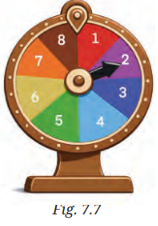
Answer:
Sample Space = S ={1,2,3,4,5,6,7,8}
Total outcomes = 8 .
(i) Probability that it will point at 8
P(8) = 1/8 = 0.125.
(ii)Probability that it will point at Odd numbers =
Favourable Outcomes={1,3,5,7} = 4
P(Odd) = 4/8 = 1/2 = 0.5.
(iii) Probability that it will point at Numbers > 2
Favourable Outcomes = {3,4,5,6,7,8} = 6 outcomes.
P= 6/8 = 3/4 = 0.75.
(iv) Probability that it will point at Numbers < 9
Favourable Outcomes ={1,2,3,4,5,6,7,8} → 8 outcomes.
P = 8/8 = 1 (Certain).
(v)Probability that it will point at Multiples of 3 =
Favourable Outcomes= {3,6} → 2 outcomes.
P = 2/8 = 1/4 = 0.25.
Q10. A basket contains 4 red balls and 5 blue balls. One ball is drawn and laid aside, and a second ball is drawn. Draw a tree diagram to represent the possible outcomes and probabilities. Use the tree diagram to answer the following questions. (i) What is the probability of drawing a red ball and then a blue ball? (ii) What is the probability of drawing 2 blue balls?
Answer:
A basket contains 4 red balls and 5 blue balls.
One ball is drawn and laid aside(without replacement ), then a second ball is drawn.
Total number of balls = 9
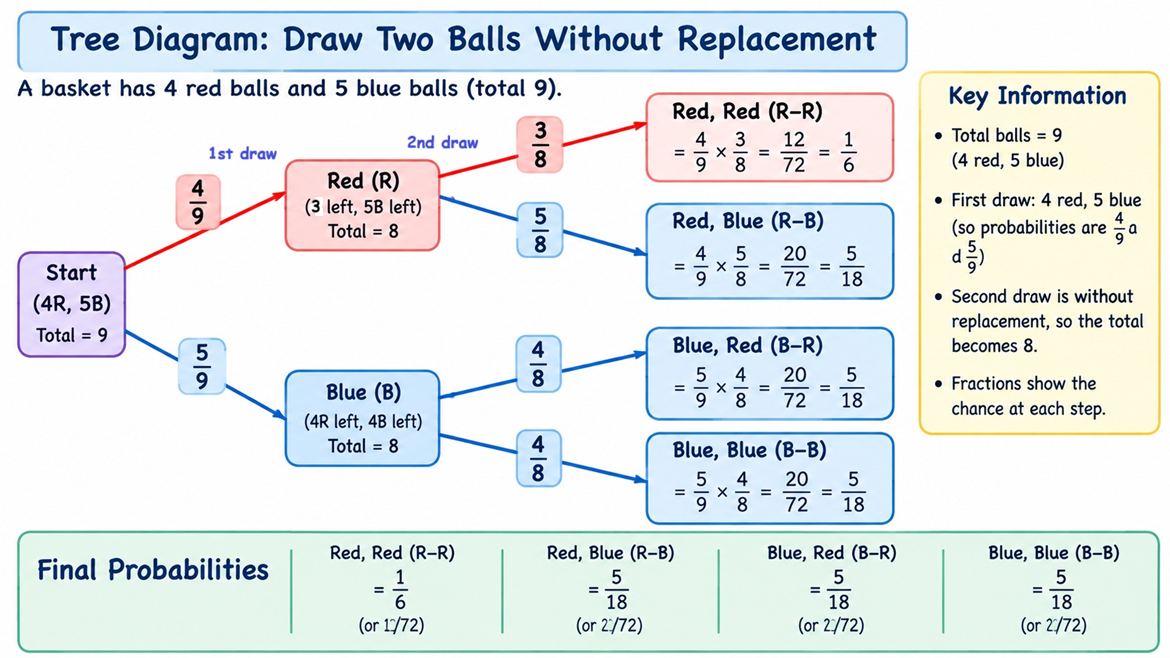
i) Probability of drawing a red ball and then a blue ball
First Draw (Red): The basket contains 4 red balls out of 9 total balls.
P(Red) = 4/9
after drawing 1 red ball ,remaining balls =8
3 Red and 5 Blue,
Second Draw (Blue):
So, Probability of second ball being blue: P(B) = 5/8
Probability of Red then Blue P(Red then Blue) = 4/9×5/8
=20/72
= 5/18
= 0.278
ii) Probability of drawing 2 blue balls
Probability of first ball being blue=
P(B)=5/9
After drawing one blue ball,remaining balls=8
Remaining blue balls =4
Probability of second Blue ball=
P(B)= 4/8
P(Blue then Blue)=5/9 ×4/8
=20/72
=5/18
Q11. I throw a pair of 6-sided dice. Write down an event that has a probability of 0 and an outcome that has a probability of 1.
Answer:
Event with probability 0:
For example,getting a sum = 13 on two dice
since maximum possible sum is 12,this event cannot occur.
P(sum=13)= 0
Event with probability 1:
For ex.
Getting a sum between 2 and 12 (inclusive) ,this event is certain when two dice are rolled.
P(sum between 2 and 12) = 1
Q12. Write the sample space and calculate the probability based on the given information. (i) Two dice are rolled. What is the probability that the sum is a prime number greater than 5? (ii) A bag contains 4 red, 3 green, and 2 blue balls. Two balls are drawn without replacement. What is the probability that both are of different colours? (iii) Three coins are tossed. What is the probability that the first coin shows heads and exactly two heads occur in total? (iv) A four-digit number is formed using the digits 1, 2, 3, and 4 with no repetition. What is the probability that the number is even? (v) A student takes a multiple-choice test with 3 questions, each having 4 options (A, B, C, D), with only one correct answer. What is the probability that the student guesses and gets exactly 2 answers correct?
Answer:
(i) Total number of outcomes when two dice are rolled= n(S) = 36.
Sums greater than 5 and prime are 7 , 11.
Favourable Outcomes :
When Sum =7, outcomes= {(2, 5), (1, 6), (3, 4), (4, 3), (6, 1), (5, 2)}→ 6 outcomes
Sum =11, Outcomes ={(5, 6), (6, 5)}→2 outcomes
Total Favourable Outcomes=6+2 = 8 ways.
Therefore, P = 8/36 = 2/9 ≈ 0.222.
(ii) The bag contains:
4 Red
3 Green
2 Blue
Total balls = 4+3+2=9 balls .
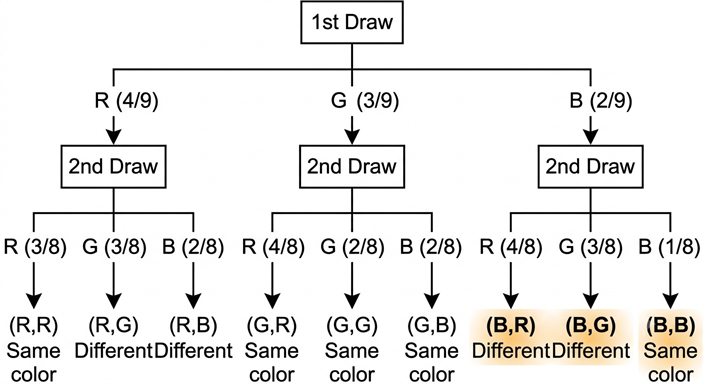
Total ways= 36.
Probability that both are of Different colours
=P(R,G)+P(R,B)+P(G,R)+P(G,B)+P(B,R)+P(B,G)
=(4/9 ×3/8)+(4/9 ×2/8)+(3/9 ×4/8)+(3/9 ×2/8)+(2/9 ×4/8)+(2/9 ×3/8)
= (12+8+12+6+8+6)/72
=52/72
=13/18
(iii) Three coins are tossed.
Sample space (S) = {HHH, HHT, HTH, THH, HTT, THT, TTH, TTT}
Event = First coin H and exactly two heads total: outcomes = {HHT, HTH}
No. of favourable outcomes = 2
Total no outcomes = 8
Probability = Number of favourable outcomes/Number of possible outcomes
= 2/8
= 1/4
= 0.25
(iv) Digits given are =1,2,3,4(no repetition).
To form 4 digit numbers,
Total numbers are =4×3×2×1= 24
Even numbers end with 2 or 4
when last digit = 2:
the remaining digits(1,3,4) can be arranged in 3×2×1 ways= 6 ways
When last digit =4
the remaining digits(1,2,3) can be arranged in 3×2×1 ways= 6 ways
Favourable outcomes= 6+6= 12
Probability = Number of favourable outcomes/ Number of possible outcomes
= 12/24
= 1/2
= 0.5
(v) Total ways = 4^3 = 64.
Probability of getting one correct answer is 1/4
Probability of getting one wrong answer is 3/4
Exactly 2 correct: choose 2 questions correct ,
each has 1 correct answer, the wrong one has 3 wrong options
the possible cases are C C W,C W C, W C C
probability of each case=1/4 ×1/4×3/4=3/64
Total probability=3 × 3/64
=9/64
Q13. A box contains 4 balls numbered 1 to 4. Record a sample space using a tree diagram for the following experiments: (i) A ball is drawn, and the number is recorded. Then the ball is returned, and a second ball is drawn and recorded. (ii) A ball is drawn and recorded. Without replacing the first ball, the experimenter draws and records a second ball. (iii) What are the sizes of these two sample spaces?
Answer:
(i) With replacement:
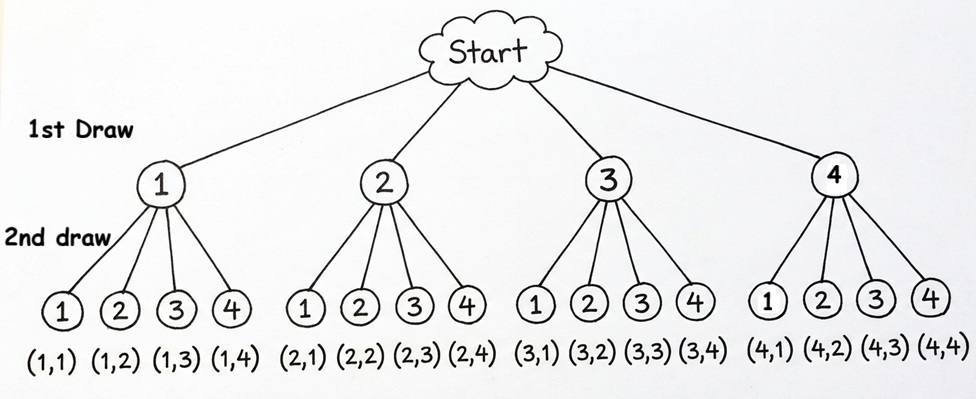
Tree diagram shows first draw (1,2,3,4) each branching to second draw (1,2,3,4).
Sample space size = n(S1) = 4×4 =16.
(ii) Without replacement: Tree diagram shows first draw (1,2,3,4) each branching to second draw excluding the first number.
Sample space size =n(S2)= 4×3 = 12.
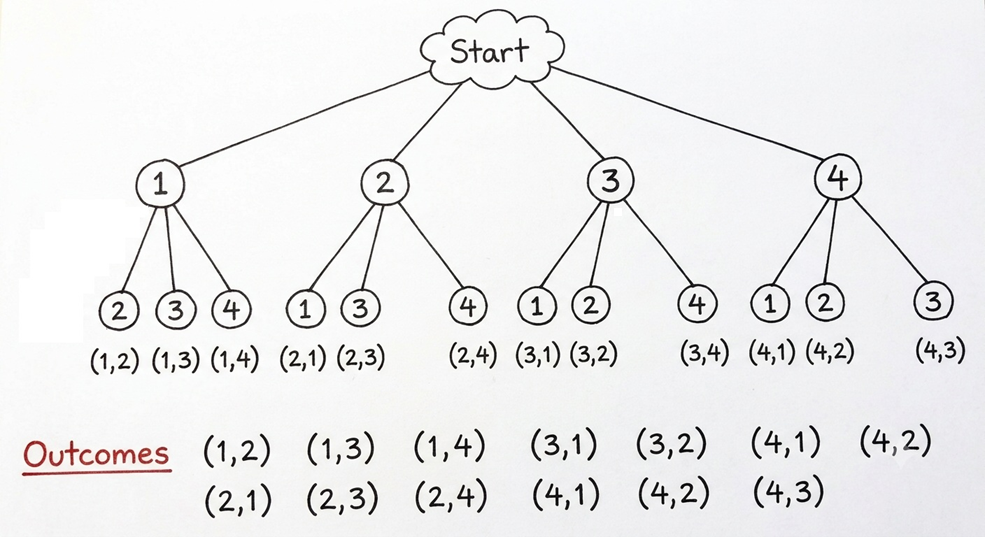
(iii) Sizes: With replacement =
Sample Space(S1) :n(S1)=16
and
Without replacement=
Sample Space(S2): n(S2)=12.
Q14. List the elements of a sample space for the simultaneous tossing of a coin and drawing of a card from a set of 6 cards numbered 1 through 6.
Answer:
A coin is tossed and a card is drawn simultaneously from a set of 6 cards numbered 1 through 6.
The possible outcomes for the coin are: H (Head) and T (Tail).
The possible outcomes for the card are: 1, 2, 3, 4, 5, 6.
Each coin outcome can occur with each of the six card outcomes. Therefore, the sample space is:
S = { (H,1), (H,2), (H,3), (H,4), (H,5), (H,6), (T,1), (T,2), (T,3), (T,4), (T,5), (T,6) }
Number of Elements
There are 2 possible outcomes for the coin and 6 possible outcomes for the card.
n(S) = 2 × 6 = 12
Final Answer
The sample space contains 12 elements:
S = { (H,1), (H,2), (H,3), (H,4), (H,5), (H,6), (T,1), (T,2), (T,3), (T,4), (T,5), (T,6) }
Q15. Three coins are tossed, and the number of heads is recorded. Which of the following lists is a sample space for this experiment? Why do the other lists fail to qualify as a sample space? (i) {1, 2, 3} (ii) {0, 1, 2} (iii) {0, 1, 2, 3, 4} (iv) {0, 1, 2, 3}
Answer:
Solution
Three coins are tossed and the number of heads is recorded.
The possible outcomes are:
- 0 heads: TTT
- 1 head: HTT, THT, TTH
- 2 heads: HHT, HTH, THH
- 3 heads: HHH
Therefore, the possible values for the number of heads are:
{0, 1, 2, 3}
Correct Answer
(iv) {0, 1, 2, 3}
Why do the other lists fail to qualify as a sample space?
| Option | List | Why it is incorrect |
|---|---|---|
| (i) | {1, 2, 3} | It does not include 0, which is possible when all three coins show tails (TTT). |
| (ii) | {0, 1, 2} | It does not include 3, which is possible when all three coins show heads (HHH). |
| (iii) | {0, 1, 2, 3, 4} | It includes 4, but it is impossible to get 4 heads when only three coins are tossed. |
| (iv) | {0, 1, 2, 3} | It contains all and only the possible values of the number of heads. Hence, it is the correct sample space. |
Q16. Suppose you drop a dye at random on the rectangular region shown in Fig. 7.8. What is the probability that it will land inside the circle with a diameter of 1m? 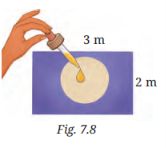
Answer:
Given:
- Length of the rectangular region = 3 m
- Breadth of the rectangular region = 2 m
- Diameter of the circle = 1 m
Step 1: Find the area of the rectangle
Area of rectangle = Length × Breadth
= 3 × 2 = 6 m2
Step 2: Find the area of the circle
Diameter = 1 m
Therefore, Radius = Diameter ÷ 2 = 1 ÷ 2 = 0.5 m
Area of circle = πr2
= π × (0.5)2
= π × 0.25 = π/4 m2
Step 3: Find the probability
Probability = Area of the circle ÷ Area of the rectangle
= (π/4) ÷ 6
= π/24
Answer:
Therefore, the probability that the dye will land inside the circle is:
π/24 ≈ 0.131