
NCERT Solutions – Class 10 Economics
Chapter 2: Sectors of the Indian Economy
This page provides NCERT solutions for Class 10 Economics Chapter 2, Sectors of the Indian Economy. The chapter explains how economic activities are classified into primary, secondary and tertiary sectors, and also into organised and unorganised sectors as well as public and private sectors. It discusses the changing importance of these sectors in India, the problem of underemployment and disguised unemployment, and ways to create more employment. Step-by-step solutions are provided for all margin questions, activities and exercises of the chapter.
LET’S WORK THESE OUT (Sectors of Economic Activities)
Question 1
Complete the above table to show how sectors are dependent on each other.
Ans: The sectors are highly interdependent. Some examples of this interdependence are:
| Example | What it shows |
|---|---|
| If farmers refuse to sell sugarcane to a sugar mill, the mill will have to shut down. | The secondary (industrial) sector depends on the primary sector. |
| If companies import all cotton they need from other countries, Indian cotton cultivation becomes less profitable and farmers may go bankrupt. | The primary sector depends on the secondary sector for demand. |
| If the price of fertilisers or pumpsets goes up, the cost of cultivation rises and farmers' profits fall. | Primary sector depends on the secondary sector for inputs. |
| If transporters strike and lorries refuse to carry vegetables and milk from rural areas, food becomes scarce in urban areas and farmers cannot sell their products. | Tertiary sector supports both primary and secondary sectors. |
Thus, all three sectors depend on each other for their smooth functioning.
Question 2
Explain the difference between primary, secondary and tertiary sectors using examples other than those mentioned in the text.
Ans: The differences between the three sectors are:
| Primary Sector | Secondary Sector | Tertiary Sector |
|---|---|---|
| Activities that directly use natural resources. | Activities that change natural products into other forms through manufacturing. | Activities that support the primary and secondary sectors by providing services. |
| Examples: growing rice, fishing, mining coal, rearing sheep for wool. | Examples: making rice flour from paddy, weaving woollen sweaters from wool, making steel from iron ore. | Examples: transporting rice flour to the market, banking services for weavers, selling sweaters in shops. |
The primary sector produces natural goods, the secondary sector produces manufactured goods, and the tertiary sector provides services that help the other two sectors.
Question 3
Classify the following list of occupations under primary, secondary and tertiary sectors:
- Tailor
- Basket weaver
- Flower cultivator
- Milk vendor
- Fishermen
- Priest
- Courier
- Workers in match factory
- Moneylender
- Gardener
- Potter
- Bee-keeper
- Astronaut
- Call centre employee
Ans:
| Primary Sector | Secondary Sector | Tertiary Sector |
|---|---|---|
| Flower cultivator | Tailor | Milk vendor |
| Fishermen | Basket weaver | Priest |
| Gardener | Workers in match factory | Courier |
| Potter | Potter | Moneylender |
| Bee-keeper | Astronaut | |
| Call centre employee |
Note: Potter is engaged in both primary (collecting clay) and secondary (making pots) activities, but mainly it is a secondary sector activity because it involves making goods from natural material. Gardener and bee-keeper are primary sector activities as they depend on natural processes.
Question 4
Students in a school are often classified into primary and secondary or junior and senior. What is the criterion that is used? Do you think this is a useful classification? Discuss.
Ans: The criterion used for classifying students into primary and secondary or junior and senior is the level of education or the age/class of the students. Primary students are in lower classes, while secondary students are in higher classes.
Yes, this classification is useful because:
- It helps in organising teaching methods and syllabus according to the age and understanding level of students.
- It helps in planning activities, examinations and facilities appropriate for each group.
- It makes administration and management of the school easier.
However, it should not lead to discrimination or labelling of students. The purpose is only to provide suitable education at each stage.
LET’S WORK THESE OUT (Comparing the Three Sectors)
Question 1
What does the history of developed countries indicate about the shifts that have taken place between sectors?
Ans: The history of developed countries indicates the following shifts between sectors:
- At initial stages of development: The primary sector was the most important sector of economic activity. Most goods produced were natural products and most people were employed in this sector.
- Over time: As new methods of manufacturing were introduced, factories came up and expanded. People who earlier worked on farms began to work in factories. The secondary sector gradually became the most important in total production and employment.
- In the past 100 years: There has been a further shift from the secondary to the tertiary sector in developed countries. The service sector has become the most important in terms of total production, and most working people are also employed in the service sector.
Thus, the general pattern is a shift from primary to secondary and then to tertiary sector.
Question 2
Correct and arrange the important aspects for calculating GDP from this Jumble.
To count goods and services we add the numbers that are produced. We count all those that were produced in the last five years. Since we shouldn’t leave out anything we add up all these goods and services.
Ans: The correct aspects for calculating GDP are:
- We use the values of goods and services, not the actual numbers.
- We count only the final goods and services, not intermediate goods.
- We count goods and services produced within a country during a particular year, not over five years.
- The sum of production in the three sectors gives the Gross Domestic Product (GDP).
Corrected statement:
To count goods and services, we add up the values of all final goods and services produced within a country during a particular year. We do not count intermediate goods, and we do not count goods produced over five years.
Question 3
Discuss with your teacher how you could calculate the total value of a good or service by using the method of value added at each stage.
Ans: The total value of a good or service can be calculated by using the method of value added at each stage. In this method, we add the value added by each producer at every stage of production, instead of adding the total value of the good at each stage.
Example:
- A farmer sells wheat to a flour mill for Rs 20 per kg. Value added by farmer = Rs 20.
- The mill grinds wheat and sells flour to a biscuit company for Rs 25 per kg. Value added by mill = Rs 25 − Rs 20 = Rs 5.
- The biscuit company makes biscuits and sells them to consumers for Rs 80 (Rs 20 per packet for 4 packets). Value added by biscuit company = Rs 80 − Rs 25 = Rs 55.
- Total value added = Rs 20 + Rs 5 + Rs 55 = Rs 80, which is the value of the final good (biscuits).
This method avoids double counting because the value of intermediate goods is not counted separately.
LET’S WORK THESE OUT (Primary, Secondary and Tertiary Sectors in India)
Question 1
Answer the following questions by looking at the graph:
- Which was the largest producing sector in 1977–78?
- Which is the largest producing sector in 2017–18?
- Can you say which sector has grown the most over forty years?
- What was the GDP of India in 2017–18?
Ans:
(i) Largest producing sector in 1977–78: The primary sector was the largest producing sector in 1977–78.
(ii) Largest producing sector in 2017–18: The tertiary (service) sector became the largest producing sector in 2017–18, replacing the primary sector.
(iii) Sector that grew the most over forty years: The tertiary sector grew the most over the forty years between 1977–78 and 2017–18.
(iv) GDP of India in 2017–18: According to the graph, the total GDP of India in 2017–18 was approximately Rs 1,30,00,000 crores (about 130 lakh crore rupees). Students should read the exact value from the graph given in the textbook.
LET’S WORK THESE OUT (How to Create More Employment?)
Question 1
Complete the table using the data given in Graphs 2 and 3 and answer the question that follows. Ignore if data are not available for some years.
| 1977-78 | 2017-18 | |
|---|---|---|
| Share in Gross Value Added (GVA) | ||
| Share in employment |
What are the changes that you observe in the primary sector over a span of forty years?
Ans:
Completed table (approximate values based on Graphs 2 and 3):
| 1977-78 | 2017-18 | |
|---|---|---|
| Share in Gross Value Added (GVA) | About 40% | About 15% |
| Share in employment | About 70% | About 45% |
Changes observed in the primary sector over forty years:
- The share of the primary sector in GVA declined significantly, from about 40% in 1977–78 to about 15% in 2017–18.
- The share of the primary sector in employment also declined, but not to the same extent. It remained the largest employer even in 2017–18.
- This shows that while the primary sector's contribution to total production has fallen, it still employs a large proportion of workers.
- This indicates underemployment and disguised unemployment in agriculture.
Question 2
Choose the correct answer:
Underemployment occurs when people
- (i) do not want to work
- (ii) are working in a lazy manner
- (iii) are working less than what they are capable of doing
- (iv) are not paid for their work
Ans: The correct answer is (iii) are working less than what they are capable of doing.
Underemployment, also called disguised unemployment, is a situation where people are apparently working but all of them are made to work less than their potential. For example, in agriculture, more people may work on a farm than actually needed, so their labour effort gets divided and no one is fully employed.
Question 3
Compare and contrast the changes in India with the pattern that was observed for developed countries. What kind of changes between sectors were desired but did not happen in India?
Ans:
Comparison with developed countries:
| Developed Countries | India |
|---|---|
| Shift from primary to secondary sector in terms of both production and employment. | Production shifted from primary to tertiary sector, but employment did not shift proportionately. |
| Then shift from secondary to tertiary sector in both production and employment. | Tertiary sector became largest in production, but primary sector remains largest employer. |
| Most workers are employed in the service sector. | More than half of workers are still in the primary sector, mainly agriculture. |
Changes desired but did not happen in India:
- A similar shift out of the primary sector did not happen in employment.
- Not enough jobs were created in the secondary and tertiary sectors.
- Industrial output and service production increased, but employment in these sectors did not rise to the same extent.
- As a result, underemployment continues in agriculture.
Question 4
Why should we be worried about underemployment?
Ans: We should be worried about underemployment because:
- People are working less than their potential, so their income remains low.
- Their standard of living does not improve even though they work throughout the year.
- It leads to wastage of human resources and labour.
- It hides the real problem of unemployment, as people appear to be working but are not fully employed.
- It keeps productivity and income low in agriculture and other sectors.
- It also affects the overall development of the economy.
Therefore, reducing underemployment is necessary for increasing income, improving living standards and ensuring better use of human resources.
Question 5
1. Why do you think MGNREGA 2005 or Viksit Bharat-G RAM G 2025 is referred to as ‘Right to work’?
2. Imagine that you are the village head. In that capacity suggest some activities that you think should be taken up under this Act that would also increase the income of people? Discuss.
3. How would income and employment increase if farmers were provided with irrigation and marketing facilities?
4. In what ways can employment be increased in urban areas?
Ans:
1. Why MGNREGA 2005 or Viksit Bharat-G RAM G 2025 is referred to as ‘Right to work’:
It is referred to as ‘Right to work’ because under this Act, all those who are able to work and are in need of work in rural areas are guaranteed 100 days of employment in a year by the government. If the government fails to provide employment, it has to give unemployment allowances to the people. This makes work a legal right for rural people.
2. Activities as village head under this Act:
- Construction and repair of village roads.
- Digging and cleaning of ponds and canals for irrigation.
- Planting trees and creating community forests.
- Building check dams and water harvesting structures.
- Construction of school buildings and health centres.
- Land development and soil conservation works.
These activities would create employment and also increase the income and productivity of the people.
3. How income and employment increase with irrigation and marketing facilities:
- Irrigation allows farmers to grow a second crop in the rabi season, which needs more labour and creates employment.
- Higher production means more income from selling crops.
- Marketing facilities help farmers get better prices for their produce, increasing their income.
- Transport and storage facilities create additional employment in transport, trade and storage.
- Setting up agro-based industries like dal mills or cold storage creates more jobs in semi-rural areas.
4. Ways to increase employment in urban areas:
- Promoting small-scale industries and service enterprises.
- Developing IT, tourism and other service sectors.
- Improving infrastructure like roads, transport and housing.
- Providing training and skill development for workers.
- Encouraging self-employment through easy credit and support.
- Strengthening public services like education, health and sanitation, which need more workers.
LET’S WORK THESE OUT (Division of Sectors as Organised and Unorganised)
Question 1
Look at the following examples. Which of these are unorganised sector activities?
- (i) A teacher taking classes in a school
- (ii) A headload worker carrying a bag of cement on his back in a market
- (iii) A farmer irrigating her field
- (iv) A doctor in a hospital treating a patient
- (v) A daily wage labourer working under a contractor
- (vi) A factory worker going to work in a big factory
- (vii) A handloom weaver working in her house
Ans: The unorganised sector activities are:
- (ii) A headload worker carrying a bag of cement on his back in a market – He is a casual worker with no job security or benefits.
- (iii) A farmer irrigating her field – Farmers work on their own and hire labourers as and when required; agriculture is largely unorganised.
- (v) A daily wage labourer working under a contractor – Daily wage labourers have no regular employment or benefits.
- (vii) A handloom weaver working in her house – This is a small, scattered unit outside government control.
The organised sector activities are (i) teacher in a school, (iv) doctor in a hospital, and (vi) factory worker in a big factory, as these have regular terms of employment and benefits.
Question 2
Talk to someone who has a regular job in the organised sector and another who works in the unorganised sector. Compare and contrast their working conditions in all aspects.
Ans: This is an activity-based question. Students should talk to people and compare their working conditions. A general comparison is given below:
| Aspect | Organised Sector | Unorganised Sector |
|---|---|---|
| Terms of employment | Regular and formal; appointment letter given | Irregular and informal; no appointment letter |
| Working hours | Fixed hours; overtime paid for extra work | Long and variable hours; no overtime payment |
| Job security | Secure; cannot be removed without reason | Not secure; can be asked to leave anytime |
| Benefits | Provident fund, gratuity, medical benefits, pension | No such benefits |
| Leave and holidays | Paid leave and holidays | No paid leave or holidays |
| Wages | Regular and fair as per laws | Low and often irregular |
Question 3
How would you distinguish between organised and unorganised sectors? Explain in your own words.
Ans: The organised and unorganised sectors can be distinguished as follows:
- Organised sector: Enterprises or places of work where the terms of employment are regular, people have assured work, and they are registered by the government and follow its rules and regulations. Workers enjoy security of employment and get benefits like paid leave, provident fund, gratuity, medical benefits and pension.
- Unorganised sector: Small and scattered units largely outside the control of the government. Rules and regulations exist but are not followed. Jobs are low-paid and often not regular. There is no provision for overtime, paid leave, holidays or sick leave. Employment is not secure and workers can be asked to leave without any reason.
In short, the organised sector offers secure and regulated employment, while the unorganised sector offers insecure and unregulated employment.
Question 4
The table below shows the estimated number of workers in India in the organised and unorganised sectors in the late 1990s. Read the table carefully. Fill in the missing data and answer the questions that follow.
| Sector | Organised | Unorganised | Total |
|---|---|---|---|
| Primary | 1 | 232 | |
| Secondary | 41 | 74 | 115 |
| Tertiary | 40 | 88 | 128 |
| Total | 82 | ||
| Total in Percentage | 100% |
- What is the percentage of people in the unorganised sector in agriculture?
- Do you agree that agriculture is an unorganised sector activity? Why?
- If we look at the country as a whole, we find that ———% of the workers in India are in the unorganised sector. Organised sector employment is available to only about ———% of the workers in India.
Ans:
Completed table:
| Sector | Organised | Unorganised | Total |
|---|---|---|---|
| Primary | 1 | 232 | 233 |
| Secondary | 41 | 74 | 115 |
| Tertiary | 40 | 88 | 128 |
| Total | 82 | 394 | 476 |
| Total in Percentage | 17% | 83% | 100% |
(i) Percentage of people in the unorganised sector in agriculture:
Unorganised workers in primary sector = 232 out of total 233 workers in primary sector.
Percentage = (232 ÷ 233) × 100 ≈ 99.6% (almost 100%).
(ii) Do you agree that agriculture is an unorganised sector activity? Why?
Yes, agriculture is largely an unorganised sector activity because:
- Farmers work on their own and hire labourers as and when required.
- There are no formal terms of employment, no appointment letters, and no job security.
- Agricultural workers do not get benefits like provident fund, gratuity or paid leave.
- Wages are low and often irregular.
(iii) Percentage of workers in unorganised and organised sectors:
About 83% of the workers in India are in the unorganised sector. Organised sector employment is available to only about 17% of the workers in India.
LET’S RECALL
Question 1
What was the most important conclusion that was derived from the classification exercises? What were the problems and solutions that were indicated? Can you summarise the information in the following table?
| Sector | Criteria used | Most important conclusion | Problems indicated and how they can be tackled |
|---|---|---|---|
| Primary, Secondary, Tertiary | Nature of activity | ||
| Organised, Unorganised |
Ans:
| Sector | Criteria used | Most important conclusion | Problems indicated and how they can be tackled |
|---|---|---|---|
| Primary, Secondary, Tertiary | Nature of activity | While the tertiary sector contributes the most to GVA/GDP, the primary sector continues to be the largest employer. | Problem: Underemployment and disguised unemployment in agriculture; low productivity. Solution: Provide irrigation, credit, marketing facilities; create jobs in secondary and tertiary sectors; promote industries in semi-rural areas. |
| Organised, Unorganised | Employment conditions | Most workers (about 83%) are in the unorganised sector, which offers low-paid and insecure jobs. | Problem: Workers are exploited, low wages, no job security or benefits, social discrimination. Solution: Provide protection and support to unorganised sector workers; ensure fair wages, safety and health measures; provide credit and marketing support. |
EXERCISES
Question 1
Fill in the blanks using the correct option given in the bracket:
- Employment in the service sector _________ increased to the same extent as production. (has / has not)
- Workers in the _________ sector do not produce goods. (tertiary / agricultural)
- Most of the workers in the _________ sector enjoy job security. (organised / unorganised)
- A _________ proportion of labourers in India are working in the unorganised sector. (large / small)
- Cotton is a _________ product and cloth is a _________ product. [natural / manufactured]
- The activities in primary, secondary and tertiary sectors are_________ [independent / interdependent]
Ans:
- Employment in the service sector has not increased to the same extent as production.
- Workers in the tertiary sector do not produce goods.
- Most of the workers in the organised sector enjoy job security.
- A large proportion of labourers in India are working in the unorganised sector.
- Cotton is a natural product and cloth is a manufactured product.
- The activities in primary, secondary and tertiary sectors are interdependent.
Question 2
Choose the most appropriate answer.
(a) The sectors are classified into public and private sector on the basis of:
- (i) employment conditions
- (ii) the nature of economic activity
- (iii) ownership of enterprises
- (iv) number of workers employed in the enterprise
(b) Production of a commodity, mostly through the natural process, is an activity in _________ sector.
- (i) primary
- (ii) secondary
- (iii) tertiary
- (iv) information technology
(c) GDP is the total value of _________ produced during a particular year.
- (i) all goods and services
- (ii) all final goods and services
- (iii) all intermediate goods and services
- (iv) all intermediate and final goods and services
(d) In terms of GVA the share of tertiary sector in 2017–18 is between _________ per cent.
- (i) 20 to 30
- (ii) 30 to 40
- (iii) 50 to 60
- (iv) 60 to 70
Ans:
(a) The correct answer is (iii) ownership of enterprises.
(b) The correct answer is (i) primary.
(c) The correct answer is (ii) all final goods and services.
(d) The correct answer is (iii) 50 to 60.
Question 3
Match the following:
| Problems faced by farming sector | Some possible measures |
|---|---|
| 1. Unirrigated land | (a) Setting up agro-based mills |
| 2. Low prices for crops | (b) Cooperative marketing societies |
| 3. Debt burden | (c) Procurement of food grains by government |
| 4. No job in the off season | (d) Construction of canals by the government |
| 5. Compelled to sell their grains to the local traders soon after harvest | (e) Banks to provide credit with low interest |
Ans: The correct matches are:
| Problems faced by farming sector | Correct Match |
|---|---|
| 1. Unirrigated land | (d) Construction of canals by the government |
| 2. Low prices for crops | (c) Procurement of food grains by government |
| 3. Debt burden | (e) Banks to provide credit with low interest |
| 4. No job in the off season | (a) Setting up agro-based mills |
| 5. Compelled to sell their grains to the local traders soon after harvest | (b) Cooperative marketing societies |
Question 4
Find the odd one out and say why.
- (i) Tourist guide, dhobi, tailor, potter
- (ii) Teacher, doctor, vegetable vendor, lawyer
- (iii) Postman, cobbler, soldier, police constable
- (iv) MTNL, Indian Railways, Air India, Jet Airways, All India Radio
Ans:
(i) Odd one out: Potter. Tourist guide, dhobi and tailor are tertiary sector activities (services), while potter is a secondary sector activity (manufacturing goods from clay).
(ii) Odd one out: Vegetable vendor. Teacher, doctor and lawyer are highly skilled tertiary sector workers, while vegetable vendor is a small trader in the unorganised tertiary sector with low skill requirements.
(iii) Odd one out: Cobbler. Postman, soldier and police constable are government (public sector) employees, while cobbler is a self-employed worker in the unorganised sector.
(iv) Odd one out: Jet Airways. MTNL, Indian Railways, Air India and All India Radio are public sector enterprises owned by the government, while Jet Airways is a private sector airline.
Question 5
A research scholar looked at the working people in the city of Surat and found the following.
| Percentage of working people | Nature of employment | Place of work |
|---|---|---|
| 15 | Organised | In offices and factories registered with the government |
| 15 | Own shops, office, clinics in marketplaces with formal license | |
| 20 | People working on the street, construction workers, domestic workers | |
| 50 | Working in small workshops usually not registered with the government |
Complete the table. What is the percentage of workers in the unorganised sector in this city?
Ans:
Completed table:
| Percentage of working people | Nature of employment | Place of work |
|---|---|---|
| 15 | Organised | In offices and factories registered with the government |
| 15 | Unorganised | Own shops, office, clinics in marketplaces with formal license |
| 20 | Unorganised | People working on the street, construction workers, domestic workers |
| 50 | Unorganised | Working in small workshops usually not registered with the government |
Percentage of workers in the unorganised sector:
Unorganised sector workers = 15% + 20% + 50% = 85%.
Therefore, 85% of the workers in Surat are in the unorganised sector.
Question 6
Do you think the classification of economic activities into primary, secondary and tertiary is useful? Explain how.
Ans: Yes, the classification of economic activities into primary, secondary and tertiary is useful because:
- It helps us understand the different types of activities people are engaged in.
- It shows the contribution of each sector to the total production (GDP/GVA) of the country.
- It helps in analysing the pattern of employment in different sectors.
- It reveals the changing importance of sectors over time, such as the rising importance of the tertiary sector.
- It helps the government to plan and make policies for different sectors.
- It helps in identifying problems like underemployment in agriculture and finding solutions.
Thus, this classification is very useful for understanding and analysing the economy.
Question 7
For each of the sectors that we came across in this chapter why should one focus on employment and GVA? Could there be other issues which should be examined? Discuss.
Ans:
Why focus on employment and GVA:
- Employment: It tells us how many people are working in each sector and whether they have productive work. It helps identify problems like unemployment and underemployment.
- GVA (Gross Value Added): It tells us how much each sector contributes to the total production of the country. It helps us understand which sector is growing and which is declining.
Other issues that should be examined:
- Quality of employment and working conditions.
- Job security and benefits like provident fund, gratuity and paid leave.
- Wages and income levels of workers.
- Distribution of income and wealth.
- Environmental sustainability of economic activities.
- Health, education and skill development of workers.
- Social discrimination in employment.
- Protection of workers in the unorganised sector.
These issues are important for the overall development and well-being of the people.
Question 8
Make a long list of all kinds of work that you find adults around you doing for a living. In what way can you classify them? Explain your choice.
Ans: This is an activity-based question. Students should observe the adults around them and make a list. A sample list and classification is given below:
| Work | Sector |
|---|---|
| Farmer growing crops | Primary |
| Milkman selling milk | Primary / Tertiary |
| Factory worker making cloth | Secondary |
| Carpenter making furniture | Secondary |
| Teacher teaching in school | Tertiary |
| Doctor treating patients | Tertiary |
| Shopkeeper selling goods | Tertiary |
| Auto driver transporting people | Tertiary |
| Government clerk | Tertiary (Organised, Public) |
| Domestic worker | Tertiary (Unorganised) |
The classification can be done on the basis of the nature of activity (primary, secondary, tertiary) and on the basis of employment conditions (organised or unorganised).
Question 9
How is the tertiary sector different from other sectors? Illustrate with a few examples.
Ans: The tertiary sector is different from the primary and secondary sectors in the following ways:
- The primary sector produces natural goods by directly using natural resources.
- The secondary sector produces manufactured goods by changing natural products into other forms.
- The tertiary sector does not produce a good. It provides services that support the primary and secondary sectors.
Examples:
- Transporting cotton from farms to factories is a tertiary activity.
- Banking services that provide loans to farmers are tertiary activities.
- Teaching in schools and treating patients in hospitals are tertiary activities.
- Trade, storage, communication and insurance are tertiary activities.
Thus, the tertiary sector is also called the service sector.
Question 10
What do you understand by disguised unemployment? Explain with an example each from the urban and rural areas.
Ans: Disguised unemployment is a situation where more people are working on a job than actually required. People appear to be employed, but all of them are working less than their potential. It is also called underemployment.
Rural example: A small farmer, Laxmi, owns two hectares of unirrigated land. All five members of her family work on the plot throughout the year, even though the work could be done by two or three people. If two members move out to work elsewhere, production on the farm will not be affected. This is disguised unemployment in agriculture.
Urban example: In cities, many casual workers work as painters, plumbers, repair persons or street vendors. Several of them do not find work every day or earn very little even after working the whole day. More people are engaged in these jobs than are actually needed, which is a form of disguised unemployment in the service sector.
Question 11
Distinguish between open unemployment and disguised unemployment.
Ans:
| Open Unemployment | Disguised Unemployment |
|---|---|
| People who are able to work and are willing to work but do not find any job. | People appear to be working but are working less than their potential. |
| Unemployment is clearly visible. | Unemployment is hidden. |
| Example: An educated youth looking for a job but not getting one. | Example: Five family members working on a small farm that needs only two or three workers. |
| It is easy to identify such people. | It is difficult to identify such people. |
Question 12
“Tertiary sector is not playing any significant role in the development of Indian economy.” Do you agree? Give reasons in support of your answer.
Ans: No, I do not agree with this statement. The tertiary sector is playing a very significant role in the development of the Indian economy.
Reasons:
- The tertiary sector has emerged as the largest producing sector in India, contributing more than half of the Gross Value Added (GVA) in 2017–18.
- Basic services like hospitals, educational institutions, post and telegraph, police stations, courts, defence, transport, banks and insurance are essential for any country.
- The development of agriculture and industry leads to the development of services like transport, trade and storage.
- As income levels rise, people demand more services like eating out, tourism, shopping, private hospitals and private schools.
- New services based on information and communication technology, such as call centres, software companies and internet services, have become important and are growing rapidly.
Therefore, the tertiary sector is playing a major role in the development of the Indian economy.
Question 13
Service sector in India employs two different kinds of people. Who are these?
Ans: The service sector in India employs two different kinds of people:
- Highly skilled and educated workers: These include a limited number of people working in services such as information technology, software companies, call centres, finance, banking, education and healthcare. They earn good salaries and have secure jobs.
- Low-skilled and less educated workers: These include a very large number of workers engaged in services such as small shopkeeping, repair work, transport, street vending and domestic work. They barely manage to earn a living and often work in the unorganised sector.
Thus, only a part of the service sector is growing in importance and provides good employment, while a large part provides low-paid and insecure work.
Question 14
Workers are exploited in the unorganised sector. Do you agree with this view? Give reasons in support of your answer.
Ans: Yes, I agree that workers are exploited in the unorganised sector. The reasons are:
- Jobs are low-paid and often not regular.
- There is no provision for overtime payment, paid leave, holidays or sick leave.
- Employment is not secure; workers can be asked to leave without any reason.
- Workers do not get benefits like provident fund, gratuity, medical benefits or pension.
- Working hours are long and working conditions may be unsafe.
- Many workers, especially from scheduled castes, tribes and backward communities, also face social discrimination.
- They are often not paid a fair wage and have no job security.
Therefore, workers in the unorganised sector need protection and support.
Question 15
How are the activities in the economy classified on the basis of employment conditions?
Ans: On the basis of employment conditions, the activities in the economy are classified into two sectors:
- Organised sector: Enterprises or places of work where the terms of employment are regular and people have assured work. They are registered by the government and follow its rules and regulations. Workers enjoy security of employment and get benefits like paid leave, provident fund, gratuity, medical benefits and pension.
- Unorganised sector: Small and scattered units largely outside the control of the government. Rules and regulations exist but are not followed. Jobs are low-paid and often not regular. There is no provision for overtime, paid leave, holidays or sick leave. Employment is not secure.
Question 16
Compare the employment conditions prevailing in the organised and unorganised sectors.
Ans:
| Organised Sector | Unorganised Sector |
|---|---|
| Terms of employment are regular and formal. | Terms of employment are irregular and informal. |
| Workers have assured work and job security. | Workers have no job security; can be asked to leave anytime. |
| Fixed working hours; overtime paid for extra work. | Long and variable working hours; no overtime payment. |
| Workers get paid leave, holidays, provident fund, gratuity, medical benefits and pension. | No such benefits are available. |
| Enterprises are registered and follow government rules. | Units are largely outside government control; rules are not followed. |
| Wages are regular and fair as per laws. | Wages are low and often irregular. |
Question 17
Explain the objective of implementing the MGNREGA 2005 or Viksit Bharat-G RAM G 2025.
Ans: The objective of implementing the MGNREGA 2005 or Viksit Bharat-G RAM G 2025 is to provide guaranteed employment to people in rural areas.
Main objectives:
- To guarantee 100 days of employment in a year to all those who are able to work and are in need of work in rural areas.
- To provide unemployment allowances if the government fails to provide employment.
- To create productive assets that would help increase production from land, such as irrigation works, roads and water conservation structures.
- To reduce underemployment and disguised unemployment in agriculture.
- To increase the income and purchasing power of rural people.
- To ensure the right to work as a legal right for rural people.
Question 18
Using examples from your area compare and contrast that activities and functions of private and public sectors.
Ans: This is an activity-based question. Students should compare the public and private sectors in their area. A general comparison is given below:
| Public Sector | Private Sector |
|---|---|
| Government owns most of the assets and provides services. | Ownership of assets and delivery of services is in the hands of private individuals or companies. |
| Main purpose is not just to earn profit but to provide services to the people. | Main motive is to earn profits. |
| Examples: Railways, post office, government schools, government hospitals, police stations, municipal services. | Examples: Tata Iron and Steel Company Limited (TISCO), Reliance Industries Limited (RIL), private schools, private hospitals, private transport companies. |
| Services are available to all at reasonable cost. | Services are available to those who can pay the price. |
Question 19
Discuss and fill the following table giving one example each from your area.
| Well managed organisation | Badly managed organisation | |
|---|---|---|
| Public sector | ||
| Private sector |
Ans: This is an activity-based question. Students should fill the table based on their observations in their area. A sample answer is given below:
| Well managed organisation | Badly managed organisation | |
|---|---|---|
| Public sector | Indian Railways (efficient services in many regions) | A poorly maintained government hospital or school with shortage of staff |
| Private sector | A well-run private hospital or school with good facilities | A private shop or factory that does not pay fair wages or follow safety rules |
Students should give reasons for their choices based on their own observations.
Question 20
Give a few examples of public sector activities and explain why the government has taken them up.
Ans: Examples of public sector activities are:
- Railways
- Post and telegraph services
- Police stations
- Courts
- Village administrative offices
- Municipal corporations
- Defence
- Public transport
- Banks and insurance companies
- Construction of roads, bridges, railways, harbours and dams
- Generation and supply of electricity
- Government schools and hospitals
Why the government has taken them up:
- These activities require large sums of money, which is beyond the capacity of the private sector.
- Collecting money from thousands of people who use these facilities is not easy.
- If the private sector provides these services, it would charge a high rate, which many people cannot afford.
- Some activities need government support because the private sector may not continue them unless encouraged.
- Providing health and education facilities for all is the primary responsibility of the government.
- The government must take care of the poorest and most ignored regions of the country.
Question 21
Explain how public sector contributes to the economic development of a nation.
Ans: The public sector contributes to the economic development of a nation in the following ways:
- It provides basic services like roads, bridges, railways, harbours, electricity and irrigation, which are essential for the development of agriculture and industry.
- It provides health and education facilities, which improve the quality of human resources.
- It supports farmers by buying food grains at fair prices and selling them at lower prices through ration shops.
- It provides electricity and other inputs at affordable rates to industries, especially small-scale industries.
- It takes up activities that require large investments and which the private sector cannot undertake.
- It pays attention to the development of the poorest and most ignored regions of the country.
- It ensures that essential goods and services are available to all at reasonable prices.
Thus, the public sector plays a key role in the overall development of the nation.
Question 22
The workers in the unorganised sector need protection on the following issues: wages, safety and health. Explain with examples.
Ans: Workers in the unorganised sector need protection on the following issues:
- Wages: Workers in the unorganised sector are often paid low wages and sometimes not paid on time. For example, a daily wage labourer working under a contractor may not get the minimum wage or may not be paid for all days worked. They need protection to ensure fair and regular wages.
- Safety: Working conditions in the unorganised sector may be unsafe. For example, construction workers may work without helmets or safety equipment, and factory workers in small workshops may work with dangerous machines. They need protection to ensure a safe working environment.
- Health: Unorganised sector workers do not get medical benefits or paid sick leave. For example, a street vendor or domestic worker who falls ill loses income for those days and may not be able to afford treatment. They need protection to ensure access to healthcare and paid sick leave.
Thus, protection is necessary for the economic and social development of these workers.
Question 23
A study in Ahmedabad found that out of 15,00,000 workers in the city, 11,00,000 worked in the unorganised sector. The total income of the city in this year (1997-1998) was Rs 60,000 million. Out of this Rs 32,000 million was generated in the organised sector. Present this data as a table. What kind of ways should be thought of for generating more employment in the city?
Ans:
Data presented as a table:
| Sector | Number of Workers | Income Generated (Rs in million) |
|---|---|---|
| Organised | 4,00,000 | 32,000 |
| Unorganised | 11,00,000 | 28,000 |
| Total | 15,00,000 | 60,000 |
Ways to generate more employment in the city:
- Promoting small-scale industries and service enterprises.
- Developing IT, tourism and other service sectors.
- Improving infrastructure like roads, transport, housing and sanitation.
- Providing training and skill development for workers.
- Encouraging self-employment through easy credit and support.
- Strengthening public services like education, health and sanitation, which need more workers.
- Setting up agro-based and other industries that can provide employment to both skilled and unskilled workers.
Question 24
The following table gives the GVA in Rupees (Crores) by the three sectors:
| Year | Primary | Secondary | Tertiary |
|---|---|---|---|
| 2001-02 | 13,23,000 | 10,40,000 | 19,31,000 |
| 2021-22 | 24,79,400 | 40,73,000 | 73,25,000 |
- Calculate the share of the three sectors in GDP for 2000 and 2013.
- Show the data as a bar diagram similar to Graph 2 in the chapter.
- What conclusions can we draw from the bar graph?
Ans:
(i) Share of the three sectors in GDP:
For 2001-02:
Total GDP = 13,23,000 + 10,40,000 + 19,31,000 = 42,94,000 crores
- Primary sector share = (13,23,000 ÷ 42,94,000) × 100 ≈ 30.8%
- Secondary sector share = (10,40,000 ÷ 42,94,000) × 100 ≈ 24.2%
- Tertiary sector share = (19,31,000 ÷ 42,94,000) × 100 ≈ 45.0%
For 2021-22:
Total GDP = 24,79,400 + 40,73,000 + 73,25,000 = 1,38,77,400 crores
- Primary sector share = (24,79,400 ÷ 1,38,77,400) × 100 ≈ 17.9%
- Secondary sector share = (40,73,000 ÷ 1,38,77,400) × 100 ≈ 29.3%
- Tertiary sector share = (73,25,000 ÷ 1,38,77,400) × 100 ≈ 52.8%
(ii) Bar diagram:
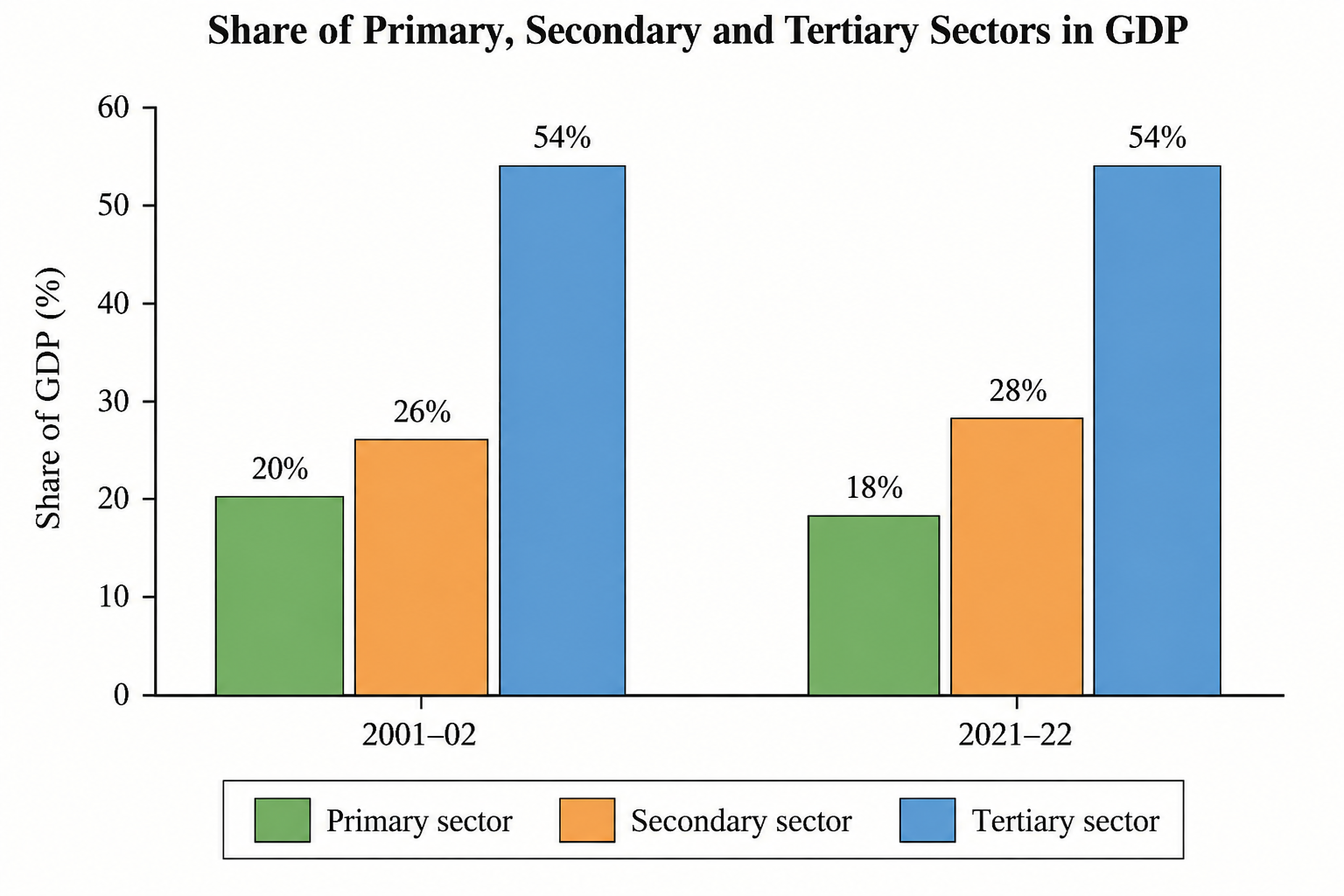
(iii) Conclusions from the bar graph:
- The share of the primary sector in GDP has declined from about 31% in 2001-02 to about 18% in 2021-22.
- The share of the secondary sector has increased from about 24% to about 29%.
- The share of the tertiary sector has increased from about 45% to about 53%, and it remains the largest contributing sector.
- This shows the rising importance of the tertiary sector and the declining importance of the primary sector in India's GDP.