
NCERT Solutions – Class 10 Economics
Chapter 1: Development
This page provides NCERT solutions for Class 10 Economics Chapter 1, Development. The chapter explains what development means to different people, how income and other goals matter, and how countries and states are compared using per capita income and human development indicators. It also discusses sustainability of development and the need to use resources wisely for future generations. Step-by-step solutions are provided for all margin questions, activities and exercises of the chapter.
LET’S WORK THESE OUT (What Development Promises — Different People, Different Goals)
Question 1
Why do different persons have different notions of development? Which of the following explanations is more important and why?
- (a) Because people are different.
- (b) Because life situations of persons are different.
Ans: The more important explanation is (b) Because life situations of persons are different.
People have different notions of development because they live in different circumstances and face different problems. A landless rural labourer wants regular work, better wages and quality education for children. A prosperous farmer wants higher support prices and cheap labour. A girl from a rich urban family wants freedom and opportunities equal to her brother. Thus, it is not merely that people are different in nature; their developmental goals arise from their actual life situations and needs.
Question 2
Do the following two statements mean the same? Justify your answer.
- (a) People have different developmental goals.
- (b) People have conflicting developmental goals.
Ans: No, the two statements do not mean the same.
- (a) People have different developmental goals: This means different people may seek different things, such as more income, freedom, security or respect. These goals may simply be different, without necessarily opposing each other.
- (b) People have conflicting developmental goals: This means the goals of different people may directly oppose each other. What is development for one person may be harmful or destructive for another.
For example, an industrialist may want more dams for electricity, while tribal people displaced by the dam may oppose it because it submerges their land and disrupts their lives. Thus, different goals may sometimes, but not always, become conflicting goals.
Question 3
Give some examples where factors other than income are important aspects of our lives.
Ans: Some examples where factors other than income are important are:
- Equal treatment: People want to be treated with dignity and without discrimination in society and at the workplace.
- Freedom: A person may prefer a job with less pay but more freedom and time for family.
- Security: Regular employment with job security may be preferred over higher pay with no security.
- Respect: Women who do paid work gain greater dignity in the household and society, but respect for women also leads to more sharing of housework.
- Safe and secure environment: A safe environment allows more women to take up jobs or run businesses.
- Friendship and relationships: Friendship and good relationships cannot be bought with money but are very important in life.
- Clean environment: Money cannot buy a pollution-free environment unless the whole community takes preventive steps.
Question 4
Explain some of the important ideas of the above section in your own words.
Ans: The important ideas of the section are:
- Development or progress means different things to different people because their life situations and aspirations are different.
- People want not only higher income but also equal treatment, freedom, security, respect and non-discrimination.
- What may be development for one person can be destructive for another. For example, a dam may give electricity to some but displace tribal people.
- Therefore, different persons can have different and even conflicting developmental goals.
- Income is an important goal, but it is not the only goal. Non-material things like friendship, security and clean environment also matter a lot in life.
- For national development, we must think about whether an idea benefits a large number of people or only a small group, and what would be a fair and just path for all.
LET’S WORK THESE OUT (National Development)
Question 1
Look at the picture on the right. What should be the developmental goals for such an area?
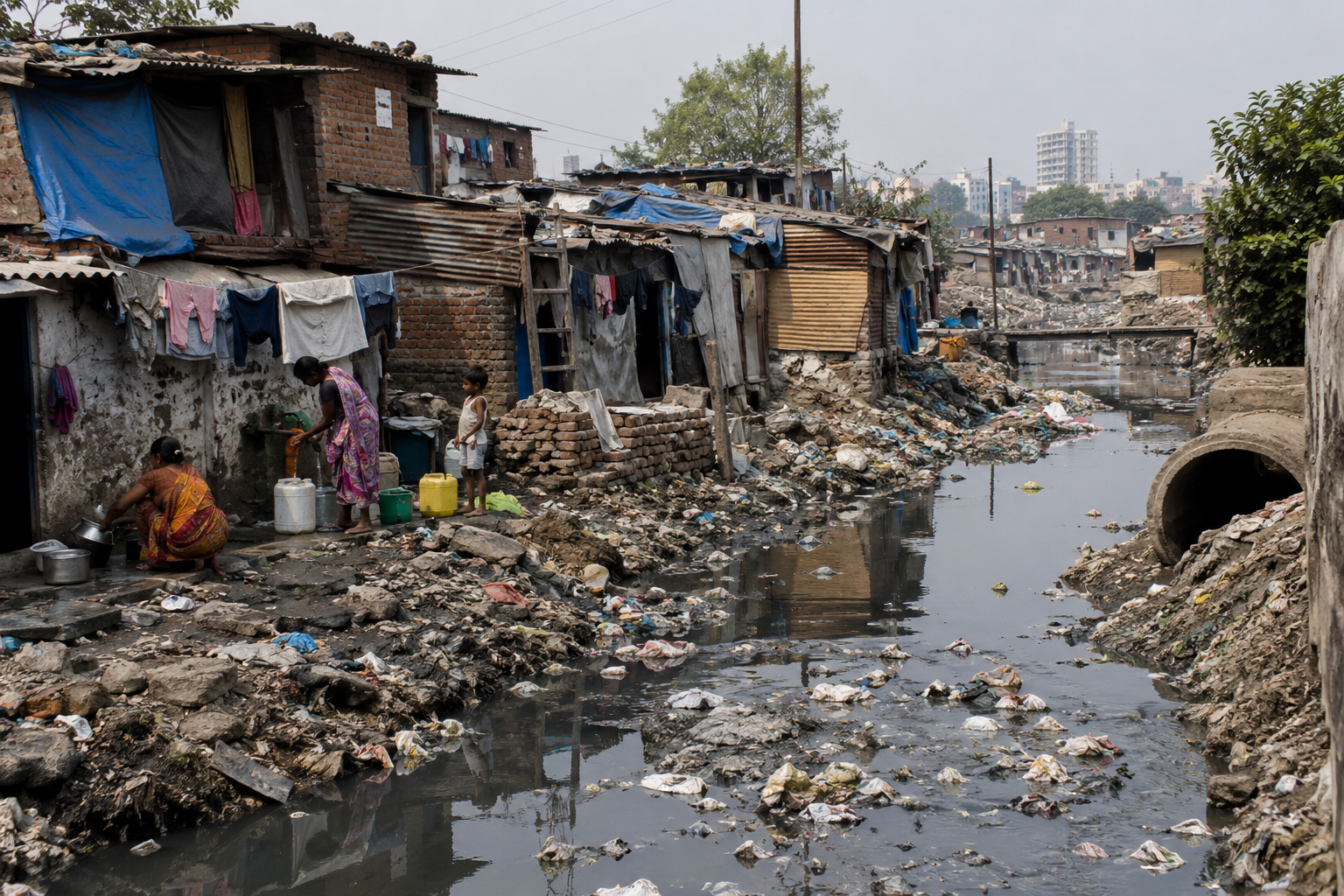
Ans: The developmental goals for such an area should include:
- Provision of basic amenities like clean drinking water, sanitation and electricity.
- Better housing and living conditions.
- Access to quality education and healthcare facilities.
- Regular employment and better wages for the people.
- Control of pollution and improvement of the environment.
- Equal treatment, safety and dignity for all residents.
The goals should focus on improving the quality of life of the people, not just on increasing income.
Question 2
Read this newspaper report and answer the questions that follow:
A vessel dumped 500 tonnes of liquid toxic wastes into open-air dumps in a city and in the surrounding sea. This happened in a city called Abidjan in Ivory Coast, a country in Africa. The fumes from the highly toxic waste caused nausea, skin rashes, fainting, diarrhoea etc. After a month seven persons were dead, twenty in hospital and twenty six thousand treated for symptoms of poisoning. A multinational company dealing in petroleum and metals had contracted a local company of the Ivory Coast to dispose the toxic waste from its ship.
- Who are the people who benefited and who did not?
- What should be the developmental goal for this country?
Ans:
(i) Who benefited and who did not:
- Benefited: The multinational company dealing in petroleum and metals saved the cost of safe disposal of toxic waste. The local company that was contracted to dispose of the waste also earned money from the contract.
- Did not benefit: The common people of Abidjan and the surrounding area suffered. Seven persons died, twenty were hospitalised and twenty-six thousand people were treated for poisoning. The environment, including the air and sea, was also damaged.
(ii) Developmental goal for this country:
The developmental goal should be to ensure safe disposal of toxic waste and to protect the health and environment of the people. The country should have strict laws and effective enforcement to prevent such dumping. It should also promote sustainable industrial practices that do not harm the health of citizens or degrade the environment.
Question 3
What can be some of the developmental goals for your village, town or locality?
Ans: Some developmental goals for a village, town or locality can be:
- Providing clean drinking water and proper sanitation facilities.
- Ensuring regular supply of electricity.
- Building and improving roads, transport and communication facilities.
- Opening good schools and health centres.
- Creating employment opportunities and supporting local businesses.
- Planting trees and keeping the environment clean and pollution-free.
- Ensuring safety, equal treatment and dignity for all people, including women and marginalised groups.
- Providing good public distribution and other basic services.
Students may add goals based on the actual problems of their own locality.
LET’S WORK THESE OUT (How to Compare Different Countries or States?)
Question 1
Give three examples where an average is used for comparing situations.
Ans: Three examples where an average is used for comparing situations are:
- Per capita income: The average income of a country is calculated by dividing total income by total population. It is used to compare the income levels of different countries.
- Average marks of students: The average marks of a class or school are used to compare the performance of different classes or schools.
- Average rainfall or temperature: The average rainfall or average temperature of different regions is used to compare their climate.
Other examples: average height of students in a class, average runs scored by a batsman, average attendance in a school.
Question 2
Why do you think average income is an important criterion for development? Explain.
Ans: Average income is an important criterion for development because:
- It tells us what an average person in a country is likely to earn. This is more useful than total income because countries have different populations.
- Higher average income generally means that people can buy more goods and services that they need for a better life.
- It is used by the World Bank to classify countries into high income, middle income and low income groups.
- It provides a simple and easily comparable measure of the economic condition of different countries.
However, average income alone is not enough because it does not show how income is distributed among people, and it ignores non-income aspects like health, education and environment.
Question 3
Besides size of per capita income, what other property of income is important in comparing two or more societies?
Ans: Besides the size of per capita income, the distribution of income is important in comparing two or more societies.
Two countries may have the same average income, but the distribution may be very different. In one country, income may be fairly evenly distributed, so most people are neither very rich nor extremely poor. In another country, most people may be poor while one person is extremely rich. In the second case, the average income hides the poverty of most people.
Therefore, along with average income, we must look at how income is distributed among the people.
Question 4
Suppose records show that the average income in a country has been increasing over a period of time. From this, can we conclude that all sections of the economy have become better? Illustrate your answer with an example.
Ans: No, we cannot conclude that all sections of the economy have become better simply because the average income has been increasing.
Average income can increase even if only a few people become richer while the condition of others remains the same or even worsens. For example, consider two countries, A and B, each with five citizens.
| Country | Monthly incomes of citizens (in Rupees) | Average |
|---|---|---|
| Country A | 9500, 10500, 9800, 10000, 10200 | 10000 |
| Country B | 500, 500, 500, 500, 48000 | 10000 |
Both countries have the same average income of Rs 10,000, but in Country B most citizens are poor and one person is extremely rich. If the income of the richest person increases further, the average income will rise, but the poor citizens will not become better off.
Thus, an increase in average income does not necessarily mean that all sections of the economy have improved.
Question 5
From the text, find out the per capita income level of about 10-15 low-income countries as per World Development Reports.
Ans: The text does not provide a list of 10–15 low-income countries. It only states that countries with per capita income of about US$ 2,300 or less are called low-income countries, and India falls in the category of low middle income countries with a per capita income of about US$ 11,000 per annum in 2024.
Students may refer to the World Development Reports or World Bank website to find the latest list and per capita income levels of low-income countries.
Question 6
Write a paragraph on your notion of what should India do, or achieve, to become a developed country.
Ans: India should aim to become a developed country not only by increasing its per capita income but also by improving the quality of life of all its citizens. It should provide good education and healthcare facilities to everyone, especially in rural and backward areas. It should create regular employment opportunities and ensure fair wages. It should reduce inequality so that the benefits of growth reach all sections of society, including the poor, women, and marginalised groups. It should also protect the environment and use natural resources sustainably so that future generations are not deprived. Along with economic growth, India must strengthen democracy, ensure equal treatment, freedom and dignity for all, and provide basic amenities like clean water, sanitation and housing. Only then can India truly be called a developed country.
LET’S WORK THESE OUT (Income and Other Criteria)
Question 1
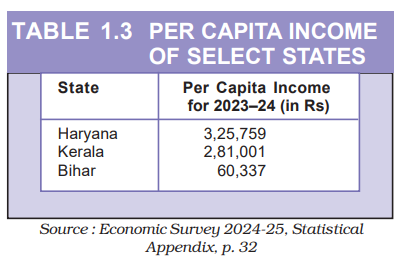
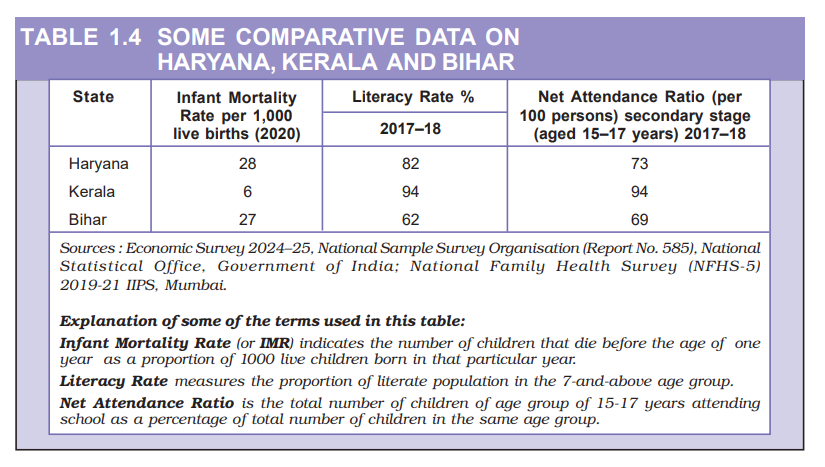
Look at data in Tables 1.3 and 1.4. Is Haryana ahead of Kerala in literacy rate etc., as it is in terms of per capita income?
Ans: No, Haryana is not ahead of Kerala in literacy rate and other human development indicators, even though it has a higher per capita income.
According to Table 1.3, Haryana has the highest per capita income (Rs 3,25,759) among the three states, while Kerala has Rs 2,81,001. But according to Table 1.4:
- Kerala has a literacy rate of 94%, while Haryana has only 82%.
- Kerala has a net attendance ratio of 94%, while Haryana has 73%.
- Kerala has an infant mortality rate of 6 per 1,000 live births, while Haryana has 28.
Thus, Kerala is ahead of Haryana in literacy, school attendance and infant mortality, even though its per capita income is lower. This shows that income alone is not an adequate measure of development.
Question 2
Think of other examples where collective provision of goods and services is cheaper than individual provision.
Ans: Examples where collective provision is cheaper than individual provision are:
- Security: It is cheaper to have a police station or community security for a whole locality than for each house to have its own security staff.
- Education: Government schools provide education to many children at a much lower cost than each family arranging private tuition or private schooling.
- Healthcare: Public health centres and government hospitals provide treatment to many people at lower cost than each person buying private treatment.
- Water supply: A community water supply system is cheaper than each household digging its own well or buying water.
- Roads and street lighting: These are provided collectively and benefit everyone at a lower total cost.
- Public distribution system: Ration shops provide food grains to many people at subsidised rates.
Question 3
Does availability of good health and educational facilities depend only on amount of money spent by the government on these facilities? What other factors could be relevant?
Ans: No, the availability of good health and educational facilities does not depend only on the amount of money spent by the government. Other relevant factors include:
- Effective planning and management: Money must be used properly and without corruption.
- Adequate number of trained teachers and doctors: Facilities are of no use if there are no qualified staff.
- Proper infrastructure: Schools and hospitals need buildings, equipment, medicines and other facilities.
- Accessibility: Facilities must be located within reach of the people, especially in rural and remote areas.
- Social awareness: People must be aware of the importance of education and health and must be willing to use these facilities.
- Support for girls and marginalised groups: Special efforts may be needed to ensure that girls and disadvantaged groups can attend school and get healthcare.
- Public participation: Community involvement and monitoring can improve the quality of services.
Question 4
In a study, it was found that in Tamil Nadu, 90 per cent of the people living in rural areas used a ration shop, whereas in West Bengal only 35 per cent of rural people did so. Where would people did better off and why?
Ans: People in Tamil Nadu would be better off because a much larger proportion of rural people (90%) used a ration shop compared to West Bengal (only 35%).
The Public Distribution System (PDS) provides essential food grains at subsidised prices. When more people use ration shops, it means they are able to get food grains at cheaper rates, which improves their food security and nutritional status. In West Bengal, where only 35% used ration shops, many people may not have been able to get subsidised food grains, which could affect their food security.
However, it is also important to check whether the ration shops function properly and provide good quality grains. If the PDS functions well, as in Tamil Nadu, people are likely to be better off.
ACTIVITY 2
Question 1
Study Table 1.5 carefully and fill in the blanks in the following paragraphs. For this, you may need to make calculations based on the table.
(a) The literacy rate for all age groups, including young and old, is _____ for rural males and _____ for rural females. However, it is not just that these many adults could not attend school but that there are _____ who are currently not in school.
(b) It is clear from the table that _____ % of rural girls and _____% of rural boys are not attending school. Therefore, illiteracy among children in the age group 10-14 is as high as _____% for rural females and _____% for rural males.
(c) This high level of illiteracy among __________ age group, even after more than 75 years of our independence, is most disturbing. In many other states also we are nowhere near realisation of the constitutional goal of free and compulsory education for all children up to the age of 14, which was expected to be achieved by 1960.
| Category | Male | Female |
|---|---|---|
| Literacy rate for rural population | 76% | 54% |
| Literacy rate for rural children in age group 10-14 years | 90% | 87% |
| Percentage of rural children aged 10-14 attending school | 85% | 82% |
Ans:
(a) The literacy rate for all age groups, including young and old, is 76% for rural males and 54% for rural females. However, it is not just that these many adults could not attend school but that there are children aged 10–14 who are currently not in school.
(b) It is clear from the table that 18% of rural girls and 15% of rural boys are not attending school. Therefore, illiteracy among children in the age group 10–14 is as high as 13% for rural females and 10% for rural males.
Calculations:
- Rural girls not attending school = 100% − 82% = 18%
- Rural boys not attending school = 100% − 85% = 15%
- Illiteracy among rural females aged 10–14 = 100% − 87% = 13%
- Illiteracy among rural males aged 10–14 = 100% − 90% = 10%
(c) This high level of illiteracy among children in the 10–14 years age group, even after more than 75 years of our independence, is most disturbing. In many other states also we are nowhere near realisation of the constitutional goal of free and compulsory education for all children up to the age of 14, which was expected to be achieved by 1960.
LET’S UNDERSTAND WHY THIS IS SO THROUGH THE FOLLOWING EXAMPLE
Question 1
Example 1: Groundwater in India
“Recent evidence suggests that the groundwater is under serious threat of overuse in many parts of the country. About 300 districts have reported a water level decline of over 4 metres during the past 20 years. Nearly one-third of the country is overusing their groundwater reserves. In another 25 years, 60 per cent of the country would be doing the same if the present way of using this resource continues. Groundwater overuse is particularly found in the agriculturally prosperous regions of Punjab and Western U.P., hard rock plateau areas of central and south India, some coastal areas and the rapidly growing urban settlements.”
- Why groundwater is overused?
- Can there be development without overuse?
Ans:
(a) Why groundwater is overused:
Groundwater is overused mainly because:
- It is used extensively for irrigation in agriculturally prosperous regions like Punjab and Western Uttar Pradesh.
- It is a renewable resource but is being extracted faster than it is replenished by rain.
- Rapidly growing urban settlements and industries also use large amounts of groundwater.
- There is lack of proper regulation and awareness about the limits of groundwater use.
(b) Can there be development without overuse:
Yes, development is possible without overusing groundwater if we use it sustainably. This can be done by:
- Using water-saving irrigation methods like drip and sprinkler irrigation.
- Harvesting rainwater to recharge groundwater.
- Growing crops that require less water.
- Regulating the extraction of groundwater and creating awareness among farmers and citizens.
- Recycling and reusing water in industries and cities.
Sustainable use of resources ensures that development continues without harming the resource base for future generations.
Question 2
Example 2: Exhaustion of Natural Resources
Look at the following data for crude oil.
| Region/Country | Reserves (2017) (Thousand Million Barrels) | Number of Years Reserves will last |
|---|---|---|
| Middle East | 836 | 70 |
| United States of America | 69 | 10.5 |
| World | 1732 | 47 |
The table gives an estimate of reserves of crude oil (column1). More important, it also tells us for how many years the stock of crude oil will last if people continue to extract it at the present rate. The reserves would last only 50 years more. This is for the world as a whole. However, different countries face different situations. Countries like India depend on importing oil from abroad because they do not have enough stocks of their own. If prices of oil increase this becomes a burden for everyone. There are countries like USA which have low reserves and hence want to secure oil through military or economic power.
The question of sustainability of development raises many fundamentally new issues about the nature and process of development.
- Is crude oil essential for the development process in a country? Discuss.
- India has to import crude oil. What problems do you anticipate for the country looking at the above situation?
Ans:
(a) Is crude oil essential for the development process in a country? Discuss.
Yes, crude oil is essential for the development process in a country at present because:
- It is a major source of energy for transport, industry, agriculture and electricity generation.
- Petroleum products like petrol, diesel, kerosene and LPG are used in daily life and in almost all sectors of the economy.
- It is also used as a raw material in many industries, such as plastics, chemicals and fertilisers.
However, crude oil is a non-renewable resource and its stock is limited. Over-dependence on crude oil is not sustainable in the long run. Countries need to shift to renewable sources of energy like solar, wind and hydro power. So, while crude oil is important today, development should not depend only on it.
(b) India has to import crude oil. What problems do you anticipate for the country looking at the above situation?
The problems India may face due to importing crude oil are:
- High import bill: India has to spend a large amount of foreign exchange on importing oil, which puts pressure on the economy.
- Price rise: If international oil prices increase, the cost of transport, electricity and goods also increases, leading to inflation.
- Burden on common people: Higher oil prices increase the cost of petrol, diesel, LPG and other goods, which affects everyone, especially the poor.
- Uncertainty of supply: Political disturbances or conflicts in oil-producing countries can disrupt supply.
- Pressure on foreign exchange reserves: Continuous imports can weaken the country's balance of payments.
To reduce these problems, India should develop renewable energy sources and use oil more efficiently.
EXERCISES
Question 1
Development of a country can generally be determined by
- (i) its per capita income
- (ii) its average literacy level
- (iii) health status of its people
- (iv) all the above
Ans: The correct answer is (iv) all the above.
Development of a country is determined not only by per capita income but also by other factors such as average literacy level and the health status of its people. All these indicators together give a better picture of development.
Question 2
Which of the following neighbouring countries has better performance in terms of human development than India?
- (i) Bangladesh
- (ii) Sri Lanka
- (iii) Nepal
- (iv) Pakistan
Ans: The correct answer is (ii) Sri Lanka.
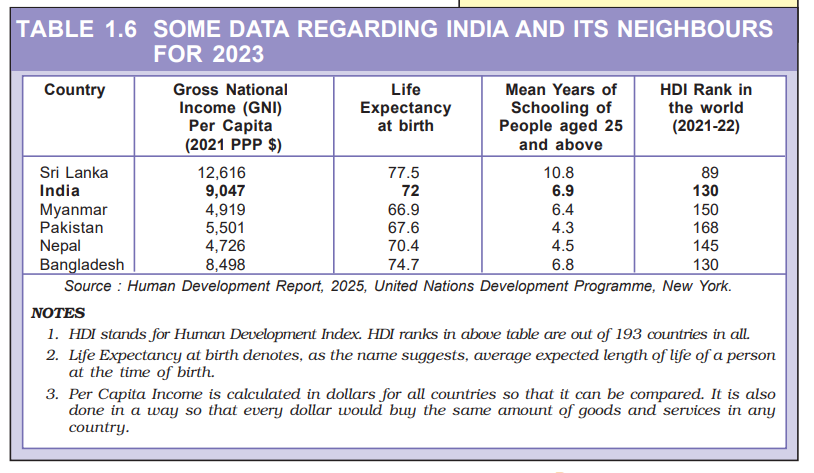
According to Table 1.6, Sri Lanka has a higher Gross National Income per capita (12,616 PPP $), higher life expectancy at birth (77.5 years), more mean years of schooling (10.8 years) and a better HDI rank (89) than India (HDI rank 130). Therefore, Sri Lanka has better performance in terms of human development than India.
Question 3
Assume there are four families in a country. The average per capita income of these families is Rs 5000. If the income of three families is Rs 4000, Rs 7000 and Rs 3000 respectively, what is the income of the fourth family?
- (i) Rs 7500
- (ii) Rs 3000
- (iii) Rs 2000
- (iv) Rs 6000
Ans: The correct answer is (iv) Rs 6000.
Calculation:
Average income = Rs 5000
Total income of four families = 4 × 5000 = Rs 20,000
Income of three families = 4000 + 7000 + 3000 = Rs 14,000
Income of the fourth family = 20,000 − 14,000 = Rs 6000
Question 4
What is the main criterion used by the World Bank in classifying different countries? What are the limitations of this criterion, if any?
Ans: The main criterion used by the World Bank in classifying different countries is per capita income (average income).
Countries with per capita income of US$ 66,500 per annum and above in 2024 are called high income or rich countries, and those with per capita income of about US$ 2,300 or less are called low-income countries. India falls in the category of low middle income countries.
Limitations of this criterion:
- It does not show how income is distributed among the people. A country may have a high average income but most people may be poor.
- It ignores non-income aspects of development such as health, education, life expectancy and environmental quality.
- Money cannot buy all the goods and services needed to live well, such as a pollution-free environment or good public facilities.
- It does not reflect the quality of life and well-being of the people.
Question 5
In what respects is the criterion used by the UNDP for measuring development different from the one used by the World Bank?
Ans: The criterion used by the UNDP for measuring development is different from the World Bank in the following respects:
| World Bank | UNDP |
|---|---|
| Uses per capita income (average income) as the main criterion. | Uses Human Development Index (HDI), which includes educational levels, health status and per capita income. |
| Classifies countries as high income, middle income and low income. | Ranks countries based on human development, considering life expectancy, mean years of schooling and GNI per capita. |
| Focuses mainly on economic prosperity. | Focuses on people's well-being, health and education along with income. |
Thus, the UNDP uses a broader and more human-centred criterion compared to the World Bank.
Question 6
Why do we use averages? Are there any limitations to their use? Illustrate with your own examples related to development.
Ans: We use averages because they give a single representative value that makes comparison easier. For example, average income (per capita income) helps compare the economic condition of different countries, and average marks help compare the performance of different classes.
Limitations of averages:
- Averages hide disparities. They do not show how the values are distributed among different people or groups.
- Two countries may have the same average income, but the distribution of income may be very different.
Example:
| Country | Monthly incomes of citizens (in Rupees) | Average |
|---|---|---|
| Country A | 9500, 10500, 9800, 10000, 10200 | 10000 |
| Country B | 500, 500, 500, 500, 48000 | 10000 |
Both countries have the same average income of Rs 10,000, but in Country A, people are neither very rich nor extremely poor, while in Country B, most people are poor and one person is extremely rich. Thus, the average hides the inequality in Country B.
Question 7
Kerala, with lower per capita income has a better human development ranking than Haryana. Hence, per capita income is not a useful criterion at all and should not be used to compare states. Do you agree? Discuss.
Ans: No, I do not fully agree with the statement. Per capita income is a useful criterion, but it is not the only criterion.
It is true that Kerala, with a lower per capita income than Haryana, has better human development indicators. According to the data, Kerala has a higher literacy rate (94%), higher net attendance ratio (94%) and lower infant mortality rate (6) compared to Haryana (82%, 73% and 28 respectively). This shows that per capita income alone does not reflect the level of development.
However, per capita income is still useful because:
- It gives an idea of the average economic condition of the people.
- It is used by the World Bank to classify countries and is easy to compare.
- Higher income generally helps people access better goods and services.
Therefore, per capita income should be used along with other indicators such as health, education and distribution of income. It should not be rejected completely, but it should not be the only criterion either.
Question 8
Find out the present sources of energy that are used by the people in India. What could be the other possibilities fifty years from now?
Ans: Present sources of energy used in India:
- Coal
- Petroleum and natural gas
- Electricity (thermal, hydel and nuclear)
- Firewood and biomass
- LPG (liquefied petroleum gas)
- Renewable sources like solar, wind and small hydro power (increasingly being used)
Possibilities fifty years from now:
- Solar energy could become a major source of power.
- Wind energy and tidal energy could be used more widely.
- Hydrogen fuel and biofuels could replace petrol and diesel.
- Nuclear energy with safer technology could be used more.
- Improved battery technology and electric vehicles could reduce dependence on oil.
- Energy from waste and geothermal sources could also be developed.
The shift will depend on the need for sustainable development and the exhaustion of non-renewable resources like coal and petroleum.
Question 9
Why is the issue of sustainability important for development?
Ans: The issue of sustainability is important for development because:
- The present type and level of development is using up natural resources like groundwater, crude oil and forests faster than they can be replenished.
- Non-renewable resources like crude oil will get exhausted in the near future if used at the present rate. For example, world crude oil reserves may last only about 47 years more.
- Environmental degradation, such as groundwater overuse and pollution, does not respect national or state boundaries and affects everyone.
- If resources are exhausted, future generations will not be able to meet their needs.
- Sustainable development ensures that development continues without harming the environment and without depriving future generations of their share of resources.
Therefore, sustainability is essential to ensure that development lasts and benefits everyone, now and in the future.
Question 10
“The Earth has enough resources to meet the needs of all but not enough to satisfy the greed of even one person”. How is this statement relevant to the disscusion of development? Discuss.
Ans: This statement is very relevant to the discussion of development. It means that:
- The Earth has sufficient resources to meet the basic needs of all people, such as food, water, shelter and energy, if they are used wisely and shared fairly.
- However, if some people or countries use resources excessively to satisfy their greed, the resources will get exhausted and others will be deprived.
- Development should focus on meeting the needs of all people, not on endless consumption and profit.
- Unsustainable use of resources, such as overuse of groundwater and excessive extraction of crude oil, is a result of greed rather than need.
- Sustainable development requires controlling greed and using resources carefully so that everyone's needs are met, including those of future generations.
Thus, the statement reminds us that development must be need-based and sustainable, not greed-based.
Question 11
List a few examples of environmental degradation that you may have observed around you.
Ans: Some examples of environmental degradation that can be observed around us are:
- Falling groundwater levels due to excessive tube-well irrigation.
- Air pollution from vehicles, factories and burning of waste.
- Water pollution from industrial effluents, sewage and dumping of waste into rivers and seas.
- Deforestation and cutting of trees for construction and fuel.
- Soil erosion and land degradation due to unscientific farming.
- Accumulation of plastic waste and garbage dumps.
- Loss of biodiversity and decline in the number of birds and animals.
- Noise pollution from traffic and loudspeakers.
Students may add examples based on what they observe in their own area.
Question 12
For each of the items given in Table 1.6, find out which country is at the top and which is at the bottom.
| Country | Gross National Income (GNI) Per Capita (2021 PPP $) | Life Expectancy at birth | Mean Years of Schooling of People aged 25 and above | HDI Rank in the world (2021-22) |
|---|---|---|---|---|
| Sri Lanka | 12,616 | 77.5 | 10.8 | 89 |
| India | 9,047 | 72 | 6.9 | 130 |
| Myanmar | 4,919 | 66.9 | 6.4 | 150 |
| Pakistan | 5,501 | 67.6 | 4.3 | 168 |
| Nepal | 4,726 | 70.4 | 4.5 | 145 |
| Bangladesh | 8,498 | 74.7 | 6.8 | 130 |
Ans: Based on Table 1.6, the country at the top and bottom for each item is:
| Item | Top Country | Bottom Country |
|---|---|---|
| Gross National Income (GNI) Per Capita (2021 PPP $) | Sri Lanka (12,616) | Nepal (4,726) |
| Life Expectancy at birth | Sri Lanka (77.5 years) | Myanmar (66.9 years) |
| Mean Years of Schooling of People aged 25 and above | Sri Lanka (10.8 years) | Pakistan (4.3 years) |
| HDI Rank in the world (2021-22) | Sri Lanka (89) | Pakistan (168) |
Sri Lanka is at the top in all the items, and Pakistan is at the bottom in mean years of schooling and HDI rank.
Question 13
The following table shows the proportion of adults (aged 15-49 years) whose BMI is below normal (BMI <18.5 kg/m2) in India. It is based on a survey of various states for the year 2019-21. Look at the table and answer the following questions.
| State | Male (%) | Female (%) |
|---|---|---|
| Kerala | 8.5 | 10 |
| Karnataka | 17 | 21 |
| Madhya Pradesh | 28 | 28 |
| All States | 20 | 23 |
- Compare the nutritional level of people in Kerala and Madhya Pradesh.
- Can you guess why around one-fifth of people in the country are undernourished even though it is argued that there is enough food in the country? Describe in your own words.
Ans:
(i) Comparison of nutritional level of people in Kerala and Madhya Pradesh:
The proportion of adults with BMI below normal is much lower in Kerala than in Madhya Pradesh.
- In Kerala, only 8.5% of males and 10% of females have BMI below normal.
- In Madhya Pradesh, 28% of males and 28% of females have BMI below normal.
This means that the nutritional level of people in Kerala is much better than in Madhya Pradesh. A smaller proportion of people in Kerala are undernourished.
(ii) Why around one-fifth of people in the country are undernourished even though there is enough food:
Even though there is enough food in the country, around one-fifth of people are undernourished because:
- Poverty: Many people do not have enough income to buy sufficient nutritious food.
- Unequal distribution of food: Food is not distributed fairly; some people have more than enough while others go hungry.
- Lack of awareness: Some people may not know what constitutes a balanced and nutritious diet.
- Poor public distribution system: In some areas, ration shops do not function properly, so people cannot get subsidised food grains.
- Lack of basic facilities: Poor sanitation and healthcare can also lead to malnutrition even if food is available.
- Gender discrimination: In some families, women and girls may not get an equal share of nutritious food.
Thus, availability of food alone is not enough; access, affordability and awareness are also important.
ADDITIONAL PROJECT / ACTIVITY
Question 1
Invite three different speakers to talk to you about the development of your region. Ask them all the questions that come to your mind. Discuss these ideas in groups. Each group should prepare a wall chart, giving reasons about ideas that you agree or do not agree with.
Ans: This is a project activity. Students should:
- Invite three speakers, such as a local official, a farmer, a teacher, a doctor or a social worker, to talk about the development of their region.
- Prepare questions in advance about the problems and possible solutions for the region's development.
- Listen carefully to the speakers and note down their ideas.
- Discuss the ideas in groups and identify which ideas they agree with and which they do not, giving reasons.
- Prepare a wall chart showing the agreed and disagreed ideas with proper reasons.
The wall chart may include ideas about education, health, employment, environment, infrastructure and equality. Students should ensure that their reasons are based on the chapter's concepts of development, such as income and other goals, sustainability and human development.