
8.1 Introduction to Sequences
Q1. Think and Reflect (Page 175): 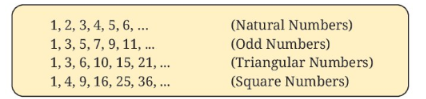 Can you describe the pattern in each of the above sequences? Can you predict the next few numbers in these sequences?
Answer:
This question refers to the sequences mentioned in the introduction: Natural numbers, Odd numbers, Square numbers, and Triangular numbers.
- Natural Numbers (1, 2, 3, 4, 5, ...): The pattern is that each term increases by 1. Next terms: 6, 7, 8.
- Odd Numbers (1, 3, 5, 7, 9, ...): The pattern is that each term increases by 2. Next terms: 11, 13, 15.
- Square Numbers (1, 4, 9, 16, 25, ...): The pattern is that each term is the square of its position (1², 2², 3², 4², 5²,...). Next terms: 36 (6²), 49 (7²), 64 (8²).
- Triangular Numbers (1, 3, 6, 10, 15, ...): The pattern is that each term is the sum of natural numbers up to that position (1, 1+2, 1+2+3, 1+2+3+4, ...). The differences between consecutive terms increase by 1. Next terms: 21 (15+6), 28 (21+7), 36 (28+8).
Q2. Think and Reflect (Page 175): Can you think of other finite sequences that you see in your daily life?
Answer:
Here are some examples of finite sequences from daily life:
- Months in a year: January, February, March, April, May, June, July, August, September, October, November, December. (12 terms)
- Days of the week: Sunday, Monday, Tuesday, Wednesday, Thursday, Friday, Saturday. (7 terms)
- Number of hours on a clock: 1, 2, 3, 4, 5, 6, 7, 8, 9, 10, 11, 12. (12 terms)
- Roll numbers of students in a class: 1, 2, 3, ..., up to the total number of students.
- Scores in a test: The list of marks obtained by students (e.g., 95, 87, 76, 65, ...).
Q3. Exercise (Page 176): Consider the sequence 1, 4, 7, 10, 13, ... Can you predict the next four terms? Can you derive the first 10 terms of the sequence obtained by adding all the terms up to a given term of this sequence? (Hint: The first term is 1. The second term is 1 + 4 = 5, the third term is 1 + 4 + 7 = 12, and so on.)
Answer:
Part 1: Predicting the next four terms
The given sequence is 1, 4, 7, 10, 13, ... The common difference is 4 - 1 = 3. Each term increases by 3.
Next four terms: 16 (13+3), 19 (16+3), 22 (19+3), 25 (22+3).
Part 2: First 10 terms of the new sequence (sums)
We need to find the cumulative sums (partial sums) of the sequence 1, 4, 7, 10, 13, 16, 19, 22, 25, 28.
- S₁ = 1
- S₂ = 1 + 4 = 5
- S₃ = 1 + 4 + 7 = 12
- S₄ = 12 + 10 = 22
- S₅ = 22 + 13 = 35
- S₆ = 35 + 16 = 51
- S₇ = 51 + 19 = 70
- S₈ = 70 + 22 = 92
- S₉ = 92 + 25 = 117
- S₁₀ = 117 + 28 = 145
The first 10 terms of the new sequence (the cumulative sums) are: 1, 5, 12, 22, 35, 51, 70, 92, 117, 145.
Q4. Exercise (Page 176): Can you write t₅, t₆, t₇ and t₈ for the sequence of triangular numbers?
Answer:
The triangular numbers sequence is: 1, 3, 6, 10, 15, 21, 28, 36, ...
In Triangular number sequence, each term represents the sum of natural numbers upto that term. Therefore:
- t₅ = 1+2+3+4+5= 15
- t₆ = 1+2+3+4+5+6= 21
- t₇ =1+2+3+4+5+6+7= 28
- t₈ = 1+2+3+4+5+6+7+8=36
Q5. Think and Reflect (Page 176): Can you think of any other kinds of sequences? List out five different types of sequences and discuss their properties with your friends.
Answer:
Here are five different types of sequences that go beyond simple linear or quadratic patterns:
- Prime Number Sequence: 2, 3, 5, 7, 11, 13, ... Property: No simple explicit formula exists to generate all prime numbers; they are numbers greater than 1 that have no positive divisors other than 1 and themselves.
- Square Number Sequence: 1, 4, 9, 16, 25, ... Property: Each term is the square of its position (n²). The differences between consecutive terms (3, 5, 7, ...) increase linearly.
- Fibonacci-type (Recursive) Sequence: 1, 1, 2, 3, 5, 8, ... Property: Each term is the sum of the two preceding terms.
- Decreasing Fraction Sequence: 1, 1/2, 1/3, 1/4, 1/5, ... Property: The terms are unit fractions that get smaller and approach zero.
- Alternating Sign Sequence: -1, 1, -1, 1, -1, 1, ... Property: The terms are constant in magnitude but alternate in sign based on the position (e.g., (-1)ⁿ).
8.2 Explicit Rule for a Sequence
Q1. Think and Reflect (Page 176): Why is it useful to have an explicit formula for the nᵗʰ term of a sequence?
Answer:
An explicit formula is useful because it allows us to calculate the value of any term in a sequence directly by substituting its position number (n).
- We can find the 20th, 53rd, 300th, or any term without needing to compute all the previous terms;
- It is a time-saving and efficient method, especially for large values of n.
- It helps in understanding the overall behavior and pattern of the sequence; Pattern understanding
The explicit rule uses the term's position number (n) to calculate its value, providing a direct relationship between n and the term value.
Q2. Exercise (Page `177): Using the explicit rule un = 2n - 1, find the 53rd term, the 108th term, and the 1170th term of the odd number sequence.
Answer:
The explicit rule for the sequence of odd numbers is un = 2n - 1.
- 53rd term (n=53): u53 = 2(53) - 1 = 106 - 1 = 105
- 108th term (n=108): u108 = 2(108) - 1 = 216 - 1 = 215
- 1170th term (n=1170): u1170 = 2(1170) - 1 = 2340 - 1 = 2339
Q3. Think and Reflect (Page 177): Can you find the rule describing the nth term of the sequence of square numbers?
Answer:
The sequence of square numbers is 1, 4, 9, 16, 25, 36, ...
Each term is the square of its position (n).
12 = 1, 22 = 4, 3² = 9, 4² = 16, 5² = 25 , 6² = 36, 7² = 49, 8² = 64, 9² = 81, 10² = 100,… and so on.
Therefore, the rule describing the nth term is:
tn = n2
Q4. Exercise (Page 178): Consider the expression tn = 3n - 7. (i) Find its first, second, third, 12th, 18th and 50th terms. (ii) Which term of the sequence is 332? (iii) Is 557 a term of this sequence? Why or why not?
Answer:
(i) Finding the terms:
Given the expression for nth term: tn = 3n - 7.
- 1st term (n=1): t₁ = 3(1) - 7 = -4
- 2nd term (n=2): t₂ = 3(2) - 7 = -1
- 3rd term (n=3): t₃ = 3(3) - 7 = 2
- 12th term (n=12): t₁₂ = 3(12) - 7 = 36 - 7 = 29
- 18th term (n=18): t₁₈ = 3(18) - 7 = 54 - 7 = 47
- 50th term (n=50): t₅₀ = 3(50) - 7 = 150 - 7 = 143
(ii) Finding which term is 332:
Set tn = 332 and solve for n:
3n - 7 = 332
→ 3n = 339
→ n = 113.
So, 332 is the 113th term of the sequence.
(iii) Checking if 557 is a term:
Set tn = 557 and solve for n:
3n - 7 = 557
→ 3n = 564
→ n = 188.
Since 188 is a natural number, 557 is a term of the sequence (specifically, the 188th term).
8.3 Recursive Rule for a Sequence
Q1. Exercise Set 8.1, Question 1 (Page 179): Find the first five terms of the sequence in which the nth term is given by: (i) tn = 3n - 4, (ii) tn = 2 - 5n, and (iii) tn = n2 - 2n + 3 for n ≥ 1.
Answer:
(i) tn = 3n - 4
- n=1: 3(1)-4 =3-4 = -1
- n=2: 3(2)-4 = 6-4 = 2
- n=3: 3(3)-4 = 9-4 = 5
- n=4: 3(4)-4 = 12-4=8
- n=5: 3(5)-4 = 15-4 = 11
First five terms: -1, 2, 5, 8, 11
(ii) tn = 2 - 5n
- n=1: 2 - 5(1) = -3
- n=2: 2 - 5(2) = -8
- n=3: 2 - 5(3) = -13
- n=4: 2 - 5(4) = -18
- n=5: 2 - 5(5) = -23
First five terms: -3, -8, -13, -18, -23
(iii) tn = n2 - 2n + 3
- n=1: 1 - 2 + 3 = 2
- n=2: 4 - 4 + 3 = 3
- n=3: 9 - 6 + 3 = 6
- n=4: 16 - 8 + 3 = 11
- n=5: 25 - 10 + 3 = 18
First five terms: 2, 3, 6, 11, 18
Q2. Question 2 : Find the 10th and 15th terms of the sequence tn = 5n - 3 for n ≥ 1.
Answer:
Given the sequence tn = 5n - 3 for n ≥ 1.
- 10th term (n=10): t₁₀ = 5(10) - 3 = 50 - 3 = 47
- 15th term (n=15): t₁₅ = 5(15) - 3 = 75 - 3 = 72
Q3. Question 3: Determine whether 97 and 172 are terms of the sequence tn = 5n - 3 for n ≥ 1.
Answer:
Checking 97:
Given, the sequence tn = 5n - 3 for n ≥ 1.
Set 5n - 3 = 97
→ 5n = 100
→ n = 20.
Since 20 is a natural number, 97 is a term (the 20th term).
Checking 172:
Set 5n - 3 = 172
→ 5n = 175
→ n = 35.
Since 35 is a natural number, 172 is a term (the 35th term).
Q4. Question 4 : Which term of the sequence tn = 5n - 3 for n ≥ 1 is 607?
Answer:
Given ,the sequence tn = 5n - 3 for n ≥ 1.
substituting tn= 607
5n-3=607
→5n = 610
→ n = 122.
Thus, 607 is the 122nd term of the sequence.
Q5. Question 5 : A sequence is given by the recursive rule t1 = -5, tn+1 = tn + 3 for n ≥ 1. Find the first five terms of the sequence. Is 52 a term of this sequence? If so, which term is it?
Answer:
Given : t1 = -5, tn+1 = tn + 3 for n ≥ 1
(i)First five terms: substitute n=1,2,3,4,5
- t₁ = -5
- t₂ = t₁ + 3 = -5 + 3 = -2
- t₃ = t₂ + 3 = -2 + 3 = 1
- t₄ = t₃ + 3 = 1 + 3 = 4
- t₅ = t₄ + 3 = 4 + 3 = 7
The first five terms are: -5, -2, 1, 4, 7.
(ii)Is 52 a term?
The sequence is an arithmetic progression with a = -5 and d = 3. Its explicit rule is:
tn = a + (n-1)d = -5 + (n-1)3 = -5 + 3n - 3 = 3n - 8.
Check if 52 is a term:
3n - 8 = 52
→ 3n = 60
→ n = 20.
Since 20 is a natural number, 52 is a term (the 20th term).
Q6. Exercise Set 8.1, Question 6 (Page 180): Let T1 = 1, T2 = 2, T3 = 4 and Tn = Tn-1 + Tn-2 + Tn-3 for n ≥ 4. Find T4, T5, T6, T7 and T8.
Answer:
Given T1 = 1, T2 = 2, T3 = 4
Using the recursive rule Tn = Tn-1 + Tn-2 + Tn-3 for n ≥ 4:
- T4 = T₃ + T₂ + T₁ = 4 + 2 + 1 = 7
- T5 = T₄ + T₃ + T₂ = 7 + 4 + 2 = 13
- T6 = T₅ + T₄ + T₃ = 13 + 7 + 4 = 24
- T7 = T₆ + T₅ + T₄ = 24 + 13 + 7 = 44
- T8 = T₇ + T₆ + T₅ = 44 + 24 + 13 = 81
Thus, T₄ = 7, T₅ = 13, T₆ = 24, T₇ = 44, T₈ = 81.
8.4 Arithmetic Progressions
Q1. Think and Reflect (Page 7): 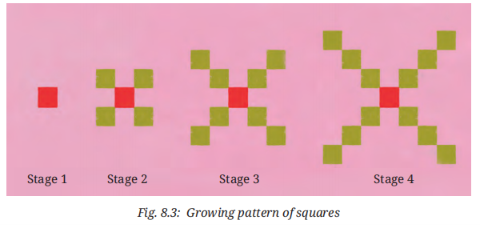 Can you predict the number of squares in Stages 5 and 6 of the sequence? In Stages 10, 11 and 12? In Stage 20? At any stage?
Answer:
The sequence from the figure is 1, 5, 9, 13, ... This is an arithmetic progression (AP) with first term a = 1 and common difference d = 4.
The explicit formula for the nth term is:
tn = 1 + (n-1) × 4 = 4n - 3
Using this formula:
- Stage 5: t₅ = 4(5) - 3 = 20 - 3 = 17 squares
- Stage 6: t₆ = 4(6) - 3 = 24 - 3 = 21 squares
- Stage 10: t₁₀ = 4(10) - 3 = 40 - 3 = 37 squares
- Stage 11: t₁₁ = 4(11) - 3 = 44 - 3 = 41 squares
- Stage 12: t₁₂ = 4(12) - 3 = 48 - 3 = 45 squares
- Stage 20: t₂₀ = 4(20) - 3 = 80 - 3 = 77 squares
At any stage, the number of squares is given by the explicit formula tn = 4n - 3.
Q2. Think and Reflect (Page 8): Consider all the sequences we have discussed so far in this chapter. Which ones are arithmetic progressions and which ones are not? Can you justify your claim?
Answer:
| Sequence | Arithmetic Progression? | Justification |
|---|---|---|
| Natural Numbers (1, 2, 3, 4, ...) | Yes | Common difference d = 1 |
| Odd Numbers (1, 3, 5, 7, ...) | Yes | Common difference d = 2 |
| Square Numbers (1, 4, 9, 16, ...) | No | Differences (3, 5, 7, ...) are not constant |
| Triangular Numbers (1, 3, 6, 10, ...) | No | Differences (2, 3, 4, 5, ...) are not constant |
| Unit Fractions (1, ½, ⅓, ¼, ...) | No | Differences are not constant |
| Virahanka-Fibonacci (1, 2, 3, 5, 8, ...) | No | Each term is the sum of previous two, not a constant addition |
| Pattern from Fig. 8.3 (1, 5, 9, 13, ...) | Yes | Common difference d = 4 |
Q3. Exercise (Page 182): Verify that the following sequences are arithmetic progressions and write their nth terms. What do you observe when you plot the ordered pairs emerging from them? (i) 2, 5, 8, 11, ... (ii) -5, -1, 3, 7, ...
Answer:
(i) 2, 5, 8, 11, ...
- Common difference d = 5 - 2 = 3. Since the difference is constant, it is an AP.
- First term a = 2.
- nth term: tn = a + (n-1)d = 2 + (n-1)3 = 3n - 1.
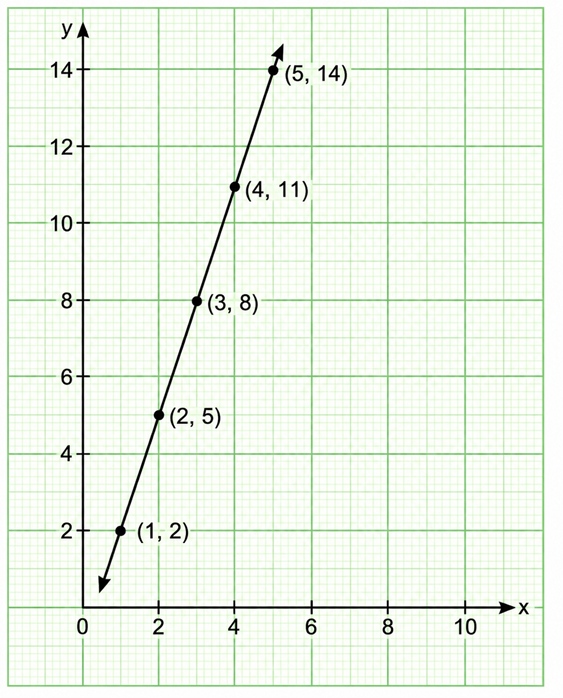
- When we plot the ordered pairs emerging from the sequence, i.e (1, 2), (2, 5), (3, 8), (4, 11), (5, 14), and so on, where the x coordinate represents the term number and y coordinate represents the value of the corresponding term.
(ii) -5, -1, 3, 7, ...
- Common difference d = -1 - (-5) = 4. Since the difference is constant, it is an AP.
- First term a = -5.
- nth term: tn = a + (n-1)d = -5 + (n-1)4 = 4n - 9.
*Plot the graph yourself
Observation when plotting ordered pairs (n, tn):
For both APs, the points (1, t₁), (2, t₂), (3, t₃), ... will lie on a straight line. This is because the explicit formula for an AP is a linear equation in n, tn = dn + (a - d), which represents a straight line.
Q4. Exercise (Page 182): Using the formula tn = a + (n - 1) × d, find the nth term of the following arithmetic progressions. (i) ½, ⁵⁄₂, ⁹⁄₂, ¹³⁄₂, ... (ii) 1.5, 3.5, 5.5, 7.5, ...
Answer:
(i) ½, ⁵⁄₂, ⁹⁄₂, ¹³⁄₂, ...
- First term a = ½.
- Common difference d = ⁵⁄₂ - ½ = ²⁄₂ = 2.
- nth term: tn = a + (n-1)d
= ½ + (n-1)2
= ½ + 2n - 2
= 2n - ³⁄₂.
(ii) 1.5, 3.5, 5.5, 7.5, ...
- First term a = 1.5.
- Common difference d = 3.5 - 1.5 = 2.
- nth term: tn = a + (n-1)d
= 1.5 + (n-1)2
= 1.5 + 2n - 2
= 2n - 0.5.
Q5. Exercise (Page 183): Find recursive rules for the APs in the previous exercises.
Answer:
(i) For the AP: 2, 5, 8, 11,…
First term a = 2 , common difference d = 3. The recursive rule is:
t₁ = 2, tn = tn-1 +3 3 for n ≥ 2.
(ii) For the AP: -5, -1, 3, 7,…
First term a = -5, common difference d =4 . The recursive rule is:
t₁ = -5, tn = tn-1 + 4 for n ≥ 2.
(iii) For the AP: ½, ⁵⁄₂, ⁹⁄₂, ¹³⁄₂, ...
First term a = ½, common difference d = 2. The recursive rule is:
t₁ = ½, tn = tn-1 + 2 for n ≥ 2.
(iv) For the AP: 1.5, 3.5, 5.5, 7.5, ...
First term a = 1.5, common difference d = 2. The recursive rule is:
t₁ = 1.5, tn = tn-1 + 2 for n ≥ 2.
8.5 Sum of the First n Natural Numbers
Q1. Think and Reflect (Page 184): Can the same approach be used to find the sum of 1 + 2 + 3 + ... + 100?
Answer:
Yes, the same approach can be used to find the sum of the first 100 natural numbers.
Let S = 1 + 2 + 3 + ... + 100.
Write the sum in reverse order: S = 100 + 99 + 98 + ... + 1.
Adding the two equations, we get:
2S = (1+100) + (2+99) + (3+98) + ... + (100+1) = 101 + 101 + 101 + ... (100 times) = 100 × 101.
Thus, 2S = 10100
→ S =10100/2= 5050.
This is the same formula Sn = n(n+1)/2. For n = 100, S = 100(101)/2 = 5050.
Q2. Think and Reflect (Page 185): Can you use this formula to find S₂₀, S₃₀ or S₁₀₀₀?
Answer:
The formula for the sum of the first n natural numbers is:
Sn = n(n+1)/2
- S₂₀: 20(21)/2 = 210
- S₃₀: 30(31)/2 = 465
- S₁₀₀₀: 1000(1001)/2 = (1000 × 1001)/2 = 500500
Q3. Think and Reflect (Page 185): Let us revisit the sequence tn of triangular numbers 1, 3, 6, 10, 15, ... shown in Fig. 8.1. Note that the nth term of this sequence is the sum of the first n natural numbers. Thus tn = n(n+1)/2. Can you use this to find the 10th, 17th and 80th triangular numbers? 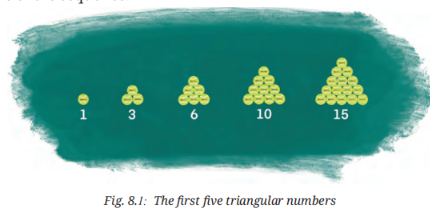
Answer:
Given, nth term of triangular number: tn = n(n+1)/2.
10th triangular number: t₁₀ = 10(11)/2 = 55
17th triangular number: t₁₇ = 17(18)/2 = 153
80th triangular number: t₈₀ = 80(81)/2 = 3240
Therefore, 10th, 17th, and 80th triangular numbers are 55, 153, and 3240 respectively.
8.6 Geometric Progressions
Q1. Think and Reflect (Page 13): Can you predict the number of squares in Stages 5 and 6 of the pattern? In Stages 10, 11 and 12? In Stage 20? At any stage? How is this different from the growing pattern in Fig. 8.3? 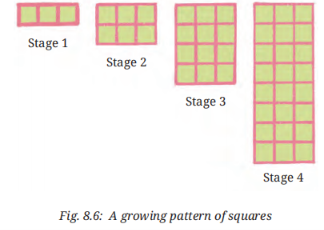
Answer:
The sequence from Fig. 8.6 is 3, 6, 12, 24, ... This is a geometric progression (GP) with first term a = 3 and common ratio r = 2.
The explicit formula for the nth term is:
tn = 3 × 2n-1
Using this formula:
- Stage 5: t₅ = 3 × 2⁴ = 3 × 16 = 48 squares
- Stage 6: t₆ = 3 × 2⁵ = 3 × 32 = 96 squares
- Stage 10: t₁₀ = 3 × 2⁹ = 3 × 512 = 1536 squares
- Stage 11: t₁₁ = 3 × 2¹⁰ = 3 × 1024 = 3072 squares
- Stage 12: t₁₂ = 3 × 2¹¹ = 3 × 2048 = 6144 squares
- Stage 20: t₂₀ = 3 × 2¹⁹ = 3 × 524288 = 1,572,864 squares
Difference from Fig. 8.3: In Fig. 8.3 (AP), the number of squares increased by a constant amount (4) each stage, so the growth was linear. In Fig. 8.6 (GP), the number of squares is multiplied by a constant factor (2) each stage, so the growth is exponential and much faster.
Q2. Think and Reflect (Page 16): Observe the Sierpinski triangle and try to answer the following questions: 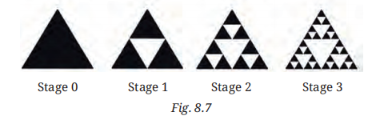 (a) How many black triangles are there in Stages 0 to 3 of Fig. 8.7? (b) Can you predict the number of black triangles at Stages 4 and 5? (c) Can you find a rule for the number of black triangles at the nth stage? (d) Suppose the area of the triangle (that is, the black region) in Stage 0 is 1 square unit. What is the area of the black region in Stages 1, 2 and 3? What will be the area of the black region in Stages 4 and 5? Find a rule for the area of the black region at the nth stage. What happens to this area as n, the number of stages, goes on increasing?
Answer:
(a) Number of black triangles in Stages 0 to 3:
- Stage 0: 1= 30(the whole triangle)
- Stage 1: 1× 3 = 31 (3 black triangles)
- Stage 2: 3 × 3 = 32=9 (each of 3 black triangles splits into 3)
- Stage 3: 9 × 3 = 33=27 (each of 9 black triangles splits into 3)
(b) Stages 4 and 5:
- Stage 4: 27 × 3 = 34 = 81
- Stage 5: 81 × 3 = 35 = 243
(c) Rule for the nth stage:
The number of black triangles at the nth stage is 3n. This is a geometric progression with first term 1 and common ratio 3.
(d) Area of the black region:
In Stage 0, area = 1 square unit. At each stage, the area is multiplied by 3/4 (since one of the four equal smaller triangles is removed).
- Stage 0: 1
- Stage 1: 3/4
- Stage 2: (3/4)² = 9/16
- Stage 3: (3/4)³ = 27/64
- Stage 4: (3/4)⁴ = 81/256
- Stage 5: (3/4)⁵ = 243/1024
Rule for the area at the nth stage: (3/4)n.
What happens as n increases? As n gets larger, (3/4)n gets smaller and smaller, approaching 0. The total black area diminishes and gets infinitely close to 0, even though the number of triangles increases without bound.