
Q1. Represent the rational numbers 2/3, −5/4 and 1/2 on a single number line.
Answer:
Solution:
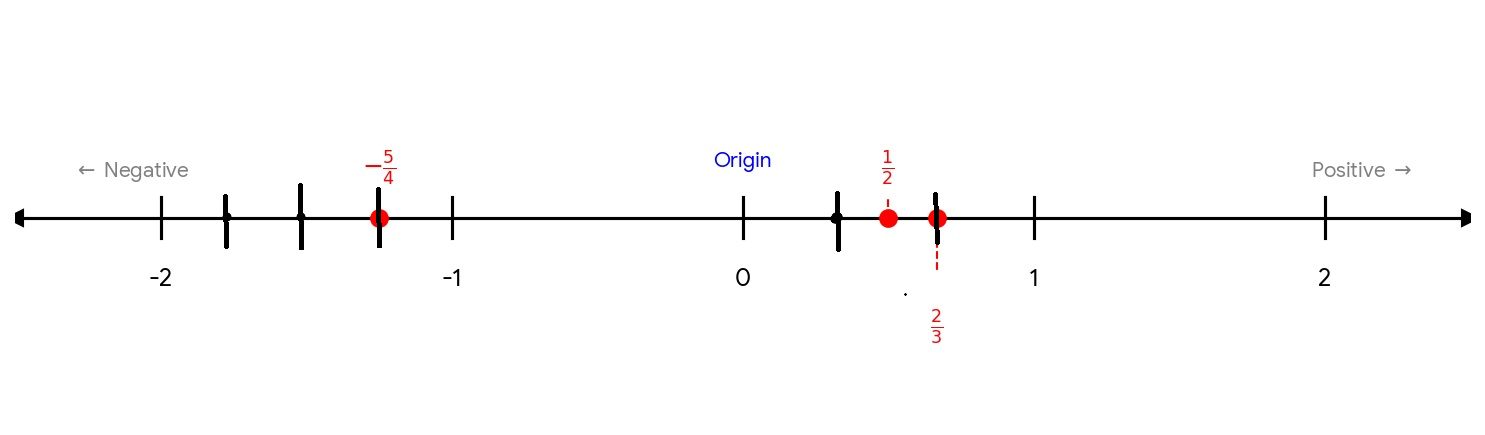
To represent these numbers on the number line, divide the intervals appropriately:
- 2/3: divide the interval between 0 and 1 into 3 equal parts and move 2 parts from 0 to the right.
- 1/2: divide the interval between 0 and 1 into 2 equal parts and move 1 part from 0 to the right.
- −5/4 = −1.25: divide the interval between −1 and −2 into 4 equal parts and move 1 part from −1 to the left.
Note: The number line should show these points as described.
Q2. Find three distinct rational numbers that lie strictly between −1/2 and 1/4.
Answer:
Solution:
We need rational numbers between −0.5 and 0.25.
Possible rational numbers: −0.4, 0, 0.1
In fraction form: −2/5, 0, 1/10
We can also find them by taking averages.
Answer: Three rational numbers between −1/2 and 1/4 are −2/5, 0, and 1/10. (Answers may vary.)
Q3. Simplify the expression: (−1/4) + (5/12).
Answer:
Solution:
LCM of 4 and 12 = 12
= (−3/12) + (5/12)
= 2/12 = 1/6
Answer: 1/6
Q4. A tailor has 15 3/4 metres of fine silk. If making one kurta requires 2 1/4 metres of silk, exactly how many kurtas can he make?
Answer:
Solution:
Total silk = 15 3/4 = 63/4 metres
Silk per kurta = 2 1/4 = 9/4 metres
Number of kurtas = (63/4) ÷ (9/4)
= 63/4 × 4/9 = 63/9 = 7
Answer: He can make exactly 7 kurtas.
Q5. Find three rational numbers between 3.1415 and 3.1416.
Answer:
Solution:
We need numbers between 3.1415 and 3.1416.
We can express them as fractions: 3.1415 = 31415/10000 and 3.1416 = 31416/10000
Possible rational numbers: 3.14151, 3.14155, 3.14159
As fractions: 314151/100000, 314155/100000, 314159/100000
Answer: Three rational numbers are 3.14151, 3.14155, and 3.14159 (or any other numbers between the given values).
Q6. Can you think of other way(s) to find a rational number between any two rational numbers?
Answer:
Solution:
Yes, there are multiple ways:
- Average method: The average of two rational numbers always lies between them. For a and b, (a + b)/2 is a rational number between a and b.
- Decimal method: Write both numbers in decimal form and insert a decimal between them. For example, between 0.12 and 0.13, we can take 0.125.
- Numerator/denominator adjustment: If a = p/q and b = r/s, we can find a rational number by cross-multiplication or by finding a common denominator and taking an intermediate numerator.
Answer: Other methods include using averages, decimal representation, or finding a common denominator and choosing an intermediate numerator.