
Q1. Convert the following rational numbers in the form of a terminating decimal or non-terminating and repeating decimal, whichever the case may be, by the process of long division: (i) 3/50 (ii) 2/9
Answer:
Solution:
(i) 3/50 = 0.06 (terminating decimal)
0.06
_______
50 | 3.00
- 0
____
3 0
- 0
____
30 0
- 30 0
______
0
(ii) 2/9 = 0.2222... = 0.2 (non-terminating repeating decimal)
0.222...
___________
9 | 2.000
-1.8
_____
20
-18
_____
20
-18
_____
2
Long division: 2 ÷ 9 = 0 remainder 2; bring down 0 → 20 ÷ 9 = 2 remainder 2; the remainder 2 repeats, so the decimal repeats 2.
Answer: (i) 0.06 (terminating), (ii) 0.2 (repeating).
Q2. Prove that √5 is an irrational number.
Answer:
Solution:
Proof by contradiction:
Assume √5 = p/q in simplest form, where p and q are co-prime integers (q ≠ 0).
Squaring both sides: 5 = p²/q² → p² = 5q²
This means p² is divisible by 5, so p is divisible by 5.
Let p = 5k, where k is an integer.
Substitute: (5k)² = 5q²
→ 25k² = 5q²
→ q² = 5k²
This means q² is divisible by 5, so q is divisible by 5.
Thus p and q both have a common factor 5, contradicting the assumption that they are co-prime.
Therefore, √5 cannot be expressed as a ratio of two integers; it is irrational.
Answer: √5 is irrational as proved by contradiction.
Q3. Convert the following decimal numbers in the form of p/q. 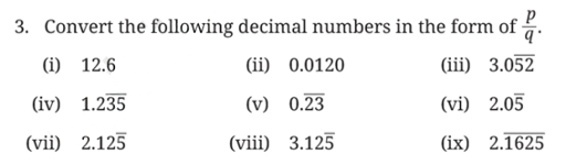
Answer:
Convert Decimal Numbers into p/q
Repeating decimal: Let the number be x. Multiply by 10, 100, 1000... according to the number of digits in the repeating and non-repeating parts. Subtract the equations and solve for x.
(i) 12.6
(ii) 0.0120
(iii) 3.052
1000x = 3052.525252...
10x = 30.525252...
1000x - 10x = 3052 - 30
(iv) 1.235
1000x - 10x = 1235 - 12
(v) 0.23
100x - x = 23
(vi) 2.05
100x - 10x = 205 - 20
(vii) 2.125
1000x - 100x = 2125 - 212
(viii) 3.125
1000x - 100x = 3125 - 312
(ix) 2.1625
10000x - x = 21625 - 2
Final Answers
(i) 63/5 (ii) 3/250 (iii) 1511/495
(iv) 1223/990 (v) 23/99 (vi) 37/18
(vii) 1913/900 (viii) 2813/900 (ix) 21623/9999
```
Q4. Locate the following rational numbers on the number line: (i) 0.532 (ii) 1.15
Answer:
Solution:
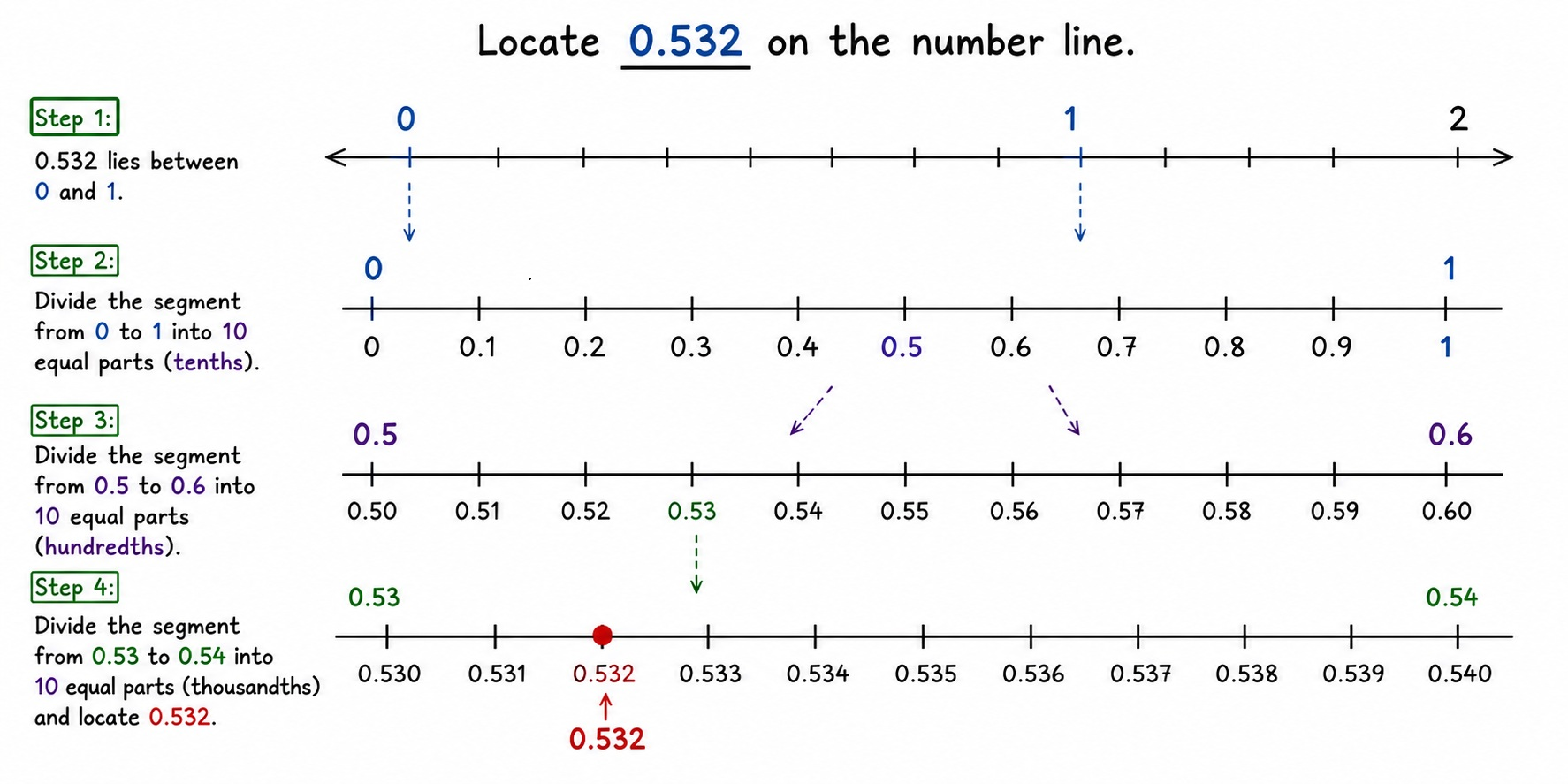
(i) 0.532 = 532/1000.
- On the number line, this lies between 0 and 1.
- Divide the interval from 0 to 1 into 1000 equal parts (or more practically into 10 parts of 0.1 each, then subdivide further).
- 0.532 is between 0.5 and 0.6, slightly closer to 0.5.
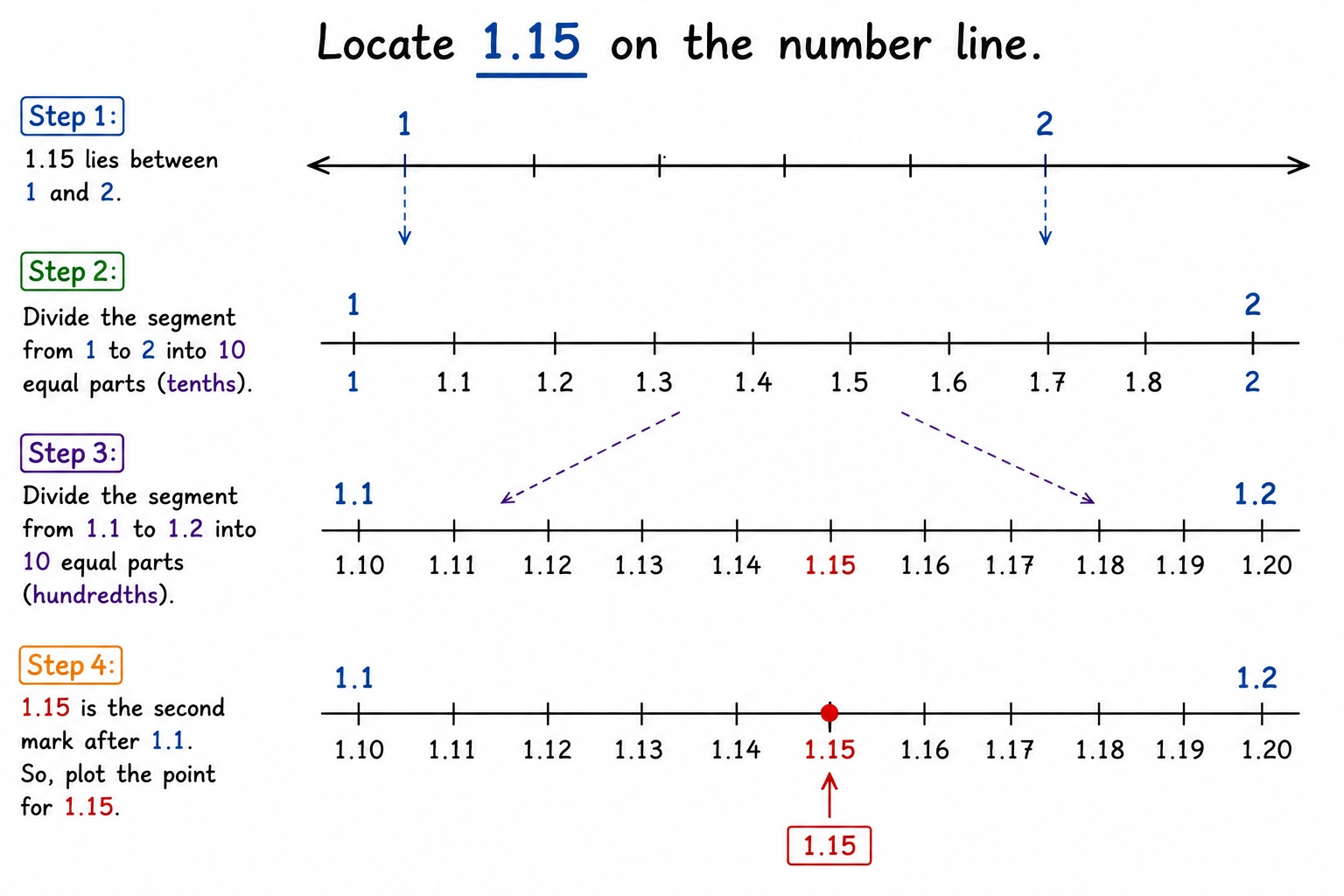
(ii)1.15 = 115/100
- This lies between 1 and 2.
- Divide the interval from 1 to 2 into 10 equal parts (each 0.1).
- 1.15 lies between 1.1 and 1.2, exactly in the middle.
- Answer: 0.532 is between 0.5 and 0.6 (closer to 0.5); 1.15 is between 1.1 and 1.2 (exactly in the middle).
Q5. Find 6 rational numbers between 3 and 4.
Answer:
Solution:
We can choose fractions between 3 and 4 by writing them with a common denominator.
For example, with denominator 7:
3 = 21/7 , 4 = 28/7
Numbers between: 22/7, 23/7, 24/7, 25/7, 26/7, 27/7
These are: 22/7, 23/7, 24/7, 25/7, 26/7, 27/7
Answer: Six rational numbers between 3 and 4 are 22/7, 23/7, 24/7, 25/7, 26/7, and 27/7. (Answers may vary.)
Q6. Find 5 rational numbers between 2/5 and 3/5.
Answer:
Solution:
We can choose fractions with a common denominator.
Use denominator 30: Multiply the Numerator and Denominator by 6
2/5 = 12/30, 3/5 = 18/30
Numbers between: 13/30, 14/30, 15/30, 16/30, 17/30
These simplify to: 13/30, 7/15, 1/2, 8/15, 17/30
Answer: Five rational numbers between 2/5 and 3/5 are 13/30, 7/15, 1/2, 8/15, and 17/30. (Answers may vary.)
Q7. Find 5 rational numbers between 1/6 and 2/5.
Answer:
Solution:
Use common denominator: LCM of 6 and 5 is 30.
1/6 = 5/30, 2/5 = 12/30
Numbers between: 6/30, 7/30, 8/30, 9/30, 10/30, 11/30
Choose any five: 6/30, 7/30, 8/30, 9/30, 10/30
Simplify: 6/30 = 1/5, other also
Answer: Five rational numbers between 1/6 and 2/5 are 1/5, 7/30, 4/15, 3/10,and 1/3. (Answers may vary.)
Q8. If x/3 + x/5 = 16/15, find the rational number x.
Answer:
Solution:
x/3 + x/5 = (5x + 3x)/15 = 8x/15
Given: 8x/15 = 16/15
Multiply both sides by 15:
8x = 16
x = 2
Answer: x = 2.
Q9. Let a and b be two non-zero rational numbers such that a + 1/b = 0. Without assigning any numerical values, determine whether ab is positive or negative. Justify your answer.
Answer:
Solution:
Given: a + 1/b = 0
⇒ a = −1/b
Multiply both sides by b:
ab = −1
Since −1 is negative, ab is negative.
Answer: ab is negative, because a = −1/b implies ab = −1.
Q10. A rational number has a terminating decimal expansion whose last non-zero digit occurs in the 4th decimal place. Show that such a number can be written in the form p/10⁴, where p is an integer not divisible by 10. Is it necessary that the denominator of this rational number, when written in the lowest form, is divisible by 2⁴ or 5⁴? Give reasons.
Answer:
Question
A rational number has a terminating decimal expansion whose last non-zero digit occurs in the 4th decimal place. Show that such a number can be written in the form p/104, where p is an integer not divisible by 10. Is it necessary that the denominator of this rational number, when written in lowest form, is divisible by 24 or 54? Give reasons.
Solution
Step 1: Let the rational number be represented by a terminating decimal whose last non-zero digit is in the 4th decimal place.
Since the decimal terminates after 4 decimal places, it can be written as:
x = p / 104
where p is an integer.
Also, since the last non-zero digit occurs in the 4th decimal place, p cannot be divisible by 10. Otherwise, the numerator and denominator would have a common factor of 10, and the decimal would end with a zero.
Hence, the number can be written in the form:
x = p / 104
where p is an integer not divisible by 10.
Step 2: Is the denominator in lowest form necessarily divisible by 24 or 54?
We know that:
104 = (2 × 5)4 = 24 × 54
When the fraction p/104 is reduced to lowest terms, some factors of 2 and 5 may cancel with the numerator. Therefore, the denominator in lowest form need not contain both 24 and 54.
Example 1:
625 / 10000 = 1 / 16
The denominator is 16 = 24, which is not divisible by 54.
Example 2:
16 / 10000 = 1 / 625
The denominator is 625 = 54, which is not divisible by 24.
Conclusion
Therefore,
- The number can be written in the form p/104, where p is an integer not divisible by 10.
- No, the denominator in lowest form is not necessarily divisible by 24 or 54, because common factors may cancel while reducing the fraction to its lowest terms.
```
Q11. Without performing division, determine whether the decimal expansion of 18/125 is terminating or non-terminating. If it terminates, state the number of decimal places.
Answer:
Solution:
125 = 5³
The prime factors of the denominator are only 5, so the decimal expansion is terminating.
To find the number of decimal places: Since 125 = 5³, we need to multiply numerator and denominator by 2³ to get a power of 10.
18/125 = 18/(5³) = (18 × 2³)/(5³ × 2³) = 144/1000 = 0.144
So it has 3 decimal places.
Answer: Terminating, with 3 decimal places.
Q12. A rational number in its lowest form has denominator 2³ × 5. How many decimal places will its decimal expansion have? Explain your answer.
Answer:
Solution:
Denominator = 2³ × 5 = 8 × 5 = 40
To make it a power of 10, we need to multiply by 2² to get: 2³ × 2² × 5 = 2⁵ × 5 = 160, which is not a power of 10 because we still need another factor of 5.
Actually, we need to make the denominator 10ⁿ = 2ⁿ × 5ⁿ.
Given denominator has 2³ and 5¹. To make it 10ⁿ, we need the exponents of 2 and 5 to be equal. So we need to multiply by 2² to get 2⁵, but we also need 5⁵, so we need to multiply by 5⁴ as well.
So the denominator becomes: 2³ × 5 × 2² × 5⁴ = 2⁵ × 5⁵ = 10⁵
Thus the number of decimal places is 5.
Alternatively, the number of decimal places is the maximum of the exponents of 2 and 5 in the denominator: max(3, 1) = 3? No, that's not correct. Let's reconsider.
For a terminating decimal, the denominator in lowest form is of the form 2ᵃ × 5ᵇ. The number of decimal places is max(a, b).
Here a = 3, b = 1, so max(3, 1) = 3.
But wait, if we multiply numerator and denominator by 2^(3-1)=2² and 5^(3-1)=5², we get 10³. So the decimal has 3 places.
Let's check: 2³ × 5 = 40 = 2³ × 5¹. To make 10³ = 2³ × 5³, multiply by 5²: 40 × 25 = 1000. So the decimal has 3 places.
Answer: The decimal expansion will have 3 decimal places (max(3, 1) = 3).
Q13. Let a = 7/12 and b = 5/6. Express both a and b in the form k₁/m and k₂/m where k₁, k₂ and m are integers and k₂ − k₁ > 6. Using the same denominator m, write exactly five distinct rational numbers lying between a and b keeping an integer numerator. Explain why the condition k₂ − k₁ > n + 1 is necessary to find n such rational numbers between the two rational numbers a and b using this method.
Answer:
Solution:
a = 7/12, b = 5/6 = 10/12
So with m = 12, k₁ = 7, k₂ = 10. Then k₂ − k₁ = 3, which is not > 6.
We need k₂ − k₁ > 6. Let's find a common denominator that satisfies this.
Let m = 36: a = 21/36, b = 30/36. Then k₂ − k₁ = 30 − 21 = 9 > 6.
Now we need exactly 5 rational numbers between 21/36 and 30/36 with integer numerators.
They are: 22/36, 23/36, 24/36, 25/36, 26/36
Simplify: 11/18, 23/36, 2/3, 25/36, 13/18
Why k₂ − k₁ > n + 1 is necessary:
If we want n distinct rational numbers with integer numerators between k₁ and k₂, we need at least n integers between them, so the difference k₂ − k₁ must be at least n + 1.
For n = 5, we need k₂ − k₁ ≥ 6. And since we need strict inequality (between, not including endpoints), we use k₂ − k₁ > n + 1 = 6.
Answer: With m = 36, the five numbers are 22/36, 23/36, 24/36, 25/36, 26/36. The condition ensures enough integer numerators exist between the two rational numbers.
Q14. Three rational numbers x, y, z satisfy x + y + z = 0 and xy + yz + zx = 0. Show that all the rational numbers x, y, z must be simultaneously zero.
Answer:
Solution:
We know that (x + y + z)² = x² + y² + z² + 2(xy + yz + zx)
Given x + y + z = 0 and xy + yz + zx = 0,
substitute the given value in the euation
0² = x² + y² + z² + 2(0)
0 = x² + y² + z²
Since x² ≥ 0, y² ≥ 0, z² ≥ 0, and their sum is 0 only when each term must be 0.
Therefore, x = y = z = 0.
Answer: x = y = z = 0.
Q15. Show that the rational number (a + b)/2 lies between the rational numbers a and b.
Answer:
Solution:
Assume a < b (if a > b, we can swap them).
We need to prove: a < (a + b)/2 < b
First inequality:
a < (a + b)/2
⇔ 2a < a + b
⇔ a < b, which is true.
Second inequality:
(a + b)/2 < b
⇔ a + b < 2b
⇔ a < b, which is true.
Therefore, (a + b)/2 lies strictly between a and b.
If a > b, the same argument with reversed roles holds.
Answer: The average (a + b)/2 always lies between a and b.
Q16. Find the lengths of the hypotenuse of all the right triangles in Fig. 3.14 which is referred to as the square root spiral. 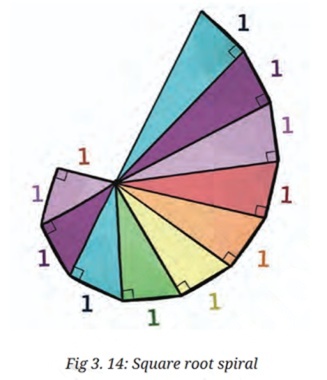
Answer:
Question
Find the lengths of the hypotenuse of all the right triangles in Fig. 3.14, which is referred to as the Square Root Spiral.
Solution
In the square root spiral, each new right triangle is formed by taking:
- One side = 1 unit
- The other side = hypotenuse of the previous triangle
Using Pythagoras Theorem:
(Hypotenuse)2 = (Previous Hypotenuse)2 + 12
| Triangle | Calculation of Hypotenuse | Hypotenuse |
|---|---|---|
| 1st | √(1² + 1²) | √2 |
| 2nd | √((√2)² + 1²) = √(2 + 1) | √3 |
| 3rd | √((√3)² + 1²) = √(3 + 1) | √4 = 2 |
| 4th | √(2² + 1²) | √5 |
| 5th | √((√5)² + 1²) | √6 |
| 6th | √((√6)² + 1²) | √7 |
| 7th | √((√7)² + 1²) | √8 = 2√2 |
| 8th | √((√8)² + 1²) | √9 = 3 |
| 9th | √(3² + 1²) | √10 |
| 10th | √((√10)² + 1²) | √11 |
| 11th | √((√11)² + 1²) | √12 = 2√3 |
| 12th | √((√12)² + 1²) | √13 |
Answer
Therefore, the lengths of the hypotenuses of the right triangles in the square root spiral are:
√2, √3, 2, √5, √6, √7, 2√2, 3, √10, √11, 2√3, √13