
On a graph sheet, mark the x-axis and y-axis and the origin O. Mark points from (– 7, 0) to (13, 0) on the x-axis and from (0, – 15) to (0, 12) on the y-axis. (Use the scale 1 cm = 1 unit.) Using Fig. 1.5, answer the given questions
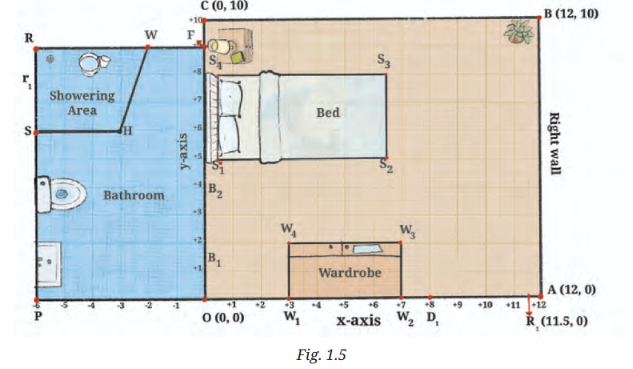
Q1. Place Reiaan's rectangular study table with three of its feet at the points (8, 9), (11, 9) and (11, 7).
(i) Where will the fourth foot of the table be?
(ii) Is this a good spot for the table?
(iii) What is the width of the table? The length? Can you make out the height of the table?
Answer:
(i) The three given points (8, 9), (11, 9), and (11, 7) form three corners of a rectangle.
The table is rectangular and these are three of its four corners,
Since opposite sides of a rectangle are parallel and equal:
The x-coordinate of the fourth foot will be the same as A: 8
The y-coordinate of the fourth foot will be the same as C: 7
Therefore, the fourth foot is at: D (8,7)
(ii) Yes,it is a good spot for the table.
The table is located in the upper right portion of the room, with corners at (8,7), (11,7), (11,9), and (8,9).
- The table is placed in the open area near the right wall and does not block:
the bed,
the wardrobe,
the room door,
the bathroom entrance. - It also leaves enough space for movement around the room.
- ITs Placement against the wall creates a highly functional and convinient study space
(iii) The width of the table is the difference in the y-coordinates (9 - 7 = 2 ft) and the length is the difference in the x-coordinates (11 - 8 = 3 ft). The height of the table cannot be determined from a 2-D floor plan because height is a three-dimensional measurement that requires the z-coordinate, which is not represented in the xy-plane.
Q2. If the bathroom door has a hinge at B1 and opens into the bedroom, will it hit the wardrobe? Are there any changes you would suggest if the door is made wider?
Answer:
The bathroom door is hinged at B1 (0, 1.5) and has a width of 2.5 ft (from B1 at y=1.5 to B2 at y=4). When the door opens into the bedroom, it swings along a circular arc with radius equal to the door's width (2.5 ft). The door swing will sweep through the area bounded by the y-axis and the arc of a circle centered at B1 with radius 2.5 ft.
If the wardrobe is positioned in the path of this swinging door (for example, if it is placed near the lower right corner of the room at coordinates (3,0) to (5,6)), the door will hit the wardrobe when opened. To avoid this, the wardrobe should be placed outside the door's swing path, or the door should be hinged on the other side.
If the door is made wider, its swing radius increases. For example, if the door width becomes 3 ft, the arc would sweep further into the room. This would require even more clear space and could make it more likely to hit furniture. To accommodate a wider door, the room layout would need to be adjusted by moving furniture away from the door's swing path or by using a sliding door instead of a hinged one.
Q3. Look at Reiaan's bathroom. (i) What are the coordinates of the four corners O, F, R, and P of the bathroom? (ii) What is the shape of the showering area SHWR in Reiaan's bathroom? Write the coordinates of the four corners. (iii) Mark off a 3 ft × 2 ft space for the washbasin and a 2 ft × 3 ft space for the toilet. Write the coordinates of the corners of these spaces.
Answer:
(i) The bathroom is a rectangle with corners at O (0, 0), F (0, 6), R (5, 6), and P (5, 0).
(ii) The showering area SHWR is a square (or rectangle) with corners at S (2, 0), H (4, 0), W (4, 2), and R (2, 2). It is 2 ft wide and 2 ft deep.
(iii) Washbasin: A 3 ft × 2 ft space could be placed at various locations. For example, one possible placement is at coordinates (0, 2) to (3, 4), where the corners would be (0, 2), (3, 2), (3, 4), and (0, 4). Toilet: A 2 ft × 3 ft space could be placed at coordinates (3, 3) to (5, 6), with corners at (3, 3), (5, 3), (5, 6), and (3, 6). The exact placement is up to the student, but they should ensure that the spaces are within the bathroom boundaries and do not overlap with each other or the showering area.
Q4. Other rooms in the house: (i) Reiaan's room door leads from the dining room which has the length 18 ft and width 15 ft. The length of the dining room extends from point P to point A. Sketch the dining room and mark the coordinates of its corners. (ii) Place a rectangular 5 ft × 3 ft dining table precisely in the centre of the dining room. Write down the coordinates of the feet of the table.
Answer:
(i) The dining room is a rectangle with length 18 ft and width 15 ft. If the room door is at the origin (0,0) and the length extends from point P to point A, we can set the coordinates as: P (0, 0), Q (18, 0), R (18, 15), and A (0, 15). This places the length along the x-axis and width along the y-axis.
(ii) The centre of the dining room is at the midpoint of the rectangle: ((0+18)/2, (0+15)/2) = (9, 7.5). For a 5 ft × 3 ft table, half its dimensions are 2.5 ft and 1.5 ft. The four corners of the table (feet) would be:
- Bottom-left: (9 - 2.5, 7.5 - 1.5) = (6.5, 6)
- Bottom-right: (9 + 2.5, 7.5 - 1.5) = (11.5, 6)
- Top-right: (9 + 2.5, 7.5 + 1.5) = (11.5, 9)
- Top-left: (9 - 2.5, 7.5 + 1.5) = (6.5, 9)
These coordinates represent the four feet of the table placed exactly at the centre of the dining room.