
Think and Reflect (Page 1)
Q1. If a proposition is true, then is its converse always true?
Answer: No. A proposition may be true while its converse is false.
Example: "If it rains, then the road is wet" is true. But its converse, "If the road is wet, then it has rained," need not be true — the road could be wet because a water tanker spilled water on it. Such an example that makes a statement false is called a counterexample.
Q2. We have proved the first statement in an earlier grade. Is the second statement true? Can you prove it? (Hint: Draw the altitude from the vertex containing the third angle.)
Answer: Yes, Statement 2 is true: If two angles of a triangle are equal, then the sides opposite the equal angles are equal.
Proof: Let ABC be a triangle in which ∠B = ∠C. Draw AD ⊥ BC, meeting BC at D.
- In ΔABD and ΔACD: ∠ABD = ∠ACD (given), ∠ADB = ∠ADC = 90° and AD = AD (common side).
- By the AAS rule, ΔABD ≅ ΔACD.
- Hence AB = AC (CPCT), i.e. the sides opposite the equal angles are equal.
📝 Exam tip: This result is the converse of the "equal sides give equal angles" theorem, and together they are used to prove that a triangle is isosceles.
In-Text Examples (Examples 2 to 5)
Example 2: Proposition P: If a number is a multiple of 6, then it is a multiple of 3. Converse Q: If a number is a multiple of 3, then it is a multiple of 6. Justify why P is true. Does this mean that all multiples of 3 are also multiples of 6? Determine if Q is true and if not, give a counterexample.
Answer:
P is true. If n is a multiple of 6, then n = 6k for some integer k. But 6k = 3 × (2k), which is a multiple of 3. So every multiple of 6 is a multiple of 3.
Q is false. Not every multiple of 3 is a multiple of 6.
Counterexample: 9 is a multiple of 3 (9 = 3 × 3) but 9 is not a multiple of 6 (9 ÷ 6 leaves remainder 3). So Q is false.
Example 3: Proposition P: If n is a perfect square, then it has an odd number of factors. Converse Q: If n has an odd number of factors, then it is a perfect square. Which of them are true?
Answer: Both P and Q are true.
Why Q is true: Factors of a number occur in "factor–partner" pairs whose product is the number, e.g. for 35 the pair is (5, 7). If n has an odd number of factors, then one pair must have the same number repeated, i.e. a pair (f, f). Then n = f × f = f², so n is a perfect square.
Why P is true: If n = f², then in the list of factor pairs the pair (f, f) is counted only once, while every other pair contributes two different factors. Also, a number cannot have two different repeated pairs (f, f) and (g, g) with f ≠ g, because that would give f² = g² = n, forcing f = g. Hence a perfect square has an odd number of factors.
So here "n is a perfect square" and "n has an odd number of factors" imply each other.
Example 4: Proposition P: If two triangles have the same area, then they are congruent. Converse Q: If two triangles are congruent, then they have the same area. Determine if these statements are true or not. Justify the true statements and give a counterexample for each false statement.
Answer:
- P is false. Equal areas do not make triangles congruent. Counterexample: A right triangle with legs 3 cm and 8 cm has area ½ × 3 × 8 = 12 cm². An isosceles triangle with sides 5 cm, 5 cm and 6 cm has base 6 cm and height 4 cm, so its area is ½ × 6 × 4 = 12 cm². The areas are equal, but the two triangles have different side lengths, so they are not congruent.
- Q is true. If two triangles are congruent, all their corresponding sides and angles are equal. Taking a corresponding base b and the corresponding height h in both triangles, the area of each is ½ × b × h, so the areas are equal.
Example 5: Here is a statement of the Baudhayana–Pythagoras theorem: Let a, b, c be the side lengths of a triangle. If the triangle is right-angled, then a² + b² = c². What is its converse? Is this converse true?
Answer:
Converse: Let a, b, c be the side lengths of a triangle. If a² + b² = c², then the triangle is right-angled.
Yes, the converse is true. Proof: Let ΔABC have sides a, b, c with a² + b² = c². Construct a right triangle ΔXYZ with YZ = a, XZ = b and ∠Z = 90°.
- By the Baudhayana–Pythagoras theorem, XY² = a² + b² = c², so XY = c.
- In ΔABC and ΔXYZ: AB = XY = c, BC = YZ = a and AC = XZ = b.
- By the SSS criterion, ΔABC ≅ ΔXYZ.
- Hence ∠C = ∠Z = 90°, so ΔABC is right-angled.
So the converse of the Baudhayana–Pythagoras theorem is also true, and the two statements are equivalent.
Discussion (Pages 2–3)
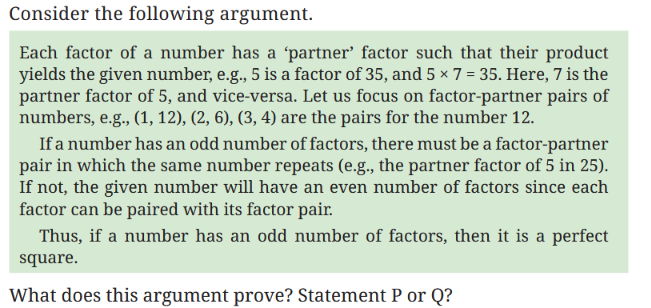
Q1. What does this argument prove? Statement P or Q?
Answer: The argument proves Statement Q — "If n has an odd number of factors, then it is a perfect square."
This is clear from the chain of reasoning used:
- (i) n has an odd number of factors,
- which implies (ii) there is a factor–partner pair in which the same number repeats, say (f, f),
- which implies (iii) n is a square number, n = f × f.
The argument starts with "odd number of factors" and ends with "perfect square", so it proves Q. It says nothing about starting with a square number, so it does not prove P.
Q2. Is P true?
Answer: Yes, P is also true: every perfect square has an odd number of factors.
Reasoning: Start with (iii): n = f², i.e. n is a perfect square. Then clearly the pair (f, f) exists, so (ii) holds. Now, can there be a second repeated pair (g, g)? If n = f² = g², then f = g, so the repeated pair is unique. Therefore exactly one factor is left unpaired, and all remaining factors occur in pairs. So the total number of factors is odd, and (i) holds.
Hence P is true, and the two statements "n is a perfect square" and "n has an odd number of factors" imply each other.
Think and Reflect (Page 3)
Q1. It can also happen that both the proposition and converse are false! Can you give an example?
Answer: Yes. Consider the proposition:
P: If a quadrilateral is a rectangle, then its diagonals are perpendicular to each other. This is false — in a rectangle with sides 4 cm and 6 cm, the diagonals are not perpendicular.
Converse Q: If the diagonals of a quadrilateral are perpendicular to each other, then it is a rectangle. This is also false — a kite (or a rhombus that is not a square) has perpendicular diagonals but is not a rectangle.
So both the proposition and its converse are false here.
Another simple example: P: "If a triangle is equilateral, then it is right-angled" (false) and Q: "If a triangle is right-angled, then it is equilateral" (false).
Think and Reflect (Page 5)
Q1. Identify real-life examples in which a proposition is true but not the converse. Give nice counterexamples!
Answer:
- P: If it rains, the ground becomes wet. (True)
Q: If the ground is wet, it has rained. (False — a water tanker may have spilled water.) - P: If you are in Delhi, then you are in India. (True)
Q: If you are in India, then you are in Delhi. (False — you could be in Chennai.) - P: If a student scores full marks in every subject, then the student gets a certificate. (True)
Q: If a student gets a certificate, then the student scored full marks in every subject. (False — certificates are given for many other achievements.) - P: If a person is a cricket player, then the person is an athlete. (True)
Q: If a person is an athlete, then the person is a cricket player. (False — the person could be a swimmer.)
Q2. Give more examples from geometry as well as number theory in which a proposition is true but not its converse. Give appropriate counterexamples.
Answer:
From geometry:
- P: If a quadrilateral is a rectangle, then its diagonals are equal. (True)
Q: If the diagonals of a quadrilateral are equal, then it is a rectangle. (False — an isosceles trapezium has equal diagonals but is not a rectangle.) - P: If two triangles are congruent, then they have equal areas. (True)
Q: If two triangles have equal areas, then they are congruent. (False — a 3 cm × 8 cm right triangle and a 5 cm, 5 cm, 6 cm triangle both have area 12 cm² but are not congruent.) - P: If a quadrilateral is a square, then all its angles are equal. (True)
Q: If all the angles of a quadrilateral are equal, then it is a square. (False — a 4 cm × 6 cm rectangle has all angles 90° but is not a square.)
From number theory:
- P: If a number is a multiple of 6, then it is a multiple of 3. (True)
Q: If a number is a multiple of 3, then it is a multiple of 6. (False — 9 is a multiple of 3 but not of 6.) - P: If a number is a multiple of 4, then it is an even number. (True)
Q: If a number is even, then it is a multiple of 4. (False — 6 is even but not a multiple of 4.) - P: If a number is divisible by 24, then it is divisible by 4 and 6. (True)
Q: If a number is divisible by 4 and 6, then it is divisible by 24. (False — 12 is divisible by 4 and 6 but not by 24.)
Exercise Set 9.1
Q1. If two lines are parallel, then the corresponding angles formed by a transversal are equal.
Answer:
Converse: If the corresponding angles formed by a transversal are equal, then the two lines are parallel.
- Proposition — True. This is the corresponding angles property of parallel lines, proved earlier: a transversal cutting two parallel lines makes each pair of corresponding angles equal.
- Converse — True. This is the converse of the corresponding angles axiom. If the corresponding angles are equal, the lines can never meet on either side (otherwise the exterior angle of the triangle formed would not equal the interior opposite angle), so the lines are parallel.
Q2. If a quadrilateral is a square, then all its angles are equal.
Answer:
Converse: If all the angles of a quadrilateral are equal, then it is a square.
- Proposition — True. A square has four right angles, so all its angles are equal (each 90°).
- Converse — False. If all angles of a quadrilateral are equal, each angle is 360° ÷ 4 = 90°, so the quadrilateral is a rectangle, but its sides need not all be equal. Counterexample: a rectangle of length 6 cm and breadth 4 cm — all angles are 90°, but it is not a square.
Q3. Given any △ABC, let us bisect the angles at B and C. The bisectors meet at the incentre I of the triangle. Now extend the bisectors beyond I till they meet the opposite sides at E and F respectively, as shown. Proposition: If AB = AC, then IE = IF.
Answer:
Converse: If IE = IF, then AB = AC.
Proposition — True. Proof: Suppose AB = AC in △ABC. Then ∠B = ∠C (angles opposite equal sides).
- Since BI and CI bisect ∠B and ∠C, ∠IBC = ½∠B = ½∠C = ∠ICB. Hence in △IBC, IB = IC.
- In △ABE and △ACF: ∠BAE = ∠CAF (common angle), ∠ABE = ½∠B = ½∠C = ∠ACF, and AB = AC. By the ASA rule, △ABE ≅ △ACF, so BE = CF.
- Therefore IE = BE − BI = CF − CI = IF.
Converse — Not always true. IE = IF does not force AB = AC.
Counterexample: Take a triangle with BC = a = 7, CA = b = 3 and AB = c = 8, so AB ≠ AC.
Using the angle-bisector length formula BE = 2ac cos(B/2)/(a+c), and BI = r/sin(B/2) = ac cos(B/2)/s (where s is the semi-perimeter), we get
IE = abc cos(B/2) / [s(a + c)] and IF = abc cos(C/2) / [s(a + b)].
Here s = (7 + 3 + 8)/2 = 9, cos(B/2) = √(27/28) = 3√21/14 and cos(C/2) = √(3/7) = √21/7.
- IE = (7 × 3 × 8 × 3√21/14) ÷ (9 × 15) = 4√21/15
- IF = (7 × 3 × 8 × √21/7) ÷ (9 × 10) = 4√21/15
So IE = IF, but AB = 8 ≠ 3 = AC. Hence the converse is false.
📝 Exam tip: This is a starred (challenging) question. In the exam, write the proof of the proposition clearly; for the converse, a correctly computed counterexample is enough.
Q4. If x = y, then a + x = a + y, where x, y and a are any three numbers. This proposition and its converse are routinely used while solving equations.
Answer:
Converse: If a + x = a + y, then x = y.
- Proposition — True. This is the addition property of equality: adding the same number a to both sides of a true equality keeps it true. If x = y, then the two quantities a + x and a + y are the same number.
- Converse — True. This is the subtraction property of equality: subtract a from both sides of a + x = a + y. We get (a + x) − a = (a + y) − a, i.e. x = y.
Both statements are used while solving equations: we add the same number to both sides (proposition) and cancel the same number from both sides (converse).
Q5. If a and b are perfect squares, then ab is a perfect square.
Answer:
Converse: If ab is a perfect square, then a and b are perfect squares.
- Proposition — True. If a and b are perfect squares, then a = m² and b = n² for some integers m and n. Then ab = m²n² = (mn)², which is a perfect square.
- Converse — False. Counterexample: Take a = 2 and b = 8. Then ab = 16 = 4², a perfect square, but neither 2 nor 8 is a perfect square.
Q6. If x = y, then x² = y². (x and y are real numbers.)
Answer:
Converse: If x² = y², then x = y.
- Proposition — True. If x = y, then x and y are the same number, so their squares are also the same: x² = y².
- Converse — False. Counterexample: Take x = 2 and y = −2. Then x² = 4 = y², but x ≠ y. (In general, x² = y² gives x = y or x = −y.)
Q7. If x = y, then x³ = y³. (x and y are real numbers.)
Answer:
Converse: If x³ = y³, then x = y.
- Proposition — True. If x = y, then x and y are the same number, so their cubes are equal: x³ = y³.
- Converse — True. If x³ = y³, then x³ − y³ = 0, i.e. (x − y)(x² + xy + y²) = 0. Now x² + xy + y² = ½[(x + y)² + x² + y²], which is zero only when x = y = 0. In every case, x² + xy + y² = 0 forces x = y; otherwise we must have x − y = 0, i.e. x = y. Hence the converse is true.
📝 Exam tip: Compare Q6 and Q7 — squaring can destroy information (two numbers may have the same square), but cubing cannot.
Q8. If n is divisible by 24, then it is divisible by both 4 and 6. (n is a positive integer.)
Answer:
Converse: If n is divisible by both 4 and 6, then it is divisible by 24.
- Proposition — True. If n = 24k, then n = 4(6k) and n = 6(4k), so n is divisible by both 4 and 6.
- Converse — False. Counterexample: n = 12 is divisible by 4 (12 = 4 × 3) and by 6 (12 = 6 × 2), but 12 is not divisible by 24. (The reason: 4 and 6 are not coprime, so divisibility by both does not give divisibility by their product.)
Q9. If n is divisible by 60, then it is divisible by both 5 and 12. (n is a positive integer.)
Answer:
Converse: If n is divisible by both 5 and 12, then it is divisible by 60.
- Proposition — True. If n = 60k, then n = 5(12k) and n = 12(5k), so n is divisible by both 5 and 12.
- Converse — True. Here 5 and 12 are coprime (HCF = 1). If n is divisible by 5, then n = 5m. Since 12 divides n = 5m and 12 is coprime to 5, 12 must divide m, so m = 12k. Hence n = 5 × 12k = 60k, i.e. n is divisible by 60.
📝 Exam tip: Compare Q8 and Q9. Divisibility by two numbers a and b together gives divisibility by their LCM. If a and b are coprime, LCM = ab.
Q10. If n is the square of a prime number, then it has exactly 3 factors. (n is a positive integer.)
Answer:
Converse: If n has exactly 3 factors, then it is the square of a prime number.
- Proposition — True. Let n = p², where p is a prime. The factors of p² are 1, p and p² only — exactly 3 factors.
- Converse — True. Factors occur in pairs (d, n/d). If n has exactly 3 factors, one factor must be left without a different partner, so n must be a perfect square: n = f². Now f cannot be composite (if f = uv with u, v > 1, then 1, u, v, f, f² would be at least 5 factors). So f is a prime p, and n = p².
Q11. If n is a product of two unequal prime numbers, then it has exactly 4 divisors. (n is a positive integer.)
Answer:
Converse: If n has exactly 4 divisors, then it is the product of two unequal prime numbers.
- Proposition — True. If n = p × q, where p and q are distinct primes, the divisors of n are exactly 1, p, q and pq — that is, 4 divisors.
- Converse — False. Counterexample: n = 8 = 2³ has exactly 4 divisors (1, 2, 4, 8), but 8 is not a product of two unequal prime numbers. Similarly, n = 27 has exactly 4 divisors but is not such a product.
Q12. If n and n + 3 have no factors in common, then n is not a multiple of 3. (n is a positive integer.)
Answer:
Converse: If n is not a multiple of 3, then n and n + 3 have no factors in common.
- Proposition — True. Suppose n is a multiple of 3. Then n = 3k, so n + 3 = 3k + 3 = 3(k + 1). Both n and n + 3 are divisible by 3, so they have the common factor 3. Hence if they have no common factor, n cannot be a multiple of 3.
- Converse — True. If n is not a multiple of 3, then neither is n + 3 (adding 3 does not change the remainder on division by 3). Any common divisor d of n and n + 3 divides (n + 3) − n = 3, so d is 1 or 3. But 3 does not divide n (n is not a multiple of 3), so d ≠ 3. Hence d = 1, i.e. n and n + 3 have no factors in common.
Q13. There are no known 'neat' expressions that generate only primes! Find counterexamples to the following claims. (i) All numbers of the form 4n² + 1 are prime. (ii) All numbers of the form n² + n + 11 are prime. (iii) All numbers of the form 4ⁿ + 3 are prime.
Answer:
- (i) Counterexample: n = 4. 4n² + 1 = 4 × 16 + 1 = 65 = 5 × 13, which is composite.
- (ii) Counterexample: n = 10. n² + n + 11 = 100 + 10 + 11 = 121 = 11 × 11, which is composite.
- (iii) Counterexample: n = 4. 4⁴ + 3 = 256 + 3 = 259 = 7 × 37, which is composite.
Q14. Find counterexamples to the following statements. (i) If n is a prime number, then 2ⁿ − 1 is a prime number. (ii) If n is an even number, then 2ⁿ + 1 is a prime number.
Answer:
- (i) Counterexample: n = 11. 2¹¹ − 1 = 2048 − 1 = 2047 = 23 × 89, which is not prime.
- (ii) Counterexample: n = 6. 2⁶ + 1 = 64 + 1 = 65 = 5 × 13, which is not prime.
Q15. Consider the statement: 'If a number is divisible by 8, then it is divisible by both 2 and 4'. (i) Justify the statement. (ii) Recall the divisibility shortcuts that we have studied for different numbers. To check whether a given number is divisible by 8, is it enough to check whether it is divisible by 2 and 4? Why or why not?
Answer:
(i) If n is divisible by 8, then n = 8k for some integer k.
- n = 8k = 2(4k), so n is divisible by 2.
- n = 8k = 4(2k), so n is divisible by 4.
Hence the statement is true.
(ii) No, it is not enough to check divisibility by 2 and 4.
- Divisibility by both 2 and 4 only guarantees divisibility by their LCM, which is 4, not 8. This happens because 2 and 4 are not coprime (4 is itself a multiple of 2).
- Counterexample: 12 is divisible by 2 and by 4, but 12 is not divisible by 8 (12 ÷ 8 leaves remainder 4).
- The correct shortcut for 8 is to check the number formed by the last three digits of the given number: a number is divisible by 8 if and only if its last three digits form a number divisible by 8.
Q16. Recall that a shortcut to check whether a given number is divisible by 3 is to add the digits of the number and check if the sum is a multiple of 3. Express the relationship between 'a number is divisible by 3' and 'sum of the digits is a multiple of 3' using 'If-then' sentences.
Answer: The relationship can be written as two "If-then" sentences, each the converse of the other:
- Statement 1: If a number is divisible by 3, then the sum of its digits is a multiple of 3.
- Statement 2: If the sum of the digits of a number is a multiple of 3, then the number is divisible by 3.
Both statements are true, so "divisible by 3" and "sum of digits is a multiple of 3" are equivalent conditions. That is exactly why the divisibility test for 3 works in both directions.
Q17. Suppose we have identified a category of quadrilaterals called Q, and we have to construct a quadrilateral of this type using two thin sticks as diagonals, so that the quadrilateral obtained by joining their endpoints is of type Q. (i) Suppose Q satisfies: If a quadrilateral is of type Q, then it has equal-length diagonals. (a) Should the two sticks be of equal length? Why or why not? (b) Will it matter how the two sticks are put together? (ii) Instead, suppose Q satisfies: If a quadrilateral has equal diagonals, then it is of type Q. What will be your answers to (a) and (b) now?
Answer:
(i) Here the property is "type Q ⟹ equal diagonals". So equal diagonals are a necessary condition for Q.
- (a) Yes, the two sticks must be of equal length. The diagonals of the quadrilateral are the sticks themselves. If the sticks were of unequal length, the quadrilateral formed would have unequal diagonals, so by the given property it could not be of type Q. Equal sticks are therefore necessary.
- (b) Yes, it matters how the sticks are put together. Equal diagonals are only a necessary condition, not a sufficient one. Many different quadrilaterals (with different shapes and different angles between the diagonals) can have equal diagonals, and only some of them need be of type Q. So the way the sticks cross decides whether the resulting quadrilateral actually belongs to type Q. (Also, if the sticks cross in such a way that the four endpoints do not form a proper quadrilateral, no quadrilateral of type Q is obtained at all.)
(ii) Here the property is "equal diagonals ⟹ type Q". So equal diagonals are a sufficient condition for Q.
- (a) Yes, the sticks should be of equal length. If we use equal sticks, the quadrilateral obtained has equal diagonals, so by the given property it is guaranteed to be of type Q. If the sticks are unequal, the property tells us nothing, and we cannot be sure the quadrilateral is of type Q.
- (b) No, it will not matter how the sticks are put together. The property says that every quadrilateral with equal diagonals is of type Q, whatever its shape. So any way of joining the endpoints of two equal sticks gives a quadrilateral of type Q.
📝 Exam tip: The key idea is "necessary" versus "sufficient": in (i) equal diagonals are necessary but not sufficient; in (ii) they are sufficient, so they guarantee the type.