
Think and Reflect
Q1. Radha stops at a fruit cart. The price tags say that mangoes cost ₹60 per kg and bananas cost ₹50 per kg. She buys some kilograms of mangoes and some kilograms of bananas. Altogether, she pays ₹280. Can we express this situation as an equation?
Answer:
Yes. Let x = number of kilograms of mangoes and y = number of kilograms of bananas.
Cost of mangoes = 60x, cost of bananas = 50y.
Total cost is ₹280, so the equation is:
60x + 50y = 280
This is a linear equation in two variables.
Exercise Set 13.1
Q1. Write a linear equation in two variables in which a = 3, b = 0 and c = −1/5.
Answer:
Standard form: ax + by + c = 0
Substituting the values: 3x + 0 · y − 1/5 = 0
So the required equation is 3x − 1/5 = 0 (or 15x − 1 = 0).
Q2. Complete the following table after expressing the given linear equations in standard form.
Answer:
| Linear equation in two variables | Standard Form | Coefficient of x | Coefficient of y | Constant term |
|---|---|---|---|---|
| y − 15 = √2 x | √2 x − y + 15 = 0 | √2 | −1 | 15 |
| 3y − 2x = 0 | −2x + 3y + 0 = 0 (or 2x − 3y = 0) | −2 | 3 | 0 |
| 5x = 3y | 5x − 3y + 0 = 0 | 5 | −3 | 0 |
| x = 8 | x + 0 · y − 8 = 0 | 1 | 0 | −8 |
| 3y = 1 | 0 · x + 3y − 1 = 0 | 0 | 3 | −1 |
Q3. (i) The cost of a notebook is twice the cost of a pen. Consider the cost of a notebook to be ₹t and that of a pen to be ₹p. Charlie wrote t = 2p, whereas Meera wrote p = 2t. Which of these two representations is correct? (ii) In a one-day International Cricket match between India and Sri Lanka played in Nagpur, two Indian batsmen together scored 176 runs. Manisha expressed this situation as x + y = 176, where the number of runs scored by one batsman is x, and the number of runs scored by the other is y. Is this a correct representation?
Answer:
(i) Charlie's representation t = 2p is correct because the cost of a notebook (t) is twice the cost of a pen (p). Meera's representation p = 2t is wrong because it says the pen costs twice the notebook, which contradicts the given condition.
(ii) Yes, Manisha's representation is correct. Let the runs scored by the two batsmen be x and y. Their total is 176, so x + y = 176.
Think and Reflect
Q1. Are (1, 9/2), (0, 6), (4, 1) and (1/2, 21/4) solutions of the equation 3x + 2y = 12? Can you find any other solution? How many solutions can you find?
Answer:
We check each ordered pair in 3x + 2y = 12:
- (1, 9/2): 3(1) + 2(9/2) = 3 + 9 = 12. Yes, it is a solution.
- (0, 6): 3(0) + 2(6) = 0 + 12 = 12. Yes, it is a solution.
- (4, 1): 3(4) + 2(1) = 12 + 2 = 14 ≠ 12. No, it is not a solution.
- (1/2, 21/4): 3(1/2) + 2(21/4) = 3/2 + 21/2 = 24/2 = 12. Yes, it is a solution.
Another solution: (2, 3) since 3(2) + 2(3) = 6 + 6 = 12.
There are infinitely many solutions because for any value of x, we can find a corresponding value of y.
Exercise Set 13.2
Q1. Verify if the ordered pair (4, 3) is a solution of 5x − 6y = 2. Explain your reasoning.
Answer:
Substitute x = 4 and y = 3 into 5x − 6y = 2:
LHS = 5(4) − 6(3) = 20 − 18 = 2 = RHS.
Since LHS = RHS, yes, (4, 3) is a solution of the equation.
Q2. Find any two solutions for each of the following equations: (i) 7x − 3y = 21 (ii) 2x + 3y = 5
Answer:
(i) 7x − 3y = 21
Put x = 0: −3y = 21 ⇒ y = −7. So (0, −7) is a solution.
Put y = 0: 7x = 21 ⇒ x = 3. So (3, 0) is a solution.
(ii) 2x + 3y = 5
Put x = 1: 2 + 3y = 5 ⇒ 3y = 3 ⇒ y = 1. So (1, 1) is a solution.
Put x = 0: 3y = 5 ⇒ y = 5/3. So (0, 5/3) is a solution.
Q3. In the equations given below, m and n are unknown constants: 2mx + 3y = 7; 4x + ny = −10. If (2, −1) is the solution of both equations, find the values of m and n.
Answer:
Substitute x = 2, y = −1 in the first equation:
2m(2) + 3(−1) = 7 ⇒ 4m − 3 = 7 ⇒ 4m = 10 ⇒ m = 5/2.
Substitute x = 2, y = −1 in the second equation:
4(2) + n(−1) = −10 ⇒ 8 − n = −10 ⇒ n = 18.
Final answer: m = 5/2, n = 18.
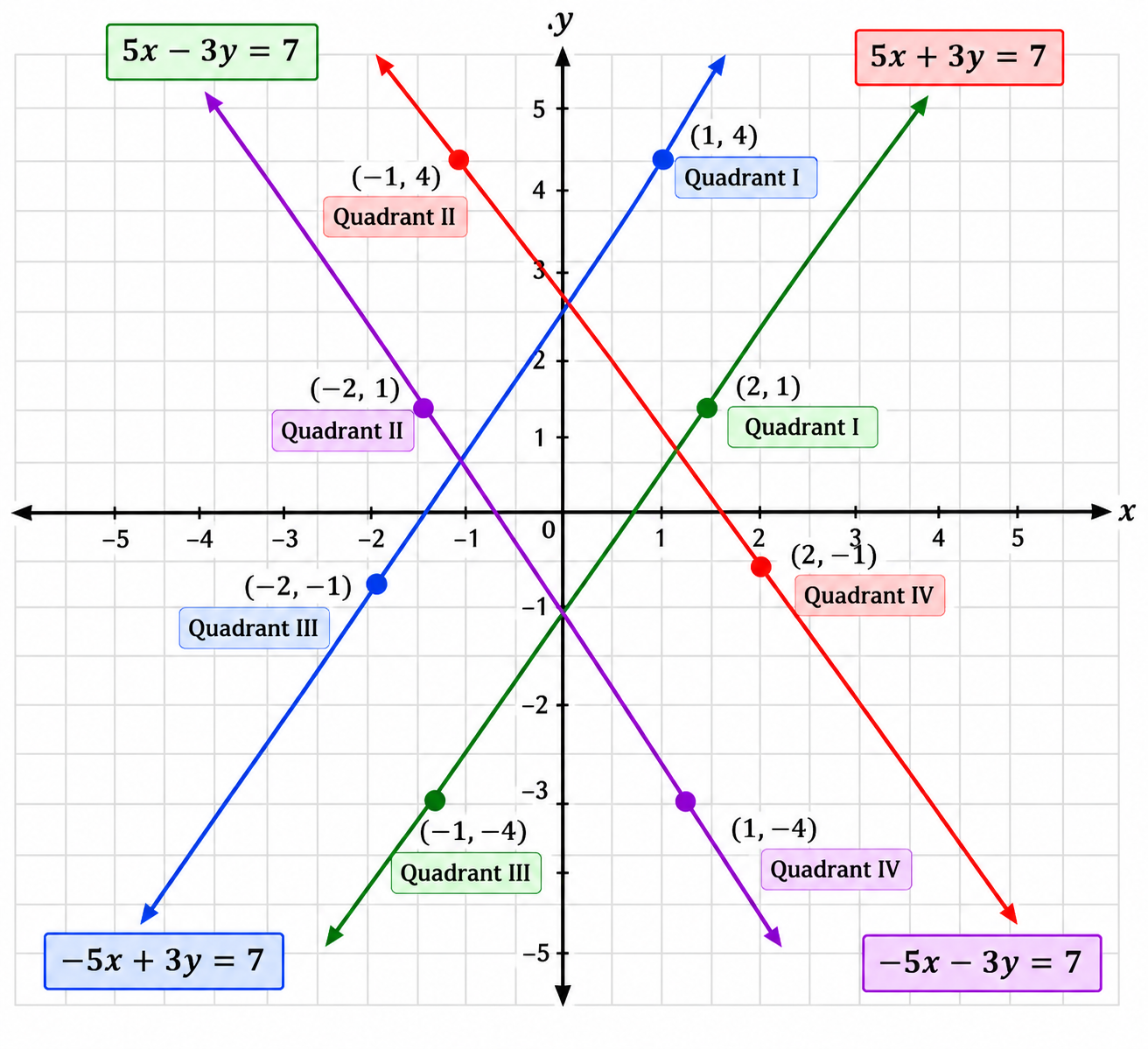
Q4. Find two solutions which lie in different quadrants for each of the following linear equations. Identify the quadrants in which the points lie. (i) 5x + 3y = 7 (ii) 5x − 3y = 7 (iii) −5x + 3y = 7 (iv) −5x − 3y = 7. Verify your solutions by representing the linear equations on a graph paper.
Answer:
(i) 5x + 3y = 7
Put x = 2: 10 + 3y = 7 ⇒ 3y = −3 ⇒ y = −1. Point (2, −1) lies in Quadrant IV.
Put x = −1: −5 + 3y = 7 ⇒ 3y = 12 ⇒ y = 4. Point (−1, 4) lies in Quadrant II.
(ii) 5x − 3y = 7
Put x = 2: 10 − 3y = 7 ⇒ 3y = 3 ⇒ y = 1. Point (2, 1) lies in Quadrant I.
Put x = −1: −5 − 3y = 7 ⇒ −3y = 12 ⇒ y = −4. Point (−1, −4) lies in Quadrant III.
(iii) −5x + 3y = 7
Put x = 1: −5 + 3y = 7 ⇒ 3y = 12 ⇒ y = 4. Point (1, 4) lies in Quadrant I.
Put x = −2: 10 + 3y = 7 ⇒ 3y = −3 ⇒ y = −1. Point (−2, −1) lies in Quadrant III.
(iv) −5x − 3y = 7
Put x = 1: −5 − 3y = 7 ⇒ −3y = 12 ⇒ y = −4. Point (1, −4) lies in Quadrant IV.
Put x = −2: 10 − 3y = 7 ⇒ −3y = −3 ⇒ y = 1. Point (−2, 1) lies in Quadrant II.
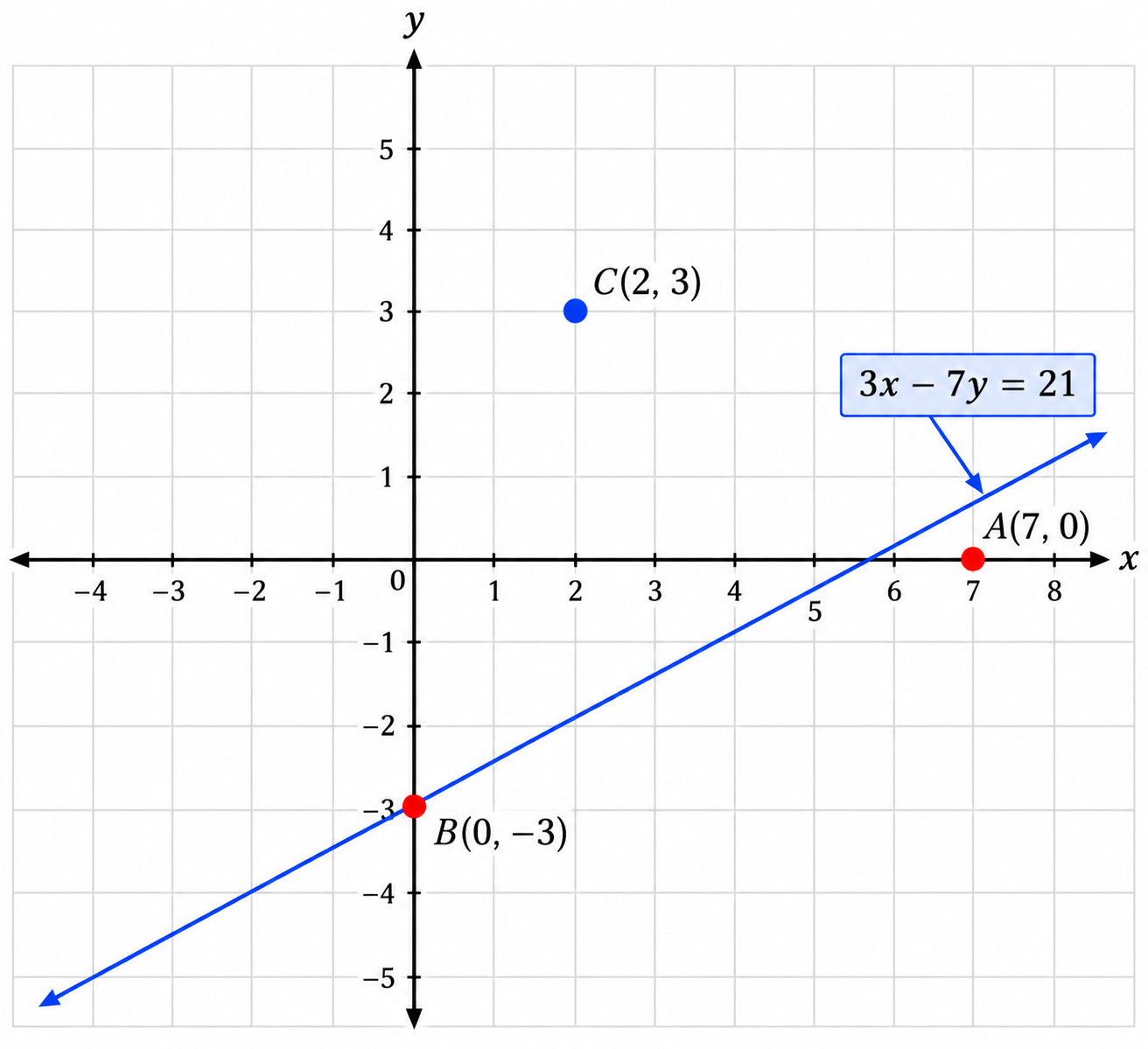
Q5. Consider the graph of the equation 3x − 7y = 21 shown below. Does the point C (2, 3) lie on the line? Does it satisfy the equation? Can points that do not lie on the line satisfy the equation?
Answer:
Substitute x = 2, y = 3 into 3x − 7y = 21:
LHS = 3(2) − 7(3) = 6 − 21 = −15 ≠ 21.
So C(2, 3) does not satisfy the equation. Hence it does not lie on the line.
No, points that do not lie on the line cannot satisfy the equation, because the graph of the equation is exactly the set of all points whose coordinates satisfy the equation.
Q6. State whether the following sentences are True or False. Justify your answer. (i) A linear equation in two variables has only one solution. (ii) The graph of a linear equation in two variables always passes through the origin. (iii) A linear equation in two variables can never have rational solutions. (iv) x = 3 is a valid linear equation in two variables. (v) The equation 2x + 3y = 7 has infinitely many solutions. (vi) The point (1, 2) is a solution of the equation 2x + 3y = 7.
Answer:
(i) False. A linear equation in two variables has infinitely many solutions, not just one.
(ii) False. It passes through the origin only if c = 0. For example, 2x + 3y = 7 does not pass through the origin.
(iii) False. It can have rational solutions. For example, (7/2, 0) is a rational solution of 2x + y = 7.
(iv) True. x = 3 can be written as 1 · x + 0 · y − 3 = 0, which is a linear equation in two variables with a = 1, b = 0, c = −3.
(v) True. 2x + 3y = 7 is a linear equation in two variables, so it has infinitely many solutions.
(vi) False. Substituting x = 1, y = 2: LHS = 2(1) + 3(2) = 2 + 6 = 8 ≠ 7. So (1, 2) is not a solution.
Q7. (i) Compare the solutions of the equations 3x + 4y = 7 and 6x + 8y = 14. Argue that they have the same set of solutions, that is, every solution of one is also a solution of the other. (ii) Show that the equations ax + by = c and kax + kby = kc, with k ≠ 0, have the same set of solutions.
Answer:
(i) The second equation 6x + 8y = 14 is obtained by multiplying both sides of the first equation 3x + 4y = 7 by 2. If (x1, y1) satisfies the first equation, then 3x1 + 4y1 = 7. Multiplying both sides by 2 gives 6x1 + 8y1 = 14, so (x1, y1) also satisfies the second equation. Similarly, if (x2, y2) satisfies the second equation, dividing both sides by 2 gives the first equation. Hence, both equations have the same set of solutions.
(ii) If (x1, y1) satisfies ax + by = c, then ax1 + by1 = c. Multiplying both sides by k ≠ 0 gives kax1 + kby1 = kc, so (x1, y1) also satisfies the second equation. Conversely, if (x2, y2) satisfies kax + kby = kc, dividing both sides by k gives ax2 + by2 = c, so it also satisfies the first equation. Hence, both equations have the same set of solutions.
Think and Reflect
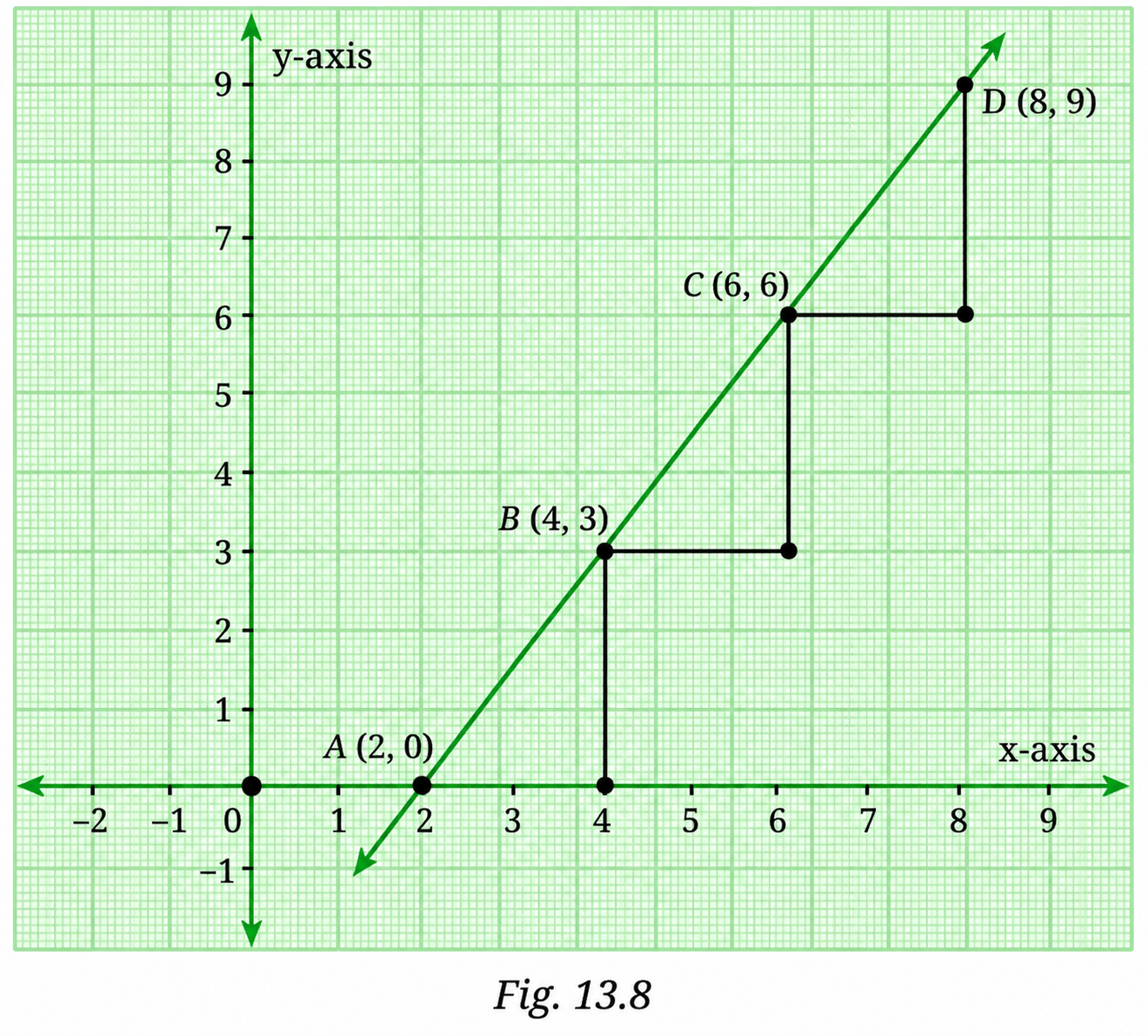
Q1. Consider the point on the line AB whose x-coordinate is 8. What is the y-coordinate of this point? Express this as an ordered pair. What is the x-coordinate of the point on the line AB whose y-coordinate is 6? Express this as an ordered pair.
Answer:
The line AB passes through A(2, 0) and B(4, 3). Slope = (3 − 0)/(4 − 2) = 3/2.
Equation of line: y − 0 = (3/2)(x − 2) ⇒ y = (3/2)(x − 2).
When x = 8: y = (3/2)(8 − 2) = (3/2) × 6 = 9. So the ordered pair is (8, 9).
When y = 6: 6 = (3/2)(x − 2) ⇒ x − 2 = 4 ⇒ x = 6. So the ordered pair is (6, 6).
Q2. Can you use the points A, B and C to verify that the slope of this line is indeed −5?
Answer:
The line is y = −5x + 3. Points: A(0, 3), B(1, −2), C(−1, 8).
Slope using A and B: (−2 − 3)/(1 − 0) = −5/1 = −5.
Slope using A and C: (8 − 3)/(−1 − 0) = 5/(−1) = −5.
Slope using B and C: (8 − (−2))/(−1 − 1) = 10/(−2) = −5.
In all cases, the slope is −5, confirming the slope of the line.
Exercise Set 13.3
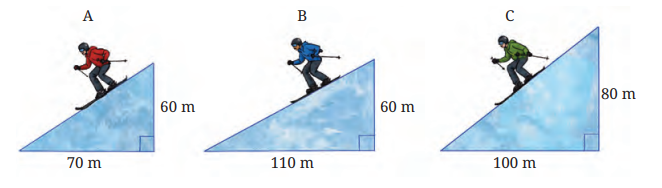
Q1. The following diagrams represent ski hills. Rank the hills in order of their steepness, from least to greatest.
Answer:
Slope = Rise / Run.
- Hill A: slope = 60/70 ≈ 0.857
- Hill B: slope = 60/110 ≈ 0.545
- Hill C: slope = 80/100 = 0.8
Order of steepness from least to greatest: B (0.545) < C (0.8) < A (0.857).
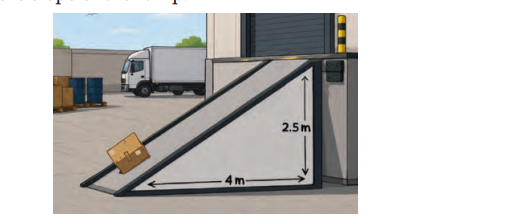
Q2. The ramp at a loading dock rises 2.5 metres over a run of 4 metres. Find the slope of the ramp.
Answer:
Slope = Rise / Run = 2.5/4 = 0.625.
Final answer: The slope of the ramp is 0.625 (or 5/8).
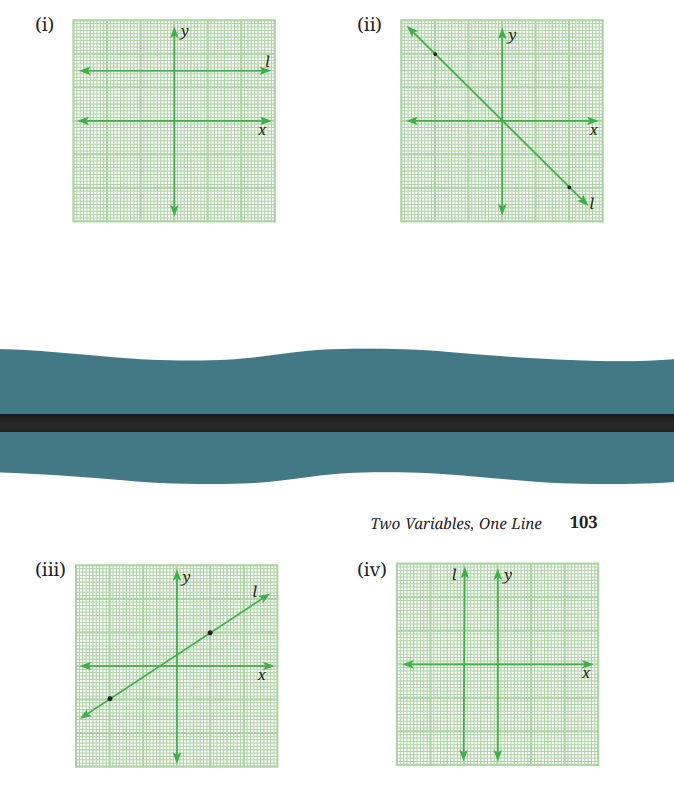
Q3. Find the slope of the line l in each of the following diagrams.
Answer:
(i) The line l is horizontal (parallel to the x-axis). For any two points on it, the rise is 0. So the slope = 0/run = 0.
(ii) The line l passes through the origin and the point (2, −1) approximately (based on the grid). Slope = (−1 − 0)/(2 − 0) = −1/2.
Final answer: (i) slope = 0, (ii) slope = −1/2.
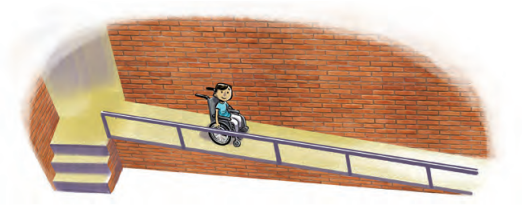
Q4. An accessibility ramp for wheelchairs is to be made alongside the staircase. The guidelines given for the slope of the ramp is 1 cm vertical rise to 12 cm horizontal length. What should be the horizontal length of the ramp if the total height of the stairs is 18 cm?
Answer:
Slope = Rise / Run = 1/12.
Given rise (height of stairs) = 18 cm.
So, 1/12 = 18/Run ⇒ Run = 18 × 12 = 216 cm.
Final answer: The horizontal length of the ramp should be 216 cm (or 2.16 m).
Think and Reflect
Q1. The cost of one paratha and 2 bowls of dahi is ₹90. Also, the cost of 2 parathas and 7 bowls of dahi is ₹260. Can you figure out the cost of one paratha and one bowl of dahi and explain your reasoning?
Answer:
Let the cost of one paratha be p and one bowl of dahi be d.
From the given information:
p + 2d = 90 ... (1)
2p + 7d = 260 ... (2)
Multiply (1) by 2: 2p + 4d = 180 ... (3)
Subtract (3) from (2): (2p + 7d) − (2p + 4d) = 260 − 180 ⇒ 3d = 80 ⇒ d = 80/3.
Substitute in (1): p + 2(80/3) = 90 ⇒ p + 160/3 = 90 ⇒ p = 90 − 160/3 = (270 − 160)/3 = 110/3.
So, cost of one paratha = ₹110/3 ≈ ₹36.67 and one bowl of dahi = ₹80/3 ≈ ₹26.67.
Exercise Set 13.4
Q1. On two different days a family buys movie tickets and snack boxes. Let the cost of one movie ticket be ₹x and the cost of one snack box be ₹y. Frame a pair of linear equations in x and y to represent the following situations: (i) On the first day, the family buys 2 movie tickets and 3 snack boxes for ₹850. (ii) On the second day, the family buys 4 movie tickets and 1 snack box for ₹1100.
Answer:
(i) 2x + 3y = 850
(ii) 4x + y = 1100
So the pair of linear equations is: 2x + 3y = 850 and 4x + y = 1100.
Q2. Two friends, Sahil and Meena, travelled by taxi. Let the fixed charge for one taxi trip be ₹x and the additional charge per kilometre be ₹y. Frame a pair of linear equations in x and y to represent the following situation: (i) Sahil travelled 6 km and paid a total fare of ₹122. (ii) Meena travelled 8 km and paid a total fare of ₹160.
Answer:
(i) x + 6y = 122
(ii) x + 8y = 160
So the pair of linear equations is: x + 6y = 122 and x + 8y = 160.
Q3. In a sports meet, tickets for adults cost ₹150 each and tickets for children cost ₹100 each. A total of 200 people attended the meet, and the total amount collected from ticket sales was ₹25,000. (Let the number of adult tickets sold be x and the number of children's tickets sold be y.) Frame a pair of linear equations in x and y to represent this situation.
Answer:
Total people: x + y = 200
Total amount: 150x + 100y = 25000
So the pair of linear equations is: x + y = 200 and 150x + 100y = 25000.
Think and Reflect
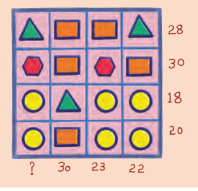
Q1. Solve the puzzle and discuss your strategy with your friends. Can you determine the value represented by each shape?
Answer:
From the first row: 2T + 2R = 28 ⇒ T + R = 14.
From the last column: 2C + T + R = 22 ⇒ 2C + 14 = 22 ⇒ 2C = 8 ⇒ C = 4.
From the second row: 2S + 2R = 30 ⇒ S + R = 15.
From the third row: 2C + T + C = 18 ⇒ 3C + T = 18 ⇒ 12 + T = 18 ⇒ T = 6.
Since T + R = 14 ⇒ 6 + R = 14 ⇒ R = 8.
Since S + R = 15 ⇒ S + 8 = 15 ⇒ S = 7.
So the values are: Triangle (T) = 6, Rectangle (R) = 8, Circle (C) = 4, and S (hexagon) = 7.
Q2. What if we had expressed y in terms of x, i.e., take Equation (2) and write y = 1/2 (3 − x). Would we still get the same solution?
Answer:
Yes, we would still get the same solution. The method of substitution works regardless of which variable we express in terms of the other. The solution (x, y) is unique for a pair of linear equations with a unique solution. So expressing y in terms of x and substituting into the other equation will give the same values x = 49/29, y = 19/29.
Q3. The method used in solving this problem is called the Elimination Method because we eliminate one of the variables to obtain a linear equation in the other variable. In the example above, we eliminated y. Try the same problem by eliminating x instead of y. Also try to solve the two equations using the Substitution Method. Assess the pros and cons of each method.
Answer:
Equations: 9x − 4y = 2000 and 7x − 3y = 2000.
Eliminating x: Multiply (1) by 7 and (2) by 9:
63x − 28y = 14000
63x − 27y = 18000
Subtracting: −y = −4000 ⇒ y = 4000. Then x = 2000. Same solution.
Substitution Method: From (1): x = (2000 + 4y)/9. Substitute in (2): 7((2000 + 4y)/9) − 3y = 2000. Solving gives y = 4000, x = 2000.
Pros and Cons: Elimination is faster when coefficients are easy to match. Substitution is better when one variable is already isolated or has coefficient 1.
Q4. Does a pair of linear equations always have a unique solution? Can you analyse this using the Elimination Method? While subtracting the equations to eliminate a particular variable, if the other variable remains, then clearly there is a unique solution. But what if the second variable gets eliminated too while eliminating the first variable? Can you think of a situation where this happens?
Answer:
No, a pair of linear equations does not always have a unique solution. If, during elimination, both variables get eliminated, then the equations are either the same (infinitely many solutions) or inconsistent (no solution). For example:
- x − y = 10 and 10x − 10y = 100: Both are the same equation, so infinitely many solutions.
- x − y = 10 and 10x − 10y = 101: Same LHS but different RHS, so no solution.
Q5. How many solutions are there to the equations 10x − 5y = 20 and 4x − 2y = 8? Give 3 more examples of pairs of equations that lead to 0 = 0 after subtraction, and therefore have infinitely many solutions. Can you find a simple rule to check when this happens?
Answer:
10x − 5y = 20 can be written as 2x − y = 4. 4x − 2y = 8 can also be written as 2x − y = 4. Both equations are the same, so there are infinitely many solutions.
Three more examples:
- 3x + 6y = 12 and x + 2y = 4
- 5x − 10y = 15 and 2x − 4y = 6
- 7x + 14y = 21 and 3x + 6y = 9
Rule: When a1/a2 = b1/b2 = c1/c2, the pair of equations has infinitely many solutions.
Q6. What if one of a2, b2, c2 is zero?
Answer:
If one of a2, b2, c2 is zero, we cannot directly use the ratio form. We need to analyse the equations separately. For example:
- If b2 = 0, the second equation becomes a2x + c2 = 0, which is a vertical line x = −c2/a2. We then check if this value of x satisfies the first equation.
- If a2 = 0, the second equation becomes b2y + c2 = 0, a horizontal line y = −c2/b2. We then check if this value of y satisfies the first equation.
The nature of solutions (unique, infinite, none) depends on whether the lines intersect, coincide, or are parallel.
Q7. Does a pair of linear equations always have either a unique solution or infinitely many solutions?
Answer:
No. A pair of linear equations can also have no solution. This happens when the lines are parallel, i.e., a1/a2 = b1/b2 ≠ c1/c2.
Q8. Give 3 more examples of pairs of equations that have no solution. Can you find a simple rule to check when this will happen?
Answer:
Three examples:
- 2x + 3y = 7 and 4x + 6y = 15
- x − y = 5 and 3x − 3y = 20
- 5x + 2y = 10 and 10x + 4y = 25
Rule: When a1/a2 = b1/b2 ≠ c1/c2, the pair has no solution.
Q9. Are the converses of the above statements true?
Answer:
Yes, the converses are true:
- If a1/a2 ≠ b1/b2, the pair has a unique solution.
- If a1/a2 = b1/b2 = c1/c2, the pair has infinitely many solutions.
- If a1/a2 = b1/b2 ≠ c1/c2, the pair has no solution.
Q10. Can there be methods other than elimination and substitution to reduce a pair of linear equations in two variables to a linear equation in one variable? If so, describe them.
Answer:
Yes, other methods exist, such as:
- Cross-multiplication method: Using the formula x = (b1c2 − b2c1)/(a1b2 − a2b1) and y = (c1a2 − c2a1)/(a1b2 − a2b1).
- Graphical method: Plotting both lines and finding the intersection point.
- Matrix method: Using determinants or matrices (studied in higher classes).
Q11. How do we find solutions from the graph? What can we say about the number of solutions when the two lines (i) intersect at a point, (ii) are parallel, (iii) are coincident?
Answer:
- (i) Intersect at a point: There is a unique solution — the coordinates of the intersection point.
- (ii) Parallel: There is no solution because the lines never meet.
- (iii) Coincident: There are infinitely many solutions because every point on the line is a solution.
Q12. Can you prove that two lines of equal slope are parallel? (Hint: Consider the equations of the two lines to be y = mx + d1 and y = mx + d2)
Answer:
Let the two lines be y = mx + d1 and y = mx + d2, with d1 ≠ d2.
If they intersect, there exists a point (x0, y0) satisfying both. Then:
y0 = mx0 + d1 and y0 = mx0 + d2.
Subtracting: 0 = d1 − d2 ⇒ d1 = d2, which contradicts d1 ≠ d2.
Hence, the lines cannot intersect, so they are parallel.
Exercise Set 13.5
Q1. Form a pair of linear equations for each of the following problems and find their solutions.
- (i) The sum of two integers is +5 and their difference is −21. Find the two numbers.
- (ii) The difference between two numbers is 26 and one number is three times the other. Find the numbers.
- (iii) The coach of a cricket team buys 7 bats and 6 balls for ₹8880. Later, she buys 3 bats and 5 balls for ₹4000. Find the cost of each bat and each ball.
- (iv) The taxi charges in a city consist of a fixed charge together with the charge for the distance covered for every km. For a distance of 10 km, the total amount paid is ₹155 and for a journey of 15 km, the total amount paid is ₹220. What is the fixed charge and the charge per km? How much does a person have to pay for travelling a distance of 25 km?
- (v) A fraction becomes equal to 9/11 if 2 is added to both the numerator and the denominator. If 3 is added to both the numerator and the denominator, it becomes equal to 5/6. Find the fraction.
- (vi) If we add 1 to the numerator and subtract 1 from the denominator, a fraction reduces to 1. It becomes equal to 1/2 if we add 1 only to the denominator. What is the fraction? (vii) Five years ago, Nuri was thrice as old as Sonu. Ten years later, Nuri will be twice as old as Sonu. How old are Nuri and Sonu?
- (viii) The sum of the digits of a two-digit number is 9. Also, nine times this number is twice the number obtained by reversing the order of the digits. Find the number.
- (ix) Meena went to a bank to withdraw ₹2000. She asked the cashier to give her ₹50 and ₹100 notes only. Meena got 25 notes in all. Find how many notes of ₹50 and ₹100 did she receive?
- (x) A lending library has a fixed charge for the first three days and an additional charge for each day thereafter. Saritha paid ₹27 for a book kept for seven days, while Susy paid ₹21 for the book she kept for five days. Find the fixed charge and the charge for each extra day.
Answer:
(i) Let the two integers be x and y.
x + y = 5, x − y = −21.
Adding: 2x = −16 ⇒ x = −8. Then y = 13.
Answer: −8 and 13.
(ii) Let the numbers be x and y with x > y.
x − y = 26, x = 3y.
Substituting: 3y − y = 26 ⇒ 2y = 26 ⇒ y = 13. Then x = 39.
Answer: 39 and 13.
(iii) Let cost of one bat = ₹x, cost of one ball = ₹y.
7x + 6y = 8880, 3x + 5y = 4000.
Multiply first by 5, second by 6:
35x + 30y = 44400, 18x + 30y = 24000.
Subtracting: 17x = 20400 ⇒ x = 1200.
Substitute: 3(1200) + 5y = 4000 ⇒ 3600 + 5y = 4000 ⇒ 5y = 400 ⇒ y = 80.
Answer: Bat = ₹1200, Ball = ₹80.
(iv) Let fixed charge = ₹x, charge per km = ₹y.
x + 10y = 155, x + 15y = 220.
Subtracting: 5y = 65 ⇒ y = 13. Then x = 155 − 130 = 25.
For 25 km: x + 25y = 25 + 25(13) = 25 + 325 = 350.
Answer: Fixed charge = ₹25, charge per km = ₹13, fare for 25 km = ₹350.
(v) Let the fraction be x/y.
(x+2)/(y+2) = 9/11 ⇒ 11(x+2) = 9(y+2) ⇒ 11x − 9y = −4.
(x+3)/(y+3) = 5/6 ⇒ 6(x+3) = 5(y+3) ⇒ 6x − 5y = −3.
Solving: Multiply first by 5, second by 9:
55x − 45y = −20, 54x − 45y = −27.
Subtracting: x = 7. Then 6(7) − 5y = −3 ⇒ 42 − 5y = −3 ⇒ 5y = 45 ⇒ y = 9.
Answer: The fraction is 7/9.
(vi) Let the fraction be x/y.
(x+1)/(y−1) = 1 ⇒ x + 1 = y − 1 ⇒ x − y = −2.
x/(y+1) = 1/2 ⇒ 2x = y + 1 ⇒ 2x − y = 1.
Subtracting: x = 3. Then 3 − y = −2 ⇒ y = 5.
Answer: The fraction is 3/5.
(vii) Let Nuri's age = x, Sonu's age = y.
Five years ago: x − 5 = 3(y − 5) ⇒ x − 3y = −10.
Ten years later: x + 10 = 2(y + 10) ⇒ x − 2y = 10.
Subtracting: y = 20. Then x − 40 = 10 ⇒ x = 50.
Answer: Nuri = 50 years, Sonu = 20 years.
(viii) Let the two-digit number be 10x + y, where x is tens digit and y is units digit.
x + y = 9.
Nine times the number = 9(10x + y). Twice the reversed number = 2(10y + x).
9(10x + y) = 2(10y + x) ⇒ 90x + 9y = 20y + 2x ⇒ 88x − 11y = 0 ⇒ 8x = y.
Substituting in x + y = 9: x + 8x = 9 ⇒ 9x = 9 ⇒ x = 1. Then y = 8.
Answer: The number is 18.
(ix) Let number of ₹50 notes = x, ₹100 notes = y.
x + y = 25, 50x + 100y = 2000.
Divide second by 50: x + 2y = 40.
Subtracting first: y = 15. Then x = 10.
Answer: 10 notes of ₹50 and 15 notes of ₹100.
(x) Let fixed charge for first 3 days = ₹x, additional charge per day = ₹y.
Saritha kept book for 7 days: x + 4y = 27.
Susy kept book for 5 days: x + 2y = 21.
Subtracting: 2y = 6 ⇒ y = 3. Then x + 6 = 21 ⇒ x = 15.
Answer: Fixed charge = ₹15, additional charge per day = ₹3.
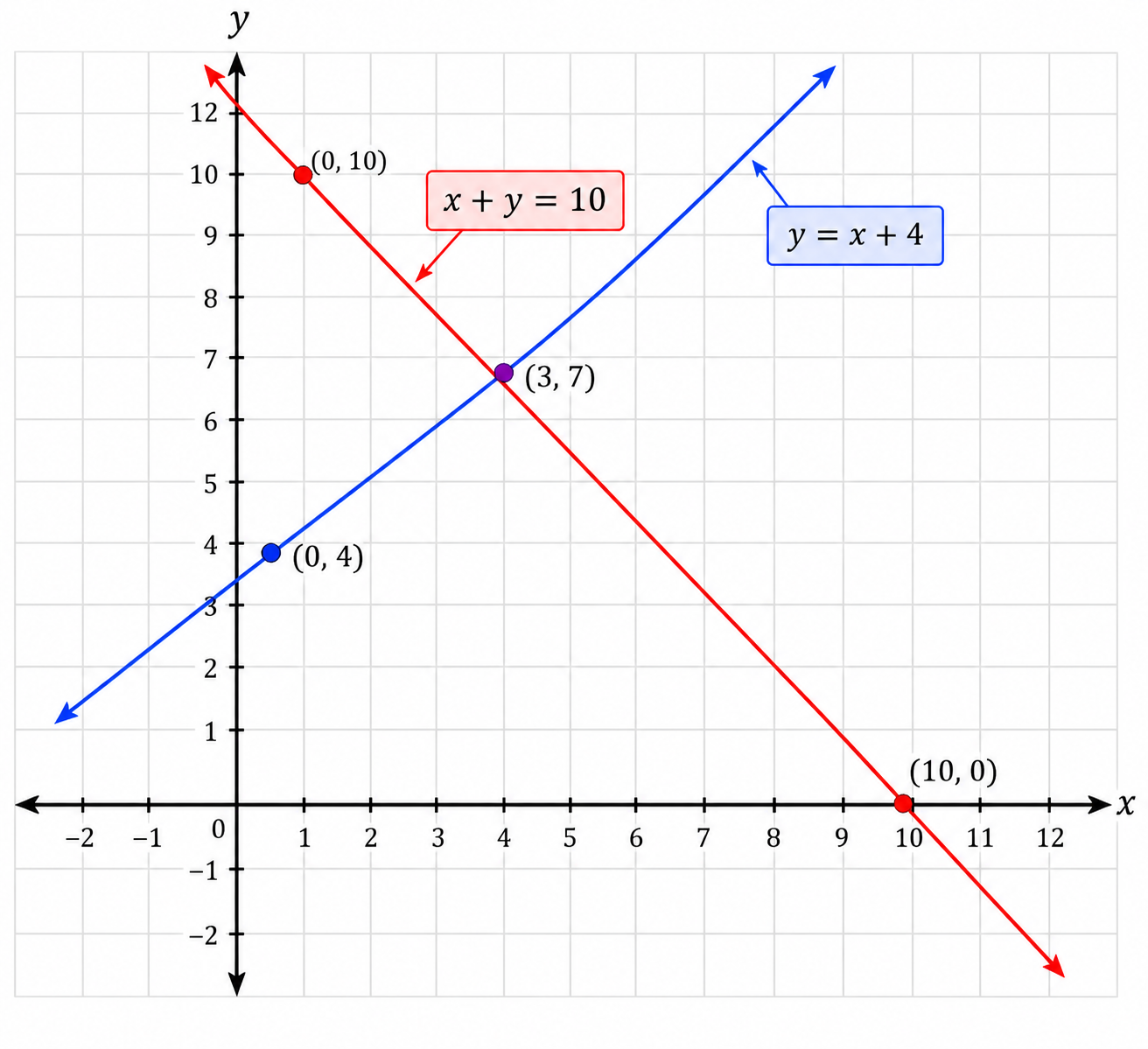
Q2. Form a pair of linear equations and find their common solutions graphically. 10 students of Grade 9 took part in a Mathematics quiz. If the number of girls is 4 more than the number of boys, find the number of boys and girls who took part in the quiz.
Answer:
Let number of boys = x, number of girls = y.
x + y = 10, y = x + 4.
Substituting: x + (x + 4) = 10 ⇒ 2x = 6 ⇒ x = 3. Then y = 7.
Answer: 3 boys and 7 girls.
Q3. Use the ratios a1/a2, b1/b2, c1/c2 to determine whether the lines representing the following pairs of linear equations intersect at a point, are parallel or are coincident. (i) 5x − 4y + 8 = 0; 7x + 6y − 9 = 0 (ii) 9x + 3y + 12 = 0; 18x + 6y + 24 = 0 (iii) 6x − 3y + 10 = 0; 2x − y + 9 = 0
Answer:
(i) a1/a2 = 5/7, b1/b2 = −4/6 = −2/3. Since 5/7 ≠ −2/3, the lines intersect at a point (unique solution).
(ii) a1/a2 = 9/18 = 1/2, b1/b2 = 3/6 = 1/2, c1/c2 = 12/24 = 1/2. All ratios are equal, so the lines are coincident (infinitely many solutions).
(iii) a1/a2 = 6/2 = 3, b1/b2 = −3/−1 = 3, c1/c2 = 10/9. Since a1/a2 = b1/b2 ≠ c1/c2, the lines are parallel (no solution).
Q4. Which of the following pairs of linear equations have solutions? If they have solutions, find them graphically. (i) x + y = 5, 2x + 2y = 10 (ii) x − y = 8, 3x − 3y = 16 (iii) 2x + y − 6 = 0, 4x − 2y − 4 = 0 (iv) 2x − 2y − 2 = 0, 4x − 4y − 5 = 0
Answer:
(i) 1/2 = 1/2 = 5/10, so the lines are coincident. Infinitely many solutions.
(ii) 1/3 = −1/−3 ≠ 8/16, so the lines are parallel. No solution.
(iii) 2/4 ≠ 1/−2, so unique solution. Solving: 2x + y = 6 and 4x − 2y = 4 ⇒ 2x − y = 2. Adding: 4x = 8 ⇒ x = 2, y = 2. Unique solution: (2, 2).
(iv) 2/4 = −2/−4 ≠ −2/−5, so the lines are parallel. No solution.
[Diagram: For (i) draw the coincident lines x + y = 5. For (iii) draw the intersecting lines and mark (2, 2).]
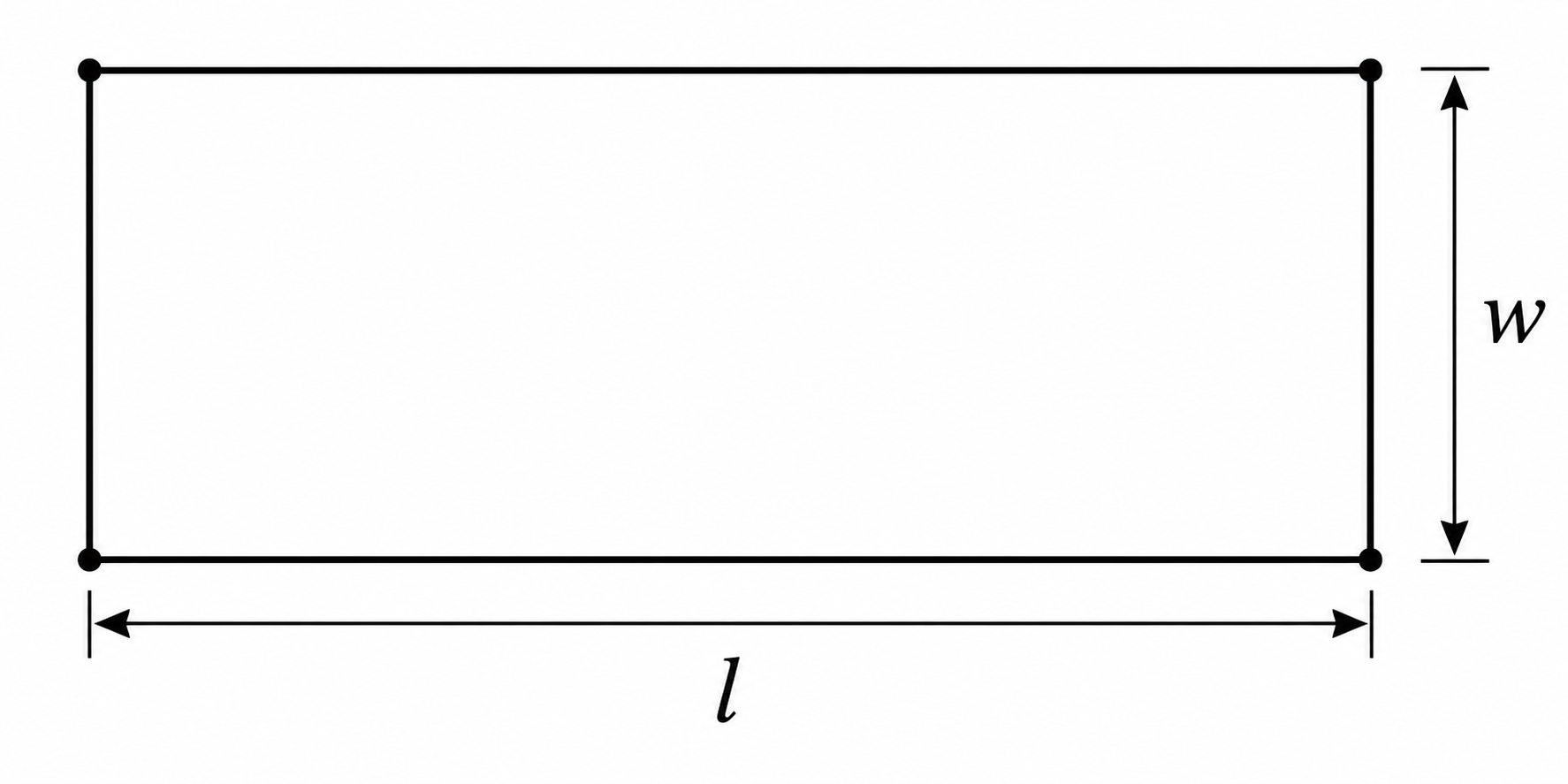
Q5. Half the perimeter of a rectangular garden, whose length is 4 m more than its width, is 36 m. Find the dimensions of the garden.
Answer:
Let length = l, width = w.
Half perimeter: l + w = 36.
Length is 4 m more than width: l = w + 4.
Substituting: w + 4 + w = 36 ⇒ 2w = 32 ⇒ w = 16. Then l = 20.
Answer: Length = 20 m, Width = 16 m.
Q6. Given the linear equation 2x + 3y − 8 = 0, write another linear equation in two variables so that the graphs of the pair formed represent (i) intersecting lines (ii) parallel lines (iii) coincident lines.
Answer:
(i) Intersecting lines: Need a1/a2 ≠ b1/b2. Example: 3x + 2y − 7 = 0.
(ii) Parallel lines: Need a1/a2 = b1/b2 ≠ c1/c2. Example: 4x + 6y − 10 = 0.
(iii) Coincident lines: Need a1/a2 = b1/b2 = c1/c2. Example: 4x + 6y − 16 = 0.
Q7. Here is a problem that was posed by Mahāvirāchārya in Gaṇita sāra saṅgraha (c. 850 CE). The price of 9 citrons and 7 fragrant wood-apples taken together is 107; and the price of 7 citrons and 9 fragrant wood-apples taken together is 101. O mathematician, tell me quickly the price of each citron and of each fragrant wood-apple.
Answer:
Let price of one citron = x, price of one fragrant wood-apple = y.
9x + 7y = 107 ... (1)
7x + 9y = 101 ... (2)
Add (1) and (2): 16x + 16y = 208 ⇒ x + y = 13 ... (3)
Subtract (2) from (1): 2x − 2y = 6 ⇒ x − y = 3 ... (4)
Solving (3) and (4): 2x = 16 ⇒ x = 8. Then y = 5.
Answer: Citron = 8, Fragrant wood-apple = 5.
Q8. 5 pencils and 7 pens together cost ₹50, whereas 7 pencils and 5 pens together cost ₹46. Find the cost of each pencil and pen.
Answer:
Let cost of pencil = ₹x, cost of pen = ₹y.
5x + 7y = 50 ... (1)
7x + 5y = 46 ... (2)
Adding: 12x + 12y = 96 ⇒ x + y = 8 ... (3)
Subtracting (2) from (1): −2x + 2y = 4 ⇒ −x + y = 2 ... (4)
From (3) and (4): 2y = 10 ⇒ y = 5. Then x = 3.
Answer: Pencil = ₹3, Pen = ₹5.
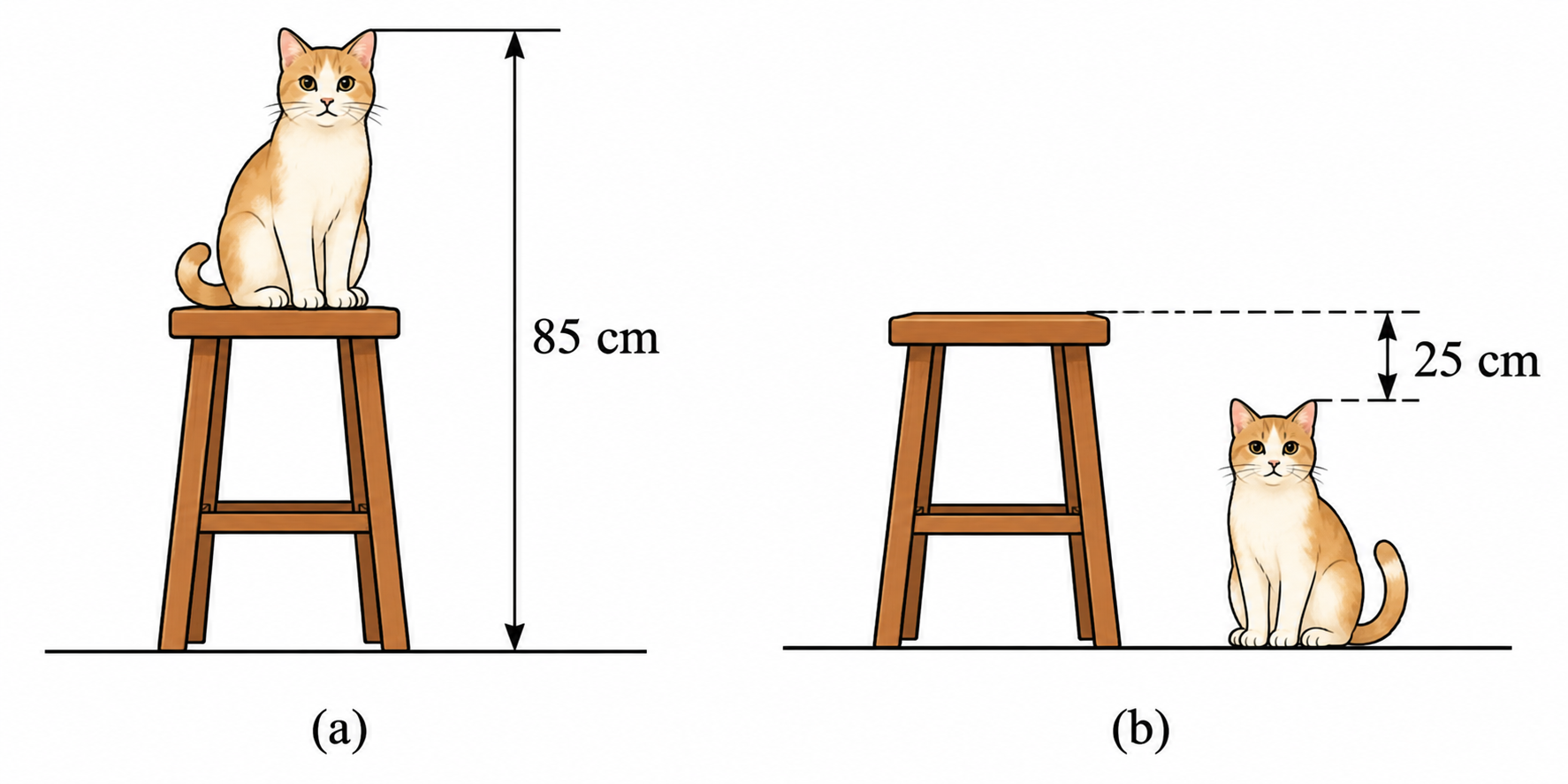
Q9. Find the height of the stool.
Answer:
Let height of stool = x cm, height of cat = y cm.
From the first figure: x + y = 85 ... (1)
From the second figure: x − y = 25 ... (2)
Adding: 2x = 110 ⇒ x = 55. Then y = 30.
Answer: Height of stool = 55 cm.
End-of-Chapter Exercises
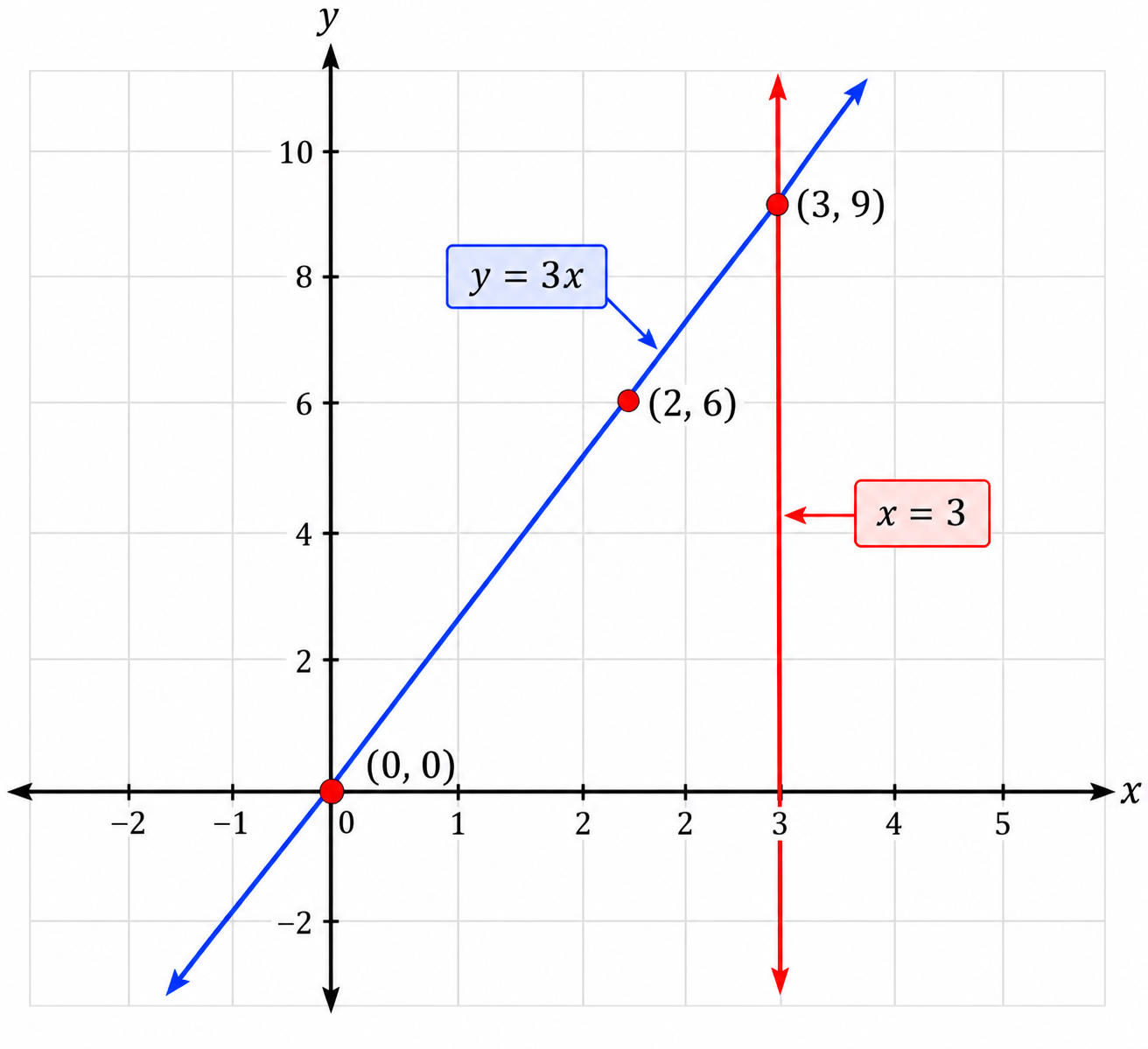
Q1. The graph of the line y = 3x, passing through (0, 0) and (2, 6) is given below.
(i) Identify the slope of the line from the graph and explain how you calculated it using the two points on the line.
(ii) What is the y-intercept of the line? Explain its significance.
(iii) A water tank is being filled so that the water level y (in cm) after x minutes follows this graph.
- (a) How high is the water after 5 minutes?
- (b) How many minutes will it take for the water to reach a height of 21 cm? (iv) Without drawing a new graph, determine whether the point (4, 10) lies on this line. Justify your answer.
(v) Plot the point where this line intersects the line x = 3. Explain how you found the coordinates.
Answer:
(i) Slope = (6 − 0)/(2 − 0) = 6/2 = 3.
(ii) The y-intercept is 0 because the line passes through the origin (0, 0). This means the water level is 0 cm initially (at time x = 0).
(iii)(a) After 5 minutes, y = 3(5) = 15 cm.
(iii)(b) 21 = 3x ⇒ x = 7 minutes.
(iv) For (4, 10): y = 3(4) = 12 ≠ 10. So the point (4, 10) does not lie on the line.
(v) When x = 3, y = 3(3) = 9. So the point of intersection is (3, 9).
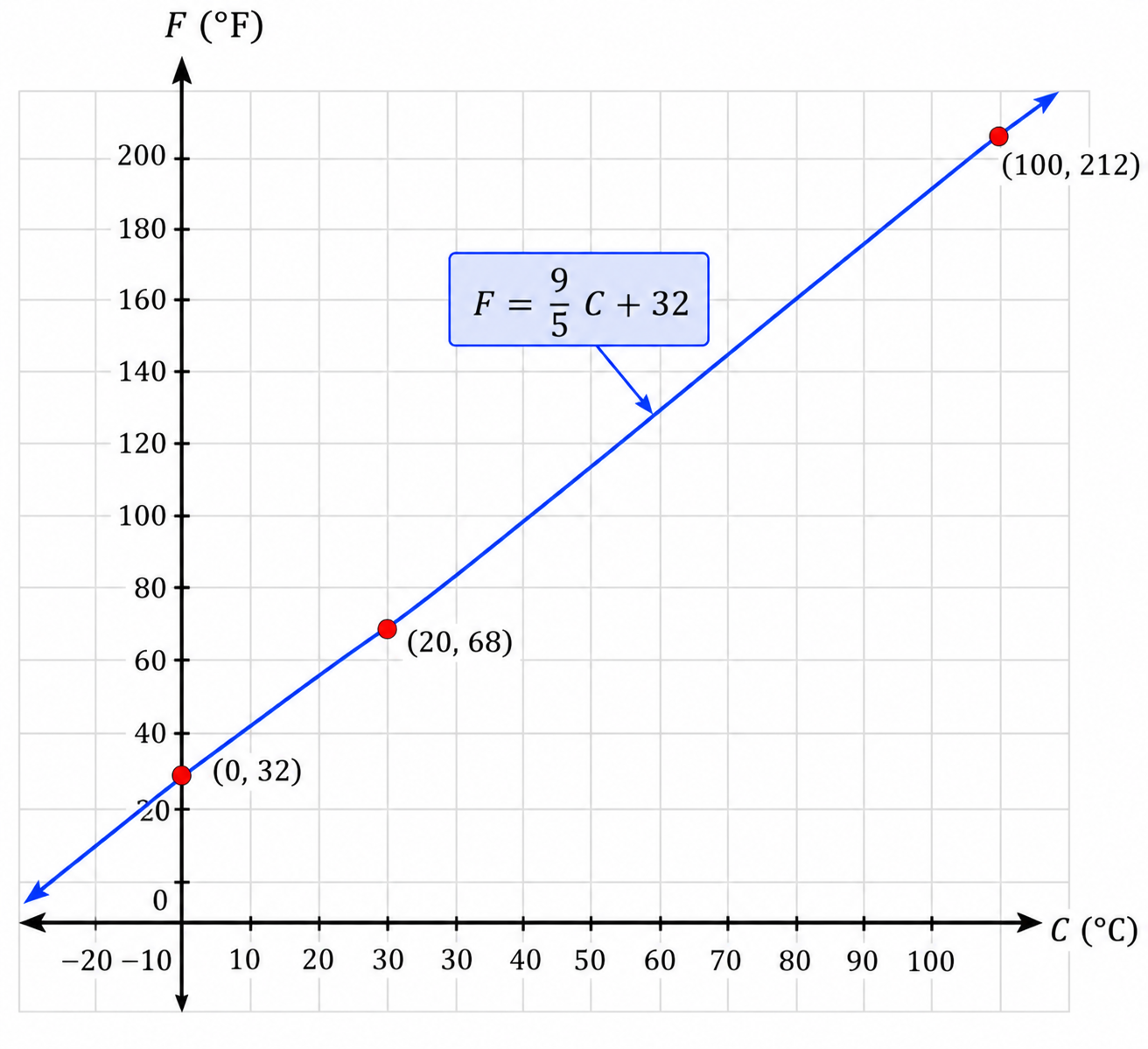
Q2. In countries like the USA, temperature is measured in Fahrenheit, whereas in countries like India, it is measured in Celsius. Here is a linear equation that converts Celsius to Fahrenheit: F = (9/5)C + 32.
(i) Draw the graph of the linear equation above using Celsius on the x-axis and Fahrenheit on the y-axis.
(ii) If the temperature is 30°C, what is the temperature in Fahrenheit?
(iii) If the temperature is 95°F, what is the temperature in Celsius?
(iv) If the temperature is 0°C, what is the temperature in Fahrenheit and if the temperature is 0°F, what is the temperature in Celsius?
(v) Is there a temperature which is numerically the same in both Fahrenheit and Celsius? If yes, find it.
Answer:
(i) Equation: F = (9/5)C + 32.
When C = 0, F = 32. When C = 100, F = 212. Plot these points and join them.
(ii) F = (9/5)(30) + 32 = 54 + 32 = 86°F.
(iii) 95 = (9/5)C + 32 ⇒ (9/5)C = 63 ⇒ C = 35°C.
(iv) At 0°C: F = 32°F. At 0°F: 0 = (9/5)C + 32 ⇒ (9/5)C = −32 ⇒ C = −160/9 ≈ −17.8°C.
(v) Let F = C = x. Then x = (9/5)x + 32 ⇒ 5x = 9x + 160 ⇒ −4x = 160 ⇒ x = −40.
So, −40°C = −40°F.
Q3. Solve the following system of equations graphically: 2x + y = 6, 2x − y − 2 = 0.
Answer:
For 2x + y = 6: (0, 6) and (3, 0).
For 2x − y = 2: (0, −2) and (1, 0).
Plotting these lines, they intersect at (2, 2).
Answer: x = 2, y = 2.
[Diagram: Draw the two lines on a graph paper. They intersect at (2, 2).]
Q4. Find the point of intersection of the lines shown on the cover page.
Answer:
This question refers to a specific figure on the cover page of the textbook. Without the cover page image, we cannot determine the exact lines. In general, to find the intersection point, solve the two equations simultaneously.
Q5. Give a formula to find the x-intercept of the line y = mx + c.
Answer:
To find the x-intercept, put y = 0:
0 = mx + c ⇒ x = −c/m (provided m ≠ 0).
So the x-intercept is −c/m.
Q6. A person is choosing between two mobile plans. Plan A: ₹50 monthly fee + ₹0.20 per minute of call time. Plan B: ₹30 monthly fee + ₹0.30 per minute of call time. For how many minutes of calling per month is Plan A cheaper than Plan B? For how many minutes is Plan B cheaper? Also find the number of minutes at which both plans cost the same.
Answer:
Let x = minutes of calling.
Plan A cost: 50 + 0.20x. Plan B cost: 30 + 0.30x.
Equal cost: 50 + 0.20x = 30 + 0.30x ⇒ 20 = 0.10x ⇒ x = 200 minutes.
- For x < 200: Plan B is cheaper.
- For x > 200: Plan A is cheaper.
- At x = 200: Both cost the same (₹90).
Q7. How many lines exist that (i) have a given slope? (ii) have a given slope and pass through a given point?
Answer:
(i) Infinitely many lines can have a given slope; they are all parallel to each other.
(ii) Exactly one line can have a given slope and pass through a given point.
Q8. For what values of p does the pair of equations given below have a unique solution? 4x + py + 8 = 0; 2x + 2y + 2 = 0.
Answer:
For unique solution: a1/a2 ≠ b1/b2.
4/2 ≠ p/2 ⇒ 2 ≠ p/2 ⇒ p ≠ 4.
Answer: All real values of p except p = 4.
Q9. Find the values of a and b for which the following system of equations has infinitely many solutions: (a + b)x − 2by = 5a + 2b + 1; 3x − y = 14.
Answer:
For infinitely many solutions: a1/a2 = b1/b2 = c1/c2.
(a+b)/3 = (−2b)/(−1) = (5a+2b+1)/14
From (a+b)/3 = 2b: a + b = 6b ⇒ a = 5b.
From 2b = (5a+2b+1)/14: 28b = 5a + 2b + 1 ⇒ 26b = 5a + 1.
Substituting a = 5b: 26b = 25b + 1 ⇒ b = 1. Then a = 5.
Answer: a = 5, b = 1.
Q10. Find the value of 'k' for which the following system of equations represents a pair of coincident lines: x + 2y = 3; (k − 1)x + (k + 1)y = k + 3.
Answer:
For coincident lines: a1/a2 = b1/b2 = c1/c2.
1/(k−1) = 2/(k+1) = 3/(k+3)
From 1/(k−1) = 2/(k+1): k + 1 = 2k − 2 ⇒ k = 3.
Check 2/(k+1) = 3/(k+3): 2/4 = 3/6 = 1/2. True.
Answer: k = 3.
Q11. (i) Robot 1 starts from the origin and traces a path by repeatedly moving 3 units to the right and then 4 units upward. Robot 2 starts from the point (10, 0) and repeatedly moves 1 unit to the right and then 2 units upward. Will the paths traced by these two robots intersect and if so, where? (ii) Robot 1 starts from (3, 0) and traces a path by repeatedly moving 5 units to the right and then 5 units upward. Robot 2 starts from the point (7, 0) and repeatedly moves 5 units to the right and then 3 units downwards. Will the paths traced by these two robots intersect and if so, where?
Answer:
(i) Robot 1: slope = 4/3, starts at (0, 0). Equation: y = (4/3)x.
Robot 2: slope = 2/1 = 2, starts at (10, 0). Equation: y = 2(x − 10).
Intersection: (4/3)x = 2x − 20 ⇒ 4x = 6x − 60 ⇒ 2x = 60 ⇒ x = 30, y = 40.
Answer: They intersect at (30, 40).
(ii) Robot 1: slope = 5/5 = 1, starts at (3, 0). Equation: y = x − 3.
Robot 2: slope = −3/5, starts at (7, 0). Equation: y = −(3/5)(x − 7).
Intersection: x − 3 = −(3/5)x + 21/5 ⇒ 5x − 15 = −3x + 21 ⇒ 8x = 36 ⇒ x = 4.5. Then y = 1.5.
Answer: They intersect at (4.5, 1.5).
Q12. At a certain time, Jacob notices that his digital watch reads 'a' minutes after two o'clock. Fifteen minutes later, it reads 'b' minutes after three o'clock. He noticed that a is six times greater than b. What time was it when he looked at his watch for the second time?
Answer:
Time after two o'clock = a minutes. So time = 2:00 + a minutes.
Fifteen minutes later, the time is 2:00 + a + 15 = 2:00 + a + 15 minutes.
This is also b minutes after three o'clock, i.e., 3:00 + b minutes.
So a + 15 = 60 + b ⇒ a − b = 45.
Given a = 6b. Substituting: 6b − b = 45 ⇒ 5b = 45 ⇒ b = 9.
So the second time is 3:09.
Answer: 3:09.
Q13. The sum of the digits of a two-digit number is 15. The number obtained by interchanging the digits exceeds the given number by 9. Find the number.
Answer:
Let the number be 10x + y, where x is tens digit and y is units digit.
x + y = 15.
Interchanged number = 10y + x.
10y + x = 10x + y + 9 ⇒ 9y − 9x = 9 ⇒ y − x = 1.
Solving: x + y = 15 and y − x = 1: 2y = 16 ⇒ y = 8, x = 7.
Answer: The number is 78.
Q14. In a cyclic quadrilateral ABCD, ∠A = (x + 7)°, ∠B = (y + 8)°, ∠C = (3y + 23)° and ∠D = (4x + 12)°. Find all four angles of the cyclic quadrilateral.
Answer:
In a cyclic quadrilateral, opposite angles are supplementary.
∠A + ∠C = 180° ⇒ (x + 7) + (3y + 23) = 180 ⇒ x + 3y = 150 ... (1)
∠B + ∠D = 180° ⇒ (y + 8) + (4x + 12) = 180 ⇒ 4x + y = 160 ... (2)
From (1): x = 150 − 3y. Substituting in (2): 4(150 − 3y) + y = 160 ⇒ 600 − 12y + y = 160 ⇒ −11y = −440 ⇒ y = 40.
Then x = 150 − 120 = 30.
Angles: ∠A = 37°, ∠B = 48°, ∠C = 143°, ∠D = 132°.
(Check: 37 + 143 = 180, 48 + 132 = 180. Correct.)
Q15. A train moving with uniform speed for a certain distance takes 6 hours less if its speed is increased by 6 km/hour. It would have taken 6 hours more had its speed been decreased by 4 km/hour. Find the distance travelled and the speed of the train.
Answer:
Let speed = x km/h, distance = d km. Time = d/x hours.
Case 1: d/x − d/(x+6) = 6 ⇒ d(6/(x(x+6))) = 6 ⇒ d = x(x+6).
Case 2: d/(x−4) − d/x = 6 ⇒ d(4/(x(x−4))) = 6 ⇒ d = (3/2)x(x−4).
Equating: x(x+6) = (3/2)x(x−4) ⇒ 2(x+6) = 3(x−4) ⇒ 2x + 12 = 3x − 12 ⇒ x = 24.
Then d = 24(24+6) = 24 × 30 = 720 km.
Answer: Speed = 24 km/h, Distance = 720 km.
Q16. The age of a father is equal to the sum of the ages of his four children. After 20 years, the sum of the ages of the children will be twice the age of the father. Find the age of the father.
Answer:
Let father's age = F, sum of children's ages = S.
F = S ... (1)
After 20 years: Father = F + 20, sum of children's ages = S + 80 (since each of 4 children grows by 20).
Given: S + 80 = 2(F + 20) ... (2)
Substituting S = F in (2): F + 80 = 2F + 40 ⇒ F = 40.
Answer: Father's age = 40 years.
Important Theorems and Rules
Linear Equation in Two Variables: An equation of the form ax + by + c = 0, where a, b, c are real numbers and a, b are not both zero.
Slope-Intercept Form: y = mx + d, where m is the slope and d is the y-intercept.
Slope Formula: For two points (x1, y1) and (x2, y2) on a line, slope m = (y2 − y1)/(x2 − x1).
Nature of Solutions for a Pair of Linear Equations:
| Condition | Graph | Number of Solutions |
|---|---|---|
| a1/a2 ≠ b1/b2 | Intersecting lines | Unique solution |
| a1/a2 = b1/b2 = c1/c2 | Coincident lines | Infinitely many solutions |
| a1/a2 = b1/b2 ≠ c1/c2 | Parallel lines | No solution |
Methods to Solve a Pair of Linear Equations:
- Substitution Method: Express one variable in terms of the other and substitute.
- Elimination Method: Make coefficients of one variable equal and subtract/add to eliminate it.
- Graphical Method: Plot both lines and find the intersection point.