
Reflect and Respond (Page 1)
Q1. I. Given below are some stringed musical instruments. Work in pairs and identify them by first letter of the spellings of their names. 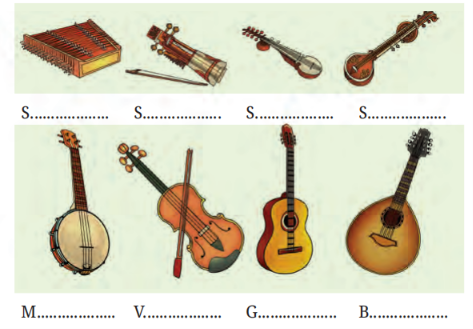
Answer:
So the blanks should be filled as:
- S.............. → Santoor
- S.............. → Sarangi
- S.............. → Sitar
- S.............. → Surbahar
- M.............. → Mandolin
- V.............. → Violin
- G.............. → Guitar
- B.............. → Banjo
Q2. II. Do you play a musical instrument? If given a choice, which one would you choose and why?
Answer:
Sample Answer:
Yes, I play the keyboard. If given a choice, I would choose to learn the guitar. I find its sound very soothing and versatile, suitable for many genres of music. Additionally, the guitar is a portable instrument, making it convenient to carry and play anywhere.
Q3. III. Is there any difference in the choice of music between children and elders? If yes, why? If no, why not?
Answer:
Answer:
Yes, there is often a difference in the choice of music between children and elders. Children are generally more inclined towards contemporary music like pop, rock, or fusion, which are trendy and energetic. Elders often prefer classical or traditional music, which they find more meaningful, soothing, and culturally significant. This difference arises due to generational gaps, exposure to different eras, and varying life experiences.
Q4. IV. Work in pairs to complete the paragraph given on the next page by choosing the correct phrases given in the box. Discuss with your teacher whether the following phrases have a literal meaning or a figurative one. 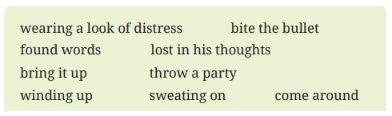
Answer:
Completed Paragraph:
The theatre club was winding up their practice. Anil saw Sunny was wearing a look of distress and not speaking to anyone. They had a disagreement in the morning and since then, Sunny was lost in his thoughts. Anil did not want to bring it up and disturb Sunny further but he finally decided to bite the bullet and speak to Sunny. He was sure if he apologised first, his friend would come around. With a lot of anxiety, he found words to apologise. And finally, Sunny smiled! Everyone clapped and asked them to throw a party to celebrate.
Figurative Meaning: Most phrases are figurative.
| Phrase | Meaning |
|---|---|
| Wearing a look of distress | To have an expression showing anxiety or sadness |
| Bite the bullet | To face a difficult situation bravely |
| Found words | Managed to speak or express oneself |
| Lost in his thoughts | Deep in thought, not paying attention to surroundings |
| Bring it up | To mention or introduce a topic |
| Throw a party | To organise a celebration or social gathering |
| Winding up | To conclude or finish |
| Sweating on | To be anxious or worried about something |
| Come around | To change one's opinion or agree after some time |
Check Your Understanding (Page 6)
Q1. I Complete the table given below based on Act I of the play. Check your answers with the teacher.
| Setting | Details |
|---|---|
| ● Where: Iqbal's room | ● Description of the room: a small rack, ...... ● On the wall: ...... |
| Children and the instruments they play | 1. Iqbal: flute 2. ...... 3. ...... 4. ...... |
| Speaker | Words of the Speaker |
| ...... | Oh ho! Wow Shruti! You are a sensation now! The least you can do is throw a party! |
| ...... | There is need to worry Iqbal! You don't know papa. |
| ...... | That's the spirit! |
Answer:
Completed Table:
| Setting | Details |
|---|---|
| ● Where: Iqbal's room | ● Description of the room: a small rack and a wooden table stacked with books ● On the wall: posters of famous Indian flute players Pandit Hariprasad Chaurasia and Shashank Subramanyam |
| Children and the instruments they play | 1. Iqbal: flute 2. Avinash: tabla 3. Peter: keyboard 4. Shruti: violin |
| Speaker | Words of the Speaker |
| Avinash | Oh ho! Wow Shruti! You are a sensation now! The least you can do is throw a party! |
| Shruti | There is need to worry Iqbal! You don't know papa. |
| Iqbal/Avinash/Peter | That's the spirit! |
Q2. II Do you think Shruti will gather the courage to speak to her father? Give a reason.
Answer:
Answer:
Yes, Shruti will gather the courage to speak to her father because she realises that it is important to be honest with him. Her friends encourage her and she understands that avoiding the conversation will only make things worse. She decides to face the situation bravely and bring up the topic at dinner.
Q3. III What might be Shruti's father's reaction? Why?
Answer:
Answer:
Shruti's father might react with initial anger and disappointment because he is very strict about classical music and disapproves of Western or fusion music. He might feel that Shruti's interest in fusion music is a desecration of the violin and a lack of respect for his views. However, being a loving father, he might eventually understand her passion and support her.
Check Your Understanding (Page 9)
Q1. I Complete the summary of Act II by choosing the correct words from the box given below. There are two extra words that you do not need. Check your answers with the teacher. Words: disapproval, plea, absent-minded, setback, surprised, scolded, courage, firm, clash, relief
Answer:
Completed Summary:
Shruti's parents are cleaning the table after dinner. Shruti is absent-minded, trying to find the right words to tell her father about the concert. When she finally speaks, her father gives a firm refusal, explaining that more than one performance in six months is not wise. Shruti makes a plea to him to attend a practice before deciding, Nabin was firm in his decision. Shruti's mother, Leela, scolded her for not seeking permission earlier. The tension highlights the clash between traditional and contemporary musical preferences within the family. Despite the setback, Shruti promises not to hide again and is urged to go to bed by her mother.
Q2. II Will Shruti's father go for the rehearsal? Support your answer with a reason.
Answer:
Answer:
It is uncertain but possible that Shruti's father might go for the rehearsal. He is stubborn about his views on fusion music, but his love for his daughter might compel him to give her a chance. The play later shows that he does attend the rehearsal and appreciates the performance, indicating that he may have been convinced by his wife or his own reconsideration.
Q3. III Do you think Shruti and her parents would understand one another? If yes, why? If no, why not?
Answer:
Answer:
Yes, Shruti and her parents would understand one another. Despite the initial conflict, Shruti's father ultimately supports her because he realises that his own father had opposed his choice of instrument. Her mother also plays a crucial role in bridging the gap. The family's bond of love and respect helps them overcome differences and appreciate each other's perspectives.
Check Your Understanding (Page 13)
Q1. I Work in pairs. Identify the true statements. Check the answers with your teacher.
- During the rehearsal, Shruti's parents enter the room and are overjoyed at her performance.
- Shruti initially considers telling her friends that she can't join them for the performance, after practising one last time.
- Shruti's father expressed that she had sung a few notes incorrectly during her performance.
- Shruti's father had followed the family's tradition of being a violinist and worked very hard to achieve all that he did.
- Shruti's mother helped her husband realise why he should support their daughter.
- Shruti's father accepts that he underrated the potential of classical music.
Answer:
True Statements:
- True – Shruti's parents enter the room and enjoy the performance.
- True – Shruti thinks of practising one last time before telling her friends she cannot join.
- False – Shruti's father praised her for not losing sight of the raga notes.
- False – Shruti's father did not follow the family tradition; he chose the violin against his family's wishes.
- True – Leela helped Nabin understand and support Shruti.
- False – Nabin accepts that he underestimated the power of 'our own music', meaning fusion/contemporary music.
Critical Reflection (Page 14)
Q1. 1. SHRUTI: There is need to worry Iqbal! You don't know papa. He is very strict about these things. He will think it a desecration of the violin to be played to Western tunes. Papa firmly believes that Classical Hindustani music, with its ragas and aalaaps, is the only kind of music that an artist of any worth should play. I don't want papa to feel that I don't care about his opinions, because I do. It's just that I want to give this a try too. I just don't know how to tell him in the right way! IQBAL: All ways are right ways, Shruti. He is your father, he will understand. (i) Select the option that correctly identifies Shruti's situation. A. confident B. indifferent C. content D. in a dilemma (ii) What does Shruti mean by 'the right way', in the sentence, "I just don't know how to tell him in the right way!"? (iii) Complete the following with a suitable reason. We can say that the extract reflects the generational gap in understanding art and tradition because
Answer:
Answers:
(i) D. in a dilemma
(ii) By 'the right way', Shruti means she doesn't know how to convey her feelings to her father without hurting him or disrespecting his beliefs. She wants to express her desire to try fusion music while still showing respect for his views on classical music.
(iii) We can say that the extract reflects the generational gap in understanding art and tradition because Shruti's father believes only classical music is worthy, while Shruti wants to explore fusion music, showing a difference in perception of art between generations.
Q2. 2. NABIN: I underestimated the power of our own music. I was afraid you would be lost to us. I realise that my fears were baseless. After all each bay, its own wind. I trust you Shruti and I will root for your group at the concert! (Shruti hugs both of her parents) (i) Select the suitable option to complete the sentence. Nabin's breakthrough in his understanding of artistic freedom, highlights a bridge between A. personal ambition and professional success B. traditional values and modern expressions C. strict discipline and casual learning D. historical techniques and futuristic innovations (ii) Fill in the blank with a suitable phrase. The extract uses the word 'lost' both in the sense of losing and physical separation. (iii) In the line, 'Shruti hugs her parents', which word from those given below, does not show what it conveys? reconciliation harmony duty acceptance understanding (iv) What can be inferred about Shruti's future in music following her father's expression of trust and support? (v) Identify the phrase that refers to the uniqueness of each artist's journey and style.
Answer:
Answers:
(i) B. traditional values and modern expressions
(ii) The extract uses the word 'lost' both in the sense of losing someone emotionally and physical separation.
(iii) duty – It does not convey what the hug represents.
(iv) Shruti's future in music looks promising. With her father's trust and support, she can confidently pursue her passion for fusion music while respecting classical traditions. She will likely continue to grow as an artist.
(v) The phrase "each bay, its own wind" refers to the uniqueness of each artist's journey and style.
Q3. 1. Justify the title 'Twin Melodies'. How does the play explore the theme of tradition and modernity?
Answer:
Answer:
The title 'Twin Melodies' refers to two parallel musical journeys: Shruti's exploration of fusion music and her father Nabin's journey of accepting change. It symbolises the harmony between traditional classical music (represented by Nabin) and modern fusion music (represented by Shruti and her friends). The play explores the theme of tradition and modernity through the conflict between Nabin's rigid views and Shruti's desire to experiment. Ultimately, the play suggests that tradition and modernity can coexist and enrich each other.
Q4. 2. What are the different perspectives of Peter, Iqbal, and Avinash regarding confronting figures of authority? How do their attitudes towards Shruti's dilemma with her father provide insight into their own characters and values?
Answer:
Answer:
Peter, Iqbal, and Avinash all encourage Shruti to speak to her father, but their approaches vary:
- Avinash is playful and light-hearted. He jokes about Shruti being a sensation and suggests she throw a party. His attitude shows that he values fun and sees problems as less serious.
- Iqbal is practical and supportive. He reminds Shruti that fathers understand and that she should just tell him. He shows maturity and empathy.
- Peter is encouraging but uses humour to lighten the mood. He shows that he cares for Shruti and wants to see her happy.
Their attitudes show that they value honesty and believe in facing problems directly. They also demonstrate their loyalty and friendship towards Shruti.
Q5. 3. Analyse the character of Nabin Sharma. How does his attitude towards music evolve throughout the play?
Answer:
Answer:
Nabin Sharma is initially portrayed as a strict, traditionalist father who believes classical Hindustani music is the only form worthy of an artist. He disapproves of fusion music and is rigid in his views. However, his character evolves when he attends Shruti's rehearsal and appreciates the performance. His wife helps him recall his own struggle against his family's tradition. By the end, he supports Shruti's group and trusts her judgment. This evolution shows that Nabin is not just strict but also loving, capable of change, and open to new perspectives when faced with genuine artistry.
Q6. 4. How does the play use Shruti's internal conflict to explore the theme of duty towards family versus personal passion?
Answer:
Answer:
Shruti's internal conflict reflects the tension between her duty towards her father's expectations and her personal passion for fusion music. She loves and respects her father and doesn't want to disappoint him, but she also wants to explore her musical interests. This conflict is resolved when she gathers courage to speak to him and later when her father accepts her choice. The play suggests that personal passion and family duty need not be opposing forces; with understanding and communication, they can coexist.
Q7. 5. Evaluate the effectiveness of the play's conclusion. Does it realistically address the conflicts presented?
Answer:
Answer:
The conclusion of the play is effective in providing a resolution to the conflicts. Nabin's transformation from a rigid traditionalist to a supportive father is believable because it is rooted in his own past experiences. The play shows that understanding and empathy can bridge generational gaps. While the resolution is somewhat idealistic, it is realistic in highlighting the importance of communication and mutual respect in families. The warm ending reinforces the play's message of harmony between tradition and modernity.
Q8. 6. Assess how well the role of cultural diversity contributes to the storyline of the play.
Answer:
Answer:
Cultural diversity plays a significant role in the play by highlighting the blend of Indian classical and Western fusion music. The Indo-Western fusion group itself represents cultural diversity. The conflict between classical and fusion music reflects the broader societal debate about tradition versus modernity. The play uses this diversity to enrich the storyline, showing how different musical forms can come together to create something beautiful. It also teaches a valuable lesson about respecting and embracing cultural differences.
Vocabulary and Structures in Context (Page 16)
Q1. I Read the highlighted word given in the brackets. SHRUTI (Aside): Oh, how much I enjoy performing this piece. Perhaps I can practise one last time and soon after that I will tell them that I can't join them for the performance. 1. What is 'aside' used for? (i) enables characters to talk about the story (ii) shows what a character thinks or feels (iii) makes a direct link between the audience and the character (iv) (i), (ii), and (iii)
Answer:
Answer:
(iv) (i), (ii), and (iii)
An aside is a theatrical technique where a character speaks directly to the audience, revealing their inner thoughts or feelings while other characters on stage are unaware. It enables characters to talk about the story, shows what a character thinks or feels, and makes a direct link between the audience and the character.
Q2. Ⅱ Read the following words from the text. Ahem ahem, I...er... Now, select the correct answer for the question given below. Why are they used? 1. to fill gaps while speaking 2. to increase clarity 3. to provide confidence Non-lexical fillers are words or sounds used in speech, like 'uh' or 'um' to fill pauses while a speaker gathers their thoughts or transitions between ideas. Now, choose suitable non-lexical fillers given in the box to describe the emoticons 1 to 4. There is an extra word you do not need. 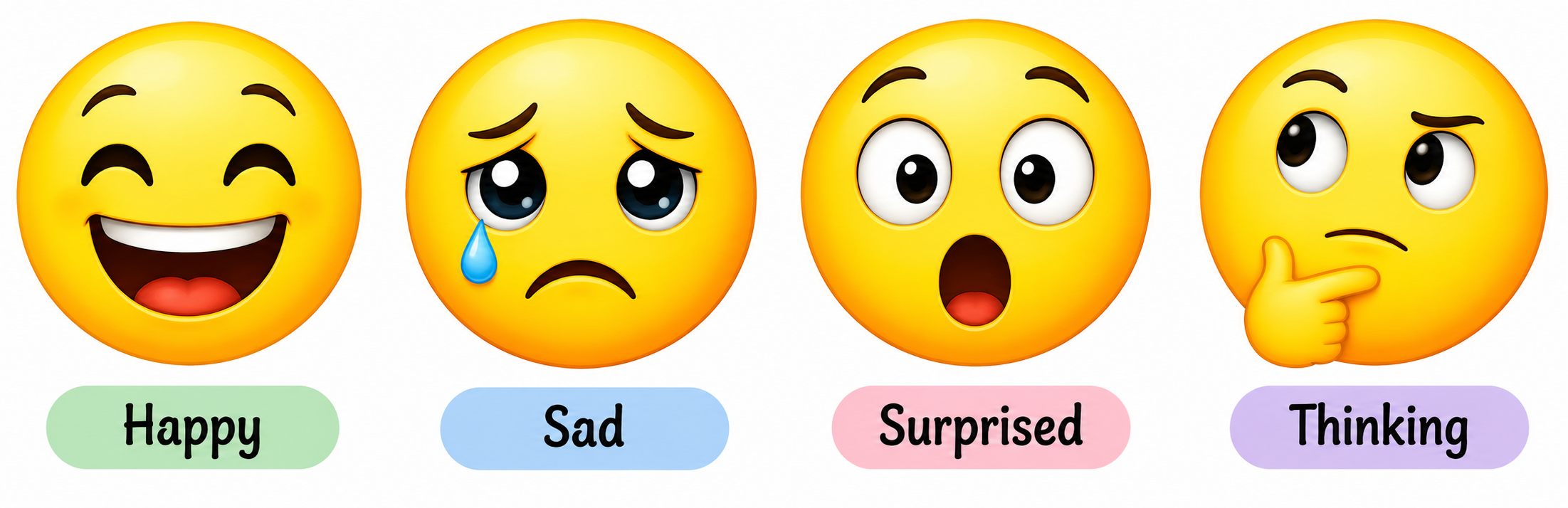
Answer:
Answers:
Why are they used?
1. to fill gaps while speaking
Non-lexical fillers for emoticons (sample):
- Happy: Ah! / Wow!
- Sad: Oh! / Alas!
- Surprised: Oh! / My!
- Thinking: Uh... / Er...
Q3. III Read the following words from the text and their meanings. notes—a single sound at a certain pitch, usually shown as a symbol on music sheet. crescendo [kri-SHEN-doe]—a gradual increase in the volume or intensity of sound Now, on the next page, match the meanings of other music-related words in Column 1 with their meanings in Column 2.
| Column 1 | Column 2 |
|---|---|
| 1. rhythm | (i) the lowest tone or part in music |
| 2. tempo | (ii) a mixture of loud unpleasant sounds |
| 3. bass [p.base] | (iii) the pattern of beats or time intervals in music |
| 4. baritone | (iv) the speed or pace at which a piece of music is played |
| 5. cacophony | (v) a male voice that falls between the higher and lower ranges |
| 6. pitch | (vi) a series of musical notes moving upwards or downwards |
| 7. scale | (vii) the perceived frequency of a sound, how high or low a sound is |
Answer:
Correct Matches:
| Column 1 | Correct Match |
|---|---|
| 1. rhythm | (iii) the pattern of beats or time intervals in music |
| 2. tempo | (iv) the speed or pace at which a piece of music is played |
| 3. bass | (i) the lowest tone or part in music |
| 4. baritone | (v) a male voice that falls between the higher and lower ranges |
| 5. cacophony | (ii) a mixture of loud unpleasant sounds |
| 6. pitch | (vii) the perceived frequency of a sound, how high or low a sound is |
| 7. scale | (vi) a series of musical notes moving upwards or downwards |
Q4. IV Write the meanings of the underlined phrases based on your understanding of the usage in sentences.
| Phrases | Meanings |
|---|---|
| 1. My mother told me, "When you follow trends without thinking, you drown your individual style." | |
| 2. The pianist was appreciated for his sense of musicality. | |
| 3. When one of the performers in the group was injured, they felt their practise would go down the drain. |
Answer:
Meanings:
| Phrases | Meanings |
|---|---|
| 1. drown your individual style | To lose or suppress your unique way of expressing yourself by following others blindly. |
| 2. sense of musicality | An understanding and appreciation of music, including rhythm, melody, and expression. |
| 3. go down the drain | To be wasted or lost, to fail completely. |
Q5. 1. Oh, how much I enjoy performing this piece! 2. Wah, how soulful! You all have done a wonderful job! Sentences 1. and 2. are ______ sentences. (declarative/interrogative/exclamatory/imperative) Now, convert the exclamatory sentences given above to declarative sentences. Use 'exclaimed' or 'exclaimed with (feeling)' instead of reporting verb 'said' Remove interjections, exclamatory mark, and quotations.
Answer:
Answers:
Sentences 1. and 2. are exclamatory sentences.
Declarative conversion:
1. She exclaimed that she enjoyed performing that piece very much.
2. Nabin exclaimed with joy that they had done a wonderful job and the music was soulful.
Q6. VI Write the sentences given below in reported speech. One example has been done for you. 1. "Wow Shruti! You're a sensation!" suggested Avinash. Avinash exclaimed with wonder that Shruti was a great sensation. 2. "What an incredible achievement! I can't believe we pulled it off!" said Iqbal. Iqbal exclaimed that it 3. "Bravo! Each note was executed perfectly, and the performance was flawless!" said Shruti's mother. Shruti's mother applauded that 4. Iqbal: I basically have a little bit of scolding for breakfast every day! 5. Shruti: Sorry mummy, won't hide from you again. I promise! 6. Avinash: You are a sensation now! The least you can do is throw a party!
Answer:
Answers:
2. Iqbal exclaimed that it was an incredible achievement and he couldn't believe they had pulled it off.
3. Shruti's mother applauded that each note had been executed perfectly and the performance was flawless.
4. Iqbal exclaimed that he basically had a little bit of scolding for breakfast every day.
5. Shruti apologised to her mother and promised not to hide from her again.
6. Avinash exclaimed with wonder that Shruti was a sensation and said that the least she could do was throw a party.
Q7. VII Report the following dialogue in the indirect form of speech. ASMA: Wow! What a unique experience I had at the art studio today! DEEPA: Tell me! I'm eager to hear! ASMA: I accidentally spilled paint all over my canvas. DEEPA: Oh, my goodness! What a pity! ASMA: No worries! The painting now looks better than my original plan! DEEPA: That's incredible! Asma exclaimed excitedly that she 1. ______. Deepa urged her to tell her as she was eager to hear. Asma said that 2. ______. Deepa pitied Asma. However, Asma replied to her not to worry as 3. ______. Deepa exclaimed that 4. ______.
Answer:
Answers:
Asma exclaimed excitedly that she had had a unique experience at the art studio that day. Deepa urged her to tell her as she was eager to hear. Asma said that she had accidentally spilled paint all over her canvas. Deepa pitied Asma. However, Asma replied to her not to worry as the painting now looked better than her original plan. Deepa exclaimed that it was incredible.
Listen and Respond (Page 20)
Q1. I Look at the given stringed musical instruments and decide which one could be the yazh [yal].
| 1 | 2 | 3 | 4 |
Answer:
Answer:
Students should look at the images of stringed instruments and identify which one resembles the yazh. The yazh is an ancient Indian string instrument with a boat-shaped resonator, similar to a harp. Without the images, the answer cannot be provided.
Q2. II Now, listen to a musician describing the yazh and check if your choice was correct. (Transcript for teacher on page 270)
Answer:
Answer:
This is a listening activity. Students must listen to the audio and verify their initial choice.
Q3. III Listen to the musician's description of the yazh once again. As you listen, complete the notes below with not more than three words. 1. Type of instrument - The Indian (i) Was used in: (ii) Earlier version of: 2. Design (i) stem tip - shaped like of mythological animal (ii) resonator A. shape of a B. material - 3. Design variety (i) peacock, and bow string
Answer:
Answer:
This is a listening comprehension activity. Students must listen to the audio and complete the notes with suitable words.
Speaking Activity (Page 21)
Q1. I Stress and intonation exercises can be a great way to understand the emotional and rhythmic feelings associated with dialogues in a play. 1. Let us pick a few lines from the play and speak them aloud. Focus on how stress and intonation can change their meaning or emotional impact.
| Sentences | Stress | Intonation |
|---|---|---|
| I don't want papa to feel that I don't care about his opinions, because I do. | • don't in the first part and "do" in the second part • highlights contrast in Shruti's internal conflict and her deep concern for her father's feelings | • start with a slightly lower tone, conveying concern • rise towards the end, emphasising her sincerity |
Answer:
Answer:
This is a speaking activity. Students should practice speaking the sentence with the suggested stress and intonation to convey the right emotions.
Q2. 2. Practice speaking aloud a few other sentences from the play on your own. Understanding what is being said and why, will help you stress the suitable portions and use the appropriate tone. 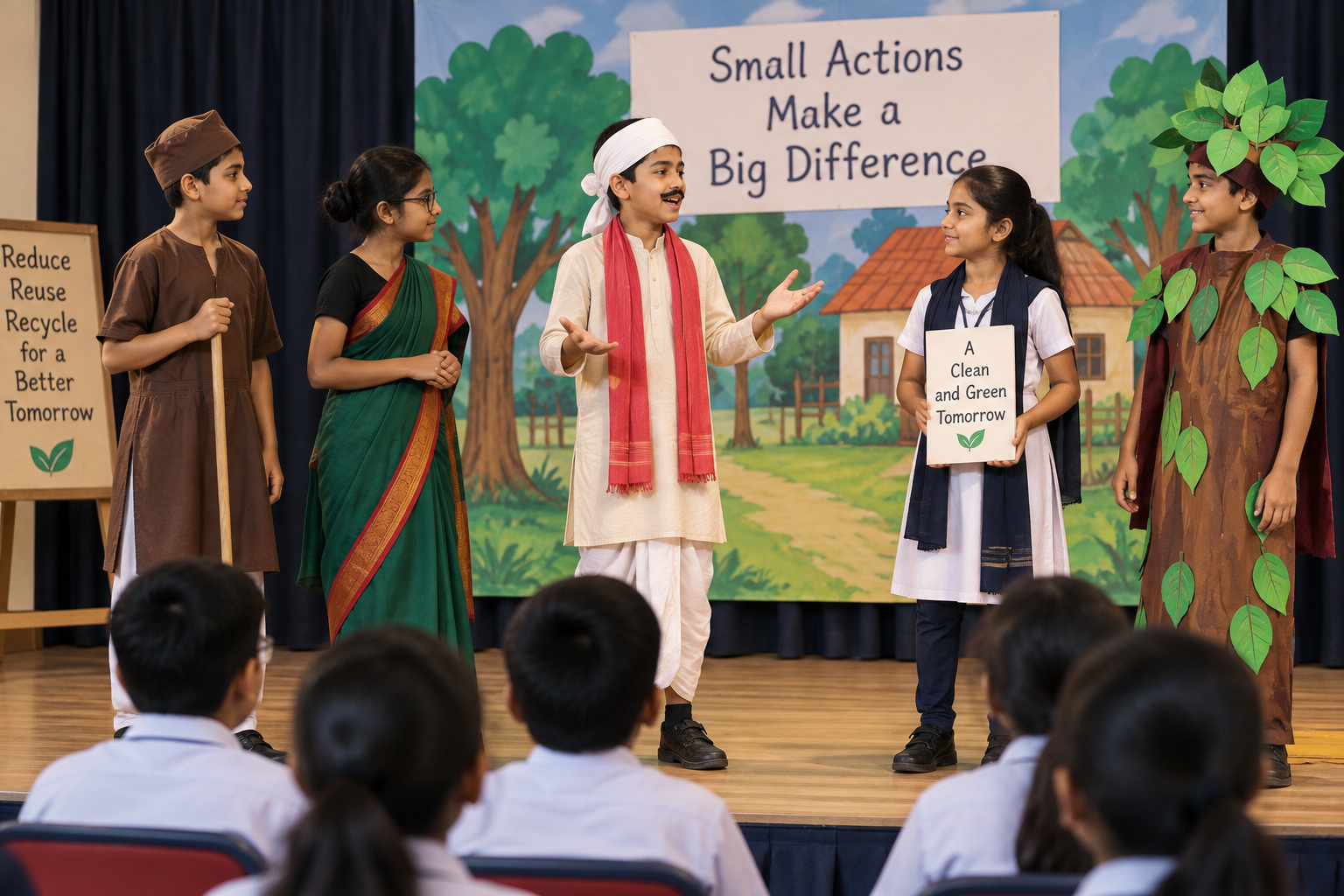
Answer:
Answer:
This is a practice activity. Students should choose sentences from the play and practice speaking them with appropriate stress and intonation.
Writing Task (Page 23)
Q1. In groups of four, create a play script based only on the beginning of the story given below. To write the script, you may refer to the play you have just read. Story beginning: Her father, a vocalist, is a music teacher in a school. He has never been supportive of her learning the tabla and rather feels she should focus on becoming a vocalist. She has been invited to perform at a prestigious event, and decides to participate in it, despite her father's disapproval. However, Anuradha's mother and brother have always rooted for her. Anuradha sat wondering. Tips for writing the script for the play.
- Write a rough draft of the script first
- Mention the setting and characters
- Use colon (:) after the speaker to introduce words of the speaker.
- Use brackets to convey to the actor the way to deliver the words.
- Refer to vocabulary and structures in context (I).
- Include 'aside' where needed.
- Refer to vocabulary and structures in context (I).
- You may use non-lexical fillers such as Ahem-Ahem!, Arrghh! to fill pauses.
- Use ellipsis where necessary. Ellipsis (...) is used to depict a short pause or silence in the script for a dramatic effect.
- Example: Yes, actually I...er...was finding the right words to say something to you...to you papa.
Answer:
Sample Script:
Setting: Anuradha's living room. Evening. A tabla is placed in the corner. Anuradha sits on a sofa, looking thoughtful.
Characters:
- Anuradha – A young tabla player
- Father – A vocalist and music teacher, strict
- Mother – Supportive and understanding
- Brother – Encouraging and cheerful
Script:
ANURADHA: (sighs deeply) What should I do? I have this wonderful opportunity to perform at the prestigious event... but papa will never approve. (aside to audience) I wish he could see how much this means to me.
(Enter Mother, carrying a cup of tea)
MOTHER: Anuradha, beta, you seem lost in thought. Is something bothering you?
ANURADHA: Mummy... I... I have been invited to perform at the City Music Festival. But you know how Papa feels about the tabla.
MOTHER: (sitting beside her) I know, dear. But your father's heart is in the right place. He wants the best for you. However, I believe you should follow your passion.
(Enter Brother, holding a cricket bat)
BROTHER: Hey, what's this about a music festival? That's amazing! You should definitely go for it, Didi!
ANURADHA: But Papa... he wants me to be a vocalist, not a tabla player.
BROTHER: (laughs) Papa and his vocal obsession! But seriously, you are so good at the tabla. Everyone in the school knows that. Just talk to him. He'll come around.
MOTHER: Your brother is right. Sometimes we have to be brave and express our feelings. I will support you.
ANURADHA: (hugs her mother) Thank you, Mummy. And you too, bhai. I guess it's time to bite the bullet. (takes a deep breath) I'll speak to Papa tonight.
(Curtain down)
Learning Beyond the Text (Page 23)
Q1. I Study the words given in brackets in the following dialogues taken from the text. What do you notice? Iqbal: (a little loudly) Shruti! Avinash: (very loudly) SHRUTI! Nabin: (calmly but firmly) No is the answer. 1. Iqbal: (picking up a newspaper from his desk)... 2. Nabin: (getting up)... 1. Why do we not use inverted commas to convey the dialogues? 2. Where do we use colons? 3. What is written within the brackets? What do these convey? 4. How does it help the actors?
Answer:
Answers:
1. In a play script, inverted commas are not used because the dialogues are meant to be spoken and are presented as a list of lines. The speaker's name is followed by a colon, and the dialogue is written without quotation marks.
2. Colons are used after the speaker's name to introduce their dialogue or action.
3. Within the brackets, instructions are given about the tone, manner, or action with which the dialogue should be delivered. These are called stage directions. They convey the emotion, volume, or physical action of the character.
4. Stage directions help actors understand how to deliver their lines, what emotions to convey, and what actions to perform, making the performance more effective and realistic.
Q2. II Did you know that there is an orchestra that made musical instruments from recycling junk or discarded waste items? There is one such orchestra, called the Recycled Orchestra of Cateura, Paraguay, that was formed in 2012, and children are a part of it. They play musical instruments made from scrap materials collected from landfills.
Answer:
Answer:
This is a reading and awareness section about the Recycled Orchestra of Cateura, Paraguay. It highlights how music can be created from recycled materials. Students may research more about this orchestra and discuss the importance of recycling and creativity.
Q3. Ⅲ Indigenous musical instruments are crafted from natural materials like bamboo, gourds, animal hides, and shells, reflecting a deep connection to the environment and cultural heritage. These instruments are diverse, ranging from percussion instruments like drums and rattles to wind instruments like flutes, etc. Find out more about such indigenous instruments that are used in your region.
Answer:
Answer:
This is a research activity. Students should explore indigenous musical instruments from their region. For example, in different parts of India:
- Bamboo flute – used in many tribal communities.
- Dhol – a double-sided drum used in Punjab.
- Ektara – a one-stringed instrument used in folk music.
- Mridangam – a percussion instrument from South India.
Q4. Ⅳ In groups of five, select objects around yourself to create a rhythm. Present it in the class. Enjoy!
Answer:
Answer:
This is a group activity. Students should select everyday objects like bottles, boxes, or spoons to create rhythmic patterns and present them in class.
Q5. Ⅴ Read the book Rigmarole and Other Plays by Sai Paranjype and enjoy the humour and wit. Rigmarole and Other Plays, a collection by Sai Paranjype, includes the play 'Rigmarole,' which follows a silly King, his Council of nine Ministers, and a bed bug, leading to humorous events. Other plays in the collection, like 'The Boy Who Wrote a Constitution,' seek to educate children while entertaining them.
Answer:
Answer:
This is a reading recommendation. Students are encouraged to read the book 'Rigmarole and Other Plays' by Sai Paranjype for enjoyment and learning.
Reflect and Respond (Page 26)
Q1. I Read the questions given below and share your answers with your classmates and teacher. 1. What kind of music do you prefer to listen to—vocal or instrumental? 2. Name your favourite musician(s). 3. Give reasons for your choice.
Answer:
Sample Answers:
1. I prefer instrumental music because it allows me to focus on the melody and rhythm without distractions. I find it very soothing.
2. My favourite musician is A.R. Rahman. I also like listening to classical instrumentalists like Ravi Shankar.
3. I like A.R. Rahman because his music blends traditional Indian sounds with modern compositions. His music is very emotional and uplifting.
Reading for Appreciation (Page 26)
Q1. 1 Read the poem again to complete the poet's diary about her feelings on music. Fill in the blanks with words from the poem. Today, I've been thinking about how essential music is to me. It is like an ocean that calls me to its 1. Music is the 2. that harmonises with my 3. moving me in ways I can't explain. When I feel sad or upset about things, music is the 4. that eases the ache. It is amazing how music has the power to lift my 5. and give me strength to pull through difficult times. I know that it is the effect of music whenever I feel 6. Music is the much 7. dependable friend when there is no one to 8. Thank you, my dear music, for being my all-time comfort.
Answer:
Answers:
1. shore
2. rhythm
3. core
4. therapy
5. spirits
6. most cheerful
7. needed
8. care
Q2. II Let us appreciate the poem. 1. The phrase 'moves me' in the line 'That moves me to the core,' is an example of 2. The poet uses metaphors for music. List these metaphors and rewrite them as similes. For example, Music is as ______ as ______. 3. What is the rhyme scheme of the poem? What impact does it have? 4. What is the poet's purpose in using the word 'music' repetitively? 5. What is the message the poet wishes to convey through the poem? 6. Identify the mood of the poem from the options given below. (i) nostalgic (ii) thoughtful (iii) amused (iv) playful 7. Give evidence from the poem to support that the speaker is the poet herself.
Answer:
Answers:
1. Personification – it gives human-like quality to music.
2. Metaphors in the poem:
- Music is the ocean
- Music is the rhythm
- Music is the therapy
- Music is the needed friend
Similes:
- Music is as vast as the ocean.
- Music is as steady as a rhythm.
- Music is as healing as therapy.
- Music is as supportive as a friend.
3. The rhyme scheme is ABCB in each stanza. It creates a rhythmic flow that makes the poem easy to read and memorable.
4. The poet uses repetition to emphasise the importance and omnipresence of music in her life. It reinforces the central theme.
5. The message is that music is a powerful and essential part of life. It brings comfort, lifts spirits, and provides companionship during difficult times.
6. (ii) thoughtful
7. The use of first-person pronouns like 'I' and 'me' (e.g., "I need when I feel blue", "music lifts my spirits") indicates that the speaker is the poet herself.
Q3. 1. Read the extract given below and answer the questions that follow. Music is the therapy I need when I feel blue. Music lifts my spirits To make sure I pull through. (i) Complete the following sentence suitably. The phrase 'feel blue' indicates (ii) Identify the line which shows music makes the poet happy. (iii) What does the last line of the extract signify? (iv) State whether the following sentence is true or false. Music plays a vital role in the poet's life. (v) Select the central idea of the extract from the following options. A. Music brings comfort during sadness. B. Music is a necessity in times of happiness. C. Music improves our ability to pull heavy loads. D. Music is a source of knowledge and excitement.
Answer:
Answers:
(i) The phrase 'feel blue' indicates feeling sad, low, or depressed.
(ii) The line that shows music makes the poet happy is "Music lifts my spirits".
(iii) The last line signifies that music helps the poet overcome difficult situations or challenges.
(iv) True – Music plays a vital role in the poet's life as it provides comfort and strength.
(v) A. Music brings comfort during sadness.
Q4. II Answer the following questions. 1. How is music able to move the poet 'to the core'? 2. Why does the poet compare music to a 'needed friend'? 3. Explain the poet's attitude towards music. 4. Support the opinion that this poem has a universal appeal. 5. Compare your experience of music with the feelings expressed in the poem.
Answer:
Answers:
1. Music deeply affects the poet emotionally. It touches her innermost feelings and resonates with her soul, making her feel understood and connected.
2. The poet compares music to a 'needed friend' because it is always there for her, especially when she feels lonely or sad. Just like a true friend, music provides comfort and support.
3. The poet has a deep appreciation and love for music. She sees it as essential for her well-being, a source of joy, and a support system in tough times.
4. The poem has universal appeal because the emotions expressed—sadness, joy, needing comfort—are experienced by people everywhere. Music is a universal language that connects all humans regardless of culture or age.
5. My experience with music is very similar to the poet's. Whenever I feel stressed or upset, listening to calm music helps me relax. Music also makes me feel happy and energetic when I am celebrating or exercising.
Q5. 1 Read the following phrases from the poem denoting happiness and sadness. Classify the words given in the box below as positive emotions and negative emotions. feel blue lifts my spirits most cheerful Positive emotions (happiness): Negative emotions (sadness): Now, fill in the blanks by choosing the correct word from those given in the brackets. 1. The familiar tune stimulated a rush of ______ transporting listeners back to cherished moments from their past. (nostalgia/elation) 2. The soulful ballad expressed the singer's ______ leaving the audience moved by the intensity of their emotions. (despondence/anguish) 3. The pianist played a soulful melody on the stage, creating an ambience of ______. (melancholy/despair) 4. The festive symphony filled the air with ______ tones, lifting the spirits of everyone present on the joyous occasion. (jubilant/euphoric)
Answer:
Answers:
Positive emotions (happiness): lifts my spirits, most cheerful
Negative emotions (sadness): feel blue
Fill in the blanks:
1. nostalgia
2. anguish
3. melancholy
4. jubilant
Q6. II Read the highlighted word in the line given below. To make sure I pull through The meaning of the verb 'pull' is 'move or remove something'. The preposition 'through' means 'from one end or side to the other'. However, when they come together they convey a completely different meaning. Here, 'pull through' means 'to succeed in doing something very difficult'. When a verb consists of two parts, the first part is a verb; the second part is a preposition or an adverb. When they come in such combinations the verbs convey a totally different meaning. Such multi-verbs are called phrasal verbs. Now, read the following lines from the poem. Music is the rhythm That moves me to the core. The phrase 'moves me' means 'to make somebody do something'. 'Move' also has different meanings. For example, to change position, to make progress, to take action, cause strong feelings.
Answer:
Answer:
This section explains the concept of phrasal verbs. Students should understand that phrasal verbs are verbs combined with prepositions or adverbs to create a new meaning.
Q7. III Choose the correct meaning from the box given below for the underlined phrasal verbs in the following sentences. 1. He's planning to move out of his parents' house next month. 2. Our new neighbours moved in yesterday. 3. I've been in this job long enough—it's time I moved on. 4. Can you move over a bit so I can sit down? 5. The police officer told the crowd to move along. 6. The bus moved off as soon as all the passengers were seated. (i) to start doing or discussing something new (ii) to begin living in a new home or place (iii) to start moving; to leave (iv) to go to a new position, especially in order to make room for other people (v) to leave a place where one has been living (vi) to shift position to make space for someone or something
Answer:
Correct Matches:
1. move out – (v) to leave a place where one has been living
2. move in – (ii) to begin living in a new home or place
3. move on – (i) to start doing or discussing something new
4. move over – (vi) to shift position to make space for someone or something
5. move along – (iv) to go to a new position, especially in order to make room for other people
6. move off – (iii) to start moving; to leave
Q8. IV Create phrasal verbs from the verbs 'put', 'get', 'look', 'break'. Find the meanings of the phrasal verbs you create. Make sentences with the phrasal verbs. Discuss them with your classmates and teacher.
Answer:
Sample Answers:
| Verb | Phrasal Verb | Meaning | Sentence |
|---|---|---|---|
| put | put off | to postpone | We had to put off the meeting due to rain. |
| put up with | to tolerate | I cannot put up with this noise anymore. | |
| get | get along | to have a good relationship | I get along well with my classmates. |
| get over | to recover from | She got over her illness quickly. | |
| look | look after | to take care of | My grandmother looks after the garden. |
| look forward to | to anticipate with pleasure | I look forward to the holidays. | |
| break | break down | to stop functioning | My car broke down on the highway. |
| break up | to end a relationship | They decided to break up after the argument. |
Listen and Respond (Page 31)
Q1. 1. Before you listen, read the questions and guess the responses to the given questions. 1. How are the two speakers connected? (i) parent-child (ii) teacher-student (iii) brother-sister 2. Where is the conversation taking place? (i) music centre (ii) park (iii) school reception area 3. Which musical instrument is the reason for the problem? (i) sitar (ii) santoor (iii) sarod 4. What is the problem being discussed? (i) inability to play the musical instrument (ii) irregularity of the music class (iii) lack of choice of the musical instrument 5. What has been the unsuccessful solution? (i) practising for longer hours (ii) singing while playing the instrument (iii) watching videos about playing the instrument 6. What is the final decision taken? (i) change classes (ii) pick a simpler instrument (iii) purchase the musical instrument
Answer:
Answer:
This is a listening comprehension activity. Students should listen to the audio and answer the questions. Guesses may vary.
Q2. II Now, listen to the conversation between the two people. As you listen, check your answers and rectify them wherever needed. Once done, discuss your responses with your classmates and teacher. (Transcript for teacher on page 270)
Answer:
Answer:
This is a listening activity. Students must listen carefully and correct their answers.
Speaking Activity (Page 32)
Q1. 1 Work in groups of four and choose a role each. Use the cues given below to present a role play in the class. Frame your responses logically in complete sentences. You may frame appropriate questions to ensure continuity in the conversation. # Music teacher: encourages the student to take up music classes # Student 1: confused- feels music class may take away time from studies # Student 2: music learner- is convinced that music is beneficial and can manage time # Parent: initially doubtful but later supportive after the discussion 
Answer:
Sample Role Play:
Setting: School classroom. Music teacher is talking to a group of students and a parent.
Characters: Music Teacher, Student 1 (Rahul), Student 2 (Priya), Parent (Rahul's mother)
Script:
TEACHER: (enthusiastically) Rahul, Priya, I heard you both are interested in music. We are starting a new music club. I encourage you to join!
RAHUL: (confused) Sir, I love music, but I'm worried that it might take away time from my studies. My exams are coming up.
PRIYA: (confident) I am already learning the keyboard. It actually helps me concentrate better on my studies. I manage my time well.
MOTHER: (doubtful) I am not sure, sir. Rahul already has a lot of homework. Will this not add to his burden?
TEACHER: (reassuringly) Music has been proven to reduce stress and improve focus. We'll have classes only twice a week. It will be a refreshing break from studies.
PRIYA: Yes, aunty! I have been learning for a year now. My grades have actually improved because I feel more relaxed and happy.
MOTHER: (after thinking) Hmm... I didn't know music could help in studies. If it makes Rahul happy and doesn't affect his studies, I don't mind.
RAHUL: (excited) Really, Mummy? Thank you! I promise I'll manage my time well.
TEACHER: Great! That's the spirit. We'll see you at the music club on Monday.
Writing Task (Page 32)
Q1. I Your school is organising a musical evening on 21 June, World Music Day. You are presenting a Sitar recital at the event. Draft an invitation letter requesting your grandparents to attend the event. Follow the guidelines given below to draft the invitation letter. # Format: Sender's address Date Salutation: Dear... # Body of the letter: Ask about their well-being. Mention the event and give details- date, time, and venue. Request them to attend. Complimentary close: Yours affectionately, Name of the sender # Language: Use first person- 'I' and second person 'We' and 'You'. Write in a warm and personalised style.
Answer:
Sample Invitation Letter:
Flat No. 4B,
Sunrise Apartments,
Mumbai - 400001
15th June 2025
Dear Grandparents,
I hope this letter finds you both in good health and high spirits. It has been a while since we last met, and I miss you both very much.
I am writing to invite you to a very special event at my school. Our school is organising a musical evening on 21st June, which is celebrated as World Music Day. I am delighted to tell you that I will be performing a Sitar recital at the event. It would mean the world to me if you could be there to see me perform.
The event will begin at 6:00 PM in the School Auditorium. I am sure you will enjoy the evening.
Please let me know if you will be able to come. I am eagerly waiting to see you both.
Yours affectionately,
Shruti
Learning Beyond the Text (Page 33)
Q1. I Did you know, India's rich musical heritage has a lot to offer to our well-being? Raga Chikitsa, one of the ancient texts, elaborates on the healing properties of music. A seventeenth century work titled Sangita Sudha gives an account of the effects of music on emotions. Find out how music is used as an alternative therapy in the present times.
Answer:
Answer:
Music therapy is increasingly used today to help people with mental health issues, stress, anxiety, and even physical ailments. It is used in hospitals, rehabilitation centres, and schools to improve emotional well-being, reduce pain, and enhance cognitive function. Therapists use specific ragas and rhythms to calm the mind, improve sleep, and promote healing.
Q2. II Everything in nature has a rhythm or sound vibration, even our heartbeat. Speak to your music teacher and find out about the origin of the seven swaras (notes) of Indian classical music.
Answer:
Answer:
The seven swaras are Sa, Re, Ga, Ma, Pa, Dha, Ni. According to legend, these notes were derived from the sounds of animals and birds. For example, 'Sa' from the peacock, 'Re' from the bull, 'Ga' from the goat, 'Ma' from the cuckoo, 'Pa' from the cuckoo/nightingale, 'Dha' from the horse, and 'Ni' from the elephant. These notes form the foundation of Indian classical music.
Q3. III You must have read or heard poems and songs about music- both in English and in your own language. Share some of them with your classmates and create a collection of these poems and songs together.
Answer:
Answer:
This is a group activity. Students should share poems and songs about music from different languages and compile them into a collection.
Q4. IV Read and enjoy the poem given below. Music When music sounds, gone is the earth I know, And all her lovely things even lovelier grow; Her flowers in vision flame, her forest trees Lift burdened branches, stilled with ecstasies. When music sounds, out of the water rise Naiads* whose beauty dims my waking eyes, Rapt in strange dreams burns each enchanted face, With solemn echoing stirs their dwelling-place. When music sounds, all that I was I am Ere to this haunt of brooding dust I came; And from Time's woods break into distant song The swift-winged hours, as I hasten along. WALTER DE LA MARE *NOTE: Naiad—a water nymph said to inhabit a river, spring, or waterfall.
Answer:
Answer:
This is a poem for enjoyment and appreciation. Students should read it and appreciate its imagery and themes.