
Reflect and Respond (Page 96 )
Q1. From your experience with an elderly person at home or in your neighbourhood, complete the following graphic organiser. 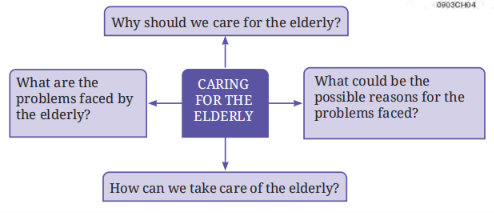 Now, discuss the points written in the organiser with your classmates and teacher.
Answer:
Caring for the Elderly
1. Why should we care for the elderly?
We should care for the elderly because they are an important part of our families and society. They have gained valuable knowledge and experience throughout their lives. They may need additional support because of age-related physical or emotional changes. Caring for them shows respect, gratitude, love and responsibility towards them.
2. What are the problems faced by the elderly?
The elderly may face several problems, such as:
- Weakness and health problems due to ageing.
- Difficulty in walking, hearing or seeing.
- Loneliness and lack of companionship.
- Financial difficulties after retirement.
- Difficulty in managing daily activities independently.
- Feeling neglected or ignored by family and society.
3. What could be the possible reasons for the problems faced?
Many problems faced by the elderly are caused by ageing and changes in their physical and social circumstances. Poor health, retirement, loss of close friends or family members, financial dependence and lack of social interaction can make their lives difficult. In some cases, busy lifestyles and lack of attention from family members may also make elderly people feel lonely or neglected.
4. How can we take care of the elderly?
We can take care of elderly people by:
- Spending time with them and listening to them patiently.
- Helping them with household and daily activities when needed.
- Ensuring that they receive proper food, rest and medical care.
- Taking them for regular health check-ups.
- Respecting their opinions, feelings and experiences.
- Keeping them involved in family activities and social events.
- Making them feel loved, valued and respected.
```
Q2. Fill in the table given below. You may check your answers with the help of a dictionary. 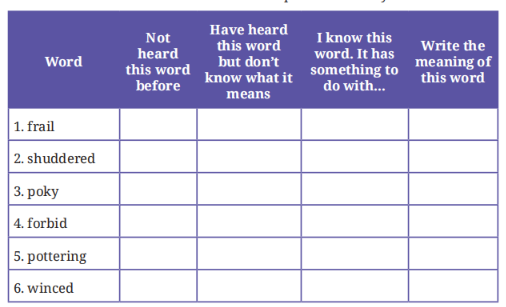
Answer:
This is an activity for you to assess your vocabulary. Here are the meanings of the words for your reference:
| Word | Meaning |
|---|---|
| 1. frail | Weak and delicate; fragile. (e.g., 'The frail old man needed help to walk.') |
| 2. shuddered | To shake or tremble suddenly, often from fear, cold, or disgust. (e.g., 'She shuddered at the terrible memory.') |
| 3. poky | Small and cramped; confined. (e.g., 'The room was so poky that it felt very small.') |
| 4. forbid | To officially refuse to allow something; to ban or prohibit. (e.g., 'Her mother forbade her from going out alone.') |
| 5. pottering | To spend time doing small, unimportant tasks in a leisurely way. (e.g., 'He loved pottering around in his garden.') |
| 6. winced | To make a slight involuntary grimace or shrinking movement due to pain or embarrassment. (e.g., 'He winced at the harsh words.') |
Q3. Think of a tradition, story, or recipe passed down by grandparents or an elderly relative in your family. What does it mean to you? How does it connect you to your growing- up years? Share with your classmates and teacher.
Answer:
This is a personal response question. Think about a specific tradition, story, or recipe from your family. Here is a sample answer to guide you:
Sample Answer: My grandmother used to make a special sweet dish called 'Payasam' on festivals. The recipe was passed down to her by her mother. This tradition means a lot to me because it connects me to my family's history and culture. The smell of cardamom and milk reminds me of my childhood, when my sister and I would sit eagerly in the kitchen, waiting for the first taste. It brings back memories of laughter and togetherness, making me feel close to my grandmother even when she is not around.
Reading for Meaning
Q1. "I wish," said Ravi's mother, hurriedly putting some green, red and orange tablets on a saucer, "that somebody would invent a memory—Vitamin- M, they could call it, and we could give it to old people to help them improve their memories."
Answer:
This line sets the theme of the story. Ravi's mother is concerned about her father's failing memory and jokingly wishes for a 'Vitamin-M' to help him. It also shows the central conflict: how to handle the challenges of old age with love and care, without making the elderly feel like a burden.
Q2. "Shh...Grandpa'll hear you," said Ravi, pointing to the frail old figure sitting in the rocking chair, holding the newspaper inches from his nose to read it.
Answer:
This line shows Ravi's concern for his grandfather. The word 'frail' highlights Grandpa's physical weakness. Also, the detail 'holding the newspaper inches from his nose' tells us that his eyesight is also failing. Ravi's reaction shows he is thoughtful and considerate of his grandfather's feelings.
Check Your Understanding
Q1. I Why did Grandpa dislike living in the city with his daughter?
Answer:
Grandpa disliked living in the city because he hated the noise and bustle of city life. He found the city 'horrible' and 'crowded'. He missed the quiet and peace of his small brick house in town, where he could even 'hear a leaf fall' at dusk. He also found the flat in the city to be 'poky' or cramped.
Q2. II Why did Vidya not want her father to go out alone?
Answer:
Vidya did not want her father to go out alone because he had gotten lost once before and forgot his way back home. He had also accidentally taken a double dose of his medicine. Vidya was worried that he might get hurt or lost again if he went out by himself, as it was 'too dangerous'.
Q3. III. Was Ravi in favour of his mother treating Grandpa like a child? How can you say so?
Answer:
No, Ravi was not in favour of his mother treating Grandpa like a child. When his mother spoke to Grandpa in an 'over-loud tone', Ravi 'winced'. He felt uncomfortable seeing his grandfather being talked down to, as if he were a child who couldn't understand. This shows that Ravi was empathetic and believed his grandfather deserved to be treated with dignity and respect.
Q4. IV Would Ravi be able to keep up his promise to his mother?
Answer:
Ravi could not keep his promise to his mother. Although he initially promised to look after Grandpa, he was easily swayed by Grandpa's words and allowed him to go out alone. He then tried to secretly follow him to ensure his safety, which shows he had good intentions but failed to do as his mother strictly instructed.
Check Your Understanding (Continued)
Q1. I Was Grandpa lost as feared by Ravi's mother?
Answer:
No, Grandpa was not lost as feared by Ravi's mother. Grandpa was perfectly aware of his surroundings and was simply out enjoying his freedom. He went to the park, tea stall, and barber shop on his own, and even gave away his cap to a stranger. He found his way back home safely, showing that he was quite capable.
Q2. III How would Ravi feel after seeing Grandpa?
Answer:
After seeing Grandpa safe at home, Ravi was filled with 'great delight and relief'. He was overwhelmed with affection for his grandfather and hugged him. He also felt confused and embarrassed when Grandpa told his mother that Ravi had disappeared instead of staying to look after him. He was also a bit anxious about whether Grandpa knew he had been following him.
Q3. IV Do you think Ravi's mother will get to know about what had happened?
Answer:
It is suggested that Ravi's mother might not get to know the full story. Grandpa made a clever comment to Ravi's father about Vidya needing 'Vitamin-M for her memory', which silenced her. He also gave Ravi a detective story book as a gift, hinting that he knew about Ravi's secret following but was keeping it a fun secret between them. This shows Grandpa's sense of humour and his way of protecting Ravi from his mother's anger.
Check Your Understanding (Final)
Q1. I Describe how Ravi's emotional reaction upon finding Grandpa safe at home reveals his feelings towards his grandfather.
Answer:
Upon finding Grandpa safe at home, Ravi felt 'great delight and relief'. His worry turned into immense joy and affection. He knelt down near the bed, put his cheek against the old man's face, and hugged him. These actions show that Ravi deeply loves his grandfather and cares for him. The overwhelming affection he felt highlights the strong, loving bond between them.
Q2. II What might be the significance of Grandpa's habit of giving gifts to everyone on his birthday rather than receiving them?
Answer:
Grandpa's habit of giving gifts on his birthday shows his selfless and generous nature. It suggests that he finds greater joy in giving than in receiving. It is also a way for him to show his love and appreciation for his family and to feel needed and connected to them. By calling his daughter and son-in-law his 'babies', he reinforces the idea that he still sees himself as a caretaker, which gives him purpose and dignity. It's a way for him to maintain his role in the family.
Q3. III Why do you think Grandpa gave Ravi a detective story book as a gift? What might this suggest about Grandpa's awareness of Ravi's actions earlier in the day?
Answer:
Grandpa gave Ravi a detective story book because it was a clever and humorous way of telling Ravi that he knew he had been following him all day. The book's theme of 'detecting' directly related to Ravi's secret mission. Grandpa's comment, 'How to avoid getting fooled when one is trailing a suspect, for instance,' is a clear hint that he was aware of Ravi's clumsy attempts. This shows that Grandpa was sharp and alert, and he chose to enjoy the situation with a sense of playful mischief rather than getting angry. It suggests a deep understanding between the two.
Critical Reflection
Q1. I Read the extracts given below and answer the questions that follow. 1. Grandpa hated the noise and bustle of city life and when they were on their own, he often spoke longingly of his small brick house in town. "Such a wonderful place...! With that big mango tree in the garden! It is so quiet that at dusk you can even hear a leaf fall!" But then Grandpa had slipped and fallen in the garden late one evening while he was pottering around and lain outside all night because there was no one at home to help him up. (i) Choose the emotion displayed by the Grandfather. A. regretful B. apologetic C. nostalgic D. wistful (ii) Complete the following sentence with a reason. Grandpa hated the busy and noisy city life because (iii) Why did Grandpa come to the city despite his dislike for city life? (iv) Choose an expression similar in meaning to, 'you can even hear a leaf fall'. A. end of one's life B. arrival of autumn C. sign of good luck D. pin drop silence (v) State one advantage and one disadvantage of the Grandfather living in the house in town.
Answer:
(i) C. nostalgic and D. wistful. The Grandfather is feeling both nostalgic (a sentimental longing for the past) and wistful (a feeling of vague or regretful longing). He misses his old home deeply.
(ii) Grandpa hated the busy and noisy city life because he missed the peace and quiet of his own home in town, where he could enjoy nature without the constant disturbance of city crowds and traffic.
(iii) Grandpa came to the city despite his dislike for it because he had an accident in his garden and lay outside all night, which made his family worry for his safety. He was getting too old to live alone, so he was forced to move in with his daughter for care and supervision.
(iv) D. pin drop silence
(v) Advantage: He had his independence and freedom to live on his own terms in a peaceful environment.
Disadvantage: Living alone posed a significant safety risk, especially in case of accidents or emergencies.
Q2. 2. "I had a quiet morning, but I don't know about Ravi. He just disappeared instead of staying at home to look after me like you told him to," answered Grandpa coolly, while Ravi just looked confused and embarrassed. Grandpa had another surprise for Ravi. A gift-wrapped parcel! "But, Papa, Ravi's birthday was three months ago. Have you forgotten?" exclaimed Ravi's mother, impatiently. (i) Choose the option that displays the tone of the Grandfather's response. A. apologetic B. hurtful C. calm D. puzzled (ii) Why was Ravi confused and embarrassed?
Answer:
(i) C. calm. The word 'coolly' indicates a calm and composed tone.
(ii) Ravi was confused and embarrassed because he knew he had broken his promise to his mother by letting Grandpa go out. Grandpa's comment made him look irresponsible in front of his mother, and he didn't know how to react. He was also confused because he didn't expect Grandpa to reveal his secret (even though Grandpa was making it clear he knew Ravi followed him).
Critical Reflection
Q3. 1. Grandpa is portrayed as a person with failing memory in the beginning of the story. Give two evidences to disprove the statement.
Answer:
Evidence 1: Grandpa remembered all the details of his past, such as his house, the mango tree, and even the quietness of the town. He also remembered his chess games and would give Ravi tips about famous chess matches.
Evidence 2: At the end, Grandpa remembered that it was his birthday and that he needed to give gifts to everyone, even though Ravi's mother had forgotten. He also cleverly hinted to Ravi that he knew he had been following him by giving him a detective book. This shows his memory was not failing, but was selective or being used playfully.
Q4. 2. Give two characteristic traits of each of the following characters. (i) Grandfather (ii) Ravi (iii) Ravi's mother
Answer:
(i) Grandfather
- Independent and Stubborn: He hates being treated like a child and insists on going out alone despite the risks.
- Wise and Humorous: He uses his intelligence to outsmart Ravi and his mother and has a playful, mischievous sense of humour, as shown by the gift of the detective book.
(ii) Ravi
- Caring and Empathetic: He worries about his grandfather's feelings and doesn't like seeing him being treated like a child.
- Obedient but Easily Swayed: He wants to keep his promise to his mother but finds it hard to disobey his grandfather's wishes.
(iii) Ravi's mother (Vidya)
- Anxious and Overprotective: She worries excessively about her father's safety and treats him like a fragile child out of fear.
- Responsible and Caring: She is the one who takes care of her father's medical needs and brings him to live with them to ensure his safety.
Q5. 3. Why was Ravi worried about what Grandfather had at the tea stall?
Answer:
Ravi was worried about what Grandpa had at the tea stall because Grandpa was eating things that were forbidden by his mother. He had a sugary cup of tea (forbidden sugar), ate two bananas (another banned item), and then tucked into an ice cream. Ravi's mother would have fainted if she saw this, as these items were likely against his diet for health reasons.
Q6. 4. Do you think it was easy for Ravi to follow his Grandfather? If yes, why? If no, why not?
Answer:
No, it was not easy for Ravi to follow his grandfather. He faced many difficulties:
- He had to hide behind bushes and cars to avoid being seen, which was embarrassing.
- He was caught by a mother in the park, threatened by a vegetable vendor, and accidentally walked into a ladies' hairdressing salon and was thrown out.
- He nearly lost Grandpa when he got on a bus, only to realize the man in the cap wasn't Grandpa at all.
His mission was filled with awkward and stressful moments.
Q7. 5. 'Ravi is a good detective'. Give one argument in favour of and against the given statement.
Answer:
In Favour: Ravi showed good determination and persistence. He never gave up following Grandpa even after multiple embarrassing and difficult situations. He was creative in trying to hide and keep track of Grandpa.
Against: He was not a good detective because he was easily fooled. He was following a stranger on a bus for a while, not realizing it wasn't his grandfather. He also failed to stay hidden and was spotted by multiple people. A good detective needs to be more discreet and observant.
Q8. 6. Was Grandfather aware that Ravi was following him? How do you know?
Answer:
Yes, Grandfather was aware that Ravi was following him. We know this because of his actions at the end of the story. He gave Ravi a book called The Best Detective Stories and made a comment about learning 'how to avoid getting fooled when one is trailing a suspect'. This was a direct hint to Ravi that he knew he was being followed. The 'twinkle in Grandpa's eye' also suggests his playful awareness.
Q9. 7. In your opinion, who needs Vitamin-M? And why?
Answer:
In the story, Vitamin-M is a fictional memory vitamin. While Ravi's mother thinks Grandpa needs it, she ironically forgets his birthday.
In my opinion, the person who needs 'Vitamin-M' the most is Ravi's mother, Vidya. She is so focused on her father's forgetfulness that she forgets her own responsibilities, like remembering her father's birthday. Grandpa himself points this out when he says, 'My daughter needs some Vitamin-M, I think—for her memory.' This suggests that being forgetful is not just a sign of old age, but can happen to anyone, and we should be mindful of that.
Q10. 8. Some people believe society shows bias based on age (being young or old). Give an example where you might have experienced or observed such discrimination, when opinions were disregarded because of age.
Answer:
This is a personal response question. Here is a sample answer:
Yes, I have observed this. For example, in our family, the opinions of my grandparents are sometimes not taken seriously by the younger generation. When we are deciding on family matters, my parents might dismiss a suggestion from my grandfather, thinking he is 'too old' to understand the modern world. I also see this in our community, where young people are sometimes not heard because they are 'too young' to have a valid opinion. For instance, during a neighbourhood meeting, a suggestion from a teenager about using technology for security was politely ignored, while a similar suggestion from an adult was taken seriously.
Vocabulary and Structures in Context
Q1. I Classify the words given in the box on the next page into movement words in Column 1 and sound words in Column 2. One example has been done for you.
Answer:
This is a hands-on activity from the textbook. As the word list is not provided in the text, please refer to the original textbook for the list of words to classify.
General Understanding:
- Movement Words: Verbs that describe action or motion (e.g., 'sprinting', 'crouching', 'creeping').
- Sound Words: Onomatopoeic words or verbs that describe sounds (e.g., 'whirr', 'boomed', 'shrieked').
Q2. II Study the highlighted word in the given sentence from the text and fill in the boxes with synonymous words. You may refer to a dictionary. Off he went, twirling his walking stick jauntily, leaving Ravi in a dilemma. 1. QU_ND_Y DILEMMA 2.PR_D_C_M NT
Answer:
1. QUANDARY (Q U A N D A R Y)
2. PREDICAMENT (P R E D I C A M E N T)
Both 'quandary' and 'predicament' are synonyms for 'dilemma', meaning a difficult situation or problem.
Q3. III Fill in the table given below. Check your answers with the help of a dictionary.
| Word | Meaning | Part of Speech | Synonym | Antonym |
|---|---|---|---|---|
| 1. craftily | ||||
| 2. dilemma | ||||
| 3. furious | ||||
| 4. boomed | ||||
| 5. humiliation | ||||
| 6. attire |
Answer:
Here are the correct answers for the vocabulary table:
| Word | Meaning | Part of Speech | Synonym | Antonym |
|---|---|---|---|---|
| 1. craftily | In a clever, skillful, or cunning way. | Adverb | slyly, cunningly | honestly, openly |
| 2. dilemma | A situation requiring a choice between two difficult or undesirable alternatives. | Noun | predicament, quandary | solution, certainty |
| 3. furious | Extremely angry. | Adjective | enraged, livid | calm, peaceful |
| 4. boomed | Made a deep, loud, resonant sound. | Verb | thundered, roared | whispered, murmured |
| 5. humiliation | The feeling of being ashamed or losing dignity. | Noun | embarrassment, disgrace | pride, honour |
| 6. attire | Clothes, especially formal or of a particular kind. | Noun | clothing, garments | N/A |
Q4. IV Match the emotions/expressions in Column 1 with their meanings in Column 2. One meaning is extra.
| Column 1 Emotions/Expressions | Column 2 Meanings |
|---|---|
| 1. embarrassed | (i) affected severely by an unpleasant feeling |
| 2. countered | (ii) to be confused |
| 3. flushed | (iii) expression of emotion |
| 4. stricken | (iv) reply to an argument |
| 5. gleam | (v) felt uncomfortable |
| (vi) became red in the face |
Answer:
The correct matches are:
| Column 1 Emotions/Expressions | Correct Meaning |
|---|---|
| 1. embarrassed | (v) felt uncomfortable |
| 2. countered | (iv) reply to an argument |
| 3. flushed | (vi) became red in the face |
| 4. stricken | (i) affected severely by an unpleasant feeling |
| 5. gleam | (iii) expression of emotion (a flash of light or emotion in the eyes) |
Grammar: Prepositions and Direct/Indirect Speech
Q1. V Fill in the blanks with appropriate prepositions. I walked (i) (through, between, against) the village, crossed a bridge (ii) (over, under, beside) a brook, and found a quiet garden (iii) (among, near, across) a cottage. Sitting on a bench (iv) (on, at, in) the garden, I enjoyed the peaceful surroundings. Later, I strolled (v) (beside, through, along) a riverbank, exploring the forest and heading (vi) (into, towards, beyond) the unknown.
Answer:
The correct prepositions are:
(i) through the village
(ii) over a brook
(iii) near a cottage
(iv) in the garden
(v) along a riverbank
(vi) towards the unknown
Q2. VI Read the following dialogues from the story. 1. "Shall we play chess or watch the cricket match on TV, Grandpa?" asked Ravi. 2. "Who are you?" said the little boy's mother. 3. "What did you both do today?" asked Ravi's mother. 4. "Have you forgotten?" countered Grandpa. 5. A small child came up to him and asked, "Are you playing hide and seek?" Now, choose the correct answer. A. The words in the quotes are (i) (exclamatory/interrogative) sentences. B. Sentences 1, 4, and 5 are (ii) (Wh-/Yes, No type) interrogative sentences. C. Sentences 2 and 3 are (iii) (Wh-/Yes, No type) interrogative sentences. So, there are (iv) (two/three) types of interrogative sentences.
Answer:
A. The words in the quotes are interrogative sentences.
B. Sentences 1, 4, and 5 are Yes, No type interrogative sentences.
C. Sentences 2 and 3 are Wh- type interrogative sentences. So, there are two types of interrogative sentences.
Q3. VII Read the following conversation. ARVIND Do you help in taking care of your grandparents at home? PRIYA Yes, I do. We take turns making sure they're alright. Do you have grandparents living with you? ARVIND No. My parents and I visit my grandpa every weekend. How do you manage your grandparents' medical needs? PRIYA We have a schedule for giving medications and visits to the doctor. Now, complete the following sentences in reported speech. Arvind asked Priya if she 1. for which Priya replied in the affirmative and said that they 2. Priya further asked Arvind 3. Arvind replied in the negative and said that 4. every weekend. He further enquired 5. Priya responded by saying that they 6.
Answer:
1. helped in taking care of her grandparents at home.
2. took turns making sure they were alright.
3. if he had grandparents living with him.
4. he and his parents visited his grandpa.
5. how she managed her grandparents' medical needs.
6. had a schedule for giving medications and visits to the doctor.
Writing Task
Q1. As you read in the story, we have a lot to learn from our elderly. Based on the lessons learned from them, write an article for your school magazine on the topic 'Our Inspiring Elderly'. Organise the article in the manner given below. Follow the steps given below to write an article about your skills and passions.
- Write the title at the top and your name and grade below it.
- Paragraph 1: Give a brief introduction to the topic. Focus on the main idea, but do not give any details.
- Paragraph 2: Give details to support the main idea—how the elderly inspire. Include examples, facts, and quotations.
- Paragraph 3: Elaborate on how they overcame challenges and the inspiring impact on you.
- Paragraph 4: Conclude with a final comment on the topic and leave the reader with the most important ideas to think about.
Answer:
Our Inspiring Elderly
By [Your Name], Class 9
Paragraph 1: In a world that races towards the future, we often overlook the wealth of wisdom standing right beside us—our elderly. They are the living libraries of our history, culture, and resilience. More than just individuals who need our care, they are a source of profound inspiration and life lessons that can guide us through our own challenges.
Paragraph 2: The elderly inspire us through their sheer resilience. They have lived through times that we only read about in history books. Their lives are testaments to facing adversities with courage and grace. As the saying goes, 'With age comes wisdom.' This wisdom is not just about facts and figures, but about understanding people, handling emotions, and knowing what truly matters in life. A grandfather's story of his first job, or a grandmother's tale of how she managed a household during tough times, is a lesson in perseverance and optimism. For instance, in the story 'Vitamin-M', Grandpa, despite his failing health, showed immense spirit, generosity, and a mischievous sense of humour, reminding us that our soul doesn't age.
Paragraph 3: The way they overcome challenges is truly inspiring. They have navigated personal losses, economic hardships, and societal changes without the modern comforts we take for granted. Their ability to adapt and keep going is a powerful lesson in resilience. Observing them instils in us a sense of patience and gratitude. They teach us to be humble and to value relationships over material things. The simple tradition of my grandmother making sweets for every festival connects me to my roots and reminds me of the importance of family and tradition. Seeing their calm in the face of difficulty encourages me to face my own challenges with a similar spirit.
Paragraph 4: In conclusion, the elderly are not just a part of our past; they are the guiding lights for our future. Their lives are a beautiful narrative of strength, love, and wisdom. It is our responsibility to listen, learn, and respect them. In doing so, we not only make their lives richer but also enrich our own. Let us remember that true inspiration often comes from the quietest voices and the most lived lives.