
The Big Questions
Q1. What is colonialism?
Answer:
Colonialism is the practice where one country takes control of another region, establishing settlements there, and imposing its political, economic, and cultural systems.
Q2. What drew European powers to India?
Answer:
European powers were drawn to India primarily by its immense wealth and the prospect of trade. They sought access to valuable commodities like spices, cotton, silk, and gems. Additionally, political competition among European nations, the desire for territorial expansion, and the motivation to spread Christianity also played a role.
Q3. What was India's economic and geopolitical standing before and during the colonial period?
Answer:
Before the colonial period, India was a vibrant economic and cultural powerhouse. Historical estimates suggest that India contributed at least one-fourth of the world GDP, making it one of the two largest economies globally. During the colonial period, India's share of the world GDP kept declining, reaching hardly 5 per cent at the time of Independence. The country was transformed from a wealthy nation to one of the poorest.
Q4. How did the British colonial domination of India impact the country?
Answer:
The British colonial domination had a devastating impact on India. It led to the systematic exploitation of India's wealth, causing severe famines that resulted in millions of deaths. It saw the decline of indigenous industries and a shift from a self-sufficient economy to a supplier of raw materials for Britain. Traditional governance structures were dismantled, and a new education system was introduced to create a class of Indians who would serve British interests. These changes resulted in widespread poverty and lasting social divisions.
Let's Explore
Q1. What do you think the cartoon (Fig. 4.3) is trying to express? (Keep in mind that the telegraph, which permitted instant communications for the first time, was then a recent invention.) Analyse different elements of the drawing.
Answer:
The cartoon depicts a British business magnate straddling Africa while holding a telegraph wire. This expresses the idea of European powers, particularly Britain, dominating and exploiting the African continent. The telegraph wire symbolizes the new technology that allowed for instant communication and control over vast colonial empires. The man's posture, astride the continent, represents the power and control the colonisers had over the colonised lands and people. The cartoon is a critique of imperialism, highlighting the exploitation of Africa's resources and people for the benefit of European nations.
Q2. Before you read further, have a good look at the painting on the first page of this chapter. It was specially ordered for the London headquarters of the East India Company and is over three metres long. Observe every aspect of it — the people in it, the objects, the symbols and the attitudes. Form groups of four or five students and let each group present its conclusions as regards the messages the painting conveys. (You will find our answers a few pages down, when we return to the painting, but avoid looking at them right now!)
Answer:
This is a group activity and may be answered based on the painting analysis. The painting, 'The East offering its riches to Britannia', portrays Britannia (a symbol of Britain) seated on a throne, receiving offerings of riches from figures representing the East, including India. The painting conveys the message that Britain is a superior power being voluntarily offered wealth by its colonies, justifying British imperialism as a beneficial and voluntary exchange. The composition and figures reinforce the idea of British superiority.
Q3. Why do you think Dadabhai Naoroji means by 'un- British rule in India'? (Hint: he was an MP in the House of Commons in 1892. )
Answer:
Dadabhai Naoroji used the term 'un-British rule' to highlight that the British rule in India was contrary to the principles of justice, fairness, and good governance that Britain claimed to uphold for its own citizens. He argued that the British administration in India was exploitative and oppressive, draining India's wealth and causing immense suffering, which went against the liberal and democratic ideals of Britain. By being a member of the House of Commons, he was in a position to critique the British government's policies in India, pointing out the hypocrisy of a nation that championed liberty at home but practiced tyranny in its colonies.
Q4. Do you understand all the terms used above to list and describe Indian textiles? If not, form groups of four or five and try to find out more, then compare your findings with the help of your teacher.
Answer:
This is a research and discussion activity. Students are expected to look up the meanings of terms like 'muslin', 'jute', 'coir', etc., and discuss their findings in groups. The teacher can guide the discussion and provide additional context about India's rich textile heritage.
Q5. Examine the map. What are the main differences with the map of today's India, in terms both of borders and of names? 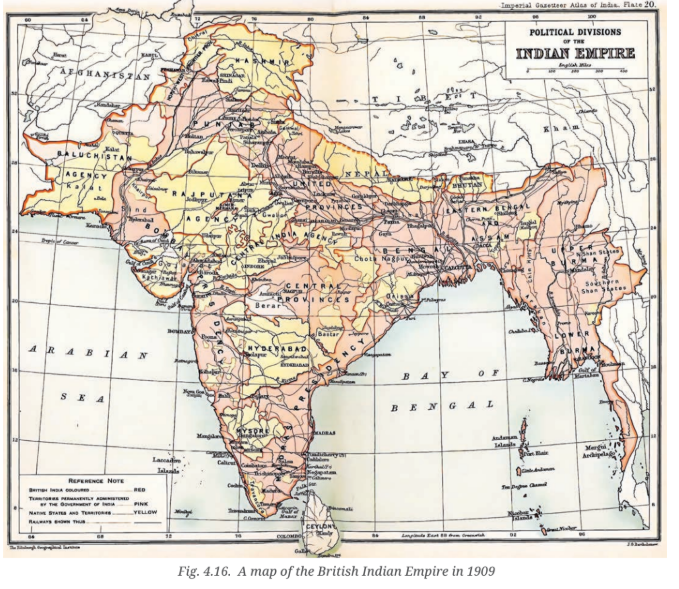
Answer:
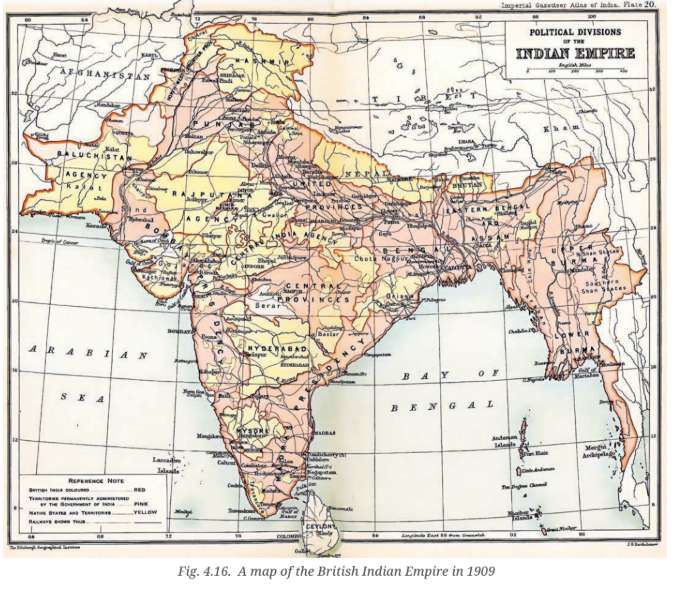
The map of the British Indian Empire in 1909 shows a larger territory than modern India, including present-day Pakistan, Bangladesh, and parts of Myanmar. The names of cities and regions have also changed; for example, 'Calcutta' is now 'Kolkata', 'Bombay' is 'Mumbai', and 'Madras' is 'Chennai'. Additionally, the political divisions are different, with many princely states that have since been integrated into the Indian Union.
Q6. Note how the Santhals are depicted in the 1856 sketch (Fig. 4.17) drawn from an artist's imagination: observe their complexion, dress, weapons and draw your conclusions as regards the image this depiction would create in the popular mind in Britain. 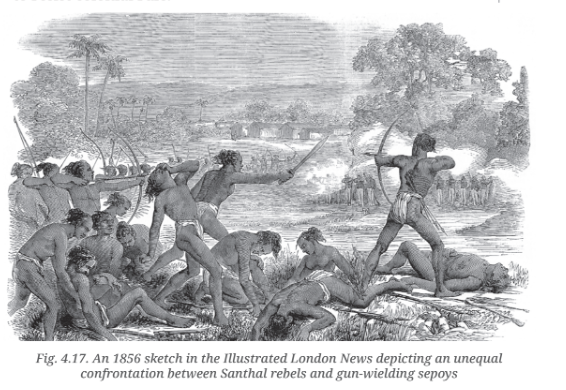
Answer:
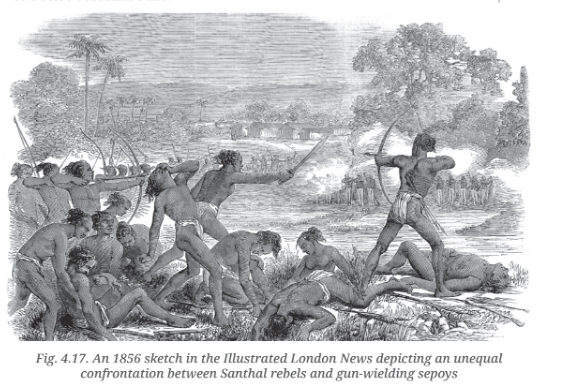
The sketch depicts the Santhals as dark-skinned, dressed in simple clothing, and armed with primitive weapons like bows and arrows, facing the superior firepower of British sepoys. This depiction was intended to create an image in the British popular mind of the 'primitive' and 'savage' natives opposing the 'civilized' and 'superior' British forces. It was a form of propaganda to justify colonial rule by portraying the colonised people as backward and in need of control.
Q7. Indigo is a natural deep blue pigment used in dyeing. Can you think of other natural substances that have been traditionally used in India to dye cloth?
Answer:
Other natural substances traditionally used in India for dyeing cloth include:
- Turmeric (yellow)
- Haldi (yellow)
- Kumkum (red)
- Manjistha (red)
- Indigo (blue)
- Myrobalan (black/grey)
- Pomegranate rind (yellow)
- Henna (orange/red)
- Saffron (yellow/orange)
- Madder root (red)
Q8. Why do you think was the term 'Sepoy Mutiny' rejected after Indian Independence? Write one paragraph explaining your reasons.
Answer:
The term 'Sepoy Mutiny' was rejected after Indian Independence because it was a term used by the British to describe the events of 1857. The word 'mutiny' implies a rebellion against lawful authority, which was the British perspective. After independence, Indian historians adopted terms like the 'Great Rebellion' or the 'First War of Independence' to reflect the Indian viewpoint, seeing it as a widespread, multi-faceted struggle against foreign rule, involving not just sepoys but also peasants, rulers, and the general populace. It was a major uprising against colonial oppression, not a mere military mutiny.
Q9. In the sentence "It opened (or re- opened) India to the world and the world to India", why do you think we added 're- opened'?
Answer:
The word 're-opened' is used because India had a long history of global trade and cultural exchange long before the colonial period. India traded with the Greeks, Romans, and other civilizations for over two millennia. The colonial period, especially the British rule, significantly increased India's global interactions but in a context of subjugation. Therefore, it 're-opened' India to the world, but under colonial conditions.
Q10. Some argue that stolen cultural heritage has been better preserved abroad than it would have been in India. What is your view on its repatriation? Discuss in groups.
Answer:
This is a discussion question. Students are expected to weigh both sides of the argument. Those in favor of repatriation argue that these artifacts are an intrinsic part of India's cultural heritage and history, and their return is a matter of dignity and justice. Those who argue for keeping them abroad may claim that they have been better preserved and are accessible to a global audience. The discussion should consider ethical and historical perspectives.
Think About It
Q1. What exactly did Macaulay mean when he wrote that "a single shelf of a good European library was worth the whole native literature of India and Arabia"? And why should he want to make Indians "English in taste, in opinions, in morals, and in intellect"? How does this relate to the 'civilising mission' mentioned at the start of the chapter? Ask your teacher to guide a class debate on these questions.
Answer:
Macaulay meant that European knowledge and literature were vastly superior to Indian and Arabic traditions. He wanted to create a class of Indians who would be 'English' in their thinking, values, and behavior to serve as intermediaries between the British rulers and the Indian masses. This was a key part of the 'civilising mission', where the British justified their rule by claiming to bring 'progress' and 'enlightenment' to the colonised people. By imposing their educational system, they aimed to undermine traditional Indian culture and create a class that would support British rule.
Q2. What is meant by “the sun never sets on the British Empire"? Do you think this was a correct statement?
Answer:
The phrase 'the sun never sets on the British Empire' meant that at any given time, it was daylight in at least one part of the British Empire, due to its vast territories spanning the globe. This was indeed a correct statement, as the British Empire had colonies across multiple time zones. However, it was also used to convey the idea of the empire's immense power, permanence, and global reach.
Questions and Activities
Q1. What is colonialism? Give three different definitions based on the chapter or on your knowledge.
Answer:
- Colonialism is the practice where one country takes control of another region, establishing settlements there, and imposing its political, economic, and cultural systems.
- Colonialism is the establishment of control and settlement by one nation over another, leading to the exploitation of the colonised territory's resources and people for the benefit of the colonising power.
- Colonialism is a system of domination where a foreign power subjugates a territory, its people, and its resources, often under the pretext of bringing 'civilisation' and 'progress', but in reality, leading to exploitation and the suppression of local cultures and political systems.
Q2. Colonial rulers often claimed that their mission was to 'civilise' the people they ruled. Based on the evidence in this chapter, do you think this was true in the case of India? Why or why not?
Answer:
Based on the evidence in the chapter, the claim that colonial rulers had a 'civilising mission' in India was not true. The British rule was characterized by economic exploitation, leading to devastating famines, the destruction of Indian industries, and the draining of India's wealth. They imposed foreign administrative and legal systems that disregarded local traditions, and they transformed the education system to create a class of Indians who would serve British interests. The colonists also committed brutal acts of violence to suppress resistance. These actions were aimed at enriching and empowering the colonisers, not at 'civilising' the Indian people. Any 'benefits' like railways and telegraphs were primarily designed to serve colonial economic and strategic needs, not the welfare of the Indian population.
Q3. How was the British approach to colonising India different from earlier European powers like the Portuguese or the French?
Answer:
The British approach was more systematic and far-reaching in its economic exploitation and political control. While the Portuguese focused heavily on religious persecution (like the Goa Inquisition) and controlling trade through permits, and the French had limited territorial ambitions and didn't intervene much in social and religious life, the British established a vast, centralized empire. They systematically dismantled traditional governance, imposed a foreign legal and educational system, and transformed India's economy to serve British interests. The British also used strategies like 'divide and rule', subsidiary alliances, and the Doctrine of Lapse to expand their control and extract maximum wealth, leading to the devastation of Indian society and economy on a scale not seen under the Portuguese or the French.
Q4. "Indians funded their own subjugation." What does this mean in the context of British infrastructure projects in India like the railway and telegraph networks?
Answer:
This statement means that the Indian people, through taxes, paid for the infrastructure projects like railways and telegraphs that the British built in India. While these projects are often seen as 'gifts' from the British, they were actually financed by Indian revenue. The railways and telegraphs were designed primarily to serve British strategic and commercial interests—moving raw materials to ports for export, distributing British manufactured goods, and quickly deploying armies to suppress rebellions. Thus, Indians were funding a system that facilitated their own economic exploitation and colonial control.
Q5. What does the phrase 'divide and rule' mean? Give examples of how this was used by the British in India?
Answer:
'Divide and rule' is a strategy of maintaining control over a large territory or population by encouraging divisions among the people, such as along religious, regional, or social lines, to prevent a unified opposition. In India, the British used this policy by exploiting rivalries between regional rulers and succession disputes. The Battle of Plassey (1757) is a prime example, where Robert Clive conspired with Mir Jafar to defeat the Nawab of Bengal. They also exploited divisions within Indian society, encouraging tensions between religious communities. This strategy made it easier for the British to conquer and control India despite being vastly outnumbered.
Q6. Choose one area of Indian life, such as agriculture, education, trade, or village life. How was it affected by colonial rule? Can you find any signs of those changes still with us today? Express your ideas through a short essay, a poem, a drawing, or a painting.
Answer:
This is an activity question. Here is a sample short essay on Education:
Colonial rule drastically transformed Indian education. Before the British, India had diverse educational traditions like pathshalas, madrasas, and viharas, which taught practical skills and cultural values. Lord Macaulay's 'Minute on Indian Education' in 1835 marked a turning point. He famously dismissed Indian literature as worthless and advocated for creating a class of Indians who would be 'Indian in blood and colour, but English in taste, in opinions, in morals, and in intellect'. The British promoted English-medium education, which created a class of English-educated elites who served as clerks and officials in the colonial administration. Traditional schools gradually disappeared, and English became a language of prestige, creating a lasting division between the English-educated elites and the masses. This system disconnected generations of Indians from their own cultural heritage. Today, the legacy of this system is visible in the continued prominence of English as a language of opportunity and power in India, the structure of our educational institutions, and the social divide between those who have access to quality English-medium education and those who do not.
Q7. Imagine you are a reporter in 1857. Write a brief news report on Rani Lakshmibai's resistance at Jhansi. Include a timeline or storyboard showing how the rebellion began, spread, and ended, highlighting key events and leaders.
Answer:
News Report: The Brave Rani of Jhansi
Jhansi, 1858 - The city of Jhansi witnessed a fierce and heroic struggle this week. The Rani of Jhansi, Lakshmibai, has been leading a determined resistance against the British forces who have come to annex her kingdom. The Rani, a woman of remarkable courage and skill, is fighting valiantly to protect her people and her land. Reports from the battlefield describe her as the 'best and bravest' of the rebel leaders. The rebellion, which has spread across northern and central India, has its roots in growing discontent over British policies, including the Doctrine of Lapse and the introduction of new rifle cartridges. After the fall of Delhi and other key cities to the British, the Rani escaped from a besieged Jhansi and, with her allies, successfully took control of the Gwalior fort. She has become a symbol of defiance against the British, inspiring many others to join the fight for freedom. The British forces are determined to crush this rebellion, but the Rani's spirit and bravery will be remembered for generations to come.
Q8. Imagine an alternate history where India was never colonised by European powers. Write a short story of about 300 words exploring how India might have developed on its own path.
Answer:
India's Untold Story
In an alternate 19th century, India's wealth was never plundered. The subcontinent remained a flourishing and independent entity, a beacon of prosperity and cultural vibrancy. The Mughal Empire had not collapsed but had evolved into a confederacy of powerful kingdoms, akin to a South Asian version of the European Union, where trade and diplomacy thrived. Indian textiles, iron, and steel were not destroyed by colonial policies. Instead, they formed the backbone of a robust industrial revolution. Calcutta and Surat were the great trade hubs of the world, their docks filled with ships from across the globe. India's universities, like Nalanda and Takshashila, had been revived and expanded, drawing scholars from Europe, China, and beyond to study mathematics, astronomy, and philosophy. The Indian concept of non-violence (Ahimsa) influenced political thought in Europe and America. In this India, political debates were held in parliaments in Delhi and regional capitals, not to serve a distant crown but to improve the lives of the people. The nation had advanced its own naval technology and scientific knowledge, making it a major global power. Its wealth and cultural influence flowed outward, shaping the world in a more equitable and prosperous manner. India's story was one of continuity and peaceful evolution, a testament to its resilience and wisdom, never having suffered the trauma of colonial subjugation.
Q9. Role-play: Enact a historical discussion between a British official and an Indian personality like Dadabhai Naoroji on the British colonial rule in India.
Answer:
This is a role-play activity. Students should prepare a script representing a debate. Here is a sample exchange:
British Official: "Mr. Naoroji, you must appreciate the good we have done for India. We have brought railways, telegraphs, and a modern legal system. We have brought order to a land of chaos."
Dadabhai Naoroji: "Order at what cost, Sir? You have drained India of billions of pounds—money that could have been used to feed our people, build our own industries, and educate our masses. While you speak of railways, do you speak of the famines that have killed millions due to your oppressive tax policies? This is not governance; this is exploitation."
British Official: "We have a civilising mission. We are helping India progress."
Dadabhai Naoroji: "Progress? You have deindustrialized our nation, destroyed our textile industry, and reduced a once-prosperous land to poverty. You have created a class of Indians who are 'English' in everything but their skin, disconnected from their own heritage. This is not progress; this is subjugation. The British rule in India is 'un-British'—contrary to the principles of justice and liberty you claim to hold dear."
Q10. Explore a local resistance movement (tribal, peasant, or princely) from your state or region during the colonial period. Prepare a report or poster describing: What was the specific trigger, if any? Who led the movement? What were their demands? How did the British respond? How is this event remembered today (e.g., local festivals, songs, monuments)?
Answer:
This is a project activity. The answer will vary based on the student's region. Students should research a local resistance movement and present their findings as a report or poster. The report should include the trigger, leaders, demands, British response, and how the event is remembered today.