
The Big Questions
Q1. How did foreign invasions and the rise of new dynasties reshape India's political boundaries during this period?
Answer:
Foreign invasions and the rise of new dynasties significantly reshaped India's political boundaries through:
- Invasions from Central Asia: Turkic, Afghan, and Mughal invasions from beyond the Hindu Kush brought large parts of India under foreign rule, leading to the decline of existing kingdoms and the establishment of new empires.
- Rise and Fall of Empires: The Delhi Sultanate (13th-16th centuries) unified large parts of northern India, while the Vijayanagara Empire (14th-17th centuries) dominated the south. The Mughal Empire (16th-18th centuries) eventually expanded to cover most of the Subcontinent.
- Fragmentation and Resistance: Regional powers like the Rajputs, Ahoms, and Sikhs resisted Mughal expansion, leading to shifting boundaries and the persistence of independent or semi-independent states.
- Decline of the Delhi Sultanate: The Sultanate weakened over time, leading to the emergence of independent Sultanates in Bengal, Gujarat, and the Deccan.
- Battle of Talikota (1565): The defeat of Vijayanagara led to its fragmentation, altering the political landscape of the south.
Q2. How did Indian society respond to invasions? How did India's economy adapt during times of political instability?
Answer:
Society's Response:
- Resistance: Many kingdoms and communities, such as the Rajputs, Ahoms, and Sikhs, resisted invasions through military campaigns, guerrilla warfare, and strategic alliances.
- Cultural Resilience: Indian society continued to preserve and adapt its cultural traditions, including art, music, literature, and religious practices, despite political upheaval.
- Religious and Social Adaptation: Movements like Bhakti and Sufism provided spiritual strength and unity, helping people cope with the challenges of the time.
Economic Adaptation:
- Agriculture: Despite instability, agriculture remained the mainstay, and irrigation systems were expanded to increase productivity.
- Trade and Commerce: Extensive trade networks continued to thrive, with Indian goods (textiles, spices, etc.) being exported to West Asia, Southeast Asia, and Europe.
- Financial Systems: The hundi system allowed for credit and transfer of funds across political boundaries, ensuring continuity of trade.
- Temples as Economic Hubs: Temples acted as centres of economic activity, providing credit, funding trade, and supporting community infrastructure.
Q3. What impact did this period have on the lives of the people?
Answer:
The period had a complex impact on people's lives:
- Political Instability: Frequent warfare, invasions, and plunder caused displacement, suffering, and loss of life. Successions were often violent, leading to uncertainty.
- Economic Burden: Heavy taxation on peasants, including land revenue and other levies, often left them with very little of their produce. Many peasants lost their land and became bonded labourers.
- Religious Intolerance: There were instances of temple destruction, iconoclasm, and imposition of discriminatory taxes like jizya, causing hardship for non-Muslim communities.
- Cultural Continuity: Despite challenges, Indian culture remained resilient. Art, architecture, music, and literature flourished under various patrons.
- Social Coexistence: By and large, people of different faiths and communities lived together peacefully, economically dependent on each other.
- Trade and Livelihood: Artisans, craftspeople, and merchants continued their work, and India remained a land of abundant trade and economic activity.
Let's Explore
Q1. Looking at Fig. 2.6, why do you think Ala-ud-din Khilji called himself 'the second Alexander'? 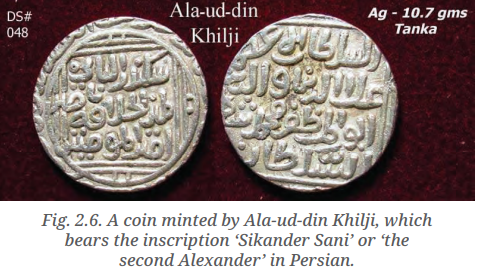
Answer:
Ala-ud-din Khilji called himself 'the second Alexander' to project himself as a great conqueror. Alexander the Great was known for his vast conquests, and by adopting this title, Khilji sought to associate himself with this legacy of military might and territorial expansion. It was a way to legitimize his rule and boast of his achievements, particularly his successful military campaigns in north and central India and his repulsion of Mongol invasions.
Q2. What kind of resources do you think were needed to maintain an army and wage war in those days? Discuss in groups the various types of expenditure involved, from weapons or food for soldiers to animals used in warfare, road construction, etc.
Answer:
Maintaining an army and waging war in those days required substantial resources, including:
- Weapons and Equipment: Swords, spears, shields, bows and arrows, cannons, gunpowder, and armour.
- Food and Supplies: Large quantities of grain and food for soldiers, and fodder for horses, camels, and elephants.
- Animals: Horses (often imported), camels, and elephants for transport and combat.
- Logistics and Infrastructure: Building and maintaining roads for troop movement, bridges, and supply depots.
- Pay and Maintenance: Salaries for soldiers, officers, and support staff, and maintenance of forts and military outposts.
- Naval Resources: For coastal campaigns, ships and naval equipment were needed.
Q3. Why do you think such locations were chosen for many of the medieval forts? Discuss pros and cons. (Hint: think of issues of strategy, security, vulnerability, etc.)
Answer:
Medieval forts were often built on hilltops or in strategically important locations.
Reasons for choosing such locations:
- Strategic Advantage: Elevated positions provided a clear view of the surrounding area, allowing for early warning of approaching enemies.
- Defense: Steep slopes made it difficult for invading armies to attack, and natural barriers like rivers or forests added to the defenses.
- Security: Hilltops were easier to defend with a smaller garrison, as attackers had to struggle uphill.
- Control of Routes: Forts near passes or river crossings could control trade routes and movement.
Pros: Easy to defend, good vantage point, strategic control of region.
Cons: Difficult to access for supplies and water, vulnerable to sieges (cut off from outside help), uncomfortable for inhabitants in harsh weather.
Q4. In Fig. 2.14, what elements do you observe? What do they tell you about life then? (Hint: observe the weapons, the animals, the activities.)
Answer:
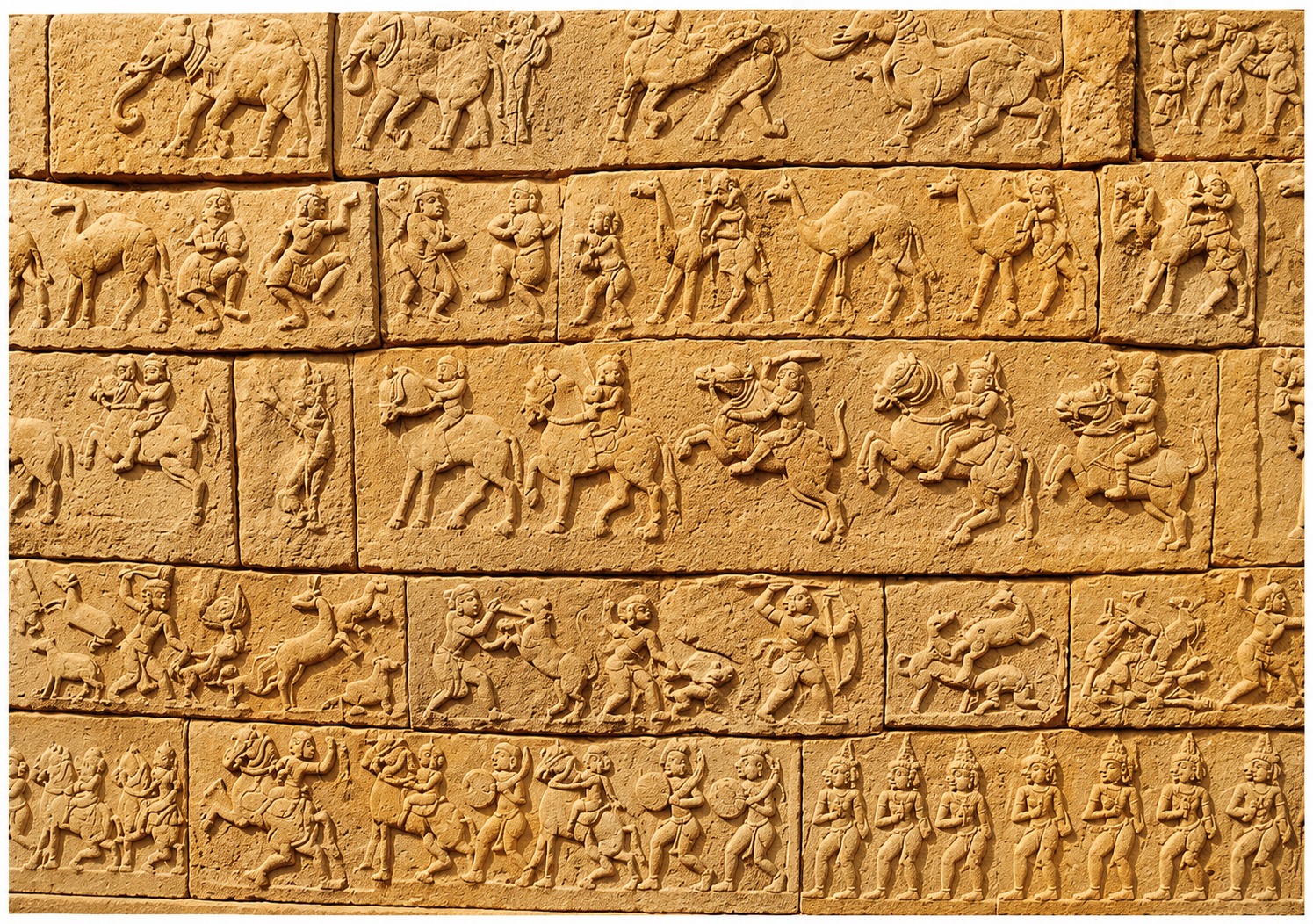
The panel from the Vitthala temple at Hampi depicts various elements:
- Weapons: Swords, shields, and other weapons suggest a martial culture and the importance of military prowess.
- Animals: Elephants and horses indicate their use in warfare, processions, and transport.
- Activities: Figures in various postures, possibly dancing or fighting, suggest the integration of art, music, and dance with daily life and temple rituals.
These elements tell us that life in Vijayanagara was vibrant, with a strong martial tradition, the importance of temple culture, and a thriving artistic and social life.
Q5. Discuss in class how the paik system affected the daily lives of the people in the Ahom kingdom, both in terms of challenges and benefits, and helped the king manage both the army and the economy.
Answer:
Benefits of the Paik System:
- It provided a large labour force for public works (roads, irrigation) and military service.
- It allowed the king to maintain a large standing force without a permanent army, as men were called upon when needed.
- It integrated the population into the state's administrative and military structure.
Challenges:
- It placed a heavy burden on able-bodied men, who had to provide labour or military service regularly.
- It could disrupt agricultural production when men were called away for service.
- It created a system of obligation that could be exploited by officials.
How it helped the king: The system ensured a ready supply of labour and soldiers, allowed for efficient management of the economy and defense, and strengthened the king's control over his subjects.
Q6. How did the Ahoms use the rivers, hills and forests of Assam to their advantage? Can you think of ways in which the geography helped them build defences and fight wars?
Answer:
The Ahoms used the geography of Assam to their advantage in several ways:
- Rivers: They used the Brahmaputra and its tributaries for water transport and naval battles. They built boats and used their knowledge of the river's currents and channels against the Mughal forces.
- Hills and Forests: The dense forests and hilly terrain provided natural cover for guerrilla warfare. The Ahoms used their knowledge of the terrain to launch surprise attacks and ambushes, as seen in the Battle of Saraighat.
- Defensive Structures: They built forts and defensive positions in strategic locations, using natural barriers like rivers and hills to strengthen their defenses.
Q7. Why do you think Guru Tegh Bahadur endured torture rather than convert? Why did he think his sacrifice would make a difference? What values did the Sikh Gurus and the Khalsa embody? How are they relevant in today's world?
Answer:
Guru Tegh Bahadur endured torture rather than convert because he believed in the principles of religious freedom and the right to practice one's faith. He chose martyrdom to protect the rights of others, including the Kashmiri Pandits who sought his protection. He believed his sacrifice would inspire others to stand up against injustice and oppression, demonstrating the power of faith and conviction.
The Sikh Gurus and the Khalsa embodied values of equality, justice, compassion, selfless service (seva), and the defense of the weak against tyranny. These values are highly relevant today as they remind us to stand up against discrimination, uphold human rights, and work for a more just and equitable society.
Think About It
Q1. Why do we use the term 'image' rather than common terms like 'idol' or 'icon'? The latter two terms are considered pejorative in the context of Judaism, Christianity and Islam, whose orthodox sects condemn 'idolatry' or the worship of 'idols' or 'icons'. India's classical texts used words like murti, vigraha, pratima, rupa, etc., to designate images, often statues, used for worship in temples or homes. In English, 'image' is a neutral term.
Answer:
The term 'image' is used because it is a neutral and respectful term, unlike 'idol' or 'icon', which can carry negative connotations for those who do not practice image worship. In many religious traditions, including Hinduism, Jainism, and Buddhism, these images are not worshipped as gods themselves but are considered representations of the divine, used as focal points for devotion. Using a neutral term like 'image' respects the beliefs and practices of these traditions and avoids the pejorative implications of terms like 'idolatry'.
Q2. During the time of the Tughlaqs, the Musunuri Nayakas, Telugu chieftains, rallied over 75 more chieftains of the region, formed a confederacy that defeated the Delhi Sultanate forces, and expelled Muhammad bin Tughlaq's army from Warangal (present-day Telangana) around 1330-1336. Do you think it would have been an easy task to bring together 75 leaders in those days?
Answer:
No, it would not have been an easy task to bring together 75 leaders in those days. It would have required:
- Diplomatic Skill: To convince diverse chieftains with their own interests and rivalries to unite against a common enemy.
- Trust and Leadership: Establishing trust and a shared vision among the leaders, and a capable leader to coordinate their efforts.
- Logistical Challenges: Coordinating military strategies, resources, and communication across different regions.
- Overcoming Differences: Setting aside personal or regional differences to present a united front.
The fact that they succeeded demonstrates remarkable leadership and a powerful shared motivation to resist foreign domination.
Q3. Have you noticed the term pati in titles like 'Gajapati'? Pati means 'lord' or 'master' and was commonly used by many ruling dynasties of this period to signify power and stature. The Vijayanagara kings were called 'Narapati', the Bahmani Sultanate rulers 'Ashwapati', and the Maratha rulers 'Chhatrapati' — each title reflecting different aspects of kingship and power. Can you guess what these three terms might mean?
Answer:
- Narapati: 'Nara' means man or hero, so 'Narapati' means 'lord of men' or 'lord of heroes', signifying the king's authority over his people and warriors.
- Ashwapati: 'Ashwa' means horse, so 'Ashwapati' means 'lord of horses', highlighting the importance of cavalry and the king's military strength.
- Chhatrapati: 'Chhatra' means umbrella, a symbol of kingship and protection, so 'Chhatrapati' means 'lord of the umbrella' or 'paramount sovereign'.
Q4. What strikes you in Babur's impressions of India? Discuss in groups.
Answer:
Babur's impressions of India reveal a mix of nostalgia for Central Asia and recognition of India's wealth and potential. He found India lacking in charms (perhaps referring to the landscape and climate) but acknowledged its abundance of gold, silver, artisans, and workmen. This shows a conqueror's perspective—seeing the land for its resources and strategic value, rather than its cultural or aesthetic appeal. It also highlights the enduring attraction of India's wealth and skilled workforce for invaders from Central Asia.
Q5. Why do you think Akbar employed different strategies to expand his empire, while the earlier rulers of Delhi relied mostly on military might?
Answer:
Akbar employed different strategies because he recognized that military might alone was insufficient to create a stable and lasting empire. His strategies included:
- Political Alliances: Marriage alliances with Rajput princesses and integrating Rajput leaders into his court.
- Religious Tolerance: Abolishing the jizya tax, promoting sulh-i-kul (peace with all), and engaging in interfaith dialogues to win the support of his non-Muslim subjects.
- Administrative Reforms: Instituting the mansabdari system and efficient revenue collection to strengthen the state.
- Cultural Integration: Patronizing Indian art, architecture, and literature, and translating Sanskrit texts into Persian.
Unlike earlier Delhi sultans, who often relied on plunder and force, Akbar understood the importance of winning the loyalty of the diverse population of India for long-term stability.
Q6. We saw above that Delhi sultans' average reign lasted about nine years. This figure becomes 27 years in the case of Mughal emperors up to Aurangzeb; and 16 years if we consider all Mughal rulers, up to the end of the empire in the 19th century. What do you make of these numbers of years of reign?
Answer:
These numbers indicate:
- Delhi Sultanate (average 9 years): This shows extreme political instability, frequent violent successions, and the fragile nature of the Sultanate's power. Rulers were often overthrown or assassinated, preventing long-term consolidation.
- Mughal Emperors up to Aurangzeb (average 27 years): This indicates greater political stability and the establishment of a more durable empire. The Mughals were able to create a more effective administrative system and secure loyalty from various regional powers.
- All Mughal Rulers (average 16 years): The decline after Aurangzeb brought back instability, reducing the average reign length. This reflects the weakening of the empire, with later rulers facing rebellions and external threats.
Q7. In his last letters to two of his sons, Aurangzeb wrote, "I came alone and am going away alone. I know not who I am and what I have been doing. ... I have not done well for the country and the people, and of the future there is no hope. I was helpless [in life] and I am departing helpless." What do these words tell us about Aurangzeb? How do you feel about them?
Answer:
These words reveal Aurangzeb's deep regret and despair at the end of his life. Despite his long reign and military conquests, he acknowledges that he has failed in his duty to the country and its people. It suggests a man who, despite his accomplishments, felt a profound sense of emptiness and failure. This is a poignant reminder of the human cost of power and the futility of conquest. It evokes a sense of empathy, even for a ruler known for his religious intolerance, as it shows the vulnerability and loneliness that can accompany a life spent in pursuit of power.
Q8. Some of the invaders and rulers mentioned above committed terrible deeds and atrocities. Many more could have been mentioned. As the 'Note on History's Darker Chapters' on page 20 makes clear, we must keep in mind that this is about people in the past, not people of today. We need to know the facts of the past, and the victims of these atrocities deserve our respect and remembrance. But it is important to keep in mind that we, today, bear no responsibility for actions of individuals hundreds of years ago.
Answer:
This is an important note on historical perspective. It reminds us that:
- We must acknowledge the dark chapters of history, including atrocities committed by both invaders and rulers.
- We should not judge or hold modern people responsible for the actions of their ancestors.
- We should study history to learn from it, to honor the victims, and to strive for a more just and tolerant future.
- It is important to avoid using historical grievances to fuel contemporary hatred or division.
Don't Miss Out
Q1. The sculpture in Fig. 2.9 narrates the story behind the Hoysalas' emblem. Kannada folklore recounts the story of Sala, a young man who fought a lion to save his guru, giving the dynasty its name — 'Hoy (strike)! Sala'. 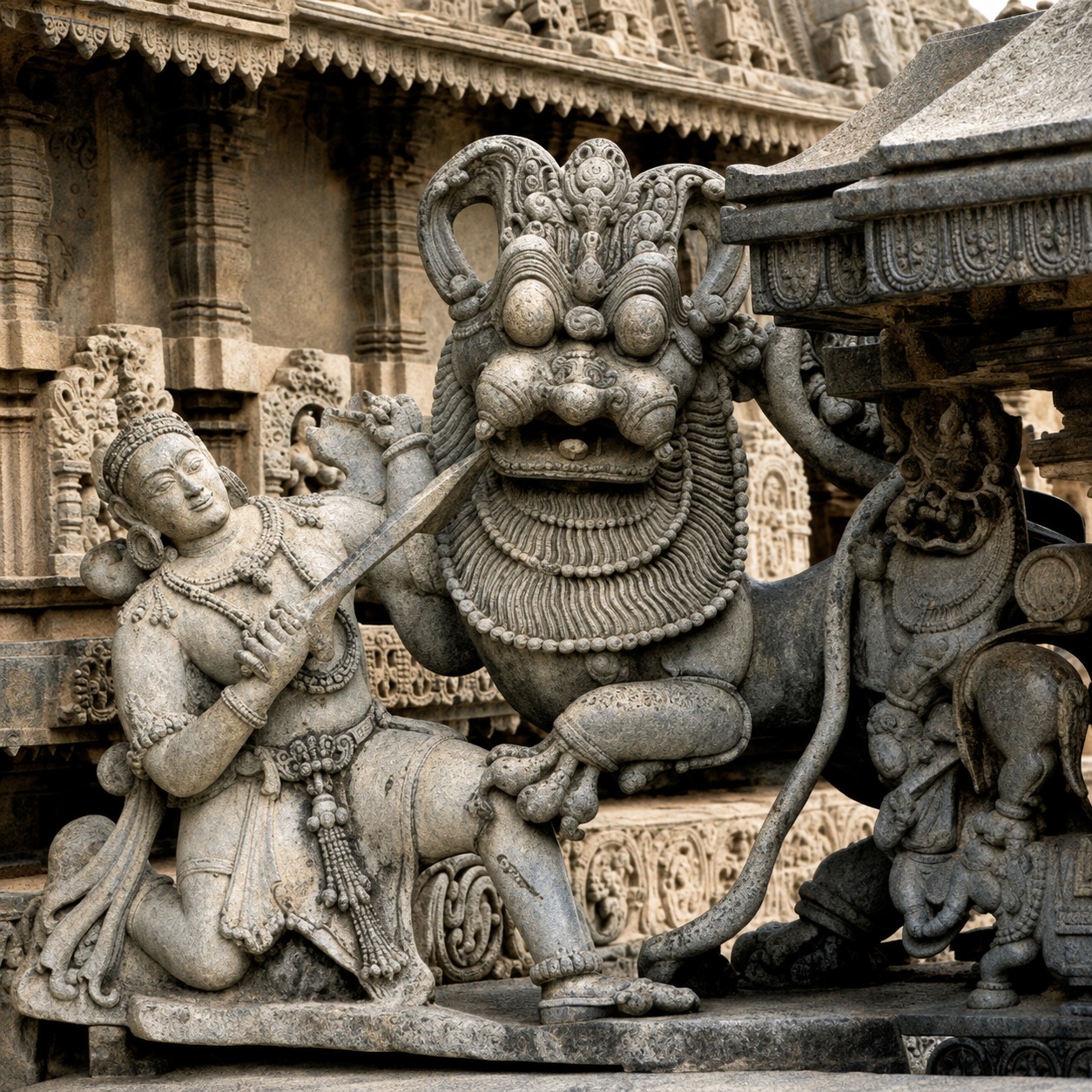
Answer:
This story highlights the origins of the Hoysala dynasty's name. 'Hoy!' was the command given to Sala by his guru to strike the lion. This act of bravery and devotion became the defining symbol of the dynasty, emphasizing their martial prowess and loyalty to their spiritual guides.
Q2. Kumbhalgarh Fort (Fig. 2.10) was built by Rana Kumbha in the 15th century in the Aravalli hills and served as a stronghold for the rulers of Mewar, a prominent Rajput kingdom (in the central and southern parts of today's Rajasthan). Surrounded by forests and steep slopes, it is famous for its massive 36-kilometre-long wall, one of the longest continuous walls in the world. 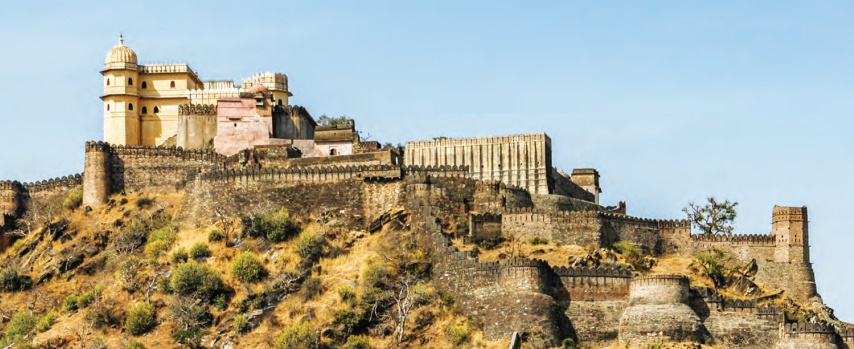
Answer:
Kumbhalgarh Fort is a testament to Rajput military architecture and strategy. Its massive wall, built on a hilly terrain, made it extremely difficult to conquer. It served as a symbol of Mewar's resistance and resilience against invaders. The fort's location and design exemplify how geography and engineering were used for defense.
Q3. According to popular folklore, Harihara and Bukka witnessed a remarkable sight at Hampi (in present-day Karnataka) — a hare turning around and chasing a pack of hounds, symbolising unexpected strength and courage. When they recounted this incident to their guru, Vidyaranya, he interpreted it as a symbol of resilience and bravery, and advised them to establish their capital at that very spot.
Answer:
This folklore signifies the founding of Vijayanagara and the symbolic meaning behind it. The hare chasing hounds represented the unexpected strength and courage that the empire would embody. The guru's interpretation was a divine sign, and the location at Hampi was chosen as the site for their capital, which would go on to become a great centre of power and culture.
Q5. Do you know what the Gurudwara Sis Ganj Sahib in Chandni Chowk — the famous shopping area in Delhi — signifies? In Sikhism, a gurudwara is a place of worship. This one marks the site where Guru Tegh Bahadur, the ninth Sikh Guru, was beheaded by Aurangzeb in 1675. This historic Gurudwara is uniquely honoured by the Sikh Regiment, which has saluted it before the President in the Republic Day parade each year since 1979. It stands as a powerful symbol of faith and sacrifice in Indian history.
Answer:
Gurudwara Sis Ganj Sahib commemorates the martyrdom of Guru Tegh Bahadur. It is a powerful symbol of the Sikh principles of standing up against oppression and defending the freedom of faith. The honour given to it by the Sikh Regiment highlights the deep respect for this sacrifice in the Indian military and national consciousness, making it a significant site in Indian history.
Questions and Activities
Q1. Compare the political strategies of the Delhi Sultanate and the Mughals. What similarities and differences existed between them?
Answer:
Similarities:
- Both empires were established through military conquest and relied on the sword to expand and maintain power.
- Both employed a centralized administrative system with the ruler at the apex.
- Both faced resistance from regional powers (Rajputs, etc.) and had to constantly deal with rebellions.
Differences:
- Religious Tolerance: The Delhi Sultanate was often characterized by religious intolerance (destruction of temples, jizya, etc.), while Akbar adopted a policy of religious tolerance and integration.
- Administrative System: The Mughals, under Akbar, implemented more sophisticated and effective administrative reforms (mansabdari system, revenue reforms) than the Sultanate's iqta system.
- Political Strategies: The Mughals used marriage alliances and diplomatic integration of regional leaders (like the Rajputs) to stabilize the empire, unlike the more confrontational approach of the Delhi Sultans.
Q2. Why did kingdoms like the Vijayanagara Empire and the Ahom Kingdom manage to resist conquest for a longer time compared to others? What geographical, military, and social factors contributed to their success?
Answer:
Vijayanagara Empire:
- Geographical: The Deccan plateau and the Tungabhadra river provided natural defenses.
- Military: A strong and well-equipped army, effective use of cavalry, and fortifications.
- Social: A prosperous economy based on trade and agriculture, and a sense of cultural and regional identity.
Ahom Kingdom:
- Geographical: The dense forests, hills, and the Brahmaputra river provided natural defenses and facilitated guerrilla warfare.
- Military: The paik system provided a large labour and military force without a permanent army. Knowledge of the terrain and effective use of riverine warfare were key.
- Social: A strong sense of local identity, assimilation of local cultures, and a well-organized administration.
Q3. Imagine you are a scholar in the court of Akbar or Krishnadevaraya. Write a letter to a friend describing the politics, trade, culture, and society you are witnessing.
Answer:
This is a creative writing activity. For example, a letter from the court of Krishnadevaraya could include:
- Politics: Describing the king's power, his conquests, and his patronage of scholars and poets.
- Trade: Describing the bustling markets of Vijayanagara, with Portuguese traders, imported horses, and the export of textiles and spices.
- Culture: Describing the magnificent temples, the vibrant music, dance, and festivals.
- Society: Describing the prosperity, the diversity of people, and the king's benevolent rule.
Q4. How come Akbar, a ruthless conqueror in his young days, grew tolerant and benevolent after some years? What could have led to such a change?
Answer:
Akbar's transformation could have been influenced by several factors:
- Exposure to Diversity: His interactions with people of different faiths, including his Rajput wives and courtiers, and the influence of Sufi saints, may have broadened his worldview.
- Political Pragmatism: He realized that a policy of tolerance was more effective for ruling a diverse empire than force and repression.
- Intellectual Curiosity: His interest in various religious and philosophical traditions, including his discussions with scholars, may have led him to question his previous beliefs.
- Guided by Advisors: His courtiers and intellectuals, like Abul Fazl, may have shaped his policies towards greater tolerance.
Q5. What might have happened if the Vijayanagara Empire had won the Battle of Talikota? Imagine and describe how it could have changed the political and cultural history of south India.
Answer:
If Vijayanagara had won the Battle of Talikota:
- Political Impact: The empire would have maintained its dominance over the Deccan, preventing the fragmentation of the region and the rise of the Deccan Sultanates.
- Cultural Impact: Vijayanagara's patronage of art, architecture, music, and literature would have continued, potentially leading to an even richer cultural legacy. The temples and monuments of Hampi would have been preserved.
- Regional History: The Maratha Empire may not have risen to the same prominence, and the British colonial influence might have taken a different shape.
Q6. Many values promoted by early Sikhism, including equality, seva, and justice, remain relevant today. Select one of these values and discuss how it remains relevant in contemporary society.
Answer:
Equality: The Sikh emphasis on equality (no caste or gender discrimination) is highly relevant today. In a world still grappling with discrimination, this value promotes inclusivity and social justice. It encourages us to treat everyone with respect and dignity, regardless of their background.
Seva (Selfless Service): Seva remains crucial, as it encourages us to contribute to our communities. In an individualistic world, the concept of serving others selflessly fosters social cohesion and helps address issues like poverty and hunger. Langar (free community meal) is a practical example of this value in action.
Q7. Imagine you are a trader in a port city (Surat, Calicut or Hooghly). Describe the scenes you see as regards goods, people you trade with, movement of ships, etc.
Answer:
This is a creative writing activity. For example, a trader in Surat could describe:
- Goods: Piles of textiles (cotton, silk), spices (pepper, cardamom), and dyes, waiting to be loaded on ships.
- People: A bustling crowd of merchants from Arabia, Persia, and Southeast Asia, as well as local traders, craftsmen, and labourers.
- Ships: A busy port with ships of various sizes—large cargo ships from the Middle East and smaller coastal vessels—coming and going.
- Activity: Loading and unloading of goods, negotiations, and the sounds of commerce and languages mixing.