
In-text Questions
Q1. I am confused. What do we call the Indian government? Is it Union, Federal or Central?
Answer:
The Indian government can be called by all three names depending on the context. It is called the Union Government because the Constitution declares India as a 'Union of States'. It is called Federal because the Indian Union is based on the principles of federalism, with power divided between the central authority and constituent units. It is called the Central Government because it is the government at the centre that looks after subjects of national importance.
Q2. Though only 25 of the world's 193 countries have federal political systems, their citizens make up 40 per cent of the world's population. Most of the large countries of the world are federations. Can you notice an exception to this rule in this map?
Answer:
An exception to the rule that most large countries are federations is China. China is one of the largest countries in the world by area and population, but it is not a federal political system; it is a unitary system. Another exception could be Japan, which is a large country but has a unitary system of government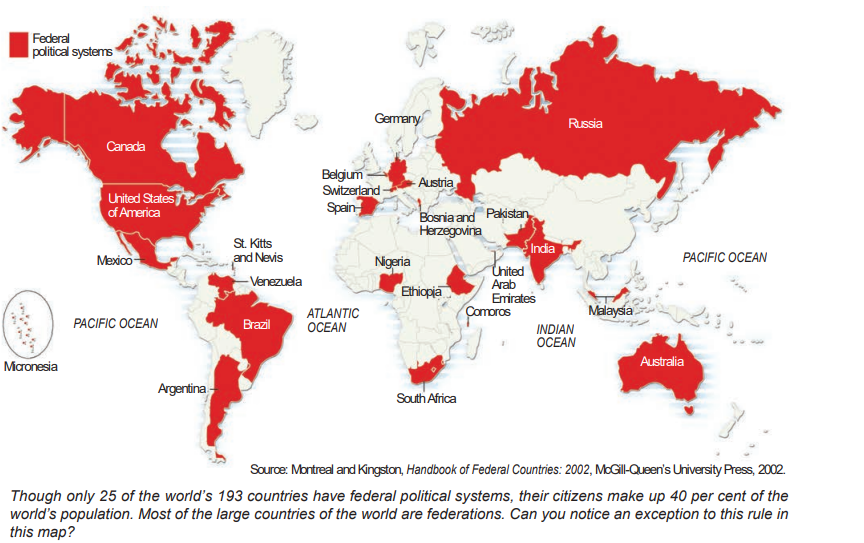
Q3. If federalism works only in big countries, why did Belgium adopt it?
Answer:
Belgium adopted federalism not because it is a big country, but because it faced serious linguistic and regional tensions between the Dutch-speaking and French-speaking communities. Federalism helped Belgium to accommodate regional diversity and share power between the central government and the regional governments, thereby preventing conflict and possible division of the country on linguistic lines. This shows that federalism is useful for managing diversity even in small countries.
Q4. Isn't that strange? Did our constitution makers not know about federalism? Or did they wish to avoid talking about it?
Answer:
Our constitution makers were fully aware of federalism. They deliberately chose not to use the word 'federation' because the Indian Union was not formed by independent states coming together on their own. Instead, India was formed by 'holding together' different regions and princely states. The Constitution declares India as a 'Union of States' to emphasise that the country is indivisible and that states do not have the right to secede. However, the Indian Union is based on the principles of federalism, with clear division of powers between the Union and State Governments.
Q5. Some Nepalese citizens were discussing the proposals on the adoption of federalism in their new constitution. This is what some of them said: If you were participating in this conversation, what would be your response to each of these? Which of these reflect a wrong understanding of what federalism is?
- Khag Raj: I don't like federalism. It would lead to reservation of seats for different caste groups as in India.
- Sarita: Ours is not a very big country. We don't need federalism.
- Babu Lal: I am hopeful that the Terai areas will get more autonomy if they get their own state government.
- Ram Ganesh: I like federalism because it will mean that powers that were earlier enjoyed by the king will now be exercised by our elected representatives.
Answer:
Response to Khag Raj: Federalism does not automatically lead to reservation of seats for caste groups. Reservation is a separate policy decision. Federalism is about sharing power between different levels of government. India's reservation system exists alongside federalism but is not a necessary consequence of it.
Response to Sarita: Federalism is not only for big countries. Belgium, a small country, adopted federalism to manage its linguistic and regional diversity. Even small countries can benefit from federalism if they have regional or cultural diversity that needs accommodation.
Response to Babu Lal: This is a correct understanding. Federalism does give more autonomy to regional governments, which can address the specific needs of areas like the Terai.
Response to Ram Ganesh: This is also a correct understanding. Federalism transfers power from a centralised authority (like a king) to elected representatives at different levels, deepening democracy.
Wrong understanding: Khag Raj and Sarita reflect a wrong understanding of federalism. Khag Raj wrongly associates federalism with caste-based reservation, and Sarita wrongly believes federalism is only for big countries.
Q6. If agriculture and commerce are state subjects, why do we have ministers of agriculture and commerce in the Union cabinet?
Answer:
Agriculture and commerce are indeed State subjects, meaning State Governments alone can make laws on them. However, the Union Government has ministers for agriculture and commerce because:
- The Union Government coordinates and formulates national policies on agriculture and commerce.
- It provides financial assistance and technical support to States.
- It represents India in international trade negotiations and agreements related to commerce and agriculture.
- It manages inter-state trade and commerce, which falls under the Union List.
Thus, while States have legislative power over agriculture and commerce, the Union Government plays a coordinating and policy-making role.
Q7. Pokharan, the place where India conducted its nuclear tests, lies in Rajasthan. Suppose the Government of Rajasthan was opposed to the Central Government's nuclear policy, could it prevent the Government of India from conducting the nuclear tests?
Answer:
No, the Government of Rajasthan could not prevent the Government of India from conducting nuclear tests at Pokharan. Defence of the country is a subject in the Union List, which means only the Union Government can make laws on it. Nuclear policy and defence are matters of national importance and fall under the exclusive jurisdiction of the Central Government. State Governments cannot interfere in such matters.
Q8. Suppose the Government of Sikkim plans to introduce new textbooks in its schools. But the Union Government does not like the style and content of the new textbooks. In that case, does the state government need to take permission from the Union Government before these textbooks can be launched?
Answer:
Education is a subject in the Concurrent List, which means both the Union and State Governments can make laws on it. If there is a conflict between the laws made by the Union and the State, the law made by the Union Government prevails. However, the State Government does not need to take permission from the Union Government before launching new textbooks. The State can proceed unless there is a specific Union law that conflicts with the State's decision. In case of a dispute, the courts would decide.
Q9. Suppose the Chief Ministers of Andhra Pradesh, Chhattisgarh and Orissa have different policies on how their state police should respond to the naxalites. Can the Prime Minister of India intervene and pass an order that all the Chief Ministers will have to obey?
Answer:
No, the Prime Minister cannot pass an order that all Chief Ministers must obey regarding state police. Police is a subject in the State List, which means State Governments alone can make laws on it. The Union Government cannot order the State Governments on matters in the State List. However, the Union Government can coordinate with States, provide central forces if requested, and formulate national policies to deal with internal security, but it cannot directly order the State police.
Q10. Has your village/town/city remained under the same State since Independence? If not, what was the name of the earlier State?
Answer:
This is a personal response question. Students should find out from their parents or grandparents about the State their village, town or city was part of at the time of Independence. Many areas have been reorganised into new States since 1947. For example, areas that were part of Madras State are now in Tamil Nadu, Andhra Pradesh or Karnataka. Students should mention the earlier State name if it has changed.
Q11. Can you identify names of three States in 1947 that have been changed later?
Answer:
Three States whose names were changed after 1947 are:
- Madras State – renamed as Tamil Nadu in 1969.
- Mysore State – renamed as Karnataka in 1973.
- United Provinces – renamed as Uttar Pradesh in 1950.
Q12. Identify any three States which have been carved out of bigger States.
Answer:
Three States carved out of bigger States are:
- Jharkhand – carved out of Bihar in 2000.
- Chhattisgarh – carved out of Madhya Pradesh in 2000.
- Uttarakhand – carved out of Uttar Pradesh in 2000.
Q13. Why Hindi? Why not Bangla or Telugu?
Answer:
Hindi was identified as the official language of India because it is the mother tongue of the largest proportion of Indians (about 40 per cent). However, the Constitution did not give the status of national language to any one language. Hindi was chosen as the official language for communication between the Union Government and the States, but safeguards were provided to protect other languages. Besides Hindi, 21 other languages are recognised as Scheduled Languages. The use of English for official purposes was also allowed to continue after demands from non-Hindi speaking States.
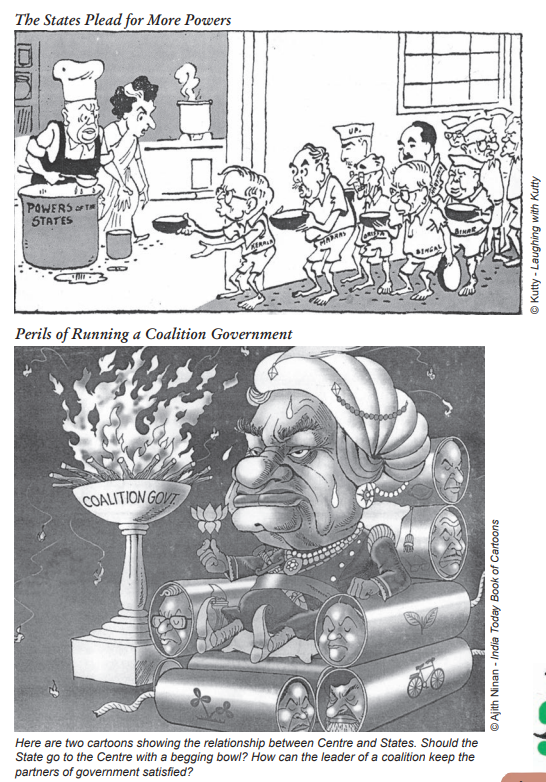
Q14. Here are two cartoons showing the relationship between Centre and States. Should the State go to the Centre with a begging bowl? How can the leader of a coalition keep the partners of government satisfied?
Answer:
The cartoons depict the unequal relationship between the Centre and States, where States often have to depend on the Centre for financial resources. States should not have to go to the Centre with a begging bowl; instead, there should be a fair and transparent devolution of funds to States as per the recommendations of the Finance Commission.
A leader of a coalition can keep partners satisfied by:
- Consulting coalition partners on important decisions.
- Sharing power and giving important portfolios to allies.
- Respecting the autonomy of regional parties.
- Adopting a common minimum programme that addresses the concerns of all partners.
Q15. Are you suggesting that regionalism is good for our democracy? Are you serious?
Answer:
Yes, regionalism can be good for democracy when it is expressed through democratic means. The rise of regional political parties and coalition governments after 1990 strengthened federalism in India by ensuring that States had a greater say in national politics. Regional parties represent the aspirations of their regions and check the dominance of national parties. This led to a new culture of power sharing and respect for the autonomy of State Governments. However, regionalism becomes harmful if it takes the form of separatism or violence.
Q16. So, we are like a three-tier coach in a train! I always prefer the lower berth!
Answer:
This humorous comment refers to the three tiers of government in India – the Union Government, the State Governments, and the local governments (Panchayats and Municipalities). The comment about preferring the 'lower berth' suggests that local governments are closest to the people and can be most effective in addressing local issues. The third tier of government is indeed the foundation of democracy at the grassroots level.
Q17. Prime Minister runs the country. Chief Minister runs the state. Logically, then, the chairperson of Zilla Parishad should run the district. Why does the D.M. or Collector administer the district?
Answer:
The District Magistrate (D.M.) or Collector is a civil servant appointed by the State Government to administer the district. The chairperson of the Zilla Parishad is an elected representative who heads the local government body. Both have different roles:
- Zilla Parishad chairperson: Heads the elected local government and looks after developmental activities, local planning and implementation of schemes.
- D.M./Collector: Is the administrative head of the district, responsible for law and order, revenue collection and coordination of government programmes.
The D.M. administers the district because the district administration is part of the State Government's executive machinery, while the Zilla Parishad is part of the local self-government system. Both work in coordination.
Q18. Read the following excerpts from an article by noted historian, Ramachandra Guha, that appeared in the Times of India on November 1, 2006: [Excerpts from the article] Take the example of your own state or any other state that was affected by linguistic reorganisation. Write a short note for or against the argument given by the author here on the basis of that example.
Answer:
This is an open-ended question. Students should write a short note based on their own state or any state affected by linguistic reorganisation. A guiding approach:
For the argument: Linguistic reorganisation has strengthened national unity by allowing people who speak the same language to live in the same State. This made administration easier and reduced conflicts. For example, the creation of Andhra Pradesh (1953) for Telugu speakers, Tamil Nadu for Tamil speakers, and Karnataka for Kannada speakers helped accommodate linguistic diversity peacefully.
Against the argument: Some may argue that linguistic reorganisation increased linguistic consciousness and regionalism, which could weaken national unity. However, the overall experience has shown that linguistic States made the country more united by addressing regional aspirations within a democratic framework.
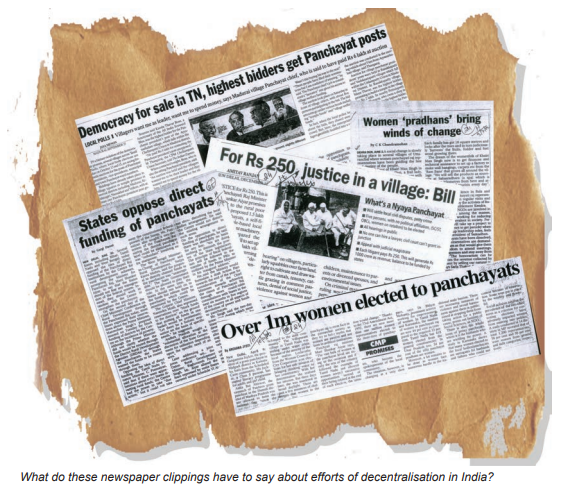
Q19. What do these newspaper clippings have to say about efforts of decentralisation in India?
Answer:
The newspaper clippings likely highlight various efforts and challenges related to decentralisation in India, such as:
- Elections to local bodies being held regularly.
- Reservation of seats for Scheduled Castes, Scheduled Tribes, Other Backward Classes and women in local government bodies.
- Devolution of powers and resources to local governments by State Governments.
- Difficulties in implementing decentralisation, such as irregular gram sabha meetings and inadequate transfer of powers and resources.
Students should read the clippings carefully and summarise the key points about decentralisation efforts mentioned in them.
Exercises
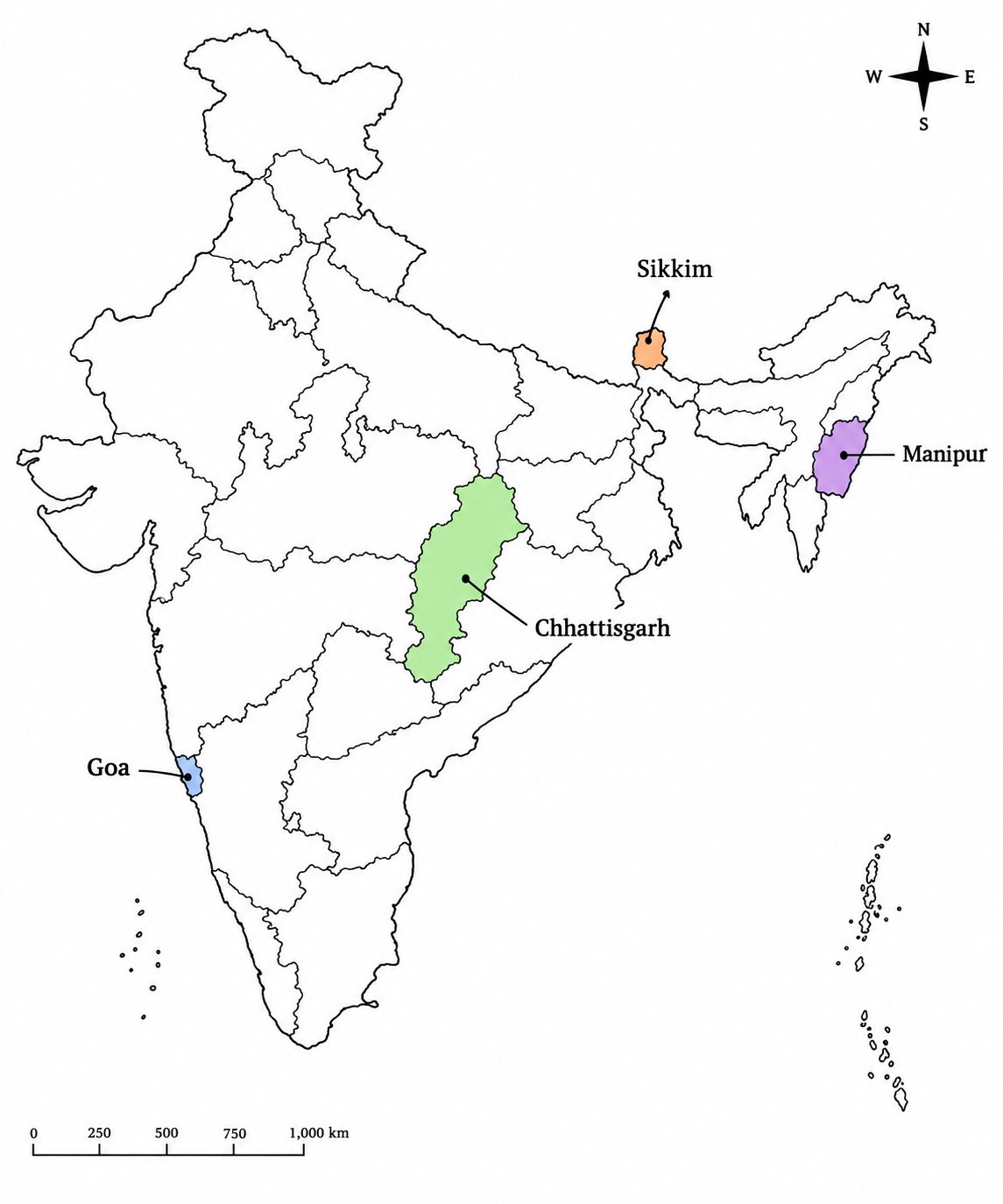
Q1. Locate the following States on a blank outline political map of India: Manipur, Sikkim, Chhattisgarh and Goa.
Answer:
Students should locate the following States on a blank outline political map of India:
- Manipur – in the north-eastern part of India, bordered by Nagaland, Mizoram and Assam.
- Sikkim – in the north-eastern Himalayas, bordered by Nepal, Tibet, Bhutan and West Bengal.
- Chhattisgarh – in central India, carved out of Madhya Pradesh, bordered by Madhya Pradesh, Maharashtra, Telangana, Andhra Pradesh, Odisha and Jharkhand.
- Goa – on the western coast of India, bordered by Maharashtra and Karnataka.
Q2. Identify and shade three federal countries (other than India) on a blank outline political map of the world.
Answer:
Students should identify and shade three federal countries (other than India) on a blank outline political map of the world. Examples of federal countries include:
- United States of America – in North America.
- Switzerland – in Europe.
- Australia – in Oceania.
Other examples include Canada, Brazil, Germany, Belgium, Malaysia, Nigeria, South Africa, etc.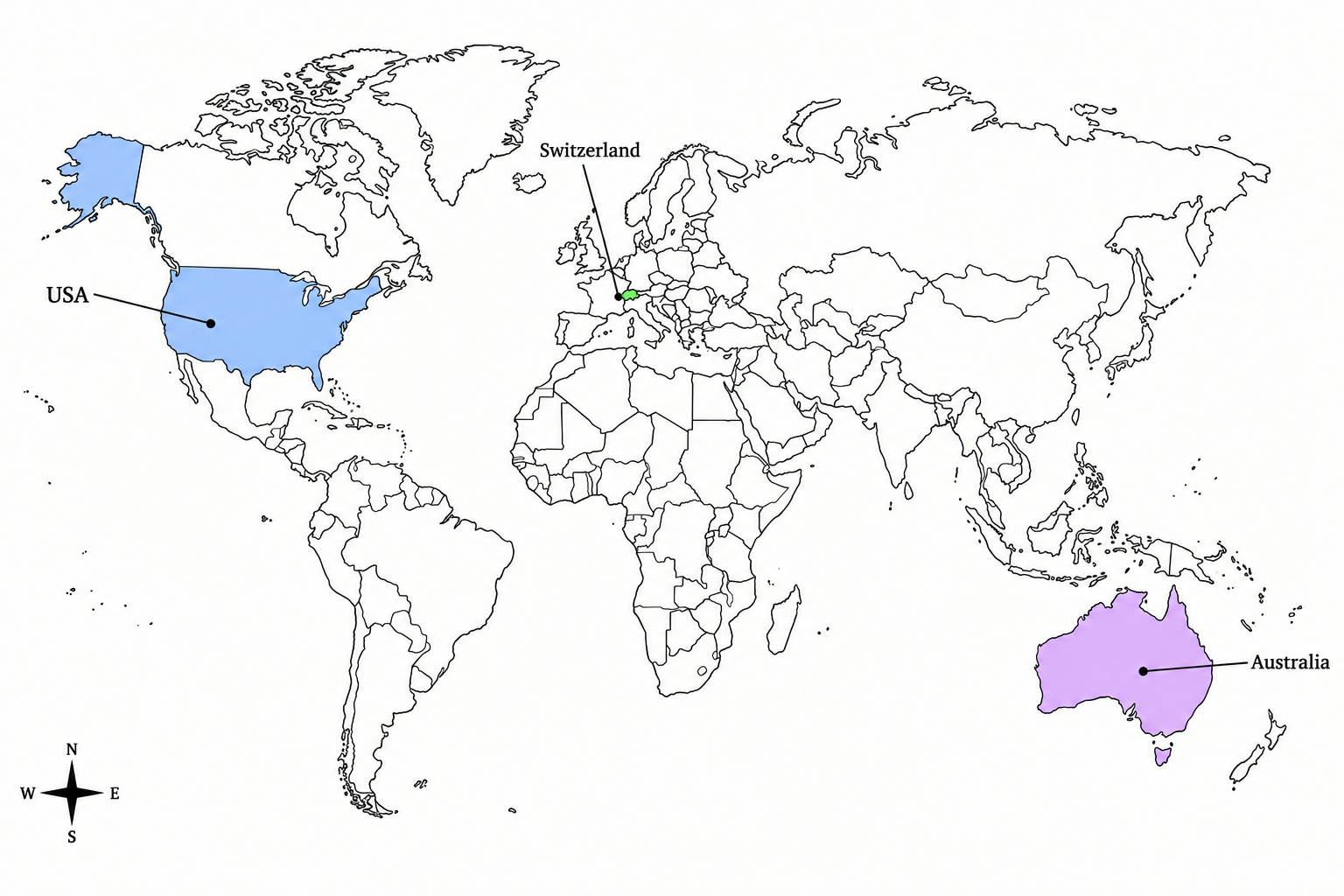
Q3. Point out one feature in the practice of federalism in India that is similar to and one feature that is different from that of Belgium.
Answer:
Similar feature: Both India and Belgium have a federal system where power is shared between the central government and regional governments. In both countries, the Constitution provides for division of powers between different levels of government.
Different feature: In Belgium, the Constitution prescribes that the number of Dutch and French-speaking ministers shall be equal in the central government, and there is a separate 'community government' elected by people belonging to one language community. In India, there is no such provision for equal representation of linguistic communities in the central government. India has a three-tier federal system with Union, State and local governments, while Belgium has a different arrangement with community governments.
Q4. What is the main difference between a federal form of government and a unitary one? Explain with an example.
Answer:
The main difference between a federal and unitary form of government is the way power is distributed:
- Federal government: Power is divided between a central authority and various constituent units (states/provinces). Both levels of government enjoy their power independently of each other. The central government cannot order the state government to do something. Example: India, USA, Australia.
- Unitary government: Either there is only one level of government or the sub-units are subordinate to the central government. The central government can pass on orders to the provincial or local government. Example: Sri Lanka, China, Japan.
In India, the Union Government and State Governments have separate jurisdictions, and State Governments are not answerable to the Union Government for matters in the State List. In Sri Lanka, the national government has all the powers, and provincial governments are subordinate to it.
Q5. State any two differences between the local government before and after the Constitutional amendment in 1992.
Answer:
Two differences between local government before and after the Constitutional amendment in 1992 are:
| Before 1992 | After 1992 |
|---|---|
| Elections to local government bodies were not held regularly. | It is now constitutionally mandatory to hold regular elections to local government bodies. |
| Local governments did not have any powers or resources of their own; they were directly under the control of State Governments. | Seats are reserved for Scheduled Castes, Scheduled Tribes, Other Backward Classes and at least one-third of positions are reserved for women. State Governments are required to share some powers and revenue with local government bodies. |
Q6. Fill in the blanks: Since the United States is a ___________________ type of federation, all the constituent States have equal powers and States are ______________ vis-à-vis the federal government. But India is a _____________________ type of federation and some States have more power than others. In India, the ____________ government has more powers.
Answer:
Since the United States is a coming together type of federation, all the constituent States have equal powers and States are strong vis-à-vis the federal government. But India is a holding together type of federation and some States have more power than others. In India, the Central (Union) government has more powers.
Q7. Here are three reactions to the language policy followed in India. Give an argument and an example to support any of these positions.
- Sangeeta: The policy of accommodation has strengthened national unity.
- Arman: Language-based States have divided us by making everyone conscious of their language.
- Harish: This policy has only helped to consolidate the dominance of English over all other languages.
Answer:
I support Sangeeta's position: The policy of accommodation has strengthened national unity.
Argument: India's language policy did not impose Hindi as the national language. Instead, it recognised 22 Scheduled Languages and allowed States to have their own official languages. The Central Government agreed to continue the use of English along with Hindi for official purposes, responding to the demands of non-Hindi speaking States. This flexibility and accommodation prevented linguistic conflicts and strengthened national unity.
Example: In Tamil Nadu, when the Central Government tried to impose Hindi in 1965, there were violent protests. The Central Government responded by agreeing to continue English for official purposes. This accommodation prevented the situation from escalating into a larger conflict, similar to what happened in Sri Lanka when Sinhala was imposed as the only official language. The formation of linguistic States like Tamil Nadu, Andhra Pradesh, Karnataka, etc., actually made the country more united and administration easier.
Q8. The distinguishing feature of a federal government is: (a) National government gives some powers to the provincial governments. (b) Power is distributed among the legislature, executive and judiciary. (c) Elected officials exercise supreme power in the government. (d) Governmental power is divided between different levels of government.
Answer:
The correct answer is (d) Governmental power is divided between different levels of government.
This is the defining feature of federalism. Option (a) describes a unitary system where the national government delegates powers to provincial governments. Option (b) describes horizontal distribution of power (separation of powers), not federalism. Option (c) describes democracy in general, not federalism specifically.
Q9. A few subjects in various Lists of the Indian Constitution are given here. Group them under the Union, State and Concurrent Lists as provided in the table below. A. Defence; B. Police; C. Agriculture; D. Education; E. Banking; F. Forests; G. Communications; H. Trade; I. Marriages
| Union List | State List | Concurrent List |
|---|---|---|
Answer:
| Union List | State List | Concurrent List |
|---|---|---|
| A. Defence | B. Police | D. Education |
| E. Banking | C. Agriculture | F. Forests |
| G. Communications | H. Trade | I. Marriages |
Q10. Examine the following pairs that give the level of government in India and the powers of the government at that level to make laws on the subjects mentioned against each. Which of the following pairs is not correctly matched? (a) State government — State List (b) Central government — Union List (c) Central and State governments — Concurrent List (d) Local governments — Residuary powers
Answer:
The pair that is not correctly matched is (d) Local governments — Residuary powers.
Residuary powers (subjects not mentioned in any of the three lists) are with the Union Government, not local governments. Local governments do not have residuary powers. Options (a), (b) and (c) are correctly matched.
Q11. Match List I with List II and select the correct answer using the codes given below the lists:
| List I | List II |
|---|---|
| 1. Union of India | A. Prime Minister |
| 2. State | B. Sarpanch |
| 3. Municipal Corporation | C. Governor |
| 4. Gram Panchayat | D. Mayor |
Answer:
The correct answer is (c) A C D B.
The correct matches are:
| List I | Correct Match |
|---|---|
| 1. Union of India | A. Prime Minister |
| 2. State | C. Governor |
| 3. Municipal Corporation | D. Mayor |
| 4. Gram Panchayat | B. Sarpanch |
Q12. Consider the following two statements. A. In a federation, the powers of the federal and provincial governments are clearly demarcated. B. India is a federation because the powers of the Union and State Governments are specified in the Constitution and they have exclusive jurisdiction on their respective subjects. C. Sri Lanka is a federation because the country is divided into provinces. D. India is no longer a federation because some powers of the States have been devolved to the local government bodies. Which of the statements given above are correct? (a) A, B and C (b) A, C and D (c) A and B only (d) B and C only
Answer:
The correct answer is (c) A and B only.
Statement A is correct: In a federation, powers of federal and provincial governments are clearly demarcated. Statement B is correct: India is a federation because powers of Union and State Governments are specified in the Constitution with exclusive jurisdiction on respective subjects. Statement C is incorrect: Sri Lanka is not a federation; it is a unitary system. Statement D is incorrect: India remains a federation; devolution of powers to local governments is an additional tier within the federal system, not a negation of federalism.