
In-text Questions
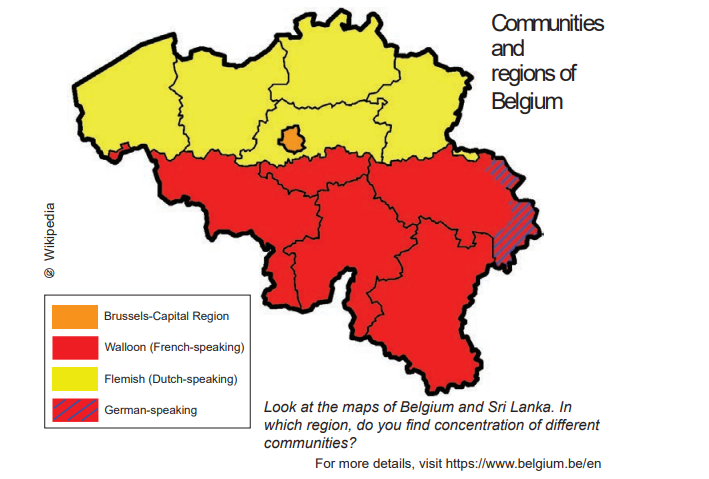
Q1. Look at the maps of Belgium and Sri Lanka. In which region, do you find concentration of different communities?
Answer:
In Belgium, the Flemish (Dutch-speaking) community is concentrated in the northern region, while the Walloon (French-speaking) community is concentrated in the southern region. The German-speaking community is concentrated in the eastern region. In Brussels, the capital, 80 per cent speak French and 20 per cent are Dutch-speaking.
In Sri Lanka, the Sinhalese are concentrated in most parts of the country, while Sri Lankan Tamils are concentrated in the northern and eastern parts of the country. Indian Tamils are concentrated in the central highlands region.
Q2. I have a simple equation in mind. Sharing power = dividing power = weakening the country. Why do we start by talking of this?
Answer:
We start by talking of this because it is a common misconception that sharing power weakens the country. The chapter aims to challenge this notion by showing through the examples of Belgium and Sri Lanka that sharing power actually strengthens the unity of the country, while refusing to share power can lead to conflict and even civil war.
Q3. What kind of a solution is this? I am glad our Constitution does not say which minister will come from which community.
Answer:
This comment refers to the Belgian model where the constitution prescribes that the number of Dutch and French-speaking ministers shall be equal in the central government. The speaker is expressing relief that the Indian Constitution does not make such specific provisions based on community for ministerial positions. However, India does have other power-sharing arrangements like reserved constituencies and federal division of power.
Q4. What’s wrong if the majority community rules? If Sinhalas don’t rule in Sri Lanka, where else will they rule?
Answer:
It is wrong if the majority community rules by disregarding the wishes and needs of the minority, as this amounts to majoritarianism. In Sri Lanka, the Sinhala majority adopted majoritarian measures that alienated the Tamil minority, leading to civil war. The majority community can rule, but it must do so while respecting the rights and interests of minorities. Power sharing ensures that the majority does not impose its will arbitrarily.
Q5. So you are saying that sharing of power makes us more powerful. Sounds odd! Let me think.
Answer:
Yes, sharing power makes a country more powerful in the sense that it strengthens national unity and political stability. When different communities and regions have a share in power, they feel included and have a stake in the system, which reduces conflict. A united country is stronger than one divided by internal strife.
Q6. In my school, the class monitor changes every month. Is that what you call a power sharing arrangement?
Answer:
Yes, rotating the position of class monitor every month is a form of power sharing. It ensures that power is not concentrated in one person and that different students get an opportunity to exercise leadership and responsibility. This reflects the democratic principle of sharing power among as many individuals as possible.
Q7. Annette studies in a Dutch medium school in the northern region of Belgium. Many French-speaking students in her school want the medium of instruction to be French. Selvi studies in a school in the northern region of Sri Lanka. All the students in her school are Tamil-speaking and they want the medium of instruction to be Tamil. If the parents of Annette and Selvi were to approach respective governments to realise the desire of the child who is more likely to succeed? And why?
Answer:
The parents of Annette are more likely to succeed. In Belgium, the power sharing arrangement includes a 'community government' elected by people belonging to one language community—Dutch, French and German-speaking—which has the power regarding cultural, educational and language-related issues. This government can address the demand for French medium instruction.
In Sri Lanka, however, the government adopted majoritarian measures, including recognising Sinhala as the only official language in 1956, disregarding Tamil. The Tamil-speaking students' demand for Tamil medium instruction is less likely to succeed because the Sri Lankan government has historically been insensitive to Tamil language and culture demands.
Q8. Here are some examples of power sharing. Which of the four types of power sharing do these represent? Who is sharing power with whom?
- The Bombay High Court ordered the Maharashtra State Government to immediately take action and improve living conditions for the 2,000-odd children at seven children’s homes in Mumbai.
- The government of Ontario state in Canada has agreed to a land claim settlement with the aboriginal community. The Minister responsible for Native Affairs announced that the government will work with aboriginal people in a spirit of mutual respect and cooperation.
- Russia’s two influential political parties, the Union of Right Forces and the Liberal Yabloko Movement, agreed to unite their organisations into a strong right-wing coalition. They propose to have a common list of candidates in the next parliamentary elections.
- The finance ministers of various states in Nigeria got together and demanded that the federal government declare its sources of income. They also wanted to know the formula by which the revenue is distributed to various State Governments.
Answer:
- Bombay High Court and Maharashtra State Government: This represents horizontal distribution of power among organs of government. The judiciary (High Court) is checking the functioning of the executive (State Government). Power is shared between the judiciary and the executive.
- Ontario state government and aboriginal community: This represents power sharing among different social groups. The government is sharing power with the aboriginal community by settling land claims and working in mutual respect. Power is shared between the government and the aboriginal community.
- Russian political parties forming a coalition: This represents power sharing among political parties. The two parties are sharing power by forming a coalition and having a common list of candidates. Power is shared between the two political parties.
- Finance ministers of Nigerian states and federal government: This represents vertical distribution of power among governments at different levels. The state governments are demanding transparency and a fair formula from the federal government regarding revenue distribution. Power is shared between the federal government and the state governments.
Questions in Between the Chapter
Q1. Can you help poor Vikram in answering Vetal? Vetal's question: "If you had the power to rewrite the rules in Lebanon, what would you do? Would you adopt the ‘regular’ rules followed everywhere, as Khalil suggests? Or stick to the old rules? Or do something else?"
Answer:
Vikram should answer that he would do something else—neither adopt the 'regular' rules as Khalil suggests nor stick entirely to the old rules. The old rules in Lebanon ensure power sharing among different communities and have maintained peace, but they are rigid and prevent a popular man like Khalil from contesting for the top post because he does not belong to the designated community.
A better approach would be to modify the rules to allow any qualified citizen to contest for any position, while retaining safeguards for minority representation. This would combine the democratic principle of open competition with the need for power sharing to maintain peace and stability. The Lebanese system should evolve to become more inclusive while preserving the spirit of accommodation that ended the civil war.
Exercises
Q1. What are the different forms of power sharing in modern democracies? Give an example of each of these.
Answer:
In modern democracies, power sharing arrangements can take the following forms:
- Horizontal distribution of power: Power is shared among different organs of government, such as the legislature, executive and judiciary. This system of checks and balances ensures that none of the organs can exercise unlimited power. Example: In India, the Parliament, the executive and the judiciary share power and check each other.
- Vertical distribution of power: Power is shared among governments at different levels – a general government for the entire country and governments at the provincial or regional level. Example: In India, power is shared between the Central or Union Government and the State Governments.
- Power sharing among different social groups: Power may be shared among religious and linguistic groups, or with socially weaker sections and women. Example: The 'community government' in Belgium, and the system of 'reserved constituencies' for Scheduled Castes and Scheduled Tribes in India.
- Power sharing among political parties, pressure groups and movements: Power is shared through competition among different parties, coalition governments, and influence of interest groups. Example: Coalition governments formed by two or more parties, such as in India.
Q2. State one prudential reason and one moral reason for power sharing with an example from the Indian context.
Answer:
Prudential reason: Power sharing helps to reduce the possibility of conflict between social groups and ensures the stability of political order. Example from India: The system of reserved constituencies for Scheduled Castes and Scheduled Tribes gives weaker sections a fair share in power, reducing their alienation and preventing social conflict.
Moral reason: Power sharing is the very spirit of democracy, as people have a right to be consulted on how they are governed. Example from India: The Panchayati Raj system gives people at the grassroots level a direct role in planning and implementing developmental schemes, ensuring their participation in governance.
Q3. After reading this chapter, three students drew different conclusions. Which of these do you agree with and why? Give your reasons in about 50 words.
- Thomman – Power sharing is necessary only in societies which have religious, linguistic or ethnic divisions.
- Mathayi – Power sharing is suitable only for big countries that have regional divisions.
- Ouseph – Every society needs some form of power sharing even if it is small or does not have social divisions.
Answer:
I agree with Ouseph. Power sharing is not merely a solution for societies with divisions; it is the very spirit of democracy. Every democratic society needs power sharing among organs of government, levels of government, and political parties to prevent concentration of power, ensure checks and balances, and give citizens a stake in the system. Even a small, homogeneous society benefits from such arrangements.
Q4. The Mayor of Merchtem, a town near Brussels in Belgium, has defended a ban on speaking French in the town’s schools. He said that the ban would help all non-Dutch speakers integrate in this Flemish town. Do you think that this measure is in keeping with the spirit of Belgium’s power sharing arrangements? Give your reasons in about 50 words.
Answer:
No, this measure is not in keeping with the spirit of Belgium’s power sharing arrangements. Belgium’s model is based on recognising and respecting linguistic and cultural diversity, with equal representation and community governments. Banning French in schools disregards the French-speaking community’s language rights and goes against the principle of accommodation and mutual respect that prevented conflict in Belgium.
Q5. Read the following passage and pick out any one of the prudential reasons for power sharing offered in this. “We need to give more power to the panchayats to realise the dream of Mahatma Gandhi and the hopes of the makers of our Constitution. Panchayati Raj establishes true democracy. It restores power to the only place where power belongs in a democracy – in the hands of the people. Giving power to Panchayats is also a way to reduce corruption and increase administrative efficiency. When people participate in the planning and implementation of developmental schemes, they would naturally exercise greater control over these schemes. This would eliminate the corrupt middlemen. Thus, Panchayati Raj will strengthen the foundations of our democracy.”
Answer:
One prudential reason from the passage is: Giving power to Panchayats is a way to reduce corruption and increase administrative efficiency. When people participate in planning and implementation of developmental schemes, they exercise greater control, which eliminates corrupt middlemen. This is a prudential reason because it is based on a careful calculation of gains—better outcomes in terms of reduced corruption and improved efficiency.
Q6. Different arguments are usually put forth in favour of and against power sharing. Identify those which are in favour of power sharing and select the answer using the codes given below? Power sharing: (a) A B D F (b) A C E F (c) A B D G (d) B C D G
- A. reduces conflict among different communities
- B. decreases the possibility of arbitrariness
- C. delays decision making process
- D. accommodates diversities
- E. increases instability and divisiveness
- F. promotes people’s participation in government
- G. undermines the unity of a country
Answer:
The correct answer is (a) A B D F.
Arguments in favour of power sharing are:
- A. reduces conflict among different communities
- B. decreases the possibility of arbitrariness
- D. accommodates diversities
- F. promotes people’s participation in government
Arguments C, E and G are against power sharing.
Q7. Consider the following statements about power sharing arrangements in Belgium and Sri Lanka. Which of the statements given above are correct? (a) A, B, C and D (b) A, B and D (c) C and D (d) B, C and D
- A. In Belgium, the Dutch-speaking majority people tried to impose their domination on the minority French-speaking community.
- B. In Sri Lanka, the policies of the government sought to ensure the dominance of the Sinhala-speaking majority.
- C. The Tamils in Sri Lanka demanded a federal arrangement of power sharing to protect their culture, language and equality of opportunity in education and jobs.
- D. The transformation of Belgium from unitary government to a federal one prevented a possible division of the country on linguistic lines.
Answer:
The correct answer is (d) B, C and D.
Statement A is incorrect because in Belgium, the Dutch-speaking majority did not try to impose their domination; instead, the Belgian leaders worked out an innovative power-sharing arrangement. Statements B, C and D are correct.
Q8. Match List I (forms of power sharing) with List II (forms of government) and select the correct answer using the codes given below in the lists:
| List I | List II |
|---|---|
| 1. Power shared among different organs of government | A. Community government |
| 2. Power shared among governments at different levels | B. Separation of powers |
| 3. Power shared by different social groups | C. Coalition government |
| 4. Power shared by two or more political parties | D. Federal government |
Answer:
The correct answer is (c) B D A C.
The correct matches are:
| List I | Correct Match |
|---|---|
| 1. Power shared among different organs of government | B. Separation of powers |
| 2. Power shared among governments at different levels | D. Federal government |
| 3. Power shared by different social groups | A. Community government |
| 4. Power shared by two or more political parties | C. Coalition government |
Q9. Consider the following two statements on power sharing and select the answer using the codes given below: Which of these statements are true and false? (a) A is true but B is false (b) Both A and B are true (c) Both A and B are false (d) A is false but B is true
- A. Power sharing is good for democracy.
- B. It helps to reduce the possibility of conflict between social groups.
Answer:
The correct answer is (b) Both A and B are true.
Power sharing is good for democracy because it is the very spirit of democracy and ensures that power is not concentrated in one hand. It also helps to reduce the possibility of conflict between social groups by giving all groups a stake in the system, ensuring stability of political order.