Understanding CUET Normalization and Percentile Calculation
- What Is CUET Normalization?
- Why Is Normalization Needed in CUET?
- What Is a CUET Percentile Score?
- How to Calculate CUET Percentile from Marks
- CUET Percentile vs Percentage: What Is the Difference?
- How CUET Normalized Score Is Calculated
- Step 1: Convert Raw Scores into Percentile Scores
- Step 2: Match Percentiles Across Shifts
- Step 3: Calculate the Normalized Score
- Can CUET Normalization Increase Your Marks?
- CUET Normalized Score Calculator: What Can You Calculate?
- Does a Higher Raw Score Always Mean a Higher Percentile?
- CUET UG 2026 Marking Scheme and Its Relation to Raw Scores
- Is Normalization Used in CUET PG?
- Key Points to Remember About CUET Normalization
- Frequently Asked Questions About CUET Normalization and Percentile
CUET UG can be conducted in multiple shifts for a subject. Since different shifts may contain different question papers, NTA uses a normalization procedure to make scores comparable across sessions. For CUET UG 2026, NTA states that the raw score of a candidate is normalized using the Equi-percentile method for subjects conducted in multiple shifts.
Understanding the difference between a raw score, percentile score and normalized score is important for students trying to estimate their CUET performance and understand their result.
What Is CUET Normalization?
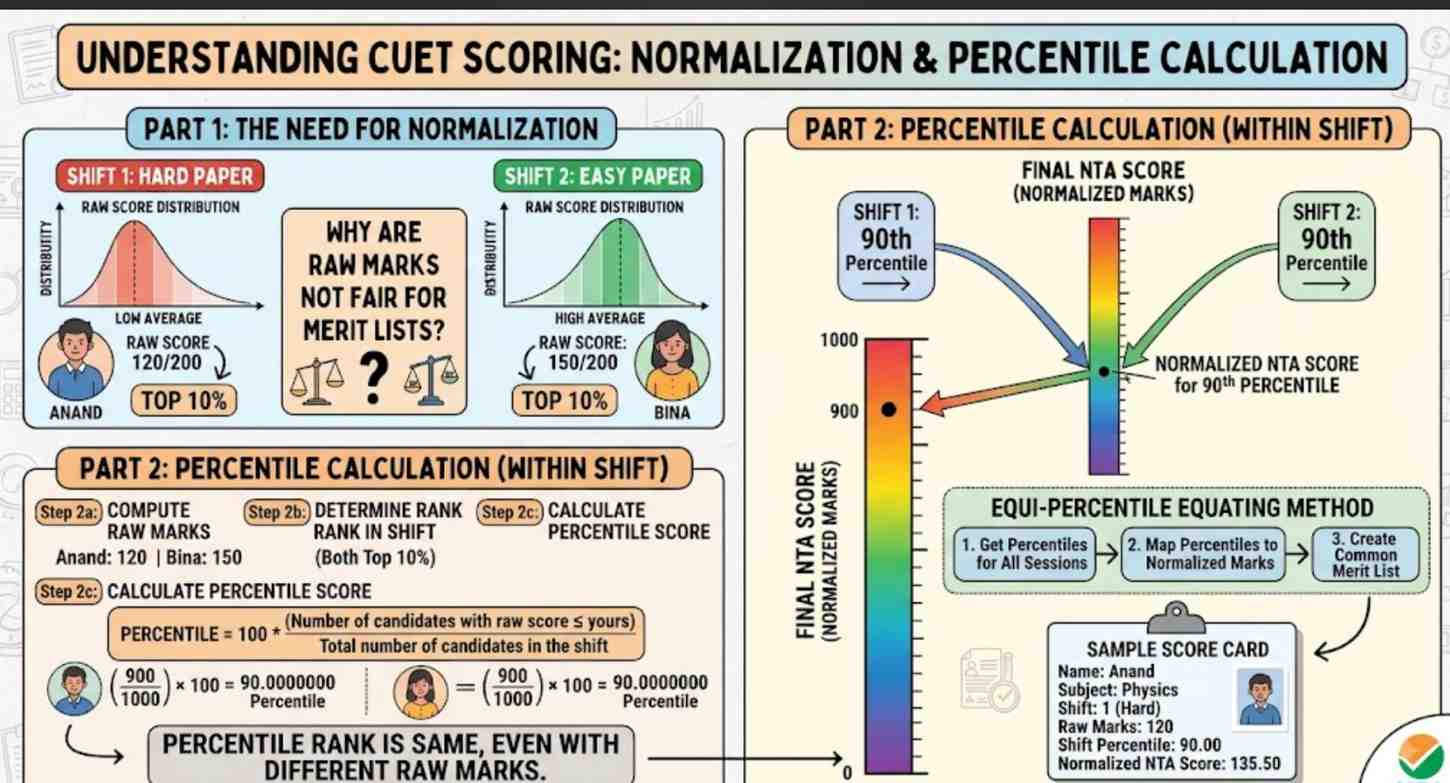
CUET normalization is the process used to make scores from different examination shifts comparable when the same subject is conducted in multiple sessions. NTA first converts raw marks into percentile scores separately for each shift and then uses those percentile values to bring scores from different sessions onto a comparable marks scale.
The purpose is not simply to add or subtract a fixed number of marks from candidates. The normalization process considers how candidates performed in their respective shifts and establishes equivalent marks across sessions.
Why Is Normalization Needed in CUET?
When a subject is conducted in multiple shifts, candidates may receive different question papers. Even when efforts are made to maintain comparable difficulty levels, the papers may not be exactly identical in difficulty. NTA therefore uses normalization so that candidates from different shifts can be compared on a common scale.
For CUET UG 2026, NTA states that normalization is carried out separately for each subject for which the examination is held in multiple shifts.
What Is a CUET Percentile Score?
A CUET percentile score indicates the relative position of a candidate within the candidates who appeared for the same subject in the same examination shift. It is different from a percentage of marks.
For CUET UG 2026, NTA calculates the percentile separately for each shift. If N is the number of candidates who appeared in a shift and m is the number of candidates in that shift whose raw scores are less than or equal to a candidate's raw score T, the percentile is calculated as:
CUET Percentile = (m ÷ N) × 100
This means the percentile depends on the candidate's relative position among candidates appearing in that particular shift, rather than simply being the percentage of marks obtained.
How to Calculate CUET Percentile from Marks
To understand how to calculate CUET percentile from marks, consider a simple example. Suppose 10,000 candidates appeared for a particular subject in your shift and 9,500 candidates scored less than or equal to your raw score. Your percentile would be:
(9,500 ÷ 10,000) × 100 = 95 percentile
This is only an illustrative calculation to explain the formula. NTA calculates the actual percentile using the candidate data from the relevant examination shift.
CUET Percentile vs Percentage: What Is the Difference?
| Term | Meaning |
|---|---|
| Raw Score | The marks obtained by a candidate according to the examination marking scheme before the multi-shift normalization process. |
| Percentage | The proportion of marks obtained out of the maximum possible marks, expressed as a percentage. |
| Percentile Score | A relative measure showing a candidate's position among candidates who appeared in the same shift for that subject. |
| Normalized Score | The score obtained after NTA uses the equi-percentile normalization procedure to make scores from different shifts comparable. |
How CUET Normalized Score Is Calculated
NTA describes the CUET UG normalization process in three broad steps. First, raw scores are converted into percentile scores separately for each shift. Second, the percentile values are brought back to the marks scale for each session, with missing values filled through linear interpolation where required. Third, the corresponding scores from the different sessions are used to calculate the normalized score.
Step 1: Convert Raw Scores into Percentile Scores
NTA first calculates percentile scores separately for each shift. Candidates within a shift are arranged according to their raw scores, and the number of candidates scoring less than or equal to a particular raw score is used in the percentile formula.
Step 2: Match Percentiles Across Shifts
The percentile data from different shifts is brought together. NTA then uses the percentile scale to identify equivalent marks across sessions. Where a corresponding raw score is not directly available for a percentile, the missing value is obtained through linear interpolation.
Step 3: Calculate the Normalized Score
For each percentile value, NTA obtains the corresponding raw-score values across the different sessions. The normalized score is calculated from these corresponding scores. In a two-session illustration in the official methodology, the normalized score is the average of the corresponding scores from the two sessions.
Can CUET Normalization Increase Your Marks?
CUET normalization can result in a normalized score that is higher or lower than a candidate's raw score. There is no fixed number of marks that every candidate gains or loses through normalization.
The final normalized score depends on the relationship between the candidate's percentile and the corresponding marks across the different examination sessions. Therefore, questions such as “How many marks can increase in normalization in CUET?” do not have one universal answer.
CUET Normalized Score Calculator: What Can You Calculate?
A CUET normalized score calculator can be useful for understanding the mathematics behind normalization, but an unofficial calculator cannot reproduce NTA's final result unless it has the complete shift-wise candidate data required for the official process.
Similarly, a simple CUET percentile calculator can estimate a percentile when the relevant number of candidates and the number scoring less than or equal to a particular score are known. The official CUET percentile, however, is calculated by NTA using the actual examination data for the relevant shift.
Does a Higher Raw Score Always Mean a Higher Percentile?
Within the same shift and subject, a higher raw score generally corresponds to a higher position in the ordered score distribution. However, comparing raw marks directly across different shifts is not appropriate when normalization is required. NTA first converts the shift-wise raw scores into percentile scores and then uses the equi-percentile process to establish comparable scores across sessions.
CUET UG 2026 Marking Scheme and Its Relation to Raw Scores
For CUET UG 2026, the NTA Information Bulletin states that a correct answer carries 5 marks and an incorrect answer attracts a negative marking of 1 mark. Each test paper has 50 compulsory questions and the duration for each test paper is 60 minutes. These marks form the basis for the raw score before the normalization procedure is applied where applicable.
| Component | CUET UG 2026 |
|---|---|
| Correct answer | +5 marks |
| Incorrect answer | -1 mark |
| Questions per test paper | 50 |
| Duration per test paper | 60 minutes |
| Exam mode | Computer Based Test (CBT) |
Is Normalization Used in CUET PG?
CUET UG and CUET PG should not be treated as having identical score-calculation procedures. The CUET UG 2026 Information Bulletin specifically describes its Equi-percentile normalization procedure for subjects conducted in multiple shifts. CUET PG has its own examination information and normalization provisions, so students preparing for CUET PG should refer to the applicable CUET PG information bulletin rather than assuming that the UG procedure automatically applies.
Key Points to Remember About CUET Normalization
- CUET percentile is not the same as percentage of marks.
- For CUET UG 2026, percentile scores are calculated separately for each shift.
- Normalization is relevant for subjects conducted in multiple shifts.
- NTA uses the Equi-percentile method for CUET UG 2026 multi-shift subjects.
- Normalization does not mean that every candidate receives a fixed increase or decrease in marks.
- Linear interpolation is used in the normalization process when corresponding marks are not directly available at a particular percentile.
- The final normalized score is calculated using the corresponding scores across examination sessions.
- Students should rely on the NTA score reported in their official result rather than trying to reproduce the final score using a simple marks-based calculator.
Frequently Asked Questions About CUET Normalization and Percentile
Frequently Asked Questions
How is CUET percentile calculated?
For CUET UG 2026, percentile is calculated separately for each shift. NTA uses the number of candidates in that shift whose raw scores are less than or equal to the candidate's score and divides it by the total number of candidates who appeared in that shift, then multiplies the result by 100.
How to calculate CUET percentile from marks?
You cannot determine the official CUET percentile from marks alone because the calculation also depends on the performance distribution of candidates in the relevant shift. NTA calculates percentile using the number of candidates scoring less than or equal to the candidate's raw score.
How to calculate normalized score in CUET?
For CUET UG 2026 multi-shift subjects, NTA first converts raw scores into shift-wise percentiles, then maps those percentiles back to the marks scale across sessions and uses the corresponding scores to calculate the normalized score. The procedure includes linear interpolation where necessary.
How many marks can increase in normalization in CUET?
There is no fixed number of marks that can increase through CUET normalization. The normalized score can be higher or lower than the raw score depending on the candidate's percentile and the corresponding scores across examination sessions.
Is CUET percentile the same as percentage?
No. Percentage represents marks obtained relative to the maximum possible marks, while percentile represents a candidate's relative position among candidates who appeared in the same shift for that subject.
Is there normalization in CUET PG?
CUET PG has its own examination and score-calculation provisions. Students preparing for CUET PG should refer to the applicable CUET PG information bulletin instead of assuming that the CUET UG normalization procedure applies unchanged. ([S3WaaS][1])