CUET 2027 Preparation Strategy From Zero: A Simple Roadmap for Beginners
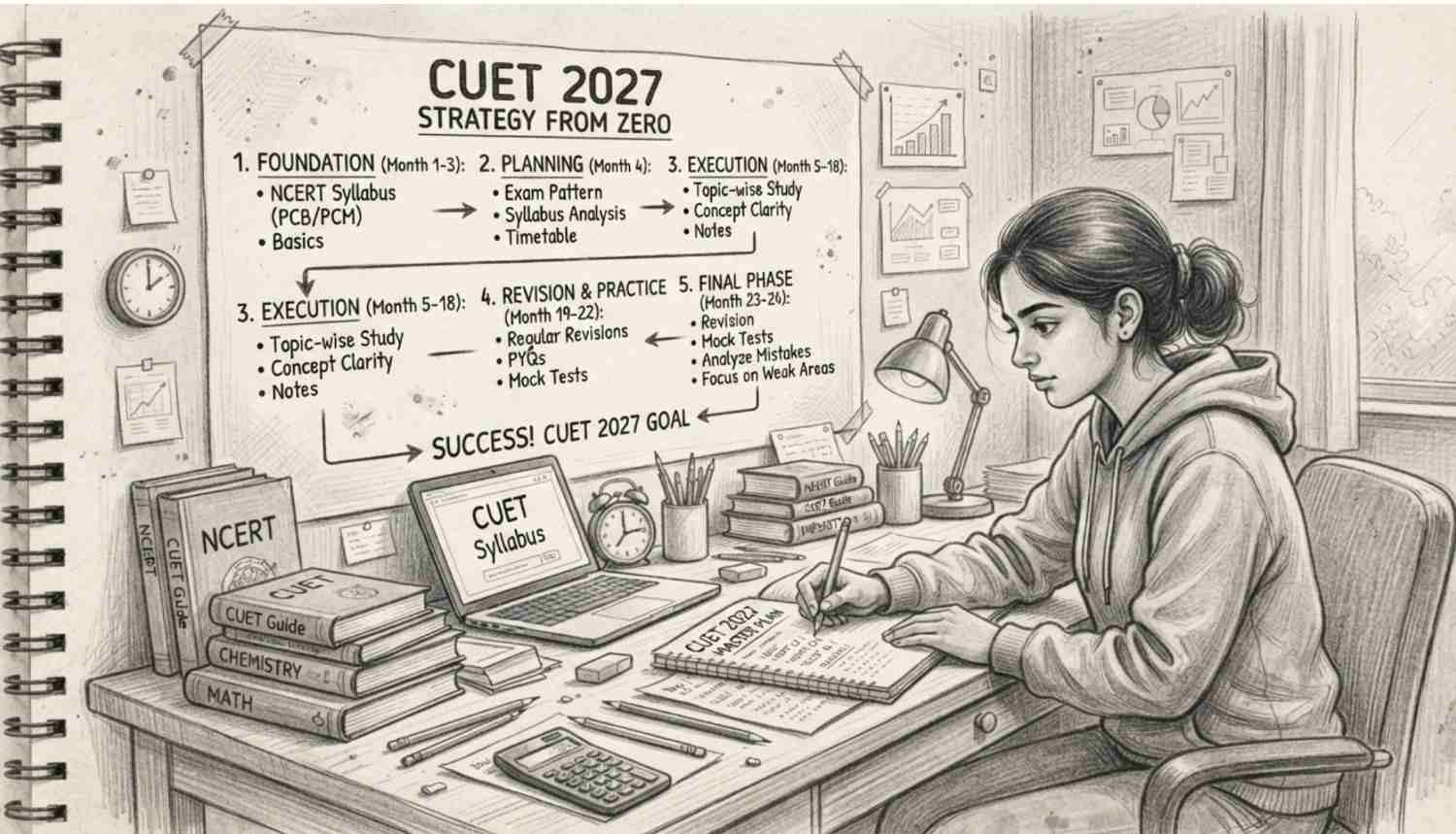
- Can You Start CUET 2027 Preparation From Zero?
- Step 1: Understand What You Actually Need to Study
- Step 2: Start With NCERT and Understand the Chapter
- Step 3: Do Not Fall Into the Endless Lecture Trap
- Step 4: Build the Habit of Solving Questions From the Beginning
- Step 5: Make PYQs Part of Your Preparation
- Step 6: Make Short Notes, Not Beautiful Notes
- Step 7: Start Revision Before You Forget Everything
- Step 8: Follow a Simple Learn-Practise-Revise Cycle
- Step 9: Use a Different Approach for Different Subjects
- Step 10: Do Not Ignore Your Weak Subjects
- Step 11: Start Mock Tests Before the Final Stage
- Step 12: Analyse Every Test You Take
- How to Plan Your CUET 2027 Preparation From Zero
- Stage 1: Build the Base
- Stage 2: Add Regular Practice
- Stage 3: Strengthen Revision
- Stage 4: Move Towards Tests
- What Should a Beginner Do Every Day?
- Common Mistakes to Avoid When Starting CUET 2027
- Final Advice: Start Small, But Start Seriously
If you are preparing for CUET 2027 and feel that you are starting from zero, first of all, do not panic. You do not need to know everything on day one. You just need to know what to do today.
A lot of students make the same mistake at the beginning. They collect books, watch several strategy videos, make elaborate timetables and then spend very little time actually solving questions. After a few weeks, they still feel that their preparation has not really started.
A better approach is much simpler: understand what you are studying, practise questions, revise what you have already covered and regularly check where you are making mistakes. The goal is not to make your preparation look perfect. The goal is to keep moving forward.
Can You Start CUET 2027 Preparation From Zero?
Yes. Starting late or starting from zero does not mean that you cannot prepare seriously. What matters first is replacing panic with a clear routine.
If you have not studied much yet, do not try to finish everything at once. Pick your subjects, understand the syllabus you need to cover and begin with one chapter. Once you understand how the study-practice-revision cycle works, you can repeat it across the rest of your preparation.
And remember one important thing: being behind today does not mean you have to remain behind. Consistent work can gradually close the gap.
Step 1: Understand What You Actually Need to Study
Before opening a book, get clear about your CUET subjects and the courses or universities you are interested in. Your subject choices should be made carefully because university and course requirements can matter when deciding which subjects to take.
Once that is clear, make a simple list of the subjects and chapters you need to cover. Do not create a timetable so complicated that you spend more time managing it than studying.
Your first objective is clarity: what subjects do I have, what do I need to study, and which topics have I already covered?
Step 2: Start With NCERT and Understand the Chapter
For many CUET domain subjects, NCERT should be at the centre of your preparation. But simply reading the same chapter again and again is not the complete strategy.
When you read a chapter, try to understand what it is actually saying. If you are reading History, connect the events and timeline. If you are studying Political Science, focus on the concepts and events. In a numerical subject, understand the concept and then see how it is applied.
Do not confuse reading with learning. The real test comes when you close the book and try to answer a question.
Step 3: Do Not Fall Into the Endless Lecture Trap
Videos can be extremely useful when you are stuck on a difficult concept. The problem begins when watching lectures becomes your main form of preparation.
You watch one teacher, then another teacher explains the same topic, then you find a strategy video and suddenly several hours have passed. It feels like studying, but you may not have solved a single question.
Use videos with a purpose. Understand the concept, close the lecture and move to questions. Once the basic idea is clear, practice is what tells you whether you actually know it.
Step 4: Build the Habit of Solving Questions From the Beginning
Do not wait until you have finished the entire syllabus before starting MCQs. After completing a chapter or a meaningful portion of it, solve questions based on what you studied.
This does two things. First, it shows you whether you really understood the chapter. Second, it exposes the small mistakes that are easy to miss while reading.
You may feel confident while reading a chapter and then suddenly realise that you cannot answer a straightforward question without looking back at the book. That is exactly why practice matters.
Step 5: Make PYQs Part of Your Preparation
Previous-year questions are useful because they show you how topics can actually be tested. A familiar topic may appear in a different form or with different wording, so simply memorising what you read is not enough.
After studying a topic, solve relevant PYQs and pay attention to the way questions are framed. Over time, this will help you become more comfortable with objective-style questions.
Step 6: Make Short Notes, Not Beautiful Notes
There is nothing wrong with making notes. The problem is spending so much time making them that there is hardly any time left for practice.
Your notes do not need perfect handwriting, multiple colours or pages of decoration. Keep them short and useful. The best notes are the ones you can actually revise quickly when you return to a chapter later.
Write down things you are likely to forget, important concepts, formulas, definitions, confusing points and mistakes that you repeatedly make.
Step 7: Start Revision Before You Forget Everything
One of the easiest mistakes to make is saying, “I will revise this chapter later.” Then one chapter becomes five, five become ten, and suddenly you are trying to revise everything just before the exam.
Instead, keep revisiting what you study. The source strategy recommends reviewing a newly studied topic within 48 hours and describes further revision points around the same day, third day, seventh day, 21st day and 30th day. The exact schedule can be adapted to your routine, but the principle is simple: do not leave revision until the end.
Regular revision keeps older chapters alive while you continue learning new ones.
Step 8: Follow a Simple Learn-Practise-Revise Cycle
If you are confused about what a normal study session should look like, keep it simple.
- Learn: Study the chapter and understand the concepts.
- Practise: Solve MCQs and relevant questions.
- Review: Check what you got wrong and why.
- Revise: Revisit the chapter at regular intervals.
- Test: Use sectional or mock tests to measure your progress.
This cycle is much more useful than spending the entire day reading without checking whether you can actually solve questions.
Step 9: Use a Different Approach for Different Subjects
There is no single magic strategy that works equally well for every CUET subject. The preparation method should reflect the nature of the subject.
| Subject | What to Focus On |
|---|---|
| History | NCERT, timelines, sources and PYQs |
| Political Science | Concepts, global events, NCERT and PYQs |
| Geography | Core concepts, detailed understanding, NCERT and PYQs |
| Sociology | Definitions, terms and regular practice |
| Economics | Concepts, diagrams, numericals and PYQs |
| Physics | Concept clarity, numericals and PYQs |
| Chemistry | NCERT, concepts, reactions and PYQs |
| Mathematics | Concepts, formulas, problem solving and PYQs |
| Biology | NCERT, diagrams, terms and PYQs |
| Accountancy | Concepts, formats, numerical practice and PYQs |
| Business Studies | NCERT terms, case studies and practice |
For example, spending most of your time memorising formulas will not solve the same problem that you face in History. Similarly, simply reading Mathematics will not replace actually solving problems.
Step 10: Do Not Ignore Your Weak Subjects
Most students naturally enjoy studying the subjects they are already good at. It feels productive because the questions come easily. But your weaker subjects need attention too.
Keep a simple record of the topics where you repeatedly make mistakes. Give those areas dedicated practice instead of avoiding them. You do not have to become equally comfortable with everything overnight. You just need to steadily reduce the number of things you cannot answer.
Step 11: Start Mock Tests Before the Final Stage
Do not wait until the end of your preparation to discover how you perform in a timed test. Mock tests give you an opportunity to practise handling questions under test conditions and identify weaknesses.
If you have not completed the syllabus, you do not necessarily have to begin with full-syllabus tests. Start with chapter-wise or sectional tests based on the topics you have already studied.
And do not get discouraged by a low score in your first few tests. A mock is not there to tell you that you are bad at the exam. It is there to show you what needs work.
Step 12: Analyse Every Test You Take
Taking a mock and immediately moving on to the next one wastes one of the most useful parts of the exercise: analysis.
After a test, look at the questions you got wrong and ask yourself what happened. Did you not know the concept? Did you forget a fact? Did you misread the question? Did you make a calculation error? Or did you rush?
Once you know the reason, you can work on the actual problem. This creates a simple growth loop: test, analyse, improve and test again.
How to Plan Your CUET 2027 Preparation From Zero
If you are starting from scratch, think of your preparation in stages rather than trying to finish everything immediately.
Stage 1: Build the Base
Start with NCERT and focus on understanding chapters properly. At this stage, do not worry about how much the student sitting next to you has completed. Your job is to build a strong base.
Stage 2: Add Regular Practice
Once you start completing chapters, add chapter-wise MCQs and PYQs. This is where you begin discovering your actual strengths and weaknesses.
Stage 3: Strengthen Revision
Keep revisiting completed chapters while moving forward with new ones. Your old syllabus should not disappear from your preparation just because you have started a new chapter.
Stage 4: Move Towards Tests
Gradually introduce sectional and mock tests. Focus not only on the score but also on the mistakes, time management and topics that continue to trouble you.
What Should a Beginner Do Every Day?
You do not need an unrealistic routine to begin. A good day should include some combination of learning, question practice and revision.
- Study and understand a new topic.
- Practise questions from a topic you have completed.
- Spend some time revising older material.
- Review mistakes from previous practice.
- Keep moving through the syllabus consistently.
The exact number of hours is less important than whether the time you spend is actually helping you learn and improve.
Common Mistakes to Avoid When Starting CUET 2027
- Waiting for the “perfect” timetable before starting.
- Watching several lectures on the same topic instead of practising.
- Reading NCERT repeatedly without testing yourself.
- Making lengthy notes that take too much time.
- Ignoring PYQs until the end.
- Leaving revision for the final stage.
- Avoiding mock tests because you are afraid of low scores.
- Spending all your time on strong subjects.
- Using exactly the same preparation method for every subject.
- Taking tests without analysing your mistakes.
Final Advice: Start Small, But Start Seriously
When you are starting CUET 2027 from zero, the biggest challenge is often not the syllabus. It is the feeling that there is too much to do.
Do not try to solve your entire preparation in one day. Start with one chapter. Understand it. Solve questions. Check your mistakes. Revise it. Then move to the next one.
After a few weeks, those small steps start adding up. The student who once felt, “I have not studied anything,” begins to recognise chapters, solve questions and understand where mistakes are happening.
That is what real preparation looks like. Not a perfect timetable. Not endless lectures. Just consistent learning, practice, revision and improvement.
Frequently Asked Questions
Can I prepare for CUET 2027 from zero?
Yes. The most important thing when starting from zero is to stop worrying about the entire syllabus at once and begin with a clear subject and chapter plan. Build your preparation gradually through understanding, question practice, revision and tests.
What should I study first for CUET 2027?
Start by identifying your CUET subjects and the course or university requirements you need to consider. Then begin with the relevant NCERT material and focus on understanding one chapter at a time.
When should I start solving MCQs for CUET 2027?
You do not need to wait until the syllabus is complete. Start solving chapter-wise MCQs as you finish topics so that you can check your understanding and identify mistakes early.
How should I revise for CUET 2027?
Do not leave all revision for the end. The strategy described in the source recommends reviewing a newly studied topic within 48 hours and revisiting it at further intervals, including the third, seventh, 21st and 30th days.
Are PYQs important for CUET preparation?
Yes. PYQs help you understand how questions can be framed from the topics you study. They can also show how similar concepts may be tested using different wording or question patterns.
Should beginners take CUET mock tests?
Yes, but you do not have to wait until the entire syllabus is complete. Beginners can start with chapter-wise or sectional tests based on completed topics and gradually move towards broader mock tests.